Melitor®
Ukraine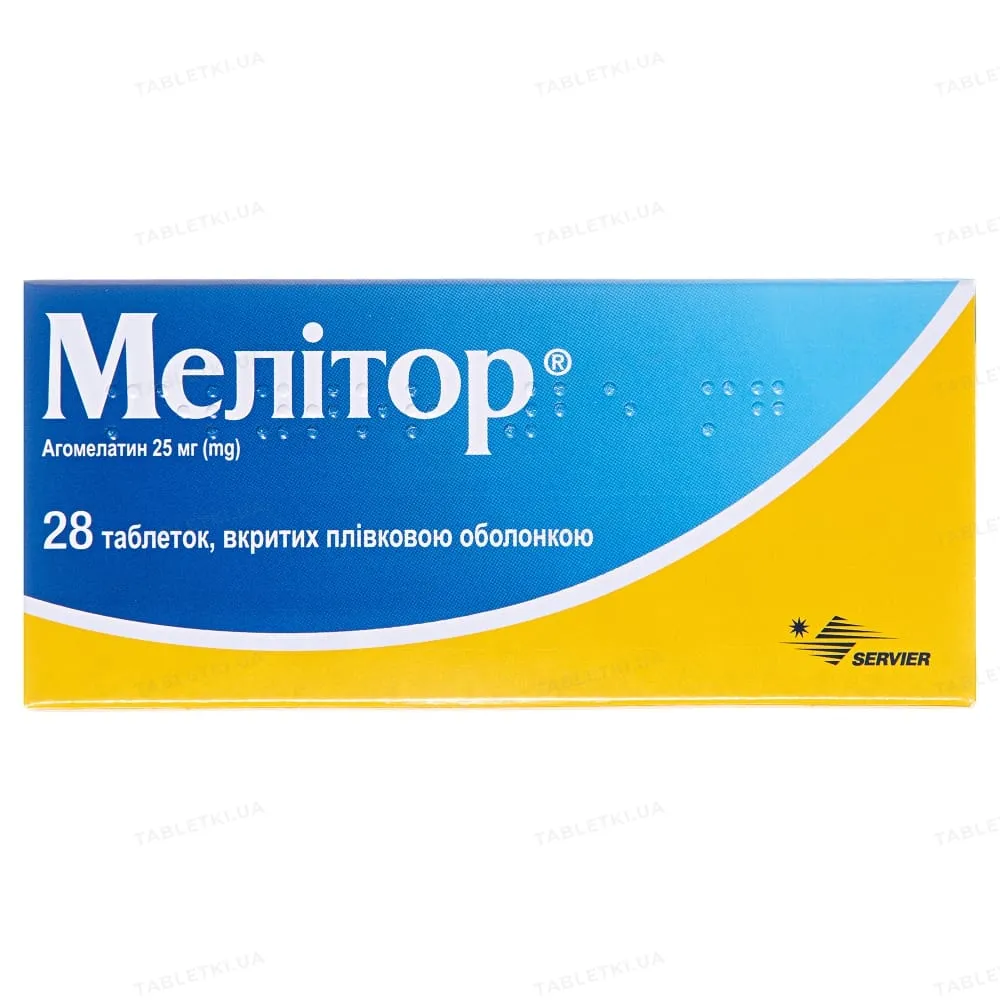
Table of Contents
INSTRUCTIONS FOR MEDICAL USE OF THE MEDICINAL PRODUCT Melitor® (Melitor®)
Composition:
Active ingredient: agomelatine;
1 tablet contains: 25 mg of agomelatine;
Excipients: lactose monohydrate; corn starch; povidone; sodium starch glycolate (type A); stearic acid; magnesium stearate; colloidal anhydrous silicon dioxide; hypromellose; iron oxide yellow (E 172); glycerin; macrogol 6000; titanium dioxide (E 171).
Pharmaceutical form. Film-coated tablets.
Main physicochemical properties: orange-yellow, elongated film-coated tablets with a blue imprint «» on one side.
Pharmacotherapeutic group. Psychoanaleptics. Other antidepressants.
ATX code: N06AX22.
Pharmacological Properties.
Pharmacodynamics.
Mechanism of action
Agomelatine is a melatonergic agonist at MT1 and MT2 receptors and a 5-HT2c receptor antagonist. Receptor binding studies have demonstrated that agomelatine does not affect monoamine reuptake and has no affinity for α- and β-adrenergic, histaminergic, cholinergic, dopaminergic, or benzodiazepine receptors.
In experimental animal studies involving circadian rhythm disorders, agomelatine has been shown to resynchronize circadian rhythms.
Agomelatine increases the release of dopamine and norepinephrine, particularly in the frontal cortex, and does not affect extracellular serotonin levels.
Pharmacodynamic effects
In experimental animal studies, agomelatine demonstrated an antidepressant effect in validated models of depression (learned helplessness, chronic mild stress), as well as in models involving circadian desynchronization and stress- and anxiety-related models.
In humans, agomelatine resynchronizes circadian rhythms; it restores sleep phase, induces a reduction in body temperature, and promotes melatonin secretion.
Clinical efficacy and safety
The efficacy and safety of agomelatine in the treatment of major depressive episodes were evaluated in a clinical program involving 7,900 patients.
In six short-term, double-blind, placebo-controlled efficacy studies evaluating agomelatine in adult patients with major depressive episodes, agomelatine at doses of 25–50 mg demonstrated statistically significant efficacy compared to placebo at the end of treatment (6–8 weeks). Changes from baseline in the HAMD-17 score were observed as the primary endpoint.
The efficacy of Melitor® has also been demonstrated in patients with more severe depression (baseline total HAM-D score ≥ 25) across all positive placebo-controlled studies.
Treatment response rates with agomelatine were statistically significantly higher compared to placebo.
In six out of seven efficacy studies in heterogeneous populations of adult patients with depression, agomelatine demonstrated either higher (2 studies) or non-inferior (4 studies) efficacy compared to selective serotonin reuptake inhibitors/serotonin-norepinephrine reuptake inhibitors (SSRIs/SNRIs) (sertraline, escitalopram, fluoxetine, venlafaxine, or duloxetine). Antidepressant effect was assessed using the HAMD-17 scale as either a primary or secondary endpoint.
Long-term antidepressant efficacy of agomelatine was demonstrated in a relapse prevention study. Regarding the primary endpoint—prevention of depressive relapse, measured as time to relapse—agomelatine at a dose of 25–50 mg/day showed statistically significant superiority compared to placebo (p=0.0001). The relapse rate over 6 months of double-blind observation was 22% and 47% for agomelatine and placebo, respectively.
The drug does not affect daytime alertness or memory in healthy volunteers. In patients with depression, treatment with agomelatine 25 mg prolonged slow-wave sleep phase without affecting rapid eye movement (REM) sleep phase or latency. Agomelatine 25 mg also shortened the time to sleep onset (facilitated sleep initiation) and time to achieve minimal heart rate. Patient-reported assessments from the first week of treatment showed significant improvements in sleep onset and sleep quality without impairing daytime functioning.
A pooled analysis of studies using the ASEX (Arizona Sexual Experience Scale) demonstrated that agomelatine use was not associated with sexual dysfunction. In healthy volunteers, agomelatine preserved sexual function compared to paroxetine.
In clinical studies, agomelatine did not affect heart rate or blood pressure.
In a study assessing discontinuation symptoms using the DESS (Discontinuation Emergent Signs and Symptoms) questionnaire in patients with depression in remission, agomelatine did not cause a discontinuation syndrome after abrupt cessation of treatment.
Agomelatine does not cause dependence, as determined in studies involving healthy volunteers using specific visual-analogue scales or the 49-item ARCI (Addiction Research Center Inventory).
A placebo-controlled 8-week study in elderly patients (≥65 years, N=222, of whom 151 received agomelatine) with depression demonstrated a statistically significant difference of 2.67 points on the total HAM-D scale (primary endpoint). The treatment response rate was favorable for agomelatine. In the subgroup of patients aged ≥75 years (N=69, of whom 48 received agomelatine), no significant improvement was observed. The tolerability of agomelatine in elderly patients was similar to that in younger adult patients.
A specific 3-week controlled study was conducted in patients with major depressive disorders who had not achieved significant improvement with paroxetine (SSRI) or venlafaxine (SNRI). When these patients were switched to agomelatine treatment, regardless of whether the prior therapy was discontinued abruptly or gradually, discontinuation symptoms occurred. These symptoms may be misinterpreted as insufficient early efficacy of agomelatine.
The proportion of patients experiencing at least one discontinuation symptom within one week after stopping SSRIs/SNRIs was lower in the group with prolonged dose reduction (gradual discontinuation of prior antidepressants over 2 weeks) compared to the short-term dose reduction group (gradual discontinuation over 1 week) and the abrupt switch group (abrupt discontinuation): 56.1%, 62.6%, and 79.8%, respectively.
Pharmacokinetics.
Absorption and bioavailability
Agomelatine is rapidly and well absorbed (≥80%) after oral administration. Absolute bioavailability is low (<5% following oral administration at therapeutic doses); inter-individual variability is high. Bioavailability is higher in women than in men. Bioavailability is increased by oral contraceptives and reduced in smokers. Maximum plasma concentration is reached within 1–2 hours.
When administered at therapeutic doses, agomelatine plasma concentration increases proportionally with dose. At higher doses, a first-pass saturation effect occurs.
Food intake (standard or high-fat meals) does not affect bioavailability or the extent of absorption.
Variability increases with high-fat meals.
Tissue distribution
The volume of distribution at steady state is approximately 35 L; plasma protein binding is 95%, independent of concentration, and does not change with age or in patients with renal impairment. However, the concentration of free fraction is doubled in patients with hepatic impairment.
Biotransformation
After administration, agomelatine is rapidly metabolized, primarily by hepatic enzymes CYP1A2; isoenzymes CYP2C9 and CYP2C19 also contribute to metabolism, but their involvement is minor. The main metabolites—hydroxylated and dimethylated agomelatine—are inactive and rapidly conjugated and excreted in urine.
Elimination
Elimination is rapid, with a mean plasma half-life of 1–2 hours. Clearance is high (approximately 1.1 mL/min) and predominantly metabolic. Excretion is primarily via urine (80%) as metabolites, while unchanged active substance excreted in urine is negligible. Pharmacokinetics are not altered after multiple administrations.
Patients with renal impairment
No relevant changes in pharmacokinetic parameters of agomelatine were observed in patients with severe renal impairment (n=8, single 25 mg dose). However, Melitor® should be used with caution in patients with moderate or severe renal impairment due to limited clinical data in this patient group (see section "Dosage and administration").
Patients with hepatic impairment
A specific study in patients with liver cirrhosis and chronic mild or moderate hepatic impairment (Child-Pugh classes A and B) demonstrated a 70- and 140-fold increase, respectively, in agomelatine concentration after a 25 mg dose compared to age-, weight-, and smoking habit-matched healthy volunteers without hepatic impairment (see sections "Dosage and administration", "Contraindications", and "Special warnings and precautions for use").
Elderly patients
A pharmacokinetic study in elderly patients (≥65 years) showed that, after administration of a 25 mg dose, mean AUC and Cmax values were approximately 4 and 13 times higher, respectively, in patients aged ≥75 years compared to those under 75 years. Pharmacokinetics of agomelatine at a 50 mg dose in this population cannot be assessed due to insufficient data. Dose adjustment is not required in elderly patients.
Ethnic groups
Data on pharmacokinetic characteristics of agomelatine according to racial origin are lacking.
Clinical characteristics.
Indications.
Treatment of major depressive episodes in adults.
Contraindications.
- Hypersensitivity to the active substance or to any of the excipients of the medicinal product.
- Hepatic impairment (liver cirrhosis or active phase of liver disease) or elevation of transaminase levels more than 3 times the upper limit of normal range (see sections "Posology and method of administration" and "Special warnings and precautions for use").
- Concomitant use with strong CYP1A2 inhibitors (fluvoxamine, ciprofloxacin) (see section "Interaction with other medicinal products and other forms of interaction").
Interaction with other medicinal products and other types of interactions.
Possible interactions of agomelatine
Agomelatine is metabolized primarily by cytochrome P450 1A2 (CYP1A2) (90%) and CYP2C9/19 (10%). Medicinal products interacting with these isoenzymes may decrease or increase the bioavailability of agomelatine.
Fluvoxamine, a strong CYP1A2 inhibitor and moderate CYP2C9 inhibitor, significantly inhibits agomelatine metabolism, resulting in a 60-fold (range 12–412) increase in agomelatine concentration. Therefore, concomitant administration of Melitor® with strong CYP1A2 inhibitors (fluvoxamine, ciprofloxacin) is contraindicated.
Combination of agomelatine with estrogens (moderate CYP1A2 inhibitors) leads to several-fold increase in agomelatine concentration. Although no specific safety signals have been observed in approximately 800 patients treated concomitantly with agomelatine and estrogens, co-administration of agomelatine with other moderate CYP1A2 inhibitors (propranolol, enoxacin) should be undertaken with caution until more experience with this combination is available (see section "Special warnings and precautions for use").
Rifampicin, an inducer of all three cytochromes involved in agomelatine metabolism, may reduce agomelatine bioavailability.
Smoking induces CYP1A2 and reduces agomelatine bioavailability, particularly in heavy smokers (≥ 15 cigarettes/day) (see section "Pharmacokinetics").
Ability of agomelatine to affect other medicinal products
In vivo, agomelatine does not induce CYP450 isoenzymes. Agomelatine does not inhibit CYP1A2 in vivo, nor other CYP450 enzymes in vitro. Consequently, it does not affect the concentrations of medicinal products metabolized by CYP450 enzymes.
Other medicinal products
Phase I clinical studies in the target patient population have not provided data on pharmacokinetic and pharmacodynamic interactions with medicinal products that may be co-administered with Melitor®: benzodiazepines, lithium, paroxetine, fluconazole, and theophylline.
Alcohol
Alcohol consumption is not recommended during treatment with agomelatine.
Electroconvulsive therapy (ECT)
Experience with concomitant use of agomelatine and ECT is lacking. Animal studies have not shown that agomelatine increases seizure susceptibility. Therefore, it is unlikely that concomitant ECT and agomelatine treatment would lead to any clinically significant complications.
Special precautions for use.
Hepatic function monitoring
During post-marketing use of agomelatine, cases of liver function abnormalities have been reported in patients, including liver failure (isolated cases with fatal outcomes or liver transplantation have been reported in patients with risk factors for hepatic dysfunction), increases in liver enzyme levels exceeding 10 times the upper limit of normal, hepatitis, and jaundice (see section "Adverse reactions"). Most of these cases occurred within the first months of treatment. Liver injury is predominantly hepatocellular in nature, with elevated serum transaminases, which usually return to normal upon discontinuation of agomelatine.
Melitor® should be prescribed with caution and careful monitoring of all patients throughout the treatment period, especially in the presence of risk factors for hepatic dysfunction or when concomitant medications that may cause liver function abnormalities are used.
Before starting treatment
Melitor® should be prescribed only after careful benefit-risk assessment in patients with risk factors for hepatic dysfunction such as obesity/excess body weight/non-alcoholic fatty liver disease, diabetes mellitus, alcohol-related disorders and/or alcohol abuse, or in patients receiving concomitant medications that may cause liver function abnormalities.
Prior to initiating treatment, liver function tests should be performed in all patients, and therapy should not be initiated in patients with baseline alanine aminotransferase (ALT) and/or aspartate aminotransferase (AST) levels exceeding three times the upper limit of normal (see section "Contraindications"). Melitor® should be used with caution in patients with elevated transaminase levels before treatment initiation (provided the transaminase levels are not more than three times the upper limit of normal).
Frequency of liver function tests:
- before starting treatment;
- and then:
- approximately after 3 weeks;
- approximately after 6 weeks (at the end of the acute phase);
- approximately after 12 weeks and 24 weeks (at the end of the maintenance phase);
- and thereafter if clinically indicated.
- when the dose is increased, liver function tests should be repeated with the same frequency as at the beginning of treatment.
Any patient in whom elevated plasma transaminase levels develop and are detected should undergo repeat liver function testing within 48 hours.
During treatment
Treatment with Melitor® should be discontinued immediately if:
- the patient develops symptoms suggestive of potential liver dysfunction (such as dark urine, pale stools, yellowing of the skin/eyes, pain in the upper right abdomen, new onset of persistent unexplained fatigue);
- serum transaminase levels exceed three times the upper limit of normal.
After discontinuation of Melitor®, liver function tests should be repeated until serum transaminase levels normalize.
Patients aged 75 years and older
The efficacy of agomelatine in patients aged ≥75 years has not been established; therefore, agomelatine should not be used in this age group (see sections "Dosage and administration" and "Pharmacodynamics").
Elderly patients with dementia
Melitor® should not be used for the treatment of major depressive episodes in elderly patients with dementia, as the safety and efficacy of Melitor® have not been established in this patient group.
Bipolar disorder/mania/hypomania
Melitor® should be used with caution in patients with a history of bipolar disorder, mania, or hypomania, and should be discontinued if manic symptoms occur (see section "Adverse reactions").
Suicide/suicidal thoughts
Depression is associated with an increased risk of suicidal thoughts, self-harm, and suicide (suicidal manifestations). This risk persists until significant remission occurs. Since improvement may not occur during the first few weeks or more of treatment, close monitoring of the patient is necessary until improvement is observed. Clinical experience generally indicates that the risk of suicide may increase in the early stages of improvement.
Patients with a history of suicidal manifestations, as well as those exhibiting high levels of suicidal ideation prior to treatment initiation, are at increased risk of suicidal thoughts or attempts and should be closely monitored during treatment. A meta-analysis of placebo-controlled clinical trials of antidepressants in adult patients with psychiatric disorders showed an increased risk of suicidal behavior with antidepressant use compared to placebo in patients under the age of 25.
Close monitoring of patients, particularly those at high risk, is necessary during treatment, especially in the early stages and after dose adjustments. Patients (and caregivers) should be advised to monitor for any signs of clinical worsening, emergence of suicidal thoughts or behaviors, or unusual changes in behavior, and to seek immediate medical attention if such symptoms occur.
Use in combination with CYP1A2 inhibitors (see sections "Contraindications" and "Interaction with other medicinal products and other forms of interaction")
Melitor® should be prescribed with caution in combination with moderate CYP1A2 inhibitors (e.g., propranolol, enoxacin), as this may lead to increased agomelatine concentrations.
Lactose intolerance
Melitor® contains lactose. Patients with rare hereditary problems of galactose intolerance, total lactase deficiency, or glucose-galactose malabsorption should not take this medicine.
Sodium content
Melitor® contains less than 1 mmol sodium (23 mg) per tablet, i.e., essentially "sodium-free".
Use during pregnancy or breastfeeding.
Pregnancy
To avoid any potential risks, it is advisable to avoid using Melitor® during pregnancy. Data on the use of agomelatine in pregnant women are lacking or limited (fewer than 300 cases). Animal studies have not revealed any direct or indirect harmful effects of agomelatine on pregnancy, embryonic/fetal development, parturition, or postnatal development.
Breastfeeding
It is unknown whether agomelatine/metabolites are excreted in human breast milk. Available pharmacodynamic/toxicological data from animal studies have shown that agomelatine/metabolites are excreted in milk. A risk to newborns/infants cannot be excluded. The decision to discontinue breastfeeding or to discontinue/abstain from Melitor® therapy should be made taking into account the benefits of breastfeeding for the child and the benefits of therapy for the mother.
Fertility
Animal reproductive studies showed no effect of agomelatine on fertility.
Ability to affect reaction speed when driving or operating machinery.
Agomelatine has a minor influence on the ability to drive or operate machinery. Given that dizziness and somnolence are common adverse reactions to the drug, patients should exercise caution when driving or operating machinery.
Dosage and Administration
Route of Administration
For oral use.
Melitor®, film-coated tablets, may be taken independently of food intake.
Dosage
The recommended dose is 25 mg once daily, taken at bedtime.
If after 2 weeks of treatment the clinical improvement is insufficient, the dose may be increased to 50 mg once daily (i.e., 2 tablets of 25 mg) to be taken together at bedtime.
When considering dose escalation, the increased risk of elevated transaminase levels should be taken into account. Dose increase to 50 mg should be individualized for each patient after benefit/risk assessment, with mandatory liver function tests.
All patients must undergo liver function tests prior to starting treatment. Treatment should not be initiated if transaminase levels exceed the upper limit of normal (ULN) by more than 3 times (see sections "Contraindications" and "Special Warnings and Precautions for Use").
During treatment, transaminase levels should be monitored periodically: approximately at 3 weeks, 6 weeks (end of acute phase), 12 weeks, and 24 weeks (end of maintenance phase), and thereafter if clinically indicated (see section "Special Warnings and Precautions for Use"). Treatment must be discontinued if transaminase levels increase to more than 3 times the ULN (see sections "Contraindications" and "Special Warnings and Precautions for Use").
When the dose is increased, liver function tests should be repeated with the same frequency as at the beginning of treatment.
Duration of Treatment
Patients with depression should be treated for at least 6 months to ensure symptom remission.
Switching from antidepressants of the selective serotonin reuptake inhibitors/serotonin-norepinephrine reuptake inhibitors (SSRIs/SNRIs) to agomelatine
Withdrawal symptoms may occur in patients after discontinuation of SSRIs/SNRIs. To avoid these symptoms, recommendations for discontinuation provided in the patient information leaflet of the antidepressant being used should be followed. Agomelatine therapy may be initiated immediately, concurrently with tapering of the antidepressant dose (see section "Pharmacodynamics").
Discontinuation of Treatment
When deciding to discontinue treatment, gradual dose reduction is not required.
Special Patient Populations
Elderly Patients
The safety and efficacy of agomelatine (25–50 mg/day) have been established in elderly patients with depression (< 75 years of age). Reliable data have not been obtained in patients aged ≥ 75 years. Therefore, agomelatine should not be used in this age group (see sections "Special Warnings and Precautions for Use" and "Pharmacodynamics"). No dose adjustment based on age is required (see section "Pharmacokinetics").
Patients with Renal Impairment
No relevant changes in the pharmacokinetic parameters of agomelatine have been observed in patients with severe renal impairment. However, clinical data on the use of agomelatine in patients with depression and moderate to severe renal impairment are limited. Therefore, agomelatine should be used with caution in these patients.
Patients with Hepatic Impairment
Agomelatine is contraindicated in patients with hepatic impairment (see sections "Contraindications", "Special Warnings and Precautions for Use", and "Pharmacokinetics").
Children
Melitor® is not recommended for the treatment of depression in children, as the safety and efficacy of this medicinal product have not been established in this patient group. Data are lacking. In clinical studies involving children and adolescents, the use of other antidepressants has been associated with a higher incidence of suicidal behavior (suicidal attempts and suicidal thoughts) and hostility (predominantly aggression, oppositional behavior, and anger) compared to patients receiving placebo.
Overdose
Symptoms
There is limited data on cases of agomelatine overdose. Overdose with agomelatine has been associated with epigastric pain, somnolence, fatigue, agitation, anxiety, tension, dizziness, cyanosis, or malaise. One case of ingestion of 2450 mg of agomelatine has been reported, with spontaneous recovery and no cardiovascular or biological abnormalities.
Treatment
There are no known specific antidotes for agomelatine. Management of overdose should consist of symptomatic treatment and standard patient monitoring. Medical observation should be conducted in a specialized facility.
Adverse Reactions
Summary of safety profile
Adverse reactions usually occurred during the first 2 weeks of treatment and were mild to moderate in severity. The most commonly reported adverse reactions were headache, nausea, and dizziness. These adverse reactions were generally transient in nature and usually did not lead to discontinuation of therapy.
Listing of adverse reactions
The table below lists adverse reactions identified during placebo-controlled clinical studies and active comparator trials.
Adverse reactions are listed below by frequency category: very common (≥ 1/10); common (≥ 1/100 to < 1/10); uncommon (≥ 1/1,000 to < 1/100); rare (≥ 1/10,000 to < 1/1,000); very rare (< 1/10,000); frequency not known (cannot be estimated from the available data). The frequency has not been adjusted for the placebo group.
| System organ class |
Frequency |
Adverse reaction |
| Psychiatric disorders |
Common |
Anxiety |
| Unusual dreams* |
||
| Uncommon |
Suicidal thoughts or behaviour (see section "Special warnings and precautions for use") |
|
| Agitation and related symptoms* (such as irritability and restlessness) |
||
| Aggression* |
||
| Nightmares* |
||
| Mania/hypomania* These symptoms may be due to the underlying disease (see section "Special warnings and precautions for use") |
||
| Confusion* |
||
| Rare |
Hallucinations* |
|
| Nervous system disorders |
Very common |
Headache |
| Common |
Dizziness |
|
| Somnolence |
||
| Insomnia |
||
| Uncommon |
Migraine |
|
| Paraesthesia |
||
| Restless legs syndrome* |
||
| Rare |
Akathisia* |
|
| Eye disorders |
Uncommon |
Blurred vision |
| Ear and labyrinth disorders |
Uncommon |
Tinnitus* |
| Gastrointestinal disorders |
Common |
Nausea |
| Diarrhoea |
||
| Constipation |
||
| Abdominal pain |
||
| Vomiting* |
||
| Hepatobiliary disorders |
Common |
Increased levels of alanine aminotransferase (ALT) and/or aspartate aminotransferase (AST) (in clinical trials, increases in ALT and/or AST levels greater than 3 times the upper limit of normal were observed in 1.2% of patients receiving agomelatine 25 mg/day and in 2.6% of patients receiving agomelatine 50 mg/day, compared to 0.5% of patients receiving placebo) |
| Uncommon |
Increased levels of gamma-glutamyl transferase* (GGT) (more than 3 times the upper limit of normal) |
|
| Rare |
Hepatitis |
|
| Increased levels of alkaline phosphatase* (more than 3 times the upper limit of normal) |
||
| Hepatic failure* (1) |
||
| Jaundice* |
||
| Skin and subcutaneous tissue disorders |
Uncommon |
Hyperhidrosis |
| Eczema |
||
| Pruritus* |
||
| Urticaria* |
||
| Rare |
Erythematous rash |
|
| Facial swelling and angioedema* |
||
| Musculoskeletal and connective tissue disorders |
Common |
Back pain |
| Uncommon |
Myalgia* |
|
| Renal and urinary disorders |
Rare |
Urinary retention* |
| General disorders and administration site conditions |
Common |
Fatigue |
| Investigations |
Common |
Weight increased* |
| Uncommon |
Weight decreased* |
* The frequency of adverse reactions identified from spontaneous reports was calculated based on clinical trial data.
(1) Isolated cases of fatal outcomes or liver transplantation have been reported in patients with risk factors for hepatic impairment.
Reporting suspected adverse reactions
Reporting of suspected adverse reactions after drug authorization is of great importance. It allows continued monitoring of the benefit-risk balance of the medicinal product. Medical and pharmaceutical professionals, as well as patients or their legal representatives, should report all suspected adverse reactions and lack of efficacy through the automated pharmacovigilance information system at the following link: https://aisf.dec.gov.ua.
Shelf life. 3 years.
Storage conditions.
No special storage conditions required. Keep out of reach of children.
Packaging.
14 film-coated tablets in a blister pack made of aluminum foil and PVC film.
1, 2, or 4 blisters per cardboard box.
Prescription status.
Prescription only.
Manufacturer.
Laboratoires Servier Industrie / Les Laboratoires Servier Industrie.
Manufacturer's location and address of manufacturing site.
905 route de Saran, 45520 Gidy, France / 905 route de Saran, 45520 Gidy, France.
Manufacturer.
Servier (Ireland) Industries Ltd.
Manufacturer's location and address of manufacturing site.
Gorey Road, Arklow, Co. Wicklow, Y14 E284, Ireland / Gorey Road, Arklow, Co. Wicklow, Y14 E284, Ireland.
Marketing Authorization Holder.
Les Laboratoires Servier.
Address of Marketing Authorization Holder.
50, rue Carnot, 92284 Suresnes Cedex, France / 50, rue Carnot, 92284 Suresnes Cedex, France.
For any inquiries, please contact LLC "Servier Ukraine" at tel. (044) 490 3441.