Mexicor
Ukraine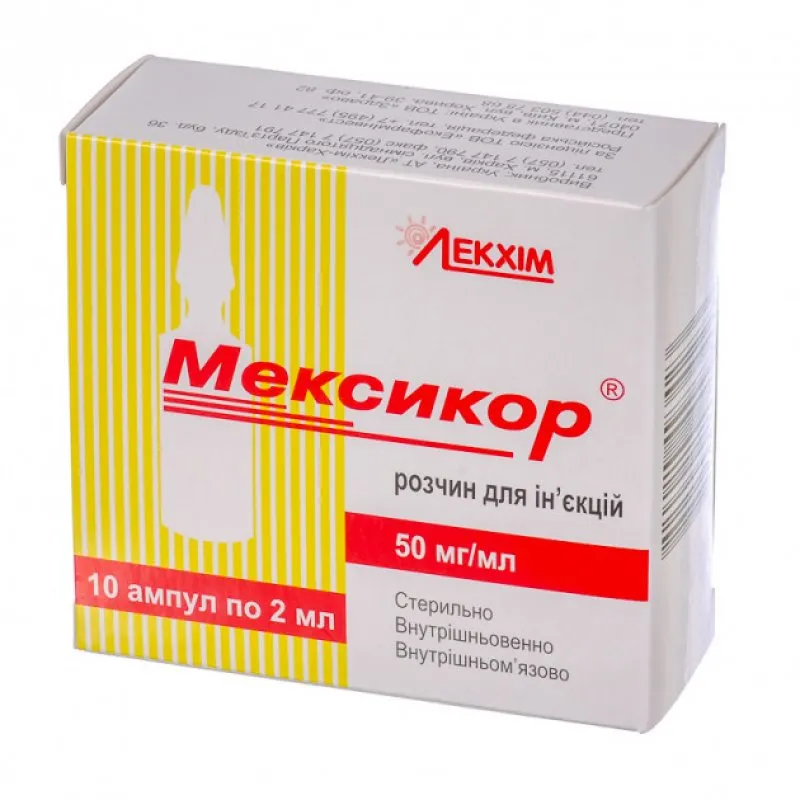
Table of Contents
INSTRUCTION FOR MEDICAL USE OF THE MEDICINAL PRODUCT MEXICOR® (MEXICOR)
Composition:
Active substance: ethylmethylhydroxypyridine succinate;
1 ml of solution contains ethylmethylhydroxypyridine succinate – 50 mg;
Excipients: succinic acid, disodium edetate, water for injections.
Pharmaceutical form. Injection solution.
Main physicochemical properties: clear, colorless or slightly colored liquid.
Pharmacotherapeutic group. Cardiology drugs. ATC code C01EB.
Pharmacological Properties
Pharmacodynamics
Mexicor® improves the functional state of ischemic myocardium in myocardial infarction and enhances cardiac contractile function. It also reduces manifestations of systolic and diastolic dysfunction of the left ventricle.
The primary mechanism of action of the drug is its antioxidant activity and ability to inhibit free radical processes (which intensify during myocardial ischemia and necrosis, especially during reperfusion), thereby reducing the damaging effects of free radicals on cardiomyocytes.
Under conditions of critically reduced coronary blood flow, Mexicor® helps preserve the structural and functional integrity of cardiomyocyte membranes and stimulates the activity of membrane enzymes—phosphodiesterase, adenylate cyclase, and acetylcholinesterase. The drug enhances the activation of aerobic glycolysis that develops during acute ischemia and promotes the restoration of mitochondrial redox processes under hypoxic conditions, increasing ATP and creatine phosphate synthesis. These mechanisms help maintain the morphological structures and physiological functions of ischemic myocardium.
Mexicor® normalizes metabolic processes in ischemic myocardium, reduces the area of necrosis, restores and/or improves myocardial electrical activity and contractility, increases coronary blood flow in the ischemic zone, enhances the antianginal efficacy of nitrate-containing drugs, improves blood rheological properties, and reduces the consequences of reperfusion syndrome in acute coronary insufficiency.
Mexicor® exerts a neuroprotective effect, stabilizes cerebral circulation during hyperperfusion, and improves cerebral blood supply during the reperfusion period following ischemia. The drug supports adaptation to ischemic injury, inhibits post-ischemic reduction in glucose and oxygen utilization by the brain, and prevents progressive lactate accumulation. Mexicor® improves and stabilizes cerebral metabolism and cerebral perfusion, maintaining brain functional activity both during ischemia and in the post-ischemic period. Mexicor® exerts a selective anxiolytic effect, which is not accompanied by sedation or myorelaxation, and effectively relieves anxiety, fear, mental tension, and distress. Mexicor® also demonstrates nootropic activity, preventing and reducing learning and memory impairments associated with cerebrovascular diseases and mild to moderate cognitive disorders. It exhibits anti-hypoxic effects, enhances attention, and improves work capacity. Including Mexicor® in the complex therapy of patients with acute cerebral circulation disorders reduces clinical symptom severity and improves the course of the rehabilitation period.
Pharmacokinetics
After intravenous administration, the drug rapidly distributes to organs and tissues within 0.5–1.5 hours, resulting in a rapid decline in its unchanged concentration in the blood. Following intramuscular administration at therapeutic doses, maximum plasma concentration is reached within 30–40 minutes and amounts to 2.5–3 µg/mL. Metabolites of the drug can be detected in plasma for 7–9 hours. The drug undergoes hepatic biotransformation via glucuronidation.
Elimination of the drug from the body occurs primarily via urine in the form of glucuronide conjugates, with a small amount excreted unchanged.
Clinical characteristics.
Indications.
In complex therapy:
− acute myocardial infarction (from the first day);
− ischemic stroke;
− dyscirculatory encephalopathy (including atherosclerotic origin);
− mild and moderate cognitive disorders of various etiologies.
Contraindications.
Increased individual sensitivity to the drug, hepatic or renal insufficiency.
Interaction with other medicinal products and other types of interactions.
Enhances the effect of benzodiazepine anxiolytics, anticonvulsants (carbamazepine), anti-Parkinson agents (levodopa), potentiates the effect of nitro-containing drugs, antihypertensive agents. Reduces toxic effects of ethanol.
Special precautions.
Particular caution is required when prescribing Mexicor® to patients with a history of severe allergies. After completion of parenteral administration, to maintain the achieved therapeutic effect, it is recommended to continue Mexicor® treatment orally in capsules of 100 mg three times daily.
Use during pregnancy or breastfeeding.
Contraindicated.
Ability to affect reaction rate when driving or operating machinery.
At the beginning of treatment with the drug, it is advisable to avoid driving or engaging in hazardous activities that require high concentration and rapid psychomotor reactions.
Administration and dosage.
Administer intravenously or intramuscularly for 14 days against the background of conventional therapy for myocardial infarction.
During the first 5 days, to achieve maximum effect, it is advisable to administer MEXICOR® intravenously; during the following 9 days, the drug may be administered intramuscularly.
For intravenous administration, the drug should be given by drip infusion slowly (to avoid adverse effects) in 100–150 mL of 0.9% sodium chloride solution or 5% dextrose (glucose) solution over 30–90 minutes. If necessary, slow bolus injection of the drug may be performed, lasting no less than 5 minutes.
The drug is administered (intravenously or intramuscularly) 3 times daily, every 8 hours.
The daily therapeutic dose is 6–9 mg/kg; the single dose is 2–3 mg/kg of body weight. The maximum daily dose should not exceed 800 mg; the single dose should not exceed 250 mg.
In acute cerebrovascular disorders (ischemic stroke), MEXICOR® is used as part of combination therapy during the first 2–4 days by intravenous infusion of 200–300 mg 2–3 times daily, followed by intramuscular administration of 100 mg 3 times daily. The treatment duration is 10–14 days. Subsequently, the drug is prescribed in capsules, 100 mg twice daily for 14 days, then 100 mg three times daily for 7 days. The frequency and duration of repeated courses are determined by the physician depending on the course of the disease.
In decompensated phase of dyscirculatory encephalopathy, MEXICOR® is prescribed intravenously by bolus or drip infusion at a dose of 100 mg 2–3 times daily for 14 days. Afterwards, the drug is administered intramuscularly, 100 mg daily for 2 weeks, followed by administration in capsules, 100 mg 2–4 times daily. For course prophylaxis, the drug is administered intramuscularly, 100 mg twice daily for 10–14 days.
In the treatment of mild to moderate cognitive disorders, MEXICOR® is prescribed intramuscularly at a dose of 100–300 mg daily for 2 weeks; if necessary, the drug is subsequently prescribed in capsules, 100 mg 2–4 times daily. The frequency and duration of treatment courses are determined by the physician depending on the course of the disease.
Children.
The drug is not recommended for use in children under 18 years of age (efficacy and safety have not been established).
Overdose.
In case of overdose, sleep disturbances such as insomnia or, in some cases, drowsiness may develop; with intravenous administration, transient and slight increase in arterial blood pressure is possible in individual cases.
Development of overdose symptoms usually does not require specific antidotal treatment. The above-mentioned sleep disturbances resolve spontaneously within 24 hours. In particularly severe cases, administration of one of the oral sedative and anxiolytic agents (nitrazepam 10 mg, oxazepam 10 mg, or diazepam 5 mg) is recommended. In case of excessive increase in arterial blood pressure, antihypertensive agents should be used under blood pressure monitoring and/or therapy should be supplemented with nitrate-containing drugs.
Adverse reactions.
When administered intravenously, especially by rapid bolus injection, dryness and a metallic taste in the mouth, sensation of warmth throughout the body, unpleasant odor, throat irritation, chest discomfort, dyspnea, palpitations, tachycardia, transient decrease or increase in arterial blood pressure, headache, tremor, facial hyperemia, and distal hyperhidrosis may occur. These phenomena are usually associated with excessive rate of drug administration and are transient in nature.
During prolonged use of the drug, the following adverse effects may occur:
Gastrointestinal tract: nausea, flatulence, dyspeptic disorders, diarrhea;
Central nervous system: sleep disturbances (drowsiness or difficulty falling asleep), weakness, anxiety, emotional lability, coordination disorders, dizziness, peripheral edema.
In case of individual hypersensitivity to the drug, allergic reactions may occur, including skin rashes, urticaria, pruritus, angioneurotic edema, bronchospasm.
Shelf life. 3 years. Do not use the drug after the expiry date stated on the packaging.
Storage conditions.
Store in a light-protected place, out of reach of children, at a temperature of 0–25 °C.
Incompatibility.
Do not mix in the same syringe with other medicinal products.
Use only solvents specified in the instructions.
Packaging.
2 ml solution in an ampoule; 5 ampoules in a blister pack; 2 blisters per cardboard box.
Prescription status. Prescription only.
Manufacturer. JSC "Lekhym-Kharkiv".
Manufacturer's address and place of business.
36 Severina Pototskoho St., Kharkiv, Ukraine, 61115.
Marketing authorization holder. LLC "ZDRAVO".
Address of the marketing authorization holder:
54/19 Avtozavodska St., lit. A, office, Kyiv, Ukraine, 04114.