Mexicor
Ukraine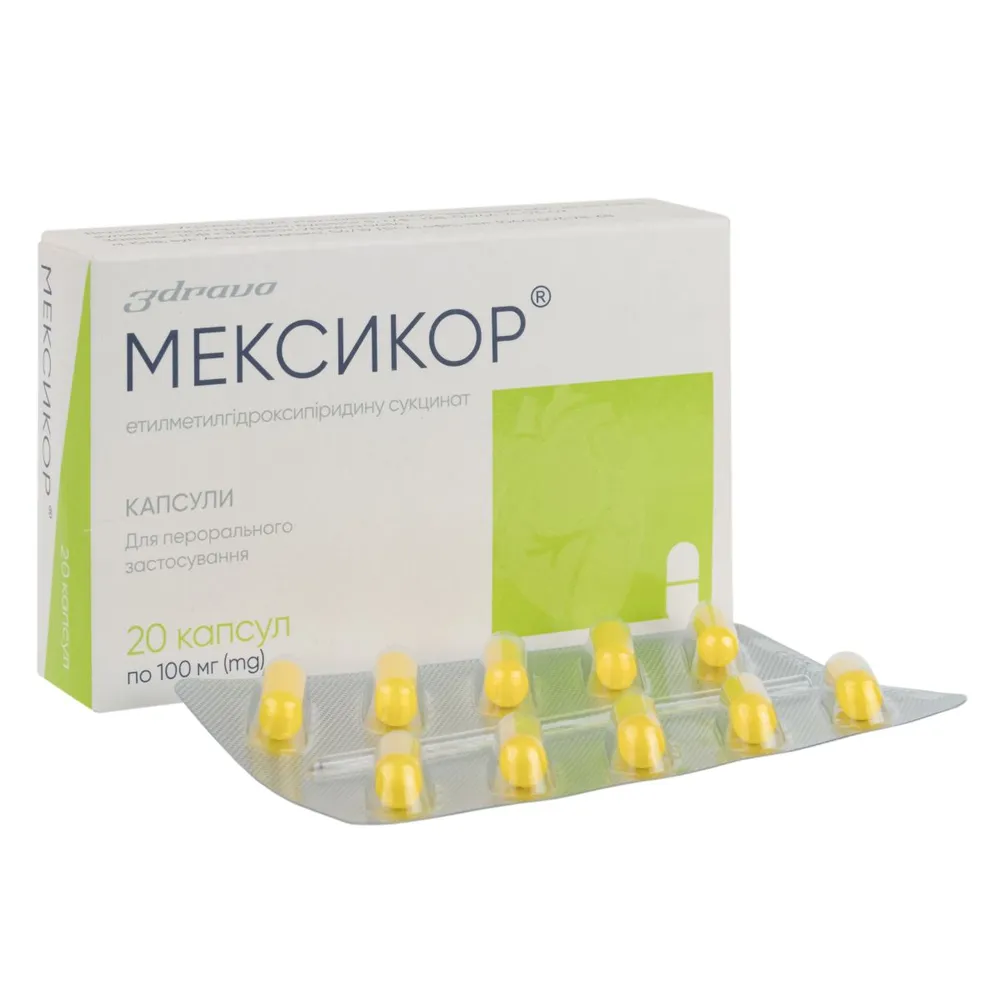
Table of Contents
INSTRUCTIONS FOR MEDICAL USE OF THE MEDICINAL PRODUCT MEXICOR® Mexiсor
Composition:
Active substance:
1 capsule contains ethylmethylhydroxypyridine succinate
calculated as 100% substance – 100 mg;
Excipients: potato starch, povidone, lactose monohydrate, magnesium stearate, microcrystalline cellulose;
capsule shell: titanium dioxide (E 171), gelatin, sunset yellow dye (E 110), quinoline yellow dye (E 104).
Pharmaceutical form. Capsules.
Main physicochemical properties:
Hard gelatin capsules size №2, yellow in colour. The capsule contents consist of granules containing white granules and powder, white or white with a yellowish tinge.
Pharmacotherapeutic group. Cardiological agents. Other cardiological agents.
ATC code C01EB.
Pharmacological Properties
Pharmacodynamics
Mexicor® reduces manifestations of oxidative stress, inhibits free radical lipid peroxidation, and enhances the activity of the enzymatic antioxidant system. Mexicor® improves cellular energy metabolism, activates mitochondrial energy-synthesizing functions, enhances compensatory activation of aerobic glycolysis, and reduces the degree of suppression of oxidative processes in the Krebs cycle. The energy-synthesizing effect of the drug is associated with increased delivery and cellular uptake of succinate, realization of the phenomenon of rapid oxidation of succinic acid by succinate dehydrogenase, and activation of the mitochondrial respiratory chain.
Upon dissociation of the drug Mexicor® within the cell into succinate and a derivative of 3-hydroxypyridine, the latter exerts antioxidant activity, stabilizing cellular membranes and restoring cellular functional activity. It exerts a modulating effect on membrane-bound enzymes (calcium-independent phosphodiesterase, adenylate cyclase, acetylcholinesterase), ion channels, and receptor complexes, thereby promoting preservation of the structural and functional integrity of biomembranes, improving neurotransmitter transport and synaptic transmission. It affects metabolism and blood supply to the brain, microcirculation and rheological properties of blood, and reduces platelet aggregation.
Mexicor® promotes restoration of the functional state of ischemic myocardium and cardiac contractile function, and also reduces manifestations of systolic and diastolic dysfunction of the left ventricle. Under conditions of coronary insufficiency, it increases collateral blood supply to ischemic myocardium and activates energy-synthesizing processes in the ischemic zone, thus contributing to preservation of cardiomyocytes and maintenance of their functional activity. It restores myocardial contractility in reversible cardiac dysfunction.
In patients with stable exertional angina, Mexicor® enhances tolerance to physical exertion and increases antianginal efficacy of nitrocompounds.
Mexicor® stabilizes membrane structures of the vascular wall, inhibits erythrocyte aggregation, normalizes microcirculatory disturbances at early stages of atherogenesis, exerts hypolipidemic effects, and reduces levels of total cholesterol and low-density lipoproteins.
Mexicor® exerts neuroprotective effects on functional activity and metabolism of ischemic brain tissue, increases resistance of cerebral circulation under conditions of hypoperfusion, and prevents reduction of cerebral blood flow during the reperfusion period following ischemia. The drug promotes adaptation to ischemia by inhibiting depletion of carbohydrate reserves, blocking postischemic reduction in glucose and oxygen utilization by the brain, and preventing progressive lactate accumulation.
Mexicor® possesses nootropic properties, preventing and reducing memory and learning impairments occurring in acute and chronic cerebrovascular disorders, as well as in mild to moderate cognitive impairments of various etiologies. It exerts antioxidant effects, enhances attention concentration and work capacity.
In patients with acute cerebrovascular disorders, Mexicor® reduces clinical manifestations of stroke and exerts a positive influence on the course of the rehabilitation period.
Mexicor® has selective action, does not cause sedation or myorelaxation, alleviates anxiety, fear, tension, and restlessness, and improves adaptability and emotional status.
Pharmacokinetics
After oral administration, Mexicor® is rapidly and completely absorbed from the gastrointestinal tract. It rapidly distributes in organs and tissues. The time to reach maximum plasma concentration (Tmax) ranges from 0.46 to 0.5 hours. The average distribution time of the drug in the body is 4.9–5.2 hours. It is metabolized in the liver via glucuronidation.
Five metabolites have been identified:
- 3-hydroxypyridine phosphate – formed in the liver and degraded by alkaline phosphatase into phosphoric acid and 3-hydroxypyridine;
- the second metabolite – pharmacologically active, formed in large quantities and detectable in urine 1–2 days after drug administration;
- the third – excreted in large amounts by the kidneys;
- the fourth and fifth – glucuronconjugates.
The elimination half-life (T1\2el) of Mexicor® is 4.7–5 hours. On average, within 12 hours, 0.3% of the unchanged drug and 50% of the administered dose as glucuronconjugate are excreted by the kidneys. Excretion of Mexicor® and its glucuronconjugates is most intensive during the first 4 hours after administration. Renal excretion rates of the unchanged drug and its metabolites show considerable individual variability.
Clinical characteristics.
Indications.
- Complex therapy of ischemic heart disease;
- complex therapy of ischemic stroke;
- dyscirculatory encephalopathy;
- mild and moderate cognitive disorders of various etiologies.
Contraindications.
Hypersensitivity to the drug, hepatic or renal insufficiency, pregnancy or lactation period, childhood.
Interaction with other medicinal products and other types of interactions.
Enhances the effects of benzodiazepine anxiolytics, anticonvulsants (carbamazepine), and antiparkinsonian agents (levodopa).
Increases the antianginal activity of nitro compounds and the antihypertensive effect of angiotensin-converting enzyme (ACE) inhibitors and beta-adrenoblockers.
Concomitant use of Mexicor® with nibentan, propranolol, and verapamil reduces the risk of arrhythmogenic effects.
Reduces the toxic effect of ethanol.
Special precautions for use.
Use with caution in patients with diabetic retinopathy.
Particular attention is required when prescribing Mexicor® to patients with a severe allergic history.
Since the medicinal product contains lactose, patients with such rare hereditary diseases as galactose intolerance, Lapp lactase deficiency, or glucose-galactose malabsorption should not take this product. The product contains the colouring agent Sunset Yellow FCF (E 110), which may cause allergic reactions. In individual cases, especially in susceptible patients and in patients with bronchial asthma with hypersensitivity to sulfites, severe hypersensitivity reactions may occur.
Use during pregnancy or breastfeeding.
Do not use during pregnancy or breastfeeding.
Ability to influence the speed of reactions when driving or operating machinery.
During treatment with this medicinal product, it is advisable to avoid potentially hazardous activities requiring high concentration and rapid psychomotor reactions, considering the possible occurrence of adverse effects that may affect reaction speed and attention.
Dosage and Administration.
Mexicor® is taken orally. Therapeutic doses and duration of treatment are determined by a physician depending on the nosological form of the disease and the patient's sensitivity to the drug.
Treatment is initiated at a dose of 100 mg three times daily, gradually increasing the dose until a therapeutic effect is achieved.
The maximum daily dose should not exceed 800 mg, and the single dose should not exceed 200 mg. The daily dose should preferably be divided into three doses taken throughout the day.
The treatment duration with Mexicor® in patients with ischemic heart disease and cerebral circulation disorders should be at least 1.5–2 months. Repeat courses of therapy are recommended in spring and autumn, as advised by a physician.
In complex therapy of dyscirculatory encephalopathy, mild to moderate cognitive disorders, the drug is prescribed at a dose of 100 mg 3–4 times daily. The duration of treatment is determined by the physician depending on the disease course and patient's condition.
Course therapy with Mexicor® should be discontinued gradually, reducing the daily dose by 100 mg each day.
Children.
Controlled clinical studies on the safety of the drug in children have not been conducted; therefore, the drug should not be used in this patient population.
Overdose.
Due to the low toxicity of the drug, overdose is unlikely. In case of accidental overdose, sleep disturbances (insomnia, drowsiness) may occur.
Treatment is symptomatic.
Side effects
The drug is usually well tolerated. In rare cases, allergic reactions, dyspeptic disorders, diarrhea, nausea and dryness in the mouth, anxiety, emotional reactivity, distal hyperhidrosis, headache, coordination disorders, increased or decreased blood pressure may occur, which quickly disappear on their own or after discontinuation of the drug.
With prolonged use, meteorism and sleep disturbances (drowsiness or difficulty falling asleep) may occur.
Shelf life
3 years.
Do not use the drug after the expiry date stated on the packaging.
Storage conditions
Store in the original packaging at a temperature not exceeding 25 ˚C.
Keep out of the reach of children.
Packaging
10 capsules in a blister; 2 blisters in a cardboard pack.
Prescription status
By prescription only.
Manufacturer
JSC "Technolog", Ukraine.
Manufacturer's address
JSC "Technolog": 20300, Cherkasy region, city of Uman, Staroproryzna Street, 8.
Applicant
LLC "ZDRAVO", Ukraine
Applicant's address
04114, Kyiv, Avtozavodska St., 54/19, Lit. A, office
tel. (044) 503-78-68