Mexarhythm
Ukraine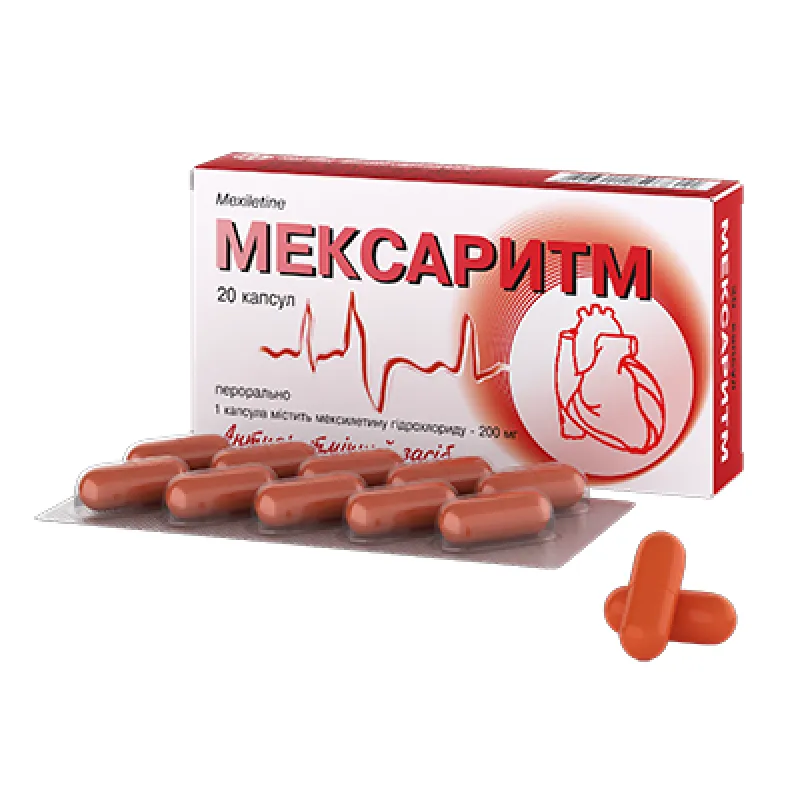
Table of Contents
INSTRUCTIONS FOR MEDICAL USE OF THE MEDICINAL PRODUCT MEXARITM (MEXARITM)
Composition:
Active substance: mexiletine hydrochloride;
1 capsule contains 200 mg of mexiletine hydrochloride calculated as 100% dry substance;
Excipients: lactose monohydrate, calcium stearate;
Capsule shell composition: yellow sunset FCF (E 110), ponzo 4R (E 124), titanium dioxide (E 171), gelatin.
Pharmaceutical form. Capsules.
Main physicochemical properties: hard gelatin capsules size №1, cylindrical in shape with rounded ends, having an orange cap and body. The capsule contents are white granular powder or a mass in the form of a partially or completely formed rod-shaped compacted material.
Pharmacotherapeutic group. Cardiological preparations. Class IB antiarrhythmic agents. ATC code C01BB02.
Pharmacological properties.
Pharmacodynamics.
Mexiletine hydrochloride belongs to class IB antiarrhythmic agents. It inhibits the rapid transmembrane influx of sodium ions, exerts membrane-stabilizing and local anesthetic effects. The drug reduces the rate of depolarization and the automaticity of pacemaker cells, decreases conduction velocity in the His-Purkinje fibers, slightly reduces the effective refractory period, and to a greater extent shortens the duration of the action potential (AP). Mexiletine increases the ratio of effective refractory period to action potential duration. Mexiletine has minimal effects on hemodynamic parameters.
Pharmacokinetics.
Mexiletine hydrochloride is well and rapidly absorbed from the gastrointestinal tract. In plasma, the drug is 50–60% protein-bound. Approximately 85% of mexiletine hydrochloride is metabolized in the liver, forming inactive metabolites. The drug is primarily excreted via bile; only 10–15% is excreted unchanged in urine. The elimination half-life (T1/2) of mexiletine hydrochloride averages 11 hours (ranging from 8 to 14 hours). This half-life may be prolonged to 25 hours in cases of heart failure or impaired liver function, to 15–17 hours in acute myocardial infarction, and increased by 30–35% in severe renal insufficiency. The drug crosses the placenta and is excreted in breast milk.
Clinical characteristics.
Indications.
Treatment of documented ventricular arrhythmias, such as sustained ventricular tachycardias and extrasystoles.
Due to the proarrhythmic potential of the drug and lack of evidence that Class I antiarrhythmic agents improve survival in patients with asymptomatic ventricular arrhythmias, the drug should be prescribed only for arrhythmias considered by the physician to be life-threatening.
Contraindications.
- Hypersensitivity to mexiletine, to other components of the drug, or to local anesthetics (e.g., lidocaine);
- cardiogenic shock;
- severe bradycardia;
- severe arterial hypotension;
- AV block of degree II–III in the absence of an artificial pacemaker;
- first 3 months following myocardial infarction when left ventricular ejection fraction is less than 35%.
Interaction with other medicinal products and other forms of interaction.
Mexiletine is metabolized by various CYP isoenzymes, primarily CYP2D and CYP1A.
Concomitant administration of mexiletine with local anesthetics, including lidocaine/tocainide, increases (mutually) their toxicity and potentiates adverse effects on the central nervous system.
Quinidine, beta-blockers, amiodarone, procainamide, disopyramide, cardiac glycosides, and certain other antiarrhythmic agents enhance the antiarrhythmic effect of mexiletine. However, concomitant use may lead to adverse effects; therefore, dose adjustment and careful clinical and ECG monitoring may be necessary.
Mexiletine does not affect serum levels of digoxin.
Mexiletine increases the blood concentration of theophylline. As a result, adverse effects of theophylline (nausea, vomiting, tremor) may occur. Therefore, serum levels of theophylline should preferably be monitored, and its dose adjusted if necessary.
Concomitant use with caffeine or products containing caffeine increases blood levels of caffeine due to reduced hepatic metabolism.
Agents that reduce gastrointestinal motility (narcotic analgesics, magnesium salts, antacids, anticholinergic drugs, including ganglion blockers, atropine, H2-histamine receptor blockers) delay the absorption of mexiletine. However, the bioavailability and clearance of mexiletine remain unchanged; therefore, no adjustment of the dosing regimen is required.
Agents that enhance gastrointestinal motility (e.g., metoclopramide) accelerate the absorption of mexiletine and the attainment of peak blood concentration. Dosage adjustment is not required, as the bioavailability of mexiletine remains unchanged.
Agents that significantly alter urine pH toward acidic or alkaline values should preferably not be used concomitantly with mexiletine, as they may increase or decrease (respectively) the renal excretion rate of mexiletine, thereby altering its plasma concentration.
Concomitant use with warfarin and other anticoagulants may increase the risk of bleeding.
Agents that induce hepatic enzymes, including phenytoin, rifampicin, and barbiturates, accelerate the metabolism of mexiletine; dose increase of mexiletine may therefore become necessary.
Special precautions for use.
Due to the proarrhythmic properties of the drug and insufficient evidence that Class I antiarrhythmic agents improve survival in patients with asymptomatic ventricular arrhythmias, mexiletine should be prescribed only for arrhythmias considered by the physician to be life-threatening.
Because of the potential for development or worsening of arrhythmias, discontinuation of previous antiarrhythmic therapy and transition to mexiletine must be carried out in a hospital setting under continuous ECG, blood pressure, and laboratory monitoring. When replacing Class IA antiarrhythmic agents with mexiletine, the following intervals are required: 6–12 hours after the last dose of quinidine or disopyramide, and 3–6 hours after procainamide or novocainamide. When switching from lidocaine to mexiletine, intravenous lidocaine infusion should be stopped immediately after administration of the first dose of mexiletine; however, the intravenous lidocaine delivery system should be disconnected only after achieving a satisfactory antiarrhythmic effect with mexiletine.
Use with caution in patients with first-degree AV block, sinus node dysfunction, intraventricular conduction disturbances, bradycardia, arterial hypotension, or severe heart failure. Patients with second- or third-degree AV block who have a permanent pacemaker implanted should be continuously monitored.
Use of Mexaritum during the first 3 months following myocardial infarction or in patients with left ventricular ejection fraction below 35% is contraindicated, except in cases of life-threatening ventricular arrhythmias.
In acute myocardial infarction, particularly when used concomitantly with opioids, absorption of the drug may be delayed, and therefore an increased loading dose of Mexaritum may be required.
Mexiletine should be used with caution in patients with hepatic impairment or renal failure. In moderate to severe liver disease (including congestive heart failure) and when creatinine clearance is below 10 mL/min, the elimination half-life of the drug is prolonged, and therefore the daily dose should be reduced.
Mexiletine rarely may cause hepatotoxicity (including liver necrosis); therefore, monitoring of liver transaminase activity is necessary during treatment. Persistent or marked elevation of transaminase levels warrants discontinuation of Mexaritum therapy.
Electrolyte imbalances may alter the body's response to the drug (e.g., hypokalemia reduces the effectiveness of mexiletine); therefore, electrolyte disturbances should be corrected prior to initiating therapy.
When used in certain patients, particularly in severely ill patients receiving concomitant therapy with drugs known to cause adverse hematological effects (e.g., procainamide, vinblastine), thrombocytopenia, leukopenia, neutropenia, and agranulocytosis have been observed; therefore, regular blood count monitoring is required during treatment.
The drug should be prescribed with caution in patients with myasthenia gravis, epilepsy, or psychiatric disorders. Mexaritum may exacerbate symptoms and increase the severity of Parkinson’s disease.
Abrupt discontinuation of the drug may be life-threatening; therefore, the dose should be tapered gradually over 1–2 weeks.
Renal excretion of mexiletine increases significantly with increased urine acidity; therefore, concomitant use of medications or food products that substantially affect urine pH should be avoided.
The drug contains lactose, which should be taken into account when prescribing Mexaritum to patients with carbohydrate intolerance disorders such as congenital galactosemia, glucose-galactose malabsorption syndrome, or lactase deficiency.
Due to the presence of the dyes sunset yellow FCF (E 110) and ponceau 4R (E 124) in the formulation, the drug may cause allergic reactions, including bronchial asthma. The risk of allergy is higher in patients with hypersensitivity to acetylsalicylic acid.
Use during pregnancy or breastfeeding.
Since mexiletine readily crosses the placenta, the use of the drug during pregnancy is contraindicated, except in exceptional cases (e.g., life-threatening ventricular rhythm disturbances).
Mexiletine is excreted in breast milk at concentrations that may affect the infant; therefore, if use of the drug is necessary in breastfeeding women, breastfeeding should be discontinued during the treatment period.
Ability to affect reaction speed when driving or operating machinery.
The drug may negatively affect reaction speed when driving or operating machinery.
Method of Administration and Dosage
Treatment with mexiletine, as with other antiarrhythmic drugs used to treat life-threatening arrhythmias, should be initiated in a hospital setting with mandatory clinical, laboratory, and ECG monitoring of the patient's condition and the antiarrhythmic effect of treatment, especially in patients with sinus node dysfunction, conduction disturbances, bradycardia, arterial hypotension, or severe cardiac, renal, or hepatic impairment.
Dosage of Mexaritum must be individualized and depends on the therapeutic response and drug tolerability.
The capsule should be swallowed whole, without chewing, during or after meals, and taken with sufficient fluid.
If rapid control of ventricular arrhythmia is required, the loading dose of Mexaritum is 400 mg (2 capsules). Subsequently (2 hours after the loading dose), the patient should be switched to a maintenance dose of 200 mg (1 capsule) every 6–8 hours. In certain cases, the loading dose (e.g., in acute myocardial infarction) may be increased to 600 mg.
The onset of therapeutic effect is usually observed within 30 minutes, reaching maximum effect within 2 hours. The usual daily dose is 600–800 mg, divided into 3–4 doses.
Treatment with Mexaritum may be initiated at a dose of 200 mg every 8 hours. If the antiarrhythmic effect is not achieved, the dose should be increased to 400 mg every 8 hours. A satisfactory response is typically achieved with a regimen of 200 mg three times daily.
The risk and severity of adverse effects increase with higher daily doses; therefore, the daily dose should not exceed 1200 mg.
The duration of treatment depends on the severity and course of the disease. After stabilization of the rhythm, discontinuation of Mexaritum should be gradual—over 1–2 weeks.
Children
There is no data available on the safety and efficacy of the drug for use in pediatric patients.
Overdose
The drug has a narrow therapeutic index (0.5–2 μg/mL; potentially toxic level > 2 μg/mL), so overdose may occur even with slight exceedance of the therapeutic range, particularly when combined with other antiarrhythmic drugs.
Symptoms: drowsiness, confusion, nausea, vomiting, ataxia, seizures. Visual disturbances (diplopia, nystagmus) and paresthesias have also been reported. However, more typical manifestations of overdose include marked arterial hypotension, sinus bradycardia, AV block, asystole, ventricular tachyarrhythmias including fibrillation, cardiovascular collapse, and coma.
Treatment: symptomatic. If necessary, gastric lavage should be performed, and the patient should be transferred to intensive care for cardiopulmonary support. In cases of severe bradycardia and arterial hypotension, atropine should be administered intravenously. Diazepam may be used in case of seizures.
Adverse reactions.
- Gastrointestinal tract.
Nausea, vomiting, heartburn, hiccup, abdominal pain, diarrhea or constipation, changes in salivation/ dry mouth/ changes in oral mucosa, altered taste sensations; isolated cases of dysphagia, esophageal, peptic ulcers, rarely − gastrointestinal bleeding.
- Nervous system.
Dizziness, tremor, coordination disturbances, irritability, sleep disorders (including somnolence), weakness, fatigue, headache, dysarthria, tinnitus, nystagmus, accommodation disorders, difficulty concentrating, paresthesia, seizures, confusion, loss of consciousness, psychiatric disorders, hallucinations, depression, possible temporary memory loss.
- Cardiovascular system.
Palpitations, chest pain, syncope, arterial hypotension/hypertension, flushing, bradycardia, manifestations of the drug's arrhythmogenic properties (atrial fibrillation/flutter, ventricular extrasystoles, atrioventricular dissociation, atrioventricular block/conduction disturbances, development of new or worsening of pre-existing arrhythmia), possible development of congestive heart failure, cardiogenic shock.
Arterial hypotension usually occurs in patients with severe heart disease who have already been receiving various antiarrhythmic or other drugs; if hypotension is associated with bradycardia, atropine should be administered.
- Blood and lymphatic system.
Thrombocytopenia, leukopenia (including neutropenia and agranulocytosis).
- Respiratory system.
Dyspnea; there have been reports of isolated cases of interstitial pneumonia, pulmonary infiltrates, pulmonary fibrosis.
- Hepatobiliary system.
Increased liver enzyme activity, especially during the first weeks of taking the drug. There have been reports of isolated cases of liver function disorders, including jaundice, severe hepatitis/acute liver necrosis.
In some patients, an increase in AST activity by 3 times or more has been observed, which was mainly associated with defined clinical events (e.g., development of heart failure, myocardial infarction) or therapeutic interventions (blood transfusion, use of other medications). This increase is often asymptomatic, may be transient, and usually does not require discontinuation of mexiletine.
- Skin and subcutaneous tissue.
Rash, swelling, dry skin, alopecia, diaphoresis, isolated cases of erythroderma, exfoliative dermatitis, and Stevens-Johnson syndrome.
- Immune system.
Hypersensitivity reactions may occur in individuals with intolerance to any component of the drug; isolated cases of lupus-like syndrome, positive titers of antinuclear factors have been reported.
Cases of DRESS syndrome (drug reaction with eosinophilia and systemic symptoms) have been reported, which typically presents with eosinophilia, fever, rash and/or lymphadenopathy in combination with organ damage in various combinations, such as hepatitis, nephritis, hematological abnormalities, myocarditis or myositis, sometimes resembling acute viral infection. If this syndrome is suspected, mexiletine should be discontinued immediately.
- Urinary and reproductive system.
Impotence/ decreased libido, urinary disorders (including urinary retention), renal failure.
- Other.
Visual disturbances, including diplopia, laryngitis and pharyngitis (dryness of mucous membranes), arthralgia, fever.
Shelf life. 3 years.
The drug should not be used after the expiry date stated on the packaging.
Storage conditions. In the original packaging at a temperature not exceeding 25 °C. Keep out of reach of children.
Packaging. 10 capsules in a blister, 2 blisters in a carton.
Prescription category. Prescription only.
Manufacturer. Public joint-stock company "Scientific and Production Center "Borshchahivskyi Chemical and Pharmaceutical Plant".
Manufacturer's address and location of business activity.
17, Miru Street, Kyiv, 03134, Ukraine.