Marcaine spinal heavy
Ukraine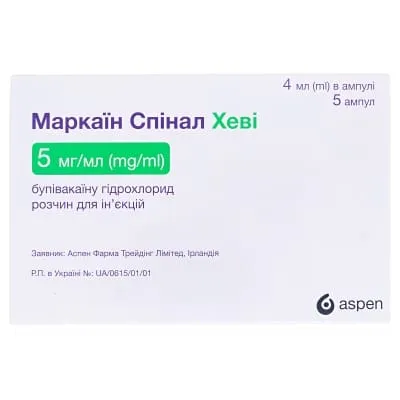
Table of Contents
INSTRUCTIONS FOR MEDICAL USE OF THE MEDICINAL PRODUCT MARCAINE SPINAL HEAVY (Marcain® Spinal Heavy)
Composition:
Active substance: bupivacaine hydrochloride;
1 ml of solution contains 5.28 mg of bupivacaine hydrochloride monohydrate equivalent to 5 mg of bupivacaine hydrochloride;
Excipients: glucose monohydrate; sodium hydroxide and/or hydrochloric acid; water for injections.
Pharmaceutical form. Injection solution.
Main physicochemical properties: clear, colorless solution.
Pharmacotherapeutic group. Local anesthetics.
ATC code N01BB01.
Pharmacological Properties.
Pharmacodynamics.
Bupivacaine is a long-acting amide-type local anesthetic.
Bupivacaine reversibly blocks impulse conduction along nerve fibers by inhibiting sodium ion transport across neuronal membranes. Similar effects may also occur at excitable membranes of the brain and myocardium.
Marcain Spinal Heavy is intended for hyperbaric spinal anesthesia. The relative density of the injection solution is 1.026 at 20 °C (equivalent to 1.021 at 37 °C), and the initial distribution of the drug in the subarachnoid space is largely dependent on gravity.
When administered spinally, a low dose is used, resulting in relatively low plasma concentrations and short duration of action.
Pharmacokinetics.
Bupivacaine is highly lipid-soluble, with an oil/water partition coefficient of 27.5.
Bupivacaine demonstrates complete biphasic absorption from the subarachnoid space, with half-lives of approximately 50 and 400 minutes for the two phases, with considerable variability. The slow absorption phase is the rate-limiting factor for bupivacaine elimination, which explains why the terminal half-life is longer after subarachnoid administration compared to intravenous administration.
Absorption from the subarachnoid space is relatively slow; together with the small dose required for spinal anesthesia, this results in relatively low peak plasma concentrations (approximately 0.4 mg/L for every 100 mg administered).
After intravenous administration, the total plasma clearance of bupivacaine is approximately 0.58 L/min, the volume of distribution at steady state is 73 L, the terminal half-life is 2.7 hours, and the hepatic extraction ratio is 0.40. Bupivacaine is almost completely metabolized in the liver via aromatic hydroxylation to 4-hydroxybupivacaine and via N-dealkylation to pipecolylxylidine (PPX), both pathways mediated by cytochrome P450 3A4. Thus, its clearance depends on hepatic perfusion and metabolic enzyme activity. Bupivacaine crosses the placental barrier. Free bupivacaine concentrations are equal in pregnant women and fetus. However, total plasma concentration is lower in the fetus, which has a lower degree of protein binding.
In children, the pharmacokinetics of the drug are similar to those in adults.
Clinical characteristics.
Indications.
Marcain Spinal Heavy is indicated in adults and children of various ages for intrathecal (subarachnoid) spinal anesthesia in surgery (urological and lower limb surgeries lasting 2−3 hours, as well as abdominal surgeries lasting 45−60 minutes).
Contraindications.
Hypersensitivity to the active substance, amide-type local anesthetics, or to any component of the medicinal product.
Intrathecal anesthesia, regardless of the local anesthetic used, has its own contraindications, including:
- active diseases of the central nervous system, such as meningitis, poliomyelitis, intracranial hemorrhage, subacute combined degeneration of the spinal cord due to pernicious anemia, and tumors of the brain and spinal cord;
- spinal canal stenosis and active-stage diseases (e.g., spondylitis, tuberculosis, tumors) or recent trauma (e.g., spinal fracture);
- septicemia;
- purulent skin infection at or near the lumbar puncture site;
- cardiogenic or hypovolemic shock;
- coagulation disorders or ongoing anticoagulant therapy.
Interaction with other medicinal products and other forms of interaction.
Since systemic toxic effects are additive, bupivacaine should be used with caution in patients receiving other local anesthetics or drugs structurally related to amide-type local anesthetics, such as certain class IB antiarrhythmic agents.
Specific interaction studies between bupivacaine and class III antiarrhythmic agents (e.g., amiodarone) have not been conducted; therefore, caution should be exercised when co-administering these agents (see also section "Special warnings and precautions for use").
Special precautions for use
It should be remembered that intrathecal anaesthesia may sometimes lead to extensive block with paralysis of intercostal muscles and the diaphragm, particularly in pregnant women.
The drug should be used with caution in patients with second- or third-degree atrioventricular block, as local anaesthetics may reduce myocardial conduction. Elderly patients and patients with liver disease, severe renal impairment, or poor general condition also require special attention.
Patients receiving class III antiarrhythmic drugs (e.g., amiodarone) should be closely monitored. In addition, ECG monitoring should be considered, since the cardiac effects of these drugs may be additive.
Intrathecal anaesthesia may lead to the development of arterial hypotension and bradycardia. The risk of these effects can be reduced, for example, by administration of vasoconstrictor agents. Hypotension should be treated immediately with intravenous sympathomimetics, repeated as necessary.
Like all local anaesthetics, bupivacaine, when used for local anaesthesia, may cause acute toxic effects on the central nervous and cardiovascular systems if high concentrations of the drug occur in the blood. This is particularly relevant in cases following accidental intravascular injection or injection into highly vascularized areas.
Cases of ventricular arrhythmia, ventricular fibrillation, sudden cardiovascular collapse, and death have been reported in association with high systemic concentrations of bupivacaine. However, high systemic concentrations are not expected with doses commonly used for intrathe游戏副本
Dosage and Administration
Marcain Spinal Heavy should be administered only by physicians experienced in regional anesthesia, or under their supervision, using the lowest doses that provide adequate anesthesia.
The recommended doses listed below should be considered as guidelines for administering the drug to adults; the dose should be individually adjusted for each patient.
Dosage should be reduced for elderly patients and for patients in the late stages of pregnancy.
Table 1
| Indications |
Dose, ml |
Dose, mg |
Time to onset of effect, min (approximately) |
Duration of effect, hrs (approximately) |
| Urological surgical procedures |
1.5−3 |
7.5−15 |
5−8 |
2−3 |
| Surgical procedures on lower limbs, including hip surgery |
2−4 |
10−20 |
5−8 |
2−3 |
| Abdominal surgical procedures (including caesarean section) |
2−4 |
10−20 |
5−8 |
3/4−1 |
The recommended injection site is below L3.
Currently, there is no clinical experience with doses higher than 20 mg.
Spinal administration of the drug should be performed only after clearly identifying the subarachnoid space via lumbar puncture (until clear cerebrospinal fluid is obtained either through the lumbar puncture needle or by aspiration). In case of ineffective anesthesia, a new attempt at drug administration should be performed only at another level and with a smaller volume of anesthetic. One of the reasons for insufficient effect may be incorrect distribution of the drug within the intrathecal space. In such cases, adequate effect can be achieved by changing the patient's body position.
Newborns, infants, and children with body weight up to 40 kg
Marcaine Spinal Heavy can be used in pediatric practice.
One of the differences between children and adults is the relatively larger volume of cerebrospinal fluid in infants and newborns, which necessitates administration of a relatively higher dose of the drug per kg of body weight to achieve the same level of block compared to adults.
Regional anesthesia procedures in children should be performed by qualified physicians experienced in administering regional anesthesia to pediatric patients, as well as experienced in performing the specific anesthetic technique.
The doses listed in Table 2 should be considered as guidelines when using the medicinal product in pediatrics. Individual variability has been observed. Standard dosing recommendations should be taken into account when factors affecting specific block techniques are present, and to meet individual patient requirements.
The lowest effective dose required to achieve adequate anesthesia should be used.
Table 2
Dosage recommendations for newborns, infants, and children
| Body weight (kg) |
Dose (mg/kg) |
| < 5 |
0.40−0.50 |
| From 5 to 15 |
0.30−0.40 |
| From 15 to 40 |
0.25−0.30 |
Children.
Marcain Spinal Heavy can be used in pediatric practice. For more information, see section "Dosage and Administration".
Overdose.
Acute systemic toxicity
Toxic effects on the central nervous and cardiovascular systems may occur with high doses of bupivacaine, especially following intravascular administration. However, a low dose is used in spinal anesthesia, making the risk of overdose unlikely. Systemic toxic reactions may occur when the drug is used concomitantly with other local anesthetics, since toxic effects are additive.
Treatment
In the event of total spinal block, adequate pulmonary ventilation should be ensured (maintaining airway patency, oxygen supplementation, intubation and artificial ventilation if necessary). In case of decreased arterial pressure or bradycardia, a vasoconstrictor agent (preferably with inotropic effect) should be administered.
If signs of acute systemic toxicity occur, administration of local anesthetics must be immediately discontinued. Treatment should focus on maintaining adequate ventilation, oxygenation, and circulation.
Oxygen should always be administered, and artificial ventilation (possibly with hyperventilation) should be performed if necessary. In case of seizures, diazepam is administered; in case of bradycardia, atropine is used. In case of circulatory shock, intravenous fluids, dobutamine, and if necessary, noradrenaline (starting at 0.05 mcg/kg/min, increasing the dose by 0.05 mcg/kg/min every 10 minutes as needed) should be administered, guided by hemodynamic monitoring, especially in more severe cases. Ephedrine may also be used. In case of cardiac arrest, resuscitation measures may be required for several hours. Any acidosis should be corrected.
Adverse reactions.
Adverse reactions caused by the drug itself are difficult to distinguish from physiological effects associated with blockade of nerve fibers (e.g., decreased arterial pressure, bradycardia, transient urinary retention), conditions directly caused by the procedure (e.g., spinal hematoma), or indirectly by needle puncture (e.g., meningitis, epidural abscess), or conditions related to cerebrospinal fluid leakage (e.g., post-dural puncture headache).
For information on symptoms and treatment of acute systemic toxicity, see section "Overdose".
Table 3
| Frequency |
System organ classes |
Adverse reactions |
| Very common (> 1/10) |
Cardiac disorders Gastrointestinal disorders |
Arterial hypotension, bradycardia Nausea |
| Common (> 1/100; <1/10) |
Nervous system disorders Gastrointestinal disorders Renal and urinary disorders |
Post-dural puncture headache Vomiting Urinary retention, urinary incontinence |
| Uncommon (>1/1000; <1/100) |
Nervous system disorders Musculoskeletal and connective tissue disorders |
Paresthesia, paresis, dysesthesia Muscle weakness, back pain |
| Rare (<1/1000) |
Cardiac disorders Immune system disorders Nervous system disorders Respiratory system disorders |
Cardiac arrest Allergic reactions, anaphylactic shock Complete unpredictable spinal block, paraplegia, paralysis, neuropathy, arachnoiditis Respiratory depression |
Pediatric population
Adverse reactions to the use of the drug in children are similar to those in adults; however, early signs of toxicity of local anesthetics may be difficult to detect in children if the block is performed under sedation or general anesthesia.
Reporting of suspected adverse reactions
Reporting of suspected adverse reactions after drug registration is important. This allows continued monitoring of the benefit/risk balance of the drug. Healthcare professionals are requested to report any suspected adverse reactions through the national reporting system.
Shelf life. 3 years.
Storage conditions. Store at a temperature not exceeding 25 °C. Keep out of reach of children.
Incompatibilities. The addition of other substances to spinal solutions is not recommended.
Packaging. 4 ml in an ampoule. 5 ampoules in a blister pack. 1 blister pack in a cardboard box.
Prescription status. Prescription only.
Manufacturer. Cenexi, France.
Manufacturer's address and place of business.
52 Rue Marcel et Jacques Gaucher, Fontenay sous Bois, 94120, France.