Manid
Ukraine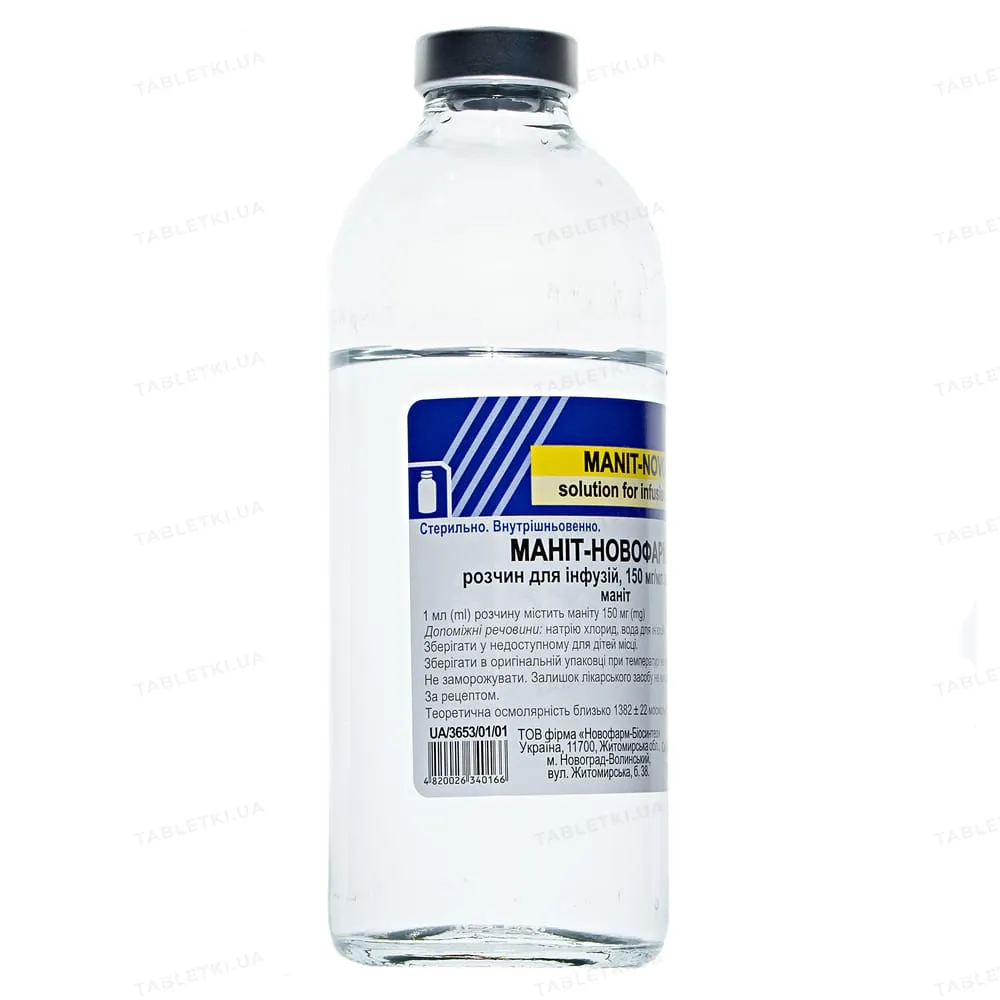
Instructions for Use
INSTRUCTION FOR MEDICAL USE OF THE MEDICINAL PRODUCT MANNIT (MANNITOL)
Composition:
Active substance: mannitol;
100 ml of solution contain 15 g of mannitol;
Excipients: sodium chloride, water for injections.
Pharmaceutical form. Infusion solution.
Main physicochemical properties: clear colorless or slightly yellowish liquid; theoretical osmolarity — 1131 mosmol/l, pH 4.5–7.0.
Pharmacotherapeutic group. Solutions for intravenous administration. Osmotic diuretic solutions. ATC code B05B C01.
Pharmacological Properties.
Pharmacodynamics.
Mannitol exerts a pronounced diuretic effect by increasing plasma osmotic pressure and filtration without subsequent tubular reabsorption, promotes retention of water in the tubules and increases urine volume. By increasing plasma osmolarity, it causes fluid shift from tissues into the vascular compartment. It promotes rapid removal of fluid from the vascular bed and increases renal blood flow, thereby reducing renal tissue hypoxia. The drug does not affect glomerular filtration. Diuresis is accompanied by excretion of a significant amount of sodium without a noticeable effect on potassium excretion.
The diuretic effect depends on the amount and rate of the administered drug and its filtration by the kidneys; therefore, it is ineffective in impaired renal filtration function and in patients with cirrhosis of the liver and ascites who have azotemia. It increases blood volume (due to elevated osmotic pressure in the vascular system). After intravenous administration, mannitol reduces water reabsorption, increases blood volume, exerts a diuretic effect, and reduces intracranial pressure.
Pharmacokinetics.
It is filtered by the kidneys without subsequent tubular reabsorption. The half-life is approximately 100 minutes (in acute renal failure, the half-life may increase up to 36 hours). The diuretic effect appears 1–3 hours after administration; reduction of cerebrospinal fluid pressure and intraocular pressure occurs within 15 minutes after the start of infusion. Maximum reduction in intraocular pressure is observed 30–60 minutes after the start of infusion. Reduced cerebrospinal fluid pressure persists for 3–8 hours; reduced intraocular pressure lasts for 4–8 hours after completion of infusion. Mannitol is minimally metabolized in the liver to form glycogen.
Approximately 80% of the administered dose is excreted in urine within 3 hours.
Clinical characteristics.
Indications.
Cerebral edema, intracranial hypertension, intensive treatment of convulsive status, ascites; acute hepatic or renal failure with preserved renal filtration capacity, and other conditions requiring enhanced diuresis (epileptic status, acute glaucoma attack, surgeries involving extracorporeal circulation, post-transfusion complications after administration of incompatible blood, barbiturate poisoning and other intoxications).
Contraindications.
Hypersensitivity to the drug; severe heart failure; severe forms of dehydration; hyperosmolar state; renal failure with impaired glomerular filtration function; acute renal failure with anuria lasting more than 12 hours; hemorrhagic stroke; subarachnoid hemorrhage; hyponatremia; hypochloremia; hypokalemia; cerebral lesions associated with disruption of the blood-brain barrier; comatose states.
Interaction with other medicinal products and other types of interactions.
Potentiates the diuretic effect of saluretics, carbonic anhydrase inhibitors, and other diuretic agents. The risk of ototoxic and nephrotoxic reactions increases when used concomitantly with neomycin. Concomitant administration of mannitol with cardiac glycosides is not recommended due to the possible enhancement of their toxic effects.
Special precautions for use.
The drug should be used only under hospital conditions.
It is necessary to monitor arterial pressure, diuresis, blood osmolarity, water and ion balance, along with central hemodynamic parameters. The drug should be administered with caution in patients with chronic heart failure. After administration of a test dose, diuresis should be closely monitored. Conclusions should not be drawn based solely on urine specific gravity.
Do not use in cerebral lesions associated with disruption of the blood-brain barrier or in comatose states. If symptoms such as headache, dizziness, vomiting, or visual disturbances occur, administration of the drug must be discontinued immediately. If crystals form in the solution, heat the container in a water bath at 50–70 °C. The drug may be used if the crystals dissolve completely, the solution becomes clear, and upon cooling below 36 °C no crystals reappear. The medicinal product may be used only if the vial is undamaged. Use only a clear, colorless or slightly yellowish solution. The medicinal product must be used immediately after opening the vial. Under no circumstances should an opened vial be stored for subsequent infusions. Any unused portion of the medicinal solution and other materials used during administration must be disposed of in accordance with Ukrainian legislation.
Use during pregnancy or breastfeeding.
Do not use the drug during pregnancy or breastfeeding.
Ability to influence reaction rate while driving or operating machinery.
There are no data regarding the effect of mannitol on reaction speed while driving or operating machinery, as the drug is administered only under hospital conditions.
Method of Administration and Dosage
The drug should be administered intravenously by drip infusion or slow bolus injection. The total dose and rate of administration depend on the indication and the patient's clinical condition.
For adults, administer 50–100 g of the drug at a rate ensuring diuresis of at least 30–50 mL/hour.
For cerebral edema, increased intracranial pressure, or glaucoma, administer the drug by infusion at a dose of 0.25–1 g/kg body weight over 30–60 minutes. For patients with low body weight or debilitated patients, a dose of 0.5 g/kg body weight is sufficient. In cases of poisoning, administer 50–180 g at an infusion rate maintaining diuresis at 100–500 mL/hour. The maximum dose for adults is 140–180 g within 24 hours.
For children, as a diuretic, administer the drug by intravenous drip infusion at a dose of 0.25–1 g/kg body weight or 30 g per 1 m² of body surface area over 2–6 hours. For cerebral edema, increased intracranial pressure, or glaucoma, administer 0.5–1 g/kg body weight or 15–30 g per 1 m² of body surface area over 30–60 minutes. For children with low body weight or debilitated patients, a dose of 0.5 g/kg body weight is sufficient. In cases of poisoning in children, administer intravenous infusion up to 2 g/kg body weight or 60 g per 1 m² of body surface area.
In renal failure with oliguria, administer 0.2 g of mannitol per 1 kg body weight over 3–5 minutes, then monitor diuresis for 1–2 hours. If diuresis exceeds 30 mL/hour or increases by 50%, continue intravenous infusion slowly to maintain diuresis at 40 mL/hour.
Test dose: In patients with oliguria or suspected impairment of renal excretory function, a test dose of mannitol should be administered. The usual test dose for adults is 0.2 g/kg body weight; for children, it is 0.2 g/kg body weight or 6 g/m² body surface area. The test dose should be administered over 3–5 minutes. Diuresis should increase to 30–50 mL/hour within 2–3 hours. If diuresis does not increase, a repeat test dose may be administered.
Children.
The efficacy and safety of the drug in pediatric patients have not been sufficiently studied; therefore, the drug should be used in children only under life-threatening conditions.
Overdose.
Rapid administration of high doses may lead to an increase in extracellular fluid volume, hyponatremia and hyperkalemia, as well as cardiac volume overload, particularly in patients with acute or chronic renal failure, and to dehydration. Treatment is symptomatic.
Side effects.
Metabolic and nutritional disorders: dehydration, electrolyte imbalance, hyponatremia, hypokalemia.
Skin and subcutaneous tissue disorders: dry skin, skin rash, pruritus.
Cardiac disorders: tachycardia, chest pain, decreased and increased blood pressure.
Neurological disorders: seizures, hallucinations, headache.
Gastrointestinal disorders: dyspepsia, dry mouth, thirst.
Other: muscle weakness, phlebitis, facial swelling.
Shelf life. 3 years.
Storage conditions.
Store at a temperature not exceeding 25 °C, in a place inaccessible to children.
If crystals form, heat the preparation in a water bath at 50–70 °C. If the crystals dissolve completely, the solution becomes clear and, upon cooling to below 36 °C, the crystals will not reappear; the preparation is suitable for use.
Incompatibility.
Mannitol must not be administered concomitantly with cardiac glycosides due to the potential enhancement of their toxic effects.
Packaging. 100 ml, 200 ml, 400 ml in bottles.
Prescription status. Prescription only.
Manufacturer. Private Joint-Stock Company "Infuziya".
Manufacturer's address and location of business activity.
84A Nemirovskе Highway, Vinnytski Khotory, Vinnytsia District, Vinnytsia Oblast, 23219, Ukraine.
Frequently Asked Questions
What is Manid prescribed for?
The drug is used to treat cerebral edema, increased intracranial pressure, glaucoma, ascites, as well as acute hepatic or renal failure. It is also used to enhance diuresis (urine excretion) in cases of poisoning and certain other conditions.
How should Manid be taken correctly?
The drug is administered intravenously via infusion or slow bolus injection in a hospital setting. The dosage and infusion rate depend on the specific disease, the patient's condition, and their body weight. For adults, the dose is typically 50 to 100 g, and in cases of poisoning, 50 to 180 g. The maximum daily dose for adults is 140–180 g.
Who should not use this drug?
Contraindications include hypersensitivity to the substance, severe heart failure, severe dehydration, renal failure with impaired filtration, hemorrhagic stroke, subarachnoid hemorrhage, low levels of sodium, potassium, or chloride in the blood, as well as comatose states and certain brain injuries. The drug should not be used during pregnancy and breastfeeding.
What could be the side effects of Manid?
Possible side effects include disturbances in water and electrolyte balance and dehydration, dry skin, rash or itching, palpitations (tachycardia), chest pain, changes in blood pressure, headache, convulsions, hallucinations, dry mouth, thirst, muscle weakness, or facial edema.
Can the drug be combined with other medicines?
Manid enhances the effect of other diuretics. Concurrent use with neomycin increases the risk of ear and kidney damage. It is strictly forbidden to prescribe the drug together with cardiac glycosides, as this may increase their toxicity.
What should be done if unpleasant symptoms appear during administration?
If you experience headache, dizziness, nausea (vomiting), or visual disturbances, the administration of the drug must be discontinued immediately.
Similar Medications
-
Manit
Form: solution for infusion
Active substance Dosage mannitol 150 mg/ml Manufacturer: Yuria-Pharm LLC
-
Manit-novopharm
Form: solution for infusion
Active substance Dosage mannitol 150 mg/ml Manufacturer: LLC Firm Novofarm-Biosyntez
This page has been machine-translated and may contain inaccuracies. The original data is available in the manufacturing country's language.
Last data check: July 21, 2026 · Data source: Державний реєстр лікарських засобів України