Maltofer® fol
Ukraine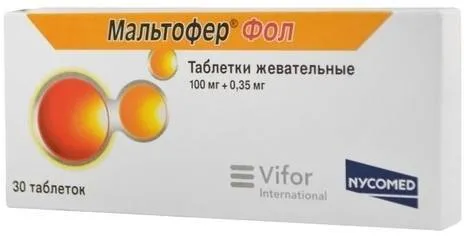
Table of Contents
INSTRUCTIONS FOR MEDICAL USE OF THE MEDICINAL PRODUCT MALTOFER® FOL (MALTOFER® FOL)
Composition:
Active ingredient:
One tablet contains 357 mg of iron (III) hydroxide polymaltose complex, equivalent to 100 mg of iron, and 0.35 mg of folic acid.
Excipients: microcrystalline cellulose, cocoa powder, sodium cyclamate, polyethylene glycol 6000, talc, vanillin, dextrates, chocolate flavor.
Pharmaceutical form. Chewable tablets.
Main physicochemical properties: brown tablets with white specks and a score line.
Pharmacotherapeutic group. Antianemic agent. Combination preparations containing iron and folic acid.
ATC code B03A D04.
Pharmacological properties.
Pharmacodynamics.
The surface of the iron (III) hydroxide core within the polymaltose complex is surrounded by non-covalently bound polymaltose molecules, resulting in an average molecular weight of approximately 50 kDa. The structure of the iron (III) hydroxide core in the iron-polymaltose complex resembles that of ferritin—the physiological protein storage form of iron. The polymaltose iron hydroxide complex is stable and does not release large amounts of free iron under normal physiological conditions. Due to its size, diffusion of the polymaltose iron hydroxide complex across the mucosa is approximately 40 times lower than that of most water-soluble iron (II) salts, which exist in aqueous solutions as the hexaaqua-iron (II) complex. Iron from the polymaltose complex is absorbed in the intestine via active mechanisms. Folic acid (folate) belongs to the B-vitamin group. It is a precursor of tetrahydrofolate, a coenzyme involved in various metabolic processes, including nucleic acid, purine, and thymidylate biosynthesis. Folic acid is essential for nucleoprotein synthesis and for maintaining normal erythropoiesis. Absorbed iron binds to transferrin and is either used for hemoglobin synthesis in the bone marrow or stored primarily in the liver in a form bound to ferritin.
Clinical efficacy.
During pregnancy, iron requirements increase to approximately 0.8 mg/day in the first trimester and up to 6 mg/day in the third trimester. Additionally, the need for folic acid increases during pregnancy. Low folic acid levels may manifest as deficiency symptoms both in the mother (anemia, peripheral neuropathy) and in the fetus (neural tube defects).
Clinical studies evaluating the safety and efficacy profile of treating iron deficiency with or without anemia, as well as preventing deficiencies of iron and folic acid, were conducted in pregnant women receiving the polymaltose iron hydroxide complex combined with folic acid (Maltofer® Fol). Hematological parameter changes were compared during treatment with chewable Maltofer® Fol tablets providing 100–300 mg of iron per day together with 0.35 mg of folic acid per day versus standard ferrous sulfate (II) preparations with or without folic acid. One study assessed the efficacy of the polymaltose iron hydroxide complex with added folic acid compared to intravenous iron formulations, while another study evaluated the efficacy and tolerability of Maltofer® Fol versus an iron-rich diet. Approximately 700 pregnant women with normal or reduced iron levels were included in these studies, more than 400 of whom received Maltofer® Fol.
Treatment of pregnant women with Maltofer® Fol demonstrated improvement in hematological parameters similar to that observed with Maltofer® in non-pregnant patients, along with good tolerability. In clinical trials, hemoglobin levels increased on average by 0.72–2.2 g/dL (p < 0.05) compared to baseline values after initiating Maltofer® Fol therapy; this increase was maintained over periods ranging from 30 days to 2.5 months. Furthermore, improvements were observed in serum ferritin levels (+5.74 µg/L) and erythrocyte ferritin levels (on average +6.3 µg/g or 5.74 µg/g after 30 days to 2.5 months of therapy compared to pre-treatment levels).
In an open-label study, the efficacy of Maltofer® Fol (200 mg of polymaltose iron hydroxide complex daily for 10 days, followed by 100 mg daily for 20 days) in combination with vitamin B12 was evaluated in pregnant women with iron-deficiency anemia. A significant increase was observed in hemoglobin and hematocrit levels, erythrocyte count, and folic acid levels (p < 0.01).
In another open-label study involving 43 adolescents aged 14.5 to 17 years with iron-deficiency anemia of varying severity, the effect of Maltofer® Fol on hemoglobin levels was assessed. Anemia was corrected after 48 days of treatment in patients with mild anemia. Hemoglobin levels increased from 104.3 ± 1.7 g/L to 134.1 ± 1.3 g/L. In patients with moderate anemia, hemoglobin levels increased from 83.0 ± 0.4 g/L to 116.4 ± 0.7 g/L, and in those with severe anemia, from 67.9 ± 0.9 g/L to 104.4 ± 0.8 g/L, achieved within 48–49 days of treatment. Anemia correction was achieved after 75–76 days in patients with moderate anemia (hemoglobin level 133.2 ± 1.1 g/L) and after 82–83 days in patients with severe anemia (hemoglobin level 134.4 ± 0.9 g/L).
Pharmacokinetics.
Studies using radiolabeled polymaltose iron hydroxide complex have shown a good correlation between iron absorption and iron accumulation in hemoglobin. There is a correlation between the degree of iron deficiency and the amount of absorbed iron (the greater the iron deficiency, the better the absorption). It has been established that, unlike iron (II) salts, food does not negatively affect the bioavailability of iron from Maltofer®: in one clinical study, iron bioavailability significantly increased when administered with food, while three other studies showed only a positive trend without a statistically significant clinical effect.
Approximately 80% of folic acid is absorbed in the small intestine, with peak levels reached within 30–60 minutes.
Excretion.Unabsorbed iron is excreted in the feces. Folic acid is primarily excreted in the urine.
Clinical characteristics.
Indications.
Treatment and prevention of iron deficiency without anemia and iron deficiency anemia in conditions with increased demand for folic acid during pregnancy or lactation.
Iron deficiency and its severity must be confirmed by appropriate laboratory tests.
Contraindications.
- Hypersensitivity or intolerance to the active substance or any component of the medicinal product;
- Excessive iron content in the body (e.g., hemochromatosis, hemosiderosis);
- Disorders of iron excretion mechanisms (lead poisoning anemia, sideroblastic anemia, thalassemia);
- Anemias not caused by iron deficiency (e.g., hemolytic anemia, vitamin B12 deficiency megaloblastic anemia).
Interaction with other medicinal products and other types of interactions.
Preclinical studies in rats using tetracycline, aluminum hydroxide, acetylsalicylic acid, sulfasalazine, calcium carbonate, calcium acetate, calcium phosphate combined with vitamin D3, bromazepam, magnesium aspartate, D-penicillamine, methyldopa, paracetamol, and auranofin did not reveal any interaction with iron(III) hydroxide polymaltose complex.
In vitro studies showed no interaction between iron(III) hydroxide polymaltose complex and food components such as phytic acid, oxalic acid, tannins, sodium alginate, choline and choline salts, vitamin A, vitamin D3, and vitamin E, soybean oil, and soy flour. Study results indicate that iron(III) hydroxide polymaltose complex can be taken during or immediately after meals.
Interaction between iron(III) hydroxide polymaltose complex and tetracycline or aluminum hydroxide was investigated in three clinical studies (crossover studies involving 22 patients each). No significant reduction in tetracycline absorption was observed. Tetracycline plasma concentrations did not fall below the level required for bacteriostatic action. Administration of aluminum hydroxide and tetracycline did not reduce iron absorption from iron(III) hydroxide polymaltose complex. Therefore, iron(III) hydroxide polymaltose complex can be administered simultaneously with tetracyclines, other phenolic compounds, and aluminum hydroxide.
The use of the medicinal product does not affect the results of the fecal occult blood test (hemoglobin-sensitive test); therefore, there is no need to discontinue treatment.
Concomitant use of parenteral iron preparations and Maltofer® Fol is not recommended, as this may impair absorption of orally administered iron preparations. Parenteral iron preparations may be used only when oral therapy is inappropriate.
Folic acid may enhance phenytoin metabolism, leading to decreased serum phenytoin concentrations, especially in patients with folic acid deficiency. In some patients, an increased frequency of epileptic seizures may occur. Patients taking phenytoin or other anticonvulsant drugs should consult their physician before using folic acid-containing products.
Concomitant use of chloramphenicol and folic acid in patients with folic acid deficiency has been reported to cause antagonism of the hematopoietic response to folic acid. Although the significance and mechanism of this interaction are unknown, careful monitoring of hematopoietic response to folic acid is recommended in patients receiving both medicinal products simultaneously.
Special precautions for use.
Treatment of anemia should always be carried out under medical supervision. If there is no improvement in hematological parameters (an increase in hemoglobin levels by approximately 20–30 g/L within 3 weeks after initiation of treatment), the treatment regimen should be re-evaluated.
Maltifer® Fol contains folic acid, which may mask vitamin B\textsubscript{12} deficiency. Potential vitamin B\textsubscript{12} deficiency should be ruled out in patients with anemia prior to initiating treatment due to the risk of developing irreversible neurological disorders (see section "Contraindications").
Administration of iron polymaltose complex may result in darkening of stool; however, this is clinically insignificant.
Caution should be exercised in patients receiving repeated blood transfusions, as red blood cells already contain iron stores, and administration of the drug may lead to iron overload.
Infections and tumors may cause the development of anemia. Oral iron preparations may be administered after recovery from the underlying disease, taking into account the benefit-risk ratio.
When prescribing this medication to patients with diabetes mellitus, it should be noted that 1 tablet contains 0.03 bread units.
Iron preparations should be used with caution in patients with the following conditions: leukemia, chronic liver and kidney diseases, inflammatory gastrointestinal disorders, peptic ulcer disease of the stomach and duodenum, intestinal disorders (enteritis, ulcerative colitis, Crohn's disease).
This medication contains 10 mg of sodium per tablet. This amount corresponds to 0.5% of the WHO recommended maximum daily sodium intake for adults of 2 g.
Use during pregnancy or breastfeeding.
Clinical data on the use of the drug during pregnancy have not shown adverse effects on pregnant women or on fetal or neonatal health. Epidemiological studies are lacking. Animal studies have not shown reproductive toxicity.
However, the drug should be used with caution during pregnancy.
Human breast milk contains iron and folic acid bound to lactoferrin. It is unknown how much iron from the iron (III) hydroxide polymaltose complex passes into breast milk. The use of Maltifer® Fol during pregnancy or breastfeeding is recommended only after consultation with a physician.
Ability to affect reaction speed when driving vehicles or operating machinery.
Appropriate studies have not been conducted. It is unlikely that Maltifer® Fol affects reaction speed during driving or when operating complex machinery.
Dosage and Administration.
Treatment of iron-deficiency anemia with increased need for folic acid:
2–3 chewable tablets daily.
After normalization of hemoglobin levels: 1 chewable tablet daily for at least the remainder of pregnancy to restore iron stores.
Treatment and prevention of iron deficiency without anemia with increased need for folic acid: 1 chewable tablet daily.
The daily dose may be taken as a single dose or divided into several doses. Maltifer® Fol chewable tablets should be taken during or immediately after a meal; they can be chewed or swallowed whole.
Children.
Currently, there are no data available regarding the use of the drug in children.
Overdose.
In case of overdose, intoxication or iron accumulation is unlikely due to the low toxicity of the iron (III) hydroxide polymaltose complex (for mice and rats, the dose causing death in 50% of animals (LD50) is > 2000 mg iron/kg body weight); saturation of iron absorption is expected. There have been no reports of accidental overdose resulting in fatal outcomes.
There have been reports that excessive folic acid doses may cause changes in the central nervous system (mental status changes, sleep pattern disturbances, irritability, and hyperactivity), nausea, abdominal distension, and flatulence.
Adverse reactions.
Undesirable effects are classified according to their frequency of occurrence into the following categories: very common (> 1/10), common (< 1/10, ≥ 1/100), uncommon (< 1/100, ≥ 1/1000), rare (< 1/1000).
The safety profile and tolerability of Maltifer® were evaluated based on a meta-analysis of data from 24 publications and clinical trial reports involving 1473 patients who received the drug. The most significant adverse drug reactions reported in these trials involved four organ system classes (see below).
Change in stool color is a well-known adverse reaction associated with oral iron preparations; however, this phenomenon is not clinically significant and is often not reported. Other common adverse events included gastrointestinal disorders (nausea, constipation, diarrhea, and abdominal pain).
Immune system disorders.
Very rare: allergic reactions.
Gastrointestinal disorders.
Very common: change in stool color*.
Common: diarrhea, nausea, abdominal pain (including abdominal pain, dyspepsia, epigastric discomfort, bloating), constipation.
Uncommon: vomiting (including vomiting, regurgitation), change in tooth enamel color, gastritis.
Skin and subcutaneous tissue disorders.
Uncommon: pruritus, rash (including rash, macular rash, bullous eruption**, urticaria**, erythema**).
Nervous system disorders.
Uncommon: headache.
Musculoskeletal and connective tissue disorders.
Rare: muscle spasms (including involuntary muscle contractions, tremor), myalgia.
*The frequency of stool color change observed in the meta-analysis was lower, although this is a well-known adverse event associated with oral iron preparations. Therefore, stool color change has been classified as a very common adverse reaction.
**Information on these events was obtained from spontaneous post-marketing reports; according to assessment, the frequency is < 1/491 (upper limit of 95% confidence interval).
Reporting of adverse reactions after drug registration is of great importance. It enables continuous monitoring of the benefit-risk balance of the drug. Healthcare and pharmacy professionals, as well as patients or their legal representatives, should report all suspected adverse reactions and lack of drug efficacy via the Automated Pharmacovigilance Information System at: https://aisf.dec.gov.ua.
Shelf life. 5 years.
Storage conditions. Store in a light-protected place at a temperature not exceeding 25 °C. Keep out of reach of children!
Packaging. 10 tablets in a blister; 3 blisters per cardboard box.
Prescription status. Prescription only.
Manufacturer.
Vifor (International) Inc., Switzerland / Vifor (International) Inc., Switzerland.
Manufacturer's address and place of business.
Rechenstrasse 37, 9014 St. Gallen, Switzerland / Rechenstrasse 37, 9014 St. Gallen, Switzerland.