Magurol
Ukraine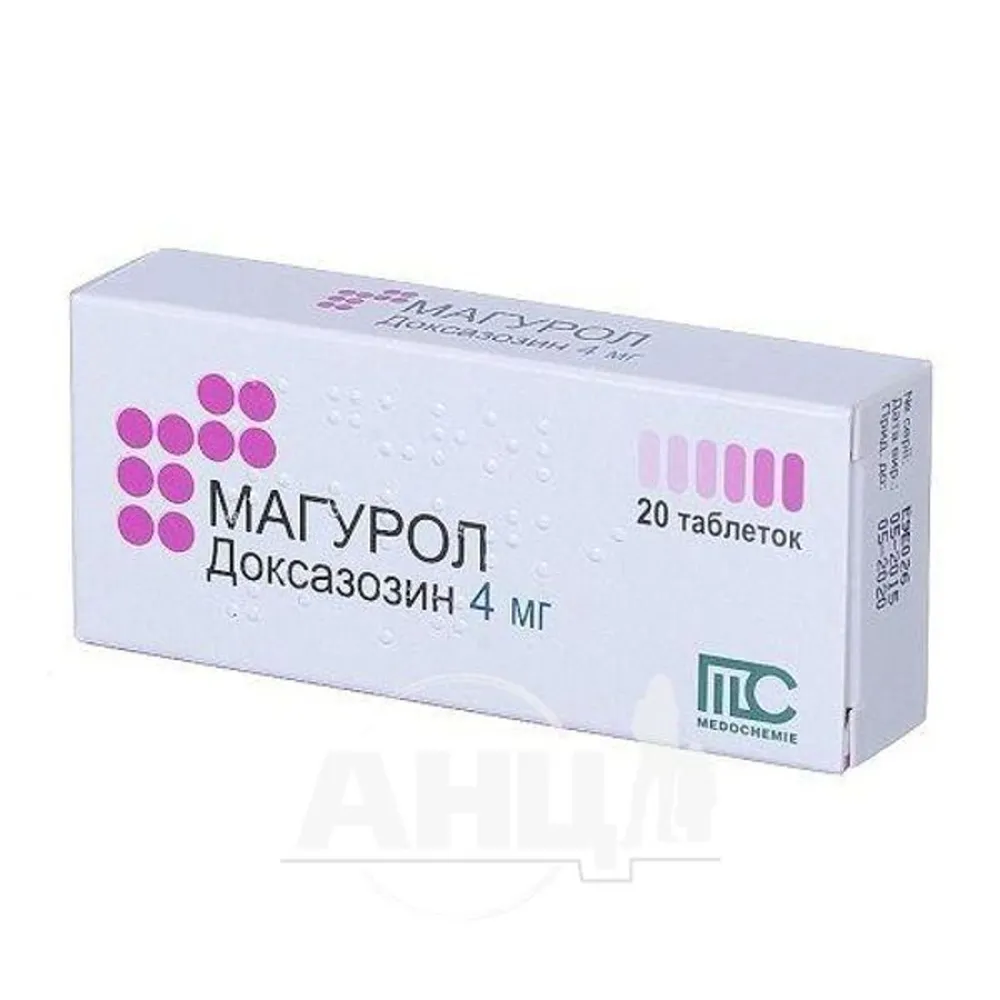
Table of Contents
INSTRUCTIONS FOR MEDICAL USE OF THE MEDICINAL PRODUCT MАGУROL (MAGUROL)
Composition:
Active substance: doxazosin;
1 tablet contains 4.86 mg of doxazosin mesylate equivalent to 4 mg of doxazosin;
Excipients: lactose monohydrate; microcrystalline cellulose, sodium starch glycolate (type A), magnesium stearate, sodium lauryl sulfate.
Pharmaceutical form. Tablets.
Main physicochemical properties: white or almost white, round, flat tablets with a score line, approximately 8.5 mm in diameter.
Pharmacotherapeutic group. Antihypertensive agents. Antiadrenergic agents with peripheral mechanism of action. α-Adrenoreceptor blockers. ATC code C02CA04.
Pharmacological properties.
Pharmacodynamics. Doxazosin is a potent and selective antagonist of postsynaptic α1-adrenoceptors. Blockade of these receptors leads to a reduction in systemic arterial pressure. The medicinal product Magurol is intended for oral administration once daily to patients with essential arterial hypertension.
It has been demonstrated that doxazosin does not cause undesirable metabolic effects and can be used in patients with diabetes mellitus, gout, or insulin resistance.
Doxazosin may also be prescribed to patients with bronchial asthma, left ventricular hypertrophy, and elderly patients. The use of the drug contributes to a reduction in left ventricular hypertrophy, inhibits platelet aggregation, and enhances the activity of tissue plasminogen activator. In addition, doxazosin treatment increases insulin sensitivity in patients with impaired insulin sensitivity.
Moreover, long-term studies have shown that, in addition to its antihypertensive effect, doxazosin use results in a moderate decrease in plasma concentrations of total cholesterol, low-density lipoproteins, and triglycerides. Therefore, this drug may be particularly beneficial for patients with arterial hypertension and hyperlipidemia.
The use of doxazosin in patients with symptomatic benign prostatic hyperplasia (BPH) leads to significant improvement in urodynamics and symptom reduction. The drug's effect in BPH is believed to be achieved through selective blockade of α1-adrenoceptors located in the smooth muscle stroma and capsule of the prostate gland, as well as in the bladder neck.
Pharmacokinetics.
Absorption. After oral administration in humans (young men or elderly individuals of either sex), doxazosin is rapidly absorbed, with a bioavailability of approximately two-thirds of the administered dose.
Biotransformation/elimination. Approximately 98% of doxazosin is bound to plasma proteins. Doxazosin has been shown to undergo extensive metabolism and is primarily eliminated via feces.
The mean elimination half-life of the drug from plasma is 22 hours, allowing for once-daily dosing.
After oral administration of doxazosin, plasma concentrations of metabolites are low. The plasma concentration of the most active metabolite,
6'-hydroxydoxazosin, is 40 times lower than the plasma concentration of the parent compound, indicating that the antihypertensive effect of the drug is primarily due to doxazosin itself.
Currently, data on the use of the drug in patients with impaired liver function and on the influence of agents capable of altering hepatic metabolism (e.g., cimetidine) are limited. In patients with moderate hepatic dysfunction, single-dose administration of doxazosin resulted in a 43% increase in AUC and a 40% decrease in apparent oral clearance. As with other drugs that are completely metabolized by the liver, doxazosin should be used with particular caution in patients showing signs of impaired liver function.
Clinical characteristics.
Indications.
Arterial hypertension.
The medicinal product is indicated for the treatment of arterial hypertension. For most patients, it can be used as monotherapy to control blood pressure. If monotherapy is ineffective in treating arterial hypertension, the medicinal product may be used in combination with thiazide diuretics, β-adrenergic blockers, calcium channel blockers, and angiotensin-converting enzyme inhibitors.
Benign prostatic hyperplasia (BPH).
The medicinal product is indicated for the treatment of urinary tract obstruction and symptoms associated with benign prostatic hyperplasia (BPH). The medicinal product may be prescribed to patients with BPH, both in the presence and absence of arterial hypertension.
Contraindications.
The use of this medicinal product is contraindicated in the following patient groups:
- Patients with hypersensitivity to quinazoline derivatives (e.g., prazosin, terazosin, doxazosin) or to any of the excipients of the medicinal product;
- Patients with a history of orthostatic hypotension;
- Patients with BPH and concomitant upper urinary tract obstruction, chronic urinary tract infections, or bladder stones;
- Patients with arterial hypotension (applies only to patients with BPH).
Doxazosin as monotherapy is contraindicated in patients with bladder distension or anuria, with or without progressive renal insufficiency.
Interaction with other medicinal products and other forms of interaction.
Phosphodiesterase-5 inhibitors (e.g., sildenafil, tadalafil, vardenafil)
Concomitant use of doxazosin with PDE-5 inhibitors may cause symptomatic arterial hypotension in some patients. Studies with extended-release formulations of doxazosin have not been conducted.
Doxazosin is highly bound to plasma proteins (98%). The drug does not affect the protein binding of digoxin, phenytoin, warfarin, or indomethacin.
No adverse interactions have been observed with concomitant use of doxazosin and thiazide diuretics, furosemide, β-adrenergic blockers, nonsteroidal anti-inflammatory drugs, antibiotics, oral hypoglycemic agents, uricosuric agents, or anticoagulants. However, formal studies investigating drug interactions are lacking.
In vitro studies indicate that doxazosin is a substrate of cytochrome P450 3A4 (CYP 3A4). Caution should be exercised when prescribing doxazosin concomitantly with strong inhibitors of CYP 3A4, such as clarithromycin, indinavir, itraconazole, ketoconazole, nefazodone, nelfinavir, ritonavir, saquinavir, telithromycin, or voriconazole (see section "Pharmacological properties").
Doxazosin potentiates the hypotensive effect of other α-adrenergic blockers as well as other antihypertensive agents.
Data are available showing that a single 1 mg dose of doxazosin administered on the first day of a four-day course of oral cimetidine (400 mg twice daily) resulted in a 10% increase in the mean AUC of doxazosin, without causing any statistically significant changes in the mean Cmax or mean T½ of doxazosin. This 10% increase in the mean AUC of doxazosin during cimetidine co-administration falls within the range of intersubject variability (27%) of mean AUC values for doxazosin compared to placebo.
Special precautions for use.
Orthostatic hypotension / syncope. Initiation of therapy. As with other α-adrenoreceptor blockers, orthostatic hypotension occurred in a very small percentage of patients receiving this drug, manifesting as dizziness and weakness or, less frequently, as loss of consciousness (syncope), particularly at the beginning of treatment. Therefore, blood pressure should be monitored at the start of therapy to minimize possible postural effects.
When prescribing therapy with any effective α-adrenoreceptor blocker, patients should be informed how to avoid symptoms of orthostatic hypotension and what actions to take if such symptoms occur. Patients should also be warned to avoid situations where there is a risk of injury due to possible dizziness or weakness at the beginning of treatment with the drug.
Use in acute cardiac conditions. As with other vasodilating antihypertensive agents, doxazosin should be used with caution in patients with the following acute cardiac conditions: pulmonary edema due to aortic or mitral stenosis; hyper-systolic heart failure; right ventricular heart failure caused by pulmonary artery thromboembolism or pericardial effusion; left ventricular heart failure with low filling pressure.
Use in hepatic impairment. As with other drugs that are completely metabolized by the liver, doxazosin should be administered with particular caution to patients with signs of hepatic dysfunction. Due to the lack of clinical experience with use in patients with severe hepatic insufficiency, administration of the drug to this patient group is not recommended.
Concomitant use with PDE-5 inhibitors. Doxazosin should be used with caution when administered together with phosphodiesterase-5 (PDE-5) inhibitors (e.g., sildenafil, tadalafil, vardenafil), since these medicinal products cause vasodilation and may therefore lead to symptomatic arterial hypotension in some patients. To reduce the risk of orthostatic hypotension, it is recommended to initiate therapy with PDE-5 inhibitors only if the patient has stable hemodynamics while receiving α-blockers. Additionally, it is recommended to initiate PDE-5 inhibitor therapy at the lowest possible dose and to maintain a 6-hour interval between administration of doxazosin and PDE-5 inhibitors. Studies with doxazosin in prolonged-release formulations have not been conducted.
Use in patients undergoing cataract surgery. In some patients who were taking tamsulosin at the time of cataract surgery or prior to surgery, intraoperative floppy iris syndrome (IFIS, a variant of small pupil syndrome) has been observed during the procedure. Isolated cases of this adverse effect have also been reported with other α1-blockers, so the possibility of this effect cannot be excluded for other drugs in this class. Since IFIS increases the frequency of procedural complications during surgery, ophthalmic surgeons should be informed whether the patient is currently taking or has previously taken α1-adrenoreceptor blockers prior to surgery.
Priapism. Cases of prolonged erection and priapism have been reported. If an erection lasts longer than 4 hours, the patient should seek immediate medical help. If priapism is not treated promptly, penile tissue damage may occur, which can lead to permanent loss of potency.
Screening for prostate cancer. Prostate carcinoma causes many of the symptoms associated with BPH, and these two conditions may coexist. Therefore, the presence of prostate carcinoma should be ruled out before initiating doxazosin therapy for BPH-related symptoms.
This medicinal product should not be used in patients with rare hereditary conditions such as galactose intolerance, lactase deficiency, or glucose-galactose malabsorption.
Use during pregnancy or breastfeeding.
Patients with arterial hypertension.
Pregnancy. Due to the lack of adequate and well-controlled studies on the use of the drug in pregnant women, the safety of doxazosin during pregnancy has not been established. Therefore, the drug should be used only when the potential benefits of treatment, in the physician’s judgment, outweigh the potential risks. Although data from animal studies indicate that the drug has no teratogenic effects, administration at very high doses—approximately 300 times the maximum recommended human dose—resulted in reduced fetal lifespan.
Breastfeeding. Doxazosin is contraindicated during breastfeeding, as animal studies have shown that doxazosin accumulates in the milk of lactating rats, and there are no data on the excretion of doxazosin into human milk during lactation. If doxazosin therapy is necessary, breastfeeding should be discontinued.
Patients with BPH.
The information in this section does not apply to patients with BPH.
Ability to affect reaction speed when driving or operating machinery.
The ability to drive or operate machinery may be impaired, especially at the beginning of treatment (see nervous system adverse reactions).
Dosage and Administration
The medicinal product can be taken either in the morning or in the evening.
Arterial Hypertension
The drug should be administered once daily. The initial dose is 1 mg to minimize the risk of orthostatic hypotension and/or syncope. After 1–2 weeks of initial therapy, the dose may be increased to 2 mg, and then, if necessary, to 4 mg. Most patients respond to treatment at a dose of 4 mg or lower. If needed, the dose may be further increased to 8 mg or up to the maximum recommended dose of 16 mg.
Benign Prostatic Hyperplasia (BPH)
The recommended initial dose of doxazosin is 1 mg once daily to minimize the risk of orthostatic hypotension and/or syncope. Depending on individual urodynamic characteristics and BPH symptoms, the dose may be increased to 2 mg, then to 4 mg, and up to the maximum recommended dose of 8 mg. The recommended dose titration interval is 1–2 weeks. The usual recommended dose is 2–4 mg daily.
Elderly Patients
Standard adult doses should be used.
Patients with Renal Impairment
Standard adult doses should be used, as the pharmacokinetic parameters of the drug are not altered in patients with renal impairment. The drug is not removed from the body by hemodialysis.
Patients with Hepatic Impairment
Currently, information regarding the use of the drug in patients with hepatic impairment and the influence of agents capable of altering hepatic metabolism (e.g., cimetidine) is limited. As with other drugs that are completely metabolized by the liver, doxazosin should be administered with caution to patients with signs of hepatic dysfunction.
When prescribing doxazosin at a dose of 1 mg, the appropriate dosage form or strength should be used.
Children
There is no experience with the use of the drug in children.
Overdose
If overdose leads to arterial hypotension, the patient should be immediately placed in a supine position with the head lowered. In individual cases, other symptomatic measures may be applied.
If symptomatic measures are insufficient, plasma expanders should be primarily used to treat shock. If necessary, vasoconstrictor agents should then be administered. Renal function should be monitored, and supportive measures applied as needed.
Hemodialysis is not indicated, as doxazosin is highly bound to plasma proteins.
Adverse reactions.
Infections and infestations: respiratory tract infections, urinary tract infections.
Blood and lymphatic system disorders: leucopenia, thrombocytopenia.
Immune system disorders: allergic reactions.
Metabolism and nutrition disorders: gout, increased appetite, loss of appetite.
Psychiatric disorders: agitation, depression, anxiety, insomnia, nervousness.
Nervous system disorders: somnolence, dizziness, headache, stroke, hypesthesia, syncope, tremor, orthostatic dizziness, paraesthesia.
Eye disorders: blurred vision, intraoperative floppy iris syndrome.
Ear and labyrinth disorders: vertigo, tinnitus.
Cardiac disorders: palpitations, tachycardia, angina pectoris, myocardial infarction, bradycardia, cardiac arrhythmias.
Vascular disorders: hypotension, orthostatic hypotension, flushing.
Respiratory, thoracic and mediastinal disorders: bronchitis, cough, dyspnoea, rhinitis, epistaxis, exacerbation of existing bronchospasm.
Gastrointestinal disorders: abdominal pain, dyspepsia, dry mouth, nausea, constipation, flatulence, vomiting, gastroenteritis, diarrhoea.
Hepatobiliary disorders: liver function test abnormalities, cholestasis, hepatitis, jaundice.
Skin and subcutaneous tissue disorders: pruritus, rash, urticaria, alopecia, purpura.
Musculoskeletal and connective tissue disorders: back pain, myalgia, arthralgia, muscle spasms, muscle weakness.
Renal and urinary disorders: cystitis, urinary incontinence, dysuria, urinary frequency, haematuria, polyuria, increased diuresis, urinary disorders, nocturia.
Reproductive system and breast disorders: impotence, gynaecomastia, priapism, retrograde ejaculation.
General disorders and administration site conditions: asthenia, chest pain, influenza-like illness, peripheral oedema, body pain, facial swelling, increased fatigue, malaise.
Investigations: weight gain.
Reporting of suspected adverse reactions.
Reporting suspected adverse reactions after medicine authorization is important. It allows continued monitoring of the benefit-risk balance of the medicinal product. Healthcare professionals are required to report any suspected adverse reactions via the pharmacovigilance system of Ukraine.
Shelf life. 5 years.
Storage conditions. Store at a temperature not exceeding 25 °C in the original packaging, in a place inaccessible to children.
Packaging. 10 tablets in a blister; 2 blisters in a cardboard box.
Prescription category. Prescription only.
Manufacturer. Medocemique LTD (Central Factory) / Medochemie LTD (Central Factory).
Manufacturer's address and place of business.
1-10 Constantinoupoleos Street, Limassol, 3011, Cyprus / 1-10 vulytsia Konstantynupoles, Lymasol, 3011, Kypr.