Magne-b6® antistress
Ukraine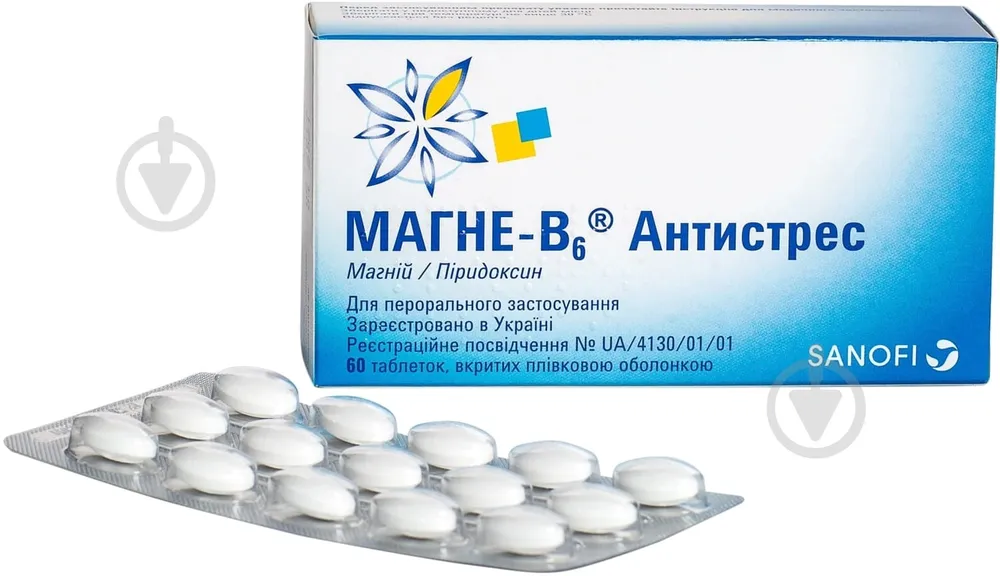
Table of Contents
INSTRUCTION FOR MEDICAL USE OF THE MEDICINAL PRODUCT MАГНЕ-B6® Antistress (MAGNE-B6® Antistress)
Composition:
Active substances: magnesium, pyridoxine;
One tablet contains anhydrous magnesium citrate 618.43 mg (equivalent to 100 mg of magnesium) and pyridoxine hydrochloride (vitamin B6) 10 mg;
Excipients: anhydrous lactose, macrogol 6000, magnesium stearate;
Coating: hypromellose, macrogol 6000, titanium dioxide (E 171), talc.
Pharmaceutical form. Film-coated tablets.
Main physicochemical properties: white, oval film-coated tablets.
Pharmacotherapeutic group. Complex of B-group vitamins with minerals.
ATC code A11E C.
Pharmacological properties.
Pharmacodynamics.
Magnesium is a cation predominantly located intracellularly. Magnesium reduces neuronal excitability and neuromuscular transmission, and participates in numerous enzymatic processes.
Magnesium is an essential component of body tissues: skeletal bone contains half of the total magnesium content in the body.
A serum magnesium concentration of 12 to 17 mg/L (1–1.4 mEq/L, or 0.5–0.7 mmol/L) indicates moderate magnesium deficiency; below 12 mg/L (1 mEq/L, or 0.5 mmol/L) indicates severe magnesium deficiency.
Magnesium deficiency may be:
- primary, due to metabolic disorders (chronic congenital hypomagnesemia);
- secondary, due to:
- inadequate dietary magnesium intake (severe malnutrition, chronic alcohol abuse, exclusive parenteral nutrition);
- impaired intestinal absorption of magnesium (chronic diarrhea, gastrointestinal fistulas, hypoparathyroidism);
- excessive renal magnesium losses (tubular disorders, severe polyuria, diuretic abuse, chronic pyelonephritis, primary hyperaldosteronism, cisplatin therapy).
Pyridoxine, a coenzyme factor, participates in most metabolic processes.
Pharmacokinetics.
A portion of magnesium salts is passively absorbed in the intestine. The degree of absorption depends on the solubility of the salt. Gastrointestinal absorption of magnesium salts does not exceed 50%. Magnesium is primarily excreted in the urine.
In the body, pyridoxine undergoes oxidation to pyridoxal or amination to pyridoxamine. Subsequent phosphorylation results in the formation of pyridoxal phosphate. This form of pyridoxine is metabolically active.
Clinical characteristics.
Indications.
Symptomatic treatment of magnesium deficiency in the body.
This medicinal product contains magnesium.
A combination of the following symptoms may indicate magnesium deficiency:
- increased excitability, irritability, anxiety, transient weakness, mild sleep disturbances;
- signs of anxiety such as gastrointestinal spasms or increased heart rate (in the absence of heart disease);
- muscle cramps, tingling sensations.
Administration of magnesium may help reduce or eliminate these symptoms.
If symptoms do not improve after one month of treatment, continued therapy is not recommended.
Contraindications.
Hypersensitivity to the active substances or to any of the excipients listed in the section "Composition". Severe renal insufficiency (creatinine clearance < 30 ml/min). Children under 6 years of age. Phenylketonuria. Hypermagnesemia, vitamin B6 hypervitaminosis, myasthenia gravis. Atrioventricular block, severe arterial hypotension. Concomitant use with levodopa (see section "Interaction with other medicinal products and other forms of interactions"). Diarrhea.
Interaction with other medicinal products and other forms of interactions.
Levodopa.
This medicinal product is contraindicated in patients receiving levodopa as monotherapy (e.g., without inhibitors of peripheral dopa-decarboxylase (DDC)), since pyridoxine reduces or inhibits the activity of levodopa.
Phosphate or calcium salts.
Medicinal products containing phosphate or calcium salts impair magnesium absorption from the intestine.
Tetracyclines.
Oral tetracyclines and Magné-B6® Anti-stress should be taken at an interval of at least 3 hours, as magnesium inhibits the absorption of tetracyclines.
Quinolones.
Quinolones should be taken at least two hours before or six hours after taking magnesium-containing preparations to avoid impaired absorption of magnesium.
Combinations to be considered.
Magnesium preparations reduce the effect of oral anticoagulants and decrease iron absorption.
Diuretics increase magnesium excretion in urine.
Use of hydralazine, isoniazid, penicillamine, and oral contraceptives increases the requirement for vitamin B6.
Special precautions for use.
This medicinal product contains lactose. Therefore, it is not recommended for use in patients with galactose intolerance, Lapp lactase deficiency, or glucose-galactose malabsorption (rare hereditary conditions).
Pyridoxine-related effects: Sensory neuropathy may occur during prolonged use of pyridoxine and/or chronic intake of high doses of pyridoxine over a long period of time (see section "Overdose").
Patients with moderate renal insufficiency should take precautionary measures to prevent any risks associated with hypermagnesemia.
If there is no improvement after one month of treatment, the drug should be discontinued.
In cases of concomitant calcium deficiency, magnesium deficiency should first be corrected before addressing calcium deficiency.
Precautions for use
This medicinal product is intended only for adults and children aged 6 years and older.
For children under 6 years of age, appropriate dosage forms are available.
Use during pregnancy or breastfeeding.
Pregnancy. Sufficient clinical data on the use of the drug in pregnant women have not revealed any fetotoxic or embryotoxic effects. Magnesium may be used during pregnancy only if necessary and after consultation with a physician. If needed, magnesium may be administered at any stage of pregnancy. Despite the lack of sufficient animal study data, the limited clinical evidence available is considered satisfactory.
Breastfeeding period. Each of the active ingredients of the drug separately (both magnesium and vitamin B6) is not contraindicated during this period. Due to limited evidence currently available regarding the use of the maximum recommended daily dose of vitamin B6 during breastfeeding, it is recommended to administer no more than 20 mg/day of vitamin B6.
Effect on the ability to drive vehicles or operate machinery.
Magne-B6® Anti-Stress, film-coated tablets, have no effect or only negligible effect on the ability to drive vehicles or operate machinery.
Method of Administration and Dosage
The tablets should be swallowed whole with a glass of water.
For adult patients: 3–4 tablets per day in 2 or 3 divided doses taken during meals.
For children aged 6 years and older (with body weight approximately from 20 kg): 10–30 mg/kg body weight per day (0.4–1.2 mmol/kg body weight per day), or 2–4 tablets per day, in 2 or 3 divided doses taken during meals. The usual duration of treatment is one month.
Children
The drug is indicated for children aged 6 years and older. Appropriate dosage forms are available for children under 6 years of age.
Overdose
Magnesium-related
Oral magnesium overdose usually does not cause toxic reactions in patients with normal renal function. However, in patients with renal insufficiency, magnesium intoxication may develop.
Prolonged use of the drug at high doses may lead to sensory neuropathy, which may manifest as numbness, impaired position and vibration sense in the lower limbs, and progression of sensory ataxia (coordination disorder).
Symptoms of overdose depend on the serum magnesium concentration and may include:
- Decreased arterial blood pressure;
- Nausea, vomiting;
- Central nervous system (CNS) depression, diminished reflexes;
- ECG abnormalities;
- Respiratory depression, coma, cardiac arrest, and paralysis of respiratory muscles;
- Anuria.
Treatment of overdose: Rehydration, forced diuresis. In cases of renal insufficiency, hemodialysis or peritoneal dialysis is required.
Pyridoxine-related
Sensory axonal neuropathy is the main adverse effect that may occur during prolonged and/or chronic use of high-dose pyridoxine (over several months or years).
Signs and symptoms
Cases have been reported of paresthesia, dysesthesia, hypoesthesia, sensory deficits, limb pain, involuntary muscle contractions, burning sensations, impaired balance, gait disturbances, hand and foot tremors, and progressive sensory ataxia (difficulty with motor coordination).
Treatment
Neurological symptoms gradually resolve after discontinuation of the drug.
Side effects.
The side effects that may occur during the use of the medicinal product Magne-B6® Anti-Stress are listed below by system organ class and frequency of occurrence: very common (≥ 1/10); common (≥ 1/100, < 1/10); uncommon (≥ 1/1,000, < 1/100); rare (≥ 1/10,000, < 1/1,000); very rare (< 1/10,000); frequency not known (cannot be estimated from the available data).
Immune system disorders.
Frequency not known: allergic reactions, hypersensitivity, angioneurotic edema.
Gastrointestinal disorders.
Frequency not known: diarrhea*, abdominal pain*, loose stools, nausea, vomiting.
Skin and subcutaneous tissue disorders.
Frequency not known: skin reactions, including urticaria, pruritus, eczema, erythema.
*Side effects associated with magnesium.
Reporting of suspected adverse reactions
Reporting of suspected adverse reactions after registration of the medicinal product is important. It allows continued monitoring of the benefit-risk balance of the medicinal product. Medical and pharmaceutical professionals, as well as patients or their legal representatives, should report any suspected adverse reactions and lack of efficacy via the Automated Pharmacovigilance Information System at the following link: https://aisf.dec.gov.ua.
Shelf life. 2 years.
Storage conditions. Keep out of the reach of children. Store at a temperature not exceeding 25 °C.
Packaging. № 60 (20 × 3): 20 tablets in a blister; 3 blisters in a cardboard box.
№ 100 (20 × 5): 20 tablets in a blister; 5 blisters in a cardboard box.
Availability category. Over-the-counter.
Manufacturers.
OPHEA HEALTHCARE INTERNATIONAL SAS.
Opella Healthcare Hungary Kft.
Manufacturers' locations and addresses of business operations.
56 rue de Chantilly, Compiègne, 60200, France.
Lévai utca 5, Veresegyháza, 2112, Hungary.
Marketing Authorization Holder. LLC "Opella Healthcare Ukraine", Ukraine.