Lorinden® a
Ukraine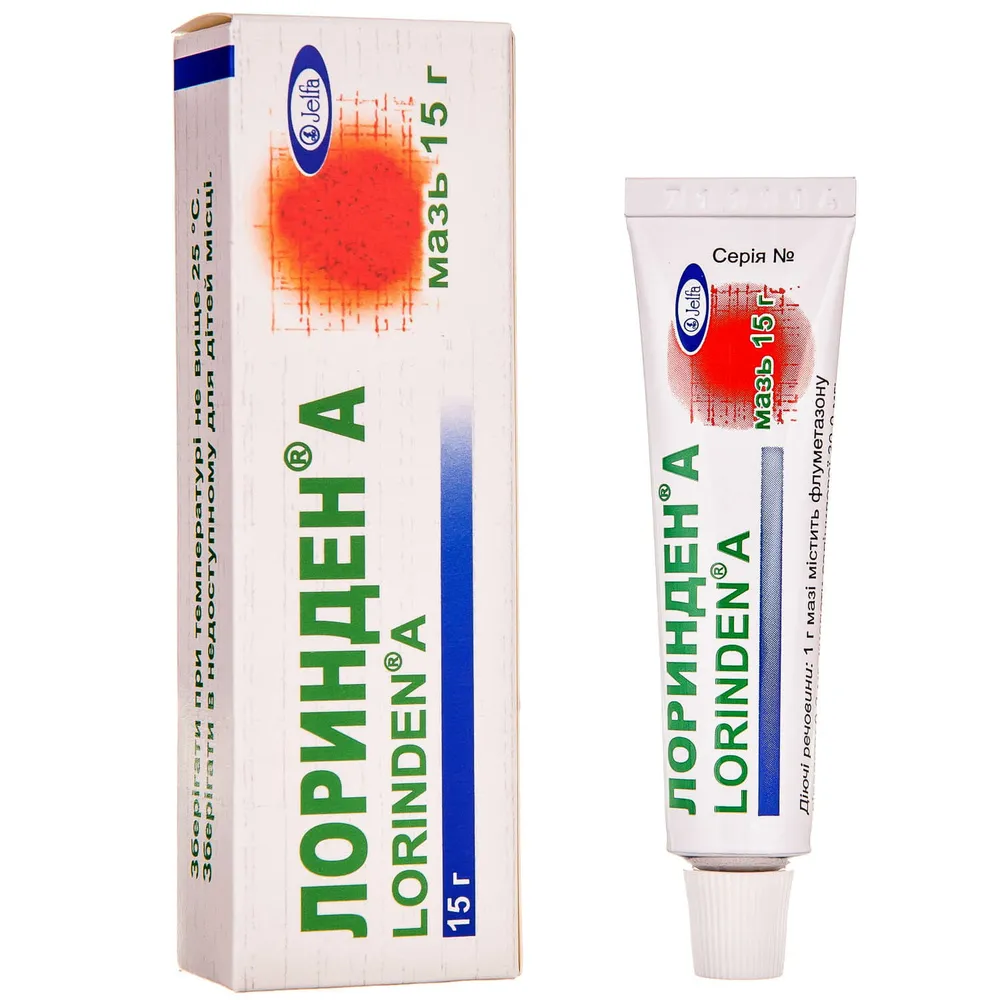
Table of Contents
I N S T R U C T I O N for medical use of the medicinal product LORINDEN® A (LORINDEN® A)
Composition:
Active substances: flumethasoni pivalas; acidum salicylicum;
1 g of ointment contains flumethasone pivalate – 0.2 mg, salicylic acid – 30.0 mg;
Excipients: propylene glycol, lanolin, white soft paraffin.
Pharmaceutical form. Ointment.
Main physicochemical properties: greasy soft mass of white color with a light-yellow tint.
Pharmacotherapeutic group.
Corticosteroids in combination with antiseptic for dermatological use.
ATC code D07BB01.
Pharmacological properties.
Pharmacodynamics.
The properties of Lorinden® A ointment are due to the combined action of flumetasone pivalate and salicylic acid.
Flumetasone pivalate is a synthetic glucocorticosteroid with moderate anti-inflammatory activity. When applied as an ointment, it exerts a locally-acting effect of medium intensity. It is lipophilic, readily penetrates the stratum corneum of the skin, and produces prolonged anti-inflammatory, antipruritic, and antiallergic effects. When applied topically, flumetasone pivalate inhibits the formation of prostaglandins and leukotrienes in the skin by suppressing phospholipase A2 activity and reducing the release of arachidonic acid from membrane phospholipids. It suppresses phagocytosis and the release of interleukins and other cytokines involved in inflammatory processes. It inhibits histamine release and the development of local allergic reactions, and reduces proliferative processes. Due to its local vasoconstrictive effect, it diminishes exudative reactions. It also reduces protein synthesis and collagen deposition.
Salicylic acid, at the concentration present in the formulation, exerts a mild keratolytic effect.
Pharmacokinetics.
Flumetasone pivalate readily penetrates into the stratum corneum of the skin, where it accumulates. It is not metabolized in the skin. In small amounts, it may be absorbed into the systemic circulation following topical application, potentially producing systemic effects. After penetration through the skin, the drug is primarily metabolized in the liver and excreted in the urine and, to a minor extent, in bile, mainly as glucuronide conjugates and unchanged. Absorption of flumetasone pivalate is increased when applied to thin skin areas such as skin folds or the face, to skin with impaired epidermis, or to skin affected by inflammatory processes. The use of occlusive dressings, which increases skin temperature and moisture, also enhances absorption of flumetasone pivalate. Furthermore, absorption increases with frequent application or application over large skin areas. Skin absorption is more intense in younger individuals compared to elderly patients.
Topical application of salicylic acid facilitates the penetration of flumetasone pivalate through the keratinized epidermis.
Clinical characteristics.
Indications.
Inflammatory skin conditions (without exudation), not complicated by bacterial infection, including those of allergic origin, accompanied by persistent pruritus and hyperkeratosis: seborrheic dermatitis, atopic dermatitis, nodular urticaria (papular urticaria), allergic contact dermatitis, erythema multiforme, lupus erythematosus, psoriasis, lichen planus.
Contraindications.
Hypersensitivity to glucocorticosteroids, salicylic acid, or to any of the components of the ointment.
Viral (e.g., herpes skin lesions) and fungal skin infections, cutaneous tuberculosis, skin neoplasms, acne vulgaris and acne rosacea, perioral and diaper dermatitis, perianal pruritus, inflammation or ulceration of varicose veins.
Do not apply over large areas of skin, especially when skin integrity is impaired, such as in burns.
Interaction with other medicinal products and other forms of interaction.
No interactions with other medicinal products have been reported with topical application of glucocorticosteroids.
Vaccination against smallpox and other forms of immunization should be avoided during treatment, particularly during prolonged use over large skin areas, due to the possibility of inadequate immune response.
Only during prolonged application over large skin areas, as a result of significant absorption of salicylic acid, enhanced effects of methotrexate and oral hypoglycemic agents (sulfonylurea derivatives) may occur. «Lorinden® A» may potentiate the action of immunosuppressive agents and suppress the effect of immunostimulatory agents.
Special precautions for use
Do not use continuously for more than 2 weeks. With prolonged use over large areas of skin, the frequency of adverse effects increases.
The medication should be discontinued immediately if it causes pain or allergic reactions (such as itching, burning, or redness of the skin).
When flumetasone pivalate is used topically, secretion of adrenocorticotropic hormone (ACTH) by the pituitary gland may decrease due to suppression of the hypothalamic-pituitary-adrenal axis, resulting in reduced blood cortisol levels and the potential development of iatrogenic Cushing's syndrome, which resolves after discontinuation of treatment. During treatment, periodic monitoring of adrenal gland function should be performed by measuring cortisol levels in blood and urine following adrenal stimulation with ACTH. If an infection develops at the site of ointment application, antibacterial or antifungal therapy should be administered. If the infectious process does not regress, the ointment should be discontinued until the infection is resolved.
Avoid applying the medication to the eyelids or periorbital skin in patients with narrow-angle or wide-angle glaucoma, as well as in patients with cataracts, due to the possibility of worsening symptoms.
Visual disturbances may occur during treatment with systemic and topical corticosteroids.
If symptoms such as blurred vision or other visual disturbances occur, patients should consult an ophthalmologist to determine possible causes, which may include cataract, glaucoma, or rare conditions such as central serous chorioretinopathy, which has been reported with the use of systemic and topical corticosteroids.
Avoid contact of the medication with eyes and mucous membranes.
Use on the facial skin, groin, and axillary areas only when absolutely necessary, as increased absorption and the development of adverse effects (e.g., telangiectasia, perioral dermatitis) are possible even after short-term use.
The use of the ointment under occlusive dressings should be limited to exceptional cases due to the risk of epidermal atrophy, skin defects, and superinfection.
Use with caution in patients with subcutaneous tissue atrophy, particularly in elderly individuals.
In the treatment of chronic conditions such as psoriasis or chronic eczema, the medication should not be discontinued abruptly.
Use with caution in patients with psoriasis, as topical application of glucocorticosteroids may lead to disease relapses due to the development of tolerance, generalized pustular psoriasis, or systemic toxicity resulting from skin dysfunction.
The product contains propylene glycol and lanolin, which may cause skin irritation and local skin reactions (e.g., contact dermatitis).
Use during pregnancy or breastfeeding
Animal studies have confirmed that glucocorticosteroids have teratogenic effects when even small doses are administered systemically. Teratogenic effects have also been demonstrated with topical application of potent glucocorticosteroids. Controlled studies on the potential teratogenic effects of topical flumetasone pivalate in pregnant women have not been conducted.
Lorinden® A ointment may be used in pregnant women only for short periods, on small areas of skin, and only when, in the physician’s opinion, the benefit outweighs the potential risk. The medication should not be used during the first trimester of pregnancy.
The extent of flumetasone pivalate penetration into breast milk following topical application is unknown. After oral administration of glucocorticosteroids, significant amounts of these hormones affecting the newborn have not been detected in breast milk. Nevertheless, Lorinden® A ointment should be used with caution and under medical supervision in breastfeeding women. In individual cases, short-term use on small skin areas may be considered. Do not apply Lorinden® A ointment to the skin of the breasts.
Effect on the ability to drive or operate machinery
The medication does not impair mental or motor functions or the ability to drive vehicles or operate machinery.
Dosage and Administration.
The product is intended for topical use. Apply the ointment as a thin layer to the affected skin area 1–2 times daily. Use under an occlusive dressing is permitted. Treatment should not be continued continuously for more than 2 weeks. Use on facial skin should not exceed 1 week. During one week, no more than one tube should be used.
In cases of marked lichenification or excessive hyperkeratosis, an occlusive dressing may be used, which should be changed every 24 hours.
Children.
The medicinal product must not be used in children under 12 years of age. In children aged 12 years and older, the ointment may be used in individual cases on small areas of skin. The product must not be applied to facial skin.
Overdose.
With prolonged use over large skin areas, symptoms of overdose may occur, manifested by an intensification of adverse effects (edema, burning sensation, irritation, pruritus, arterial hypertension, hyperglycemia, increased susceptibility to infections, hypothalamic-pituitary-adrenal axis dysfunction, growth and developmental suppression in children), and in severe cases, Cushing's syndrome may develop. The drug should be discontinued gradually and in a timely manner, or weak-acting glucocorticoids should be used. Rarely, salicylate poisoning symptoms may occur: headache, dizziness, tinnitus, and very rarely, disturbances in acid-base balance or decreased visual acuity. Treatment is symptomatic.
Adverse Reactions
Skin and subcutaneous tissue disorders: rash, skin peeling, acne, post-steroidal purpura, epidermal growth suppression, subcutaneous tissue atrophy, dry skin, burning sensation, irritation, itching, excessive hair growth or alopecia, skin discoloration or hyperpigmentation, skin atrophy and impaired skin integrity, telangiectasias, contact and perioral dermatitis, folliculitis, secondary infections. In isolated cases: urticaria, maculopapular rash, or exacerbation of existing symptoms may occur.
Eye disorders: when applied externally to the skin of the eyelids, cataract or glaucoma may occasionally develop.
Visual blurring is possible.
Cardiovascular system: arterial hypertension.
Endocrine system: glucosuria, hyperglycemia, hypothalamic-pituitary-adrenal (HPA) axis dysfunction, Cushing's syndrome, growth and developmental suppression in children.
Other: use of the ointment under occlusive dressing, due to increased absorption, may lead to systemic effects manifested as edema, arterial hypertension, and increased susceptibility to infections.
Hypersensitivity reactions may occur in individuals with known hypersensitivity to any component of the medicinal product.
Shelf life.
3 years.
Storage conditions. Store at a temperature not exceeding 25 °C. Keep out of reach of children.
Packaging. 15 g in a tube; 1 tube per carton.
Prescription status. Prescription only.
Manufacturer. Jelfa Pharmaceutical Plant A.T.
Manufacturer's address and place of business.
58-500 Jelenia Góra, ul. Wincentego Póła 21, Poland.