Loratadine
Ukraine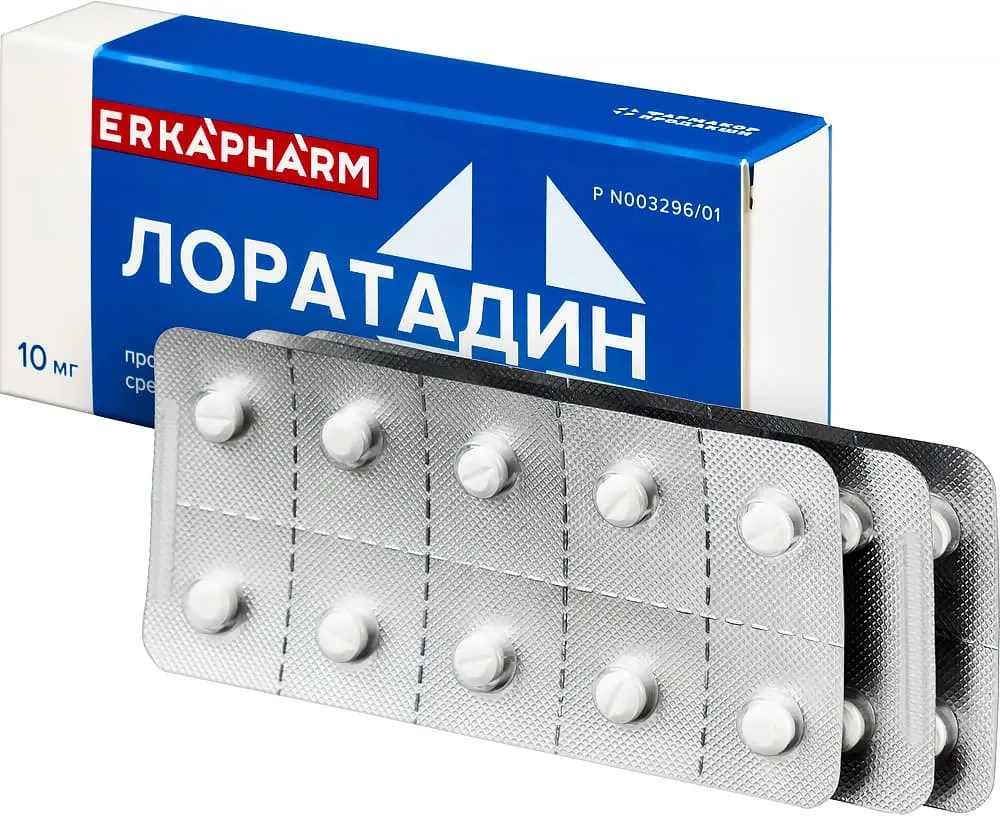
Table of Contents
INSTRUCTION FOR MEDICAL USE OF THE MEDICINAL PRODUCT LORATADINE (LORATADINE)
Composition:
Active substance: loratadine;
1 tablet contains loratadine (calculated as 100 % substance) 10 mg;
Excipients: lactose monohydrate; povidone; potato starch; magnesium stearate.
Pharmaceutical form. Tablets.
Main physico-chemical properties: white-colored, flat cylindrical tablets with beveled edges, with a score line on one side.
Pharmacotherapeutic group.
Antihistamines for systemic use. ATC code R06AX13.
Pharmacological Properties
Pharmacodynamics
Loratadine is a tricyclic selective peripheral H1-histamine receptor blocker. At the recommended dose, it does not produce clinically significant sedative or anticholinergic effects. During prolonged treatment, no clinically significant changes in vital function parameters, laboratory test results, physical examination findings, or electrocardiograms have been observed. Loratadine has no significant effect on H2-histamine receptor activity. It does not inhibit norepinephrine uptake and has virtually no effect on the cardiovascular system or pacemaker activity.
Skin tests with histamine after a single 10 mg dose showed that the antihistamine effect begins within 1–3 hours, reaches its peak within 8–12 hours, and lasts more than 24 hours. No development of tolerance to the drug's effect was observed after 28 days of loratadine use.
Clinical Efficacy and Safety
More than 10,000 individuals (aged 12 years and older) received loratadine treatment (10 mg tablets) in controlled clinical trials. Loratadine (tablets) at a dose of 10 mg once daily was more effective than placebo and as effective as clemastine in improving symptoms (nasal and non-nasal) of allergic rhinitis. In these studies, somnolence occurred less frequently with loratadine than with clemastine, and occurred at approximately the same frequency as with terfenadine and placebo.
Among participants in these studies (aged 12 years and older), 1,000 patients with chronic idiopathic urticaria were enrolled in placebo-controlled trials. Loratadine at a dose of 10 mg once daily was more effective than placebo in treating chronic idiopathic urticaria, as demonstrated by reduction in itching, erythema, and allergic rash. In these studies, the incidence of somnolence was similar with loratadine and placebo.
Pediatric Population
Approximately 200 children (aged 6 to 12 years) with seasonal allergic rhinitis received loratadine (syrup) at doses up to 10 mg once daily in controlled clinical trials. In another study, 60 children (aged 2 to 5 years) received loratadine (syrup) at a dose of 5 mg once daily. No unexpected adverse reactions were observed.
Efficacy in children was similar to that in adults.
Pharmacokinetics
Absorption. Loratadine is rapidly and extensively absorbed. Administration with food may slightly delay absorption of loratadine, but this does not affect the clinical effect. The bioavailability parameters of loratadine and its active metabolite are dose-proportional.
Distribution. Loratadine is highly bound (97% to 99%) to plasma proteins, while its active metabolite is moderately bound (73% to 76%).
In healthy volunteers, the plasma half-life of loratadine and its active metabolite is approximately 1 hour and 2 hours, respectively.
Biotransformation. After oral administration, loratadine is rapidly and well absorbed and undergoes extensive first-pass metabolism in the liver, primarily via CYP3A4 and CYP2D6. The main metabolite, desloratadine, is pharmacologically active and largely responsible for the clinical effect. Loratadine and desloratadine reach maximum plasma concentration (Tmax) at 1–1.5 hours and 1.5–3.7 hours, respectively, after administration.
Elimination. Approximately 40% of the dose is excreted in urine and 42% in feces over 10 days, primarily as conjugated metabolites. About 27% of the dose is excreted in urine within the first 24 hours. Less than 1% of the active substance is excreted unchanged in active form—either as loratadine or desloratadine.
In healthy adult volunteers, the mean elimination half-life of loratadine was 8.4 hours (range: 3 to 20 hours), and that of the main active metabolite was 28 hours (range: 8.8 to 92 hours).
Renal Impairment. In patients with chronic renal impairment, AUC and maximum plasma concentration (Cmax) of loratadine and its active metabolite are increased compared to patients with normal renal function. The mean elimination half-life of loratadine and its active metabolite does not differ significantly from that in healthy volunteers. Hemodialysis does not affect the pharmacokinetics of loratadine and its active metabolite in patients with chronic hepatic impairment.
Hepatic Impairment. In patients with chronic alcoholic liver disease, AUC and Cmax of loratadine were twice as high, while corresponding values for the active metabolite did not change significantly compared to patients with normal liver function. The elimination half-life of loratadine and its active metabolite is 24 and 37 hours, respectively, and increases depending on the severity of liver disease.
Geriatric Patients. Pharmacokinetic parameters of loratadine and its active metabolite were similar in healthy adult volunteers and healthy elderly volunteers.
Clinical characteristics.
Indications.
Symptomatic treatment of allergic rhinitis and chronic idiopathic urticaria.
Contraindications.
Hypersensitivity to the active substance or to any of the other components of the medicinal product.
Interaction with other medicinal products and other forms of interaction.
Cimetidine, erythromycin, and ketoconazole increase the plasma concentration of loratadine; however, this increase has no clinical manifestation, including on electrocardiogram findings.
Concomitant use with CYP3A4 or CYP2D6 inhibitors may lead to increased loratadine levels, which in turn may enhance adverse effects.
Loratadine does not potentiate the depressant effect of alcohol on psychomotor performance.
Children. Interaction studies with other medicinal products have been conducted only in adult patients.
Special precautions for use.
Loratadine should be used with caution in patients with severe hepatic impairment.
Administration of loratadine should be discontinued at least 48 hours before skin testing, since antihistamines may suppress or otherwise interfere with the positive skin reaction used to determine skin reactivity index.
The product contains lactose and therefore should not be administered to patients with rare hereditary forms of galactose intolerance, lactase deficiency, or glucose-galactose malabsorption syndrome.
Use during pregnancy or breastfeeding.
Pregnancy. A substantial amount of data from use during pregnancy (over 1000 outcomes) indicates that loratadine does not cause developmental malformations and is non-toxic to the fetus and newborn. Animal studies have not revealed any direct or indirect adverse effects related to reproductive toxicity. However, as a precautionary measure, it is advisable to avoid using loratadine during pregnancy.
Breastfeeding. Physicochemical data indicate excretion of loratadine/metabolites into breast milk. Since a risk to the infant cannot be excluded, loratadine should not be used during breastfeeding.
Fertility. There are no data available regarding the effect of the medicinal product on male or female fertility.
Ability to affect reaction speed when driving or operating machinery.
There has been no reported effect of the drug on the patient's reaction speed while driving or operating machinery. However, patients should be informed about the very rare occurrence of drowsiness or dizziness, which may affect the ability to drive or operate machinery.
Dosage and Administration
Administer orally. Tablets can be taken regardless of food intake.
Adults and children aged 12 years and older: 10 mg (1 tablet) once daily.
For children aged 2 to 12 years, dosage is based on body weight. Children with body weight above 30 kg: 10 mg (1 tablet) once daily. Children with body weight below 30 kg: loratadine should be administered in an appropriate dosage form (syrup).
Patients with hepatic impairment.
In patients with severe hepatic impairment, a lower initial dose should be prescribed due to possible reduced loratadine clearance. For adults and children with body weight above 30 kg, the recommended initial dose is 10 mg every other day.
Patients with renal impairment.
Dosage adjustment is not required in patients with renal impairment.
Elderly patients.
Dosage adjustment is not required in elderly patients.
Children.
The efficacy and safety of the drug in children under 2 years of age have not been established.
Loratadine tablets are indicated for children with body weight above 30 kg; for children aged 2 to 12 years with body weight below 30 kg, loratadine should be administered in an appropriate dosage form (syrup).
Overdose.
Overdose of loratadine increases the frequency of anticholinergic symptoms. Overdose has been reported to cause somnolence, tachycardia, and headache.
Treatment. In case of overdose, symptomatic and supportive treatment is recommended for the necessary duration. Administration of activated charcoal as an aqueous suspension may be considered. Gastric lavage may also be performed. Loratadine is not effectively removed by hemodialysis; the efficacy of peritoneal dialysis in eliminating the drug is unknown. After emergency treatment, the patient should remain under medical supervision.
Adverse Reactions
Short description of the safety profile. In clinical studies involving adults and adolescents receiving loratadine at the recommended dose of 10 mg once daily for indications including allergic rhinitis and chronic idiopathic urticaria, adverse reactions were reported in 2% of patients (exceeding the rate in patients receiving placebo). The most common adverse reactions reported more frequently than with placebo were: somnolence (1.2%), headache (0.6%), increased appetite (0.5%), and insomnia (0.1%). In clinical studies in children aged 2 to 12 years, the following adverse events were observed: headache (2.7%), nervousness (2.3%), and fatigue (1.0%).
List of adverse reactions. Adverse reactions reported during the post-marketing period are listed below by system organ classes. Frequency is defined as: very common (≥ 1/10), common (≥ 1/100 to < 1/10), uncommon (≥ 1/1000 to < 1/100), rare (≥ 1/10,000 to < 1/1000), very rare (< 1/10,000), frequency not known (cannot be estimated from the available data).
Within each frequency group, adverse reactions are listed in order of decreasing severity.
| Organ system class |
Frequency |
Adverse reactions |
| Immune system |
Rare |
Hypersensitivity reactions (including anaphylaxis, angioedema) |
| Nervous system |
Rare |
Dizziness, convulsions |
| Cardiovascular system |
Rare |
Tachycardia, palpitations |
| Gastrointestinal tract |
Rare |
Nausea, dry mouth, gastritis |
| Hepatobiliary system |
Rare |
Liver function abnormalities |
| Skin and subcutaneous tissue |
Rare |
Rash, alopecia |
| General disorders |
Rare |
Increased fatigue |
| Results of laboratory and other investigations |
Frequency unknown |
Weight gain |
Reporting of suspected adverse reactions
Reporting of adverse reactions after the medicinal product has been registered is of great importance. It allows continuous monitoring of the benefit-risk balance of the medicinal product. Medical and pharmaceutical professionals, as well as patients or their legal representatives, should report all cases of suspected adverse reactions and lack of efficacy of the medicinal product through the Automated Pharmacovigilance Information System at the following link: https://aisf.dec.gov.ua.
Shelf life. 3 years.
Storage conditions.
Store in the original packaging at a temperature not exceeding 25 °C.
Keep out of reach of children.
Packaging.
10 tablets per blister; 1, 2, 9, or 10 blisters per carton.
Availability category. Over-the-counter (without prescription).
Manufacturer.
LLC "ASTRAFARM".
Manufacturer's address and place of business.
6 Kyivska Street, city of Vyshneve, Bucha district, Kyiv region, 08132, Ukraine.