Lorangin® chlorhexidine with vitamin c
Ukraine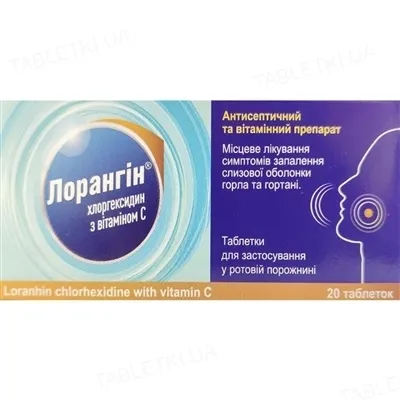
Table of Contents
INSTRUCTIONS FOR MEDICAL USE OF THE MEDICINAL PRODUCT LORENGIN® CHLORHEXIDINE WITH VITAMIN C
Composition:
Active substances: chlorhexidine/ascorbic acid;
1 tablet contains: chlorhexidine dihydrochloride (recalculated to 100% dry substance) 5 mg, ascorbic acid 50 mg;
Excipients: sugar confectionery, povidone, magnesium stearate, talc, tartrazine (E 102), ponceau 4R (E 124), "fruit mix" flavouring (containing propylene glycol).
Pharmaceutical form. Tablets for use in the oral cavity.
Main physicochemical properties: pink-orange tablets with specks, flat cylindrical with bevelled edges.
Pharmacotherapeutic group. Antiseptic and vitamin preparation.
ATC code R02A A05.
Pharmacological properties.
Pharmacodynamics. Lorange® Chlorhexidine with Vitamin C is a combination preparation consisting of 2 components. Chlorhexidine exerts an antibacterial effect by nonspecific binding to phospholipids of the bacterial cell membrane, where chlorhexidine inhibits the activity of dehydrogenases and ATPase, and disrupts membrane permeability for potassium, nucleotides, and amino acids.
Chlorhexidine acts as a bacteriostatic agent at low concentrations (less than 20 mg/L) and as a bactericidal agent at high concentrations. Its action is primarily directed against gram-positive microorganisms and Candida albicans, and to a lesser extent against gram-negative microorganisms. Chlorhexidine is particularly effective against Streptococcus mutans, Streptococcus salivarius, Escherichia coli, Selenomonas, anaerobic bacteria, and Candida albicans. It is somewhat less effective against Streptococcus sanguis, Proteus, Pseudomonas, Klebsiella, and Veillonella species.
Ascorbic acid reduces inflammation and edema of the oral and nasopharyngeal mucosa, enhances immune response, and acts as a cofactor in collagen synthesis and tissue regeneration.
Pharmacokinetics.
Chlorhexidine is practically not absorbed through the mucous membranes or skin. When sucking the tablet, chlorhexidine is gradually released into saliva and binds to the mucous membranes of the oral cavity and tongue, from where it is subsequently released back into saliva, exerting its antibacterial effect. Chlorhexidine may be swallowed with saliva; however, its absorption from the gastrointestinal tract is very low. Chlorhexidine is minimally metabolized in the liver and is excreted with bile into the intestine.
Typically, 90% of ingested chlorhexidine is excreted unchanged in feces.
Chlorhexidine concentrations in body fluids are measured by high-performance liquid chromatography, with a method sensitivity of up to 1 mg/L.
Ascorbic acid is well absorbed from the gastrointestinal tract. Its degree of plasma protein binding is approximately 25%. Ascorbic acid is metabolized to dehydroascorbic acid and oxalic acid and is primarily excreted in urine.
Clinical characteristics.
Indications.
Local treatment of symptoms of inflammation of the mucous membrane of the throat and larynx.
Contraindications.
Hypersensitivity to chlorhexidine or to any other component of the medicinal product.
Interaction with other medicinal products and other forms of interaction.
There are no reports of interactions with other medicinal products.
Concomitant use with iodine-containing products is not recommended.
Special precautions for use
The product contains confectioner's sugar, which should be taken into account in patients with diabetes mellitus, fructose intolerance, glucose-galactose malabsorption syndrome, and those predisposed to dental caries.
Use of "Lorangin® chlorhexidine with vitamin C" may temporarily cause a slight alteration in taste sensation; however, taste perception fully returns within 4 hours after administration. The product is recommended to be taken after meals.
Prolonged use of "Lorangin® chlorhexidine with vitamin C" may cause slight, temporary discoloration of teeth and tongue. These effects disappear after discontinuation of the product; in some cases, medical consultation may be required to resolve these manifestations.
Occasionally, patients with gastrointestinal disorders and/or liver disease may experience nausea, vomiting, and belching. If these symptoms occur, the product should be discontinued and medical advice sought.
Use during pregnancy or breastfeeding
Studies investigating the effects of chlorhexidine during pregnancy have not been conducted. Animal studies using doses 300 times (in rats) and 40 times (in rabbits) higher than those potentially received by humans when using chlorhexidine did not reveal any embryotoxic effects. Pregnant women should consult a physician before using "Lorangin® chlorhexidine with vitamin C".
It is not known whether chlorhexidine passes into breast milk. Ascorbic acid is excreted into breast milk. Women who are breastfeeding should consult a physician before using "Lorangin® chlorhexidine with vitamin C".
Ability to influence reaction speed when driving or operating machinery
No effect.
Method of administration and dosage.
For adults and children aged 12 years and older, the recommended dose is 1 tablet 4 times daily (every 6 hours).
The tablet should be slowly dissolved by sucking. "Lorangin® chlorhexidine with vitamin C" should be taken after meals and after tooth brushing. It is recommended not to rinse the mouth or drink large amounts of liquid within 2 hours after sucking the tablets.
The average duration of treatment is 5–7 days; do not use the drug for more than 14 days.
Children.
Do not use in children under 12 years of age.
Overdose.
The drug is practically not absorbed from the gastrointestinal tract, therefore overdose is unlikely. In case of overdose, clinical evaluation and symptomatic treatment are required.
Side effects.
Rarely, allergic reactions (nasal congestion, skin rash, oral mucosal desquamation, and parotid gland swelling); taste disturbances; increased dental plaque; discoloration (brown stains) of teeth, fillings, and dental prostheses; irritation or inflammation of the oral mucosa; gastric mucosal irritation, diarrhea, nausea, vomiting, and belching may occur.
The medicinal product contains Ponceau 4R, which may cause allergic reactions.
Shelf life. 3 years.
Storage conditions.
Store in a dry, light-protected place at a temperature not exceeding 25°C.
Keep out of reach of children.
Packaging.
20 tablets (10 × 2) in blisters.
Supply category. Over-the-counter.
Manufacturer/Applicant.
LLC "Ternopharm"
Manufacturer's location and address of business activity.
LLC "Ternopharm"
4 Fabrychna Street, Ternopil, 46010, Ukraine