Lomustine medak
Ukraine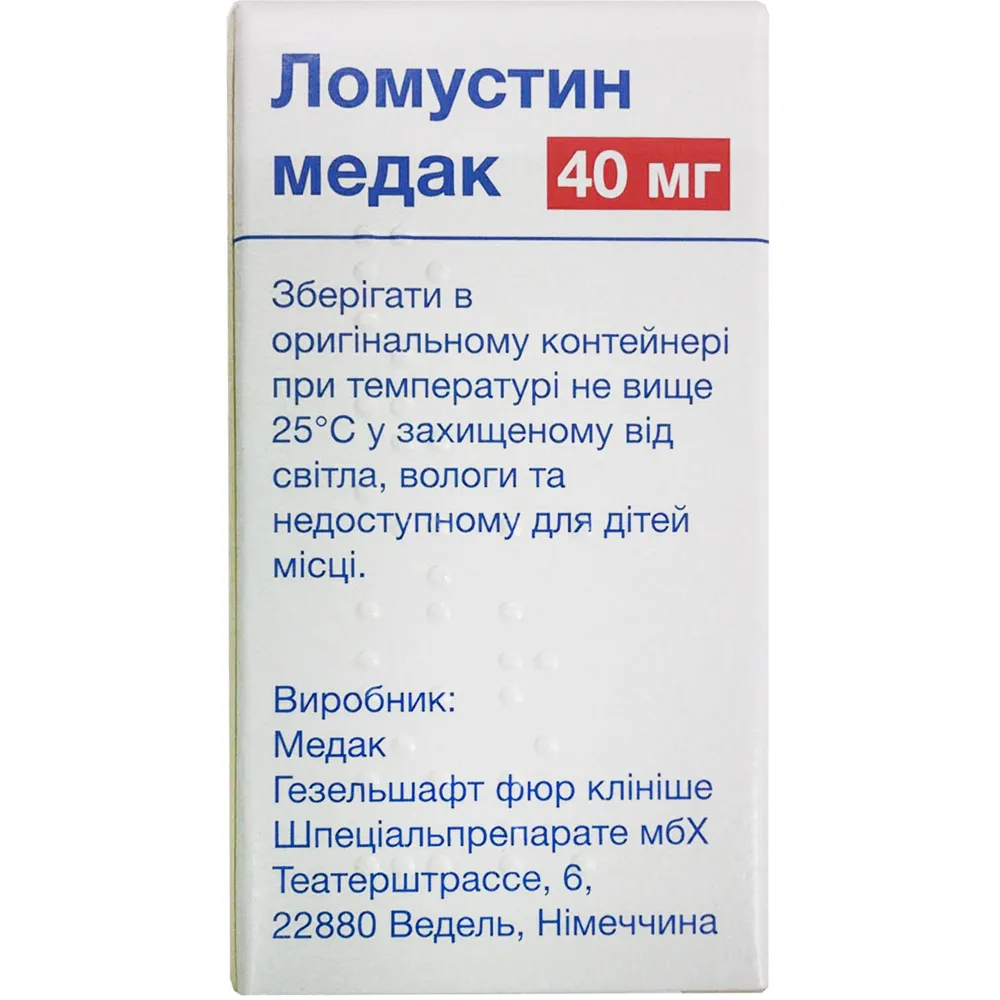
Table of Contents
INSTRUCTIONS FOR MEDICAL USE OF THE MEDICINAL PRODUCT LOMUSTINE MEDAC (LOMUSTINE MEDAC)
Composition:
Active substance: lomustine;
1 capsule contains lomustine 40 mg;
Excipients: lactose monohydrate, wheat starch, talc, magnesium stearate, gelatin, titanium dioxide (E 171), indigo carmine (E 132).
Pharmaceutical form. Capsules.
Main physicochemical properties: hard gelatin capsules size number 3, blue-colored body and cap. The capsule contents are a white or slightly yellowish powder.
Pharmacotherapeutic group. Antineoplastic agents. Alkylating agents. Nitrosourea derivatives. ATC code L01AD02.
Pharmacological Properties.
Pharmacodynamics.
Lomustine is an alkylating agent from the nitrosourea group. Lomustine and/or its metabolites impair DNA and RNA function and inhibit DNA synthesis.
Lomustine acts as an alkylating agent, inhibiting multiple stages of nucleic acid synthesis and inhibiting repair of single-strand DNA breaks.
Pharmacokinetics.
The drug is well and rapidly absorbed from the gastrointestinal tract. Maximum plasma concentration (0.5–2 ng/mL) is reached within 3 hours after oral administration at a dose of 30–100 mg/m².
The chloroethyl group is eliminated from plasma in a monophasic manner with a half-life of 72 hours. Elimination of the cyclohexyl group from plasma occurs in two phases: α half-life of 4 hours and β half-life of 50 hours.
After oral administration of radiolabeled lomustine, passage across the blood-brain barrier has been observed. Radioactivity in cerebrospinal fluid amounted to 15% to 30% of the radioactivity measured in plasma.
Lomustine medac is rapidly metabolized, with metabolites being excreted predominantly via the kidneys. Lomustine is not detected in urine in its active form.
Clinical Characteristics.
Indications.
Palliative therapy, either as an adjunct to other treatment methods or within standard combination regimens with other known chemotherapeutic agents, in the following conditions:
- Brain tumors (primary and metastatic);
- Lung tumors (particularly small cell carcinoma);
- Hodgkin’s disease (resistant to conventional chemotherapy);
- Malignant melanoma (with metastases).
Also indicated as a second-line treatment for non-Hodgkin's lymphoma.
Contraindications.
- Hypersensitivity to nitrosourea compounds;
- Tumor insensitivity to nitrosourea agents;
- Severe bone marrow depression;
- Severe renal impairment;
- Celiac disease or wheat allergy;
- Concurrent administration of yellow fever vaccine or other live vaccines in immunocompromised patients.
Safety precautions. Extreme caution must be exercised when handling antineoplastic agents. Appropriate protective measures should be taken to avoid exposure. This includes using suitable personal protective equipment, such as gloves, and washing hands thoroughly with soap and water after handling these agents.
Interaction with other medicinal products and other forms of interaction.
Drug interaction studies have not been conducted.
Medicinal products causing hematological abnormalities may enhance the leukopenic and thrombocytopenic effects of lomustine.
Concomitant use with theophylline or cimetidine increases bone marrow toxicity. Phenobarbital reduces the antitumor effect of lomustine. Cytostatic agents and radiation therapy may potentiate lomustine-induced leukopenia and thrombocytopenia. Combined use of lomustine with amphotericin B increases the risk of nephrotoxic effects, hypotension, and bronchospasm.
Due to possible immunosuppression during lomustine therapy, the efficacy of antiviral vaccinations may be reduced.
There is an increased risk of systemic vaccine-related disease when administering the yellow fever vaccine, which may result in fatal outcomes. Live vaccines are contraindicated in immunocompromised patients.
Concomitant use of antiepileptic drugs and chemotherapeutic agents, including Lomustine, apart from pharmacokinetic interactions between the drugs, may lead to disease complications.
If a patient is taking any other medicinal products or plans to receive vaccinations, consultation with a physician regarding the possibility of using the drug is mandatory.
Special precautions for use
Lomustine medac should be prescribed only by oncologists experienced in the use of antineoplastic agents.
The most common and severe toxic effect of lomustine is delayed bone marrow suppression, particularly a marked reduction in blood leukocytes and platelets, which may lead to bleeding and generalized infections in patients with compromised immunity.
Therefore, blood counts (including formed blood elements) must be monitored before the first dose and frequently thereafter (preferably weekly for at least 6 weeks following initiation of treatment).
The dosing regimen of Lomustine medac is determined exclusively by the physician and depends on blood parameters such as hemoglobin, leukocyte, and platelet levels.
When using Lomustine medac, periodic monitoring of liver, kidney, and lung function is necessary.
Patients must be clearly informed that they must not take higher doses of Lomustine medac than recommended by their physician, that the dose is administered orally as a single dose (or may be divided over three consecutive days), and that it must not be repeated within at least 6 weeks (see section “Dosage and administration”).
Myelotoxicity of lomustine is cumulative; therefore, dose adjustments should be based on the lowest levels of blood formed elements observed after the previous dose (see dose adjustment schedule).
Caution is required when administering lomustine to patients with pre-existing low levels of platelets, leukocytes, and erythrocytes in peripheral blood.
Pulmonary toxicity associated with lomustine is considered dose-dependent. In addition to baseline pulmonary function tests before starting treatment, repeated evaluations should be performed during therapy. Patients with baseline predicted forced vital capacity (FVC) or carbon monoxide diffusing capacity (DLCO) below 70% are considered at higher risk.
Since lomustine may affect liver function, periodic monitoring of liver function tests is recommended.
Renal function should also be periodically assessed.
Long-term use of nitrosoureas has been reported to possibly be associated with the development of secondary malignant neoplasms.
Use during pregnancy or breastfeeding
Lomustine medac is contraindicated in pregnant and breastfeeding women.
Pregnancy The safety of lomustine during pregnancy has not been established. Therefore, if the drug is used during pregnancy or if pregnancy occurs during treatment with lomustine, the patient should be informed of the potential risk to the fetus. Women of childbearing potential should be advised to avoid pregnancy during lomustine therapy.
Lactation Lomustine, due to its lipophilic nature, is likely to be excreted in breast milk. Because of the potential risk to the infant, a decision should be made whether to discontinue breastfeeding or discontinue lomustine therapy, taking into account the benefits of breastfeeding for the child and the therapeutic benefit for the mother.
Fertility Lomustine may have mutagenic effects. Men receiving lomustine should not father children during treatment and for at least 6 months after its completion. Sperm preservation prior to starting therapy is recommended, as treatment with lomustine may cause irreversible infertility.
Ability to drive and operate machinery
Studies on the effect of lomustine on the ability to drive or operate machinery have not been conducted.
Given that adverse reactions may occur during treatment, patients should refrain from driving vehicles or performing other tasks requiring concentration during therapy.
Dosage and Administration.
For oral use.
The recommended single dose for patients with normally functioning bone marrow who are receiving Lomustine medac as a single chemotherapeutic agent is 120–130 mg/m² every 6 or 8 weeks (the dose may be divided over 3 days, 40 mg/m²/day).
Dosage reduction is required if:
- Lomustine medac is administered concomitantly with other medicinal products that suppress bone marrow function;
- blood leukocyte count is below 3×10⁹/L or platelet count is below 75×10⁹/L.
When taking Lomustine medac, bone marrow suppression tends to be more prolonged compared to nitrogen mustard, and recovery of white blood cells and platelets may take 6 weeks or longer.
Lomustine medac must not be readministered until the levels of blood formed elements have recovered to acceptable values (platelets ≥100×10⁹/L, leukocytes ≥4×10⁹/L). Blood counts should be monitored weekly. The next dose must not be administered before the end of the 6-week interval.
Subsequent doses should be adjusted according to the patient's hematopoietic response to the previous dose. The following scheme may be used as a guideline for dose adjustment:
| Minimum after previous dose |
Required dose (% of previous) |
|
| Leukocytes |
Thrombocytes |
|
| > 4×10⁹/L 3-3.9×10⁹/L 2-2.9×10⁹/L < 2×10⁹/L |
> 100×10⁹/L 75-99.9×10⁹/L 25-74.9×10⁹/L < 25×10⁹/L |
100 % 100 % 70 % 50 % |
Treatment with Lomustine Medac should be continued as long as it produces a therapeutic effect. If no response is observed after 1 or 2 treatment cycles, further administration of the drug is unlikely to be effective. The drug should not be administered more frequently than once every 6 weeks.
Children.
Treatment of oncological diseases (except brain tumors) with Lomustine Medac in pediatric patients should only be carried out in specialized centers and in exceptional circumstances. The dose for children, as for adults, depends on body surface area (120–130 mg/m² every 6–8 weeks) and should be adjusted according to the same criteria.
Overdose.
Cases of accidental overdose with lomustine, including fatal outcomes, have been reported. In case of overdose, the following adverse effects may be expected: myelotoxicity, toxic effects on the hematopoietic system, abdominal pain, diarrhea, nausea, vomiting, anorexia, lethargy, dizziness, liver function disorders, cough, dyspnea, gastrointestinal disturbances, and neurological disorders.
In cases of overdose, gastric lavage is recommended.
There is no specific antidote for lomustine overdose. Symptomatic or supportive therapy should be administered. Blood cell component replacement should be performed as clinically indicated.
Adverse reactions.
| Organ and system |
Frequency |
MedDRA term |
| Benign, malignant and unspecified neoplasms (including cysts and polyps) |
Unknown |
Acute leukemia, myelodysplastic syndrome |
| Blood and lymphatic system |
Very common |
Leukopenia, thrombocytopenia |
| Unknown |
Bone marrow failure, anemia |
|
| Nervous system |
Unknown |
Coordination disorder, disorientation, lethargy, dysarthria |
| Respiratory system |
Unknown |
Lung fibrosis, pulmonary infiltration |
| Gastrointestinal tract |
Unknown |
Nausea, vomiting, stomatitis |
| Hepatobiliary system |
Unknown |
Increased transaminases, increased blood bilirubin |
| Skin and subcutaneous tissue |
Unknown |
Alopecia |
| Renal and urinary system |
Unknown |
Renal failure, azotemia, renal atrophy, kidney damage |
| Investigations (laboratory tests) |
Unknown |
Increased blood alkaline phosphatase |
Toxic effect on the hematopoietic system. The main and most severe toxicity of lomustine is related to delayed bone marrow suppression. It usually develops 4–6 weeks after drug administration, is dose-dependent, and persists at the level of 80,000–100,000/mm³. Leukopenia (4,000–5,000/mm³) typically develops approximately 5–6 weeks after administration and lasts for 1–2 weeks. Thrombocytopenia is usually more severe than leukopenia; however, dose limitation of the drug is determined by both types of toxicity.
Hematological toxicity may be cumulative and lead to persistent reduction in leukocyte and platelet counts with continued drug administration. In approximately 65% of patients who received 130 mg/m² of the drug, the blood leukocyte count was less than 5×10⁹/L, and in 36% of patients, it was less than 3×10⁹/L. Thrombocytopenia was generally more severe than leukopenia. However, both types of toxicity determine the dose limitation of the drug.
Cases of acute leukemia and bone marrow dysplasia have been reported in patients after prolonged therapy with nitrosoureas.
Cases of anemia have also been reported, but they were less frequent and less severe than thrombocytopenia or leukopenia.
Cumulative myelosuppression may occur.
Gastrointestinal tract. Nausea and vomiting sometimes occur 4–6 hours after drug administration, usually lasting less than 24–48 hours, followed by anorexia persisting for two or three days. These effects may be minimized by dividing the dose calculated for 6 weeks into 3 parts, which the patient should take during the first 3 days of each 6-week cycle. The frequency and duration of these adverse effects may be reduced by administering antiemetic agents (metoclopramide or chlorpromazine) prior to Lomustine Medac administration, as well as by administering the drug on an empty stomach. Cases of stomatitis have also been reported.
Hepatic toxicity. Reversible hepatotoxic effects manifested by elevated levels of transaminases, alkaline phosphatase, and bilirubin have been reported in a small percentage of patients receiving lomustine. In some cases, cholestatic jaundice may occur. In isolated cases, patients may develop stomatitis and diarrhea.
Nervous system. When used in combination with other antineoplastic agents and radiation therapy, mild neurological symptoms such as apathy, coordination disturbances, disorientation, lethargy, dysarthria, confusion, and stuttering have been rarely observed.
Pulmonary toxicity. Rare cases of interstitial pneumonia, pulmonary fibrosis, and lung infiltration have been reported.
Renal toxicity. In patients who received high repeated doses of the drug during prolonged treatment with Lomustine Medac and other similar-acting nitrosourea agents, kidney function impairment occurred, manifested by reduced kidney size, progressive azotemia, and renal failure. Therefore, it is recommended not to exceed the maximum total cumulative dose of lomustine (1000 mg/m²).
Renal damage has also been reported in patients who received lower total doses of the drug.
Other toxic effects. Alopecia is rarely observed. When lomustine is used in combination with radiation therapy, isolated cases of optic nerve atrophy, visual disturbances, and blindness have been reported.
Carcinogenesis, mutagenesis, reproductive toxicity. Treatment with nitrosourea agents is associated with a risk of carcinogenic effects.
Lomustine may cause irreversible infertility in males.
Reporting suspected adverse reactions after drug registration is of great importance. It allows continuous monitoring of the benefit-risk balance of the medicinal product. Healthcare professionals are requested to report any suspected adverse reactions via national reporting systems.
Shelf life. 3 years.
Storage conditions. Store in the original container at a temperature not exceeding 25 °C, protected from light and moisture, and kept out of reach of children.
Packaging. 20 capsules in a plastic container, placed in a cardboard box.
Prescription status. Prescription only.
Manufacturer.
Medac Gesellschaft für klinische Spezialpräparate mbH.
Manufacturer's address and place of business.
Theaterstraße 6, 22880 Wedel, Germany.