Litfulo
Ukraine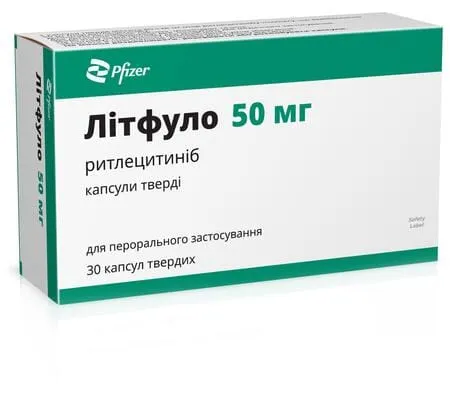
Table of Contents
INSTRUCTIONS FOR MEDICAL USE OF THE MEDICINAL PRODUCT LITFULO (LITFULO)
Composition:
Active substance: ritlecitinib;
1 hard capsule contains 80.128 mg of ritlecitinib tosylate, equivalent to 50 mg of ritlecitinib;
Excipients: microcrystalline cellulose, lactose monohydrate, crospovidone (type A), glycerol dibehenate; capsule shell: hypromellose (E 464), titanium dioxide (E 171), yellow iron oxide (E 172), brilliant blue FCF – FD&C Blue No. 1 (E 133); printing ink.
Dosage form. Hard capsules.
Main physicochemical properties: opaque size № 3 capsules containing white to almost white powder, with the inscription "RCB 50" printed in black ink around the yellow body, and the inscription "Pfizer" printed in black ink around the blue cap of the capsule.
Pharmacotherapeutic group. Immunosuppressants, Janus kinase (JAK) inhibitors.
ATC code L04AF08.
Pharmacological properties.
Pharmacodynamics.
Mechanism of action
Ritlecitinib irreversibly and selectively inhibits Janus kinase (JAK) 3 and tyrosine kinase family members expressed in hepatocellular carcinoma (HCC), by blocking the adenosine triphosphate (ATP) binding site. In cellular assays, ritlecitinib specifically inhibits cytokines with a common γ-chain (IL-2, IL-4, IL-7, IL-15, and IL-21) via JAK3-dependent common γ-chain receptor signaling. Additionally, ritlecitinib suppresses HCC-family kinases, leading to reduced cytolytic activity of NK cells and CD8+ T cells.
Signaling pathways mediated by JAK3 and HCC-family kinases are involved in the pathogenesis of alopecia areata, although its pathophysiology is not yet fully understood.
Pharmacodynamic effects
Subpopulations of lymphocytes
In patients with alopecia areata, treatment with ritlecitinib was associated with a dose-dependent early decrease in absolute lymphocyte count, T-lymphocytes (CD3), and T-lymphocyte subpopulations (CD4 and CD8). Following this initial decline, cell counts partially recovered and remained stable through Week 48. No changes in B-lymphocytes (CD19) were observed in any treatment group. An early, dose-dependent reduction in NK cell count (CD16/56) was observed, which remained stable at a lower level through Week 48.
Immunoglobulins
In patients with alopecia areata, treatment with ritlecitinib was not associated with clinically meaningful changes in immunoglobulins (Ig)G, IgM, or IgA through Week 48, indicating absence of systemic humoral immunosuppression.
Clinical efficacy and safety
The efficacy and safety of ritlecitinib were evaluated in a pivotal, randomized, double-blind, placebo-controlled trial (Study AA-I) in patients aged 12 years and older with alopecia areata and ≥50% scalp hair loss, including totalis and universalis forms. This study also assessed treatment response according to ritlecitinib dose. The treatment period in the study consisted of a 24-week placebo-controlled phase followed by a 24-week extension phase. A total of 718 patients were enrolled in Study AA-I and were randomized to receive one of the following treatment regimens over 48 weeks: 1) 200 mg once daily for 4 weeks, followed by 50 mg once daily for 44 weeks; 2) 200 mg once daily for 4 weeks, followed by 30 mg once daily for 44 weeks; 3) 50 mg once daily for 48 weeks; 4) 30 mg once daily for 48 weeks; 5) 10 mg once daily for 48 weeks; 6) placebo for 24 weeks, followed by 200 mg once daily for 4 weeks and then 50 mg once daily for 20 weeks; or 7) placebo for 24 weeks, followed by 50 mg once daily for 24 weeks.
In this study, the primary endpoint was the proportion of patients achieving a Severity of Alopecia Tool (SALT) score of ≤10 (≥90% scalp hair regrowth) at Week 24. Additionally, a key secondary endpoint was Patient’s Global Impression of Change (PGI-C) at Week 24. Secondary endpoints included the proportion of patients achieving a SALT score of ≤20 (≥80% scalp hair regrowth) at Week 24 and improvement in eyebrow and/or eyelash regrowth at Week 24.
Baseline characteristics
Study AA-I included male and female patients aged ≥12 years. All patients had alopecia areata with ≥50% scalp hair loss (SALT score ≥50), no evidence of long hair regrowth in the preceding 6 months, and a current episode of scalp hair loss lasting ≤10 years, without any other known cause of hair loss (e.g., androgenetic alopecia).
Overall, across all treatment groups, 62.1% of participants were female, 68.0% were of White race, 25.9% were of Asian race, and 3.8% were of Black race. The mean age was 33.7 years, and the majority of participants (85.4%) were adults (≥18 years). A total of 105 (14.6%) patients were aged 12 to <18 years, and 20 (2.8%) were aged ≥65 years. The mean baseline SALT score ranged from 88.3 (16.87) to 93.0 (11.50) across treatment groups; in patients without totalis/universalis alopecia at baseline, the mean SALT score ranged from 78.3 to 87.0. At treatment initiation, eyebrow involvement was present in 83.0% and eyelash involvement in 74.7% of patients across all treatment groups. The median duration of disease since diagnosis of alopecia areata was 6.9 years, and the median duration of the current episode was 2.5 years. Randomization was stratified by presence of totalis/universalis alopecia; in 46% of patients, the condition was classified as totalis/universalis alopecia based on a baseline SALT score of 100.
Clinical response
A significantly greater proportion of patients achieved a SALT score ≤10 with ritlecitinib 50 mg compared to placebo at Week 24 (Table 1). The response rate for SALT score ≤10 with ritlecitinib 50 mg further increased at Week 48 (see Figure).
A significantly greater proportion of patients reported treatment response based on Patient’s Global Impression of Change (PGI-C) with ritlecitinib 50 mg compared to placebo at Week 24 (Table 1); the response rate continued to increase through Week 48 (see Figure).
A significantly greater proportion of patients achieved a SALT score ≤20 with ritlecitinib 50 mg compared to placebo at Week 24 (Table 1). The response rate for SALT score ≤20 further increased at Week 48.
Improvement in eyebrow and/or eyelash regrowth was observed at Week 24 (Table 1) in patients treated with ritlecitinib 50 mg who had baseline eyebrow and/or eyelash involvement, with further improvement observed at Week 48.
Treatment effects at Week 24 in subgroups (age, sex, race, body weight, region, duration of disease since diagnosis, duration of current episode, prior pharmacological treatment) were consistent with results in the overall study population. Treatment effects at Week 24 were lower in the subgroup of patients with totalis/universalis alopecia compared to those without totalis/universalis alopecia. Treatment effects at Week 24 in children aged 12 to 18 years were consistent with those in the overall study population.
Table 1
Efficacy results of ritlecitinib at Week 24
| Endpoint |
Ritlecitinib 50 mg once daily (N = 130) % of patients responding to therapy |
Placebo (N = 131) % of patients responding to therapy |
Difference vs placebo (95 % CI) |
| Response ≤ 10 points on SALT scaleа,б |
13.4 |
1.5 |
11.9 (5.4; 18.3) |
| Response on PGI-C scaleб,в |
49.2 |
9.2 |
40.0 (28.9; 51.1) |
| Response ≤ 20 points on SALT scaleг,д |
23.0 |
1.6 |
21.4 (13.4; 29.5) |
| Response on EBA scaleе |
29.0 |
4.7 |
24.3 (14.8; 34.5) |
| Response on ELA scaleж |
28.9 |
5.2 |
23.7 (13.6; 34.5) |
Abbreviations: EBA – eyebrow assessment; ELA – eyelash assessment; CI – confidence interval; N – total number of patients; PGI-C – patient’s global impression of change; SALT – Severity of Alopecia Tool.
a Patients with a response of ≤10 points on the SALT scale are patients with ≤10% hair loss on the scalp. SALT scores range from 0 to 100, where 0 indicates no hair loss on the scalp and 100 indicates complete hair loss on the scalp.
b Statistically significant result without multiplicity adjustment.
c Patients with a response on the PGI-C scale are patients with a rating of "moderate improvement" or "marked improvement" based on a 7-point scale ranging from "marked improvement" to "marked worsening".
d Patients with a response of ≤20 points on the SALT scale are patients with ≤20% hair loss on the scalp. SALT scores range from 0 to 100, where 0 indicates no hair loss on the scalp and 100 indicates complete hair loss on the scalp.
e Statistically significant result.
f Treatment response on the EBA scale is defined as an improvement of at least 2 points compared to baseline or normal score on the 4-point EBA scale in patients with baseline eyebrow involvement.
g Treatment response on the ELA scale is defined as an improvement of at least 2 points compared to baseline or normal score on the 4-point ELA scale in patients with baseline eyelash involvement.
Abbreviations: CI – confidence interval; N – total number of patients; PGI-C – patient’s global impression of change; q.d. – once daily; SALT – Severity of Alopecia Tool.
Figure. Response of ≤10 points on the SALT scale and on the PGI-C scale by Week 48
Paediatric population
The European Medicines Agency has deferred the obligation for the marketing authorization holder to submit the results of studies with ritlecitinib in one or more subsets of paediatric patients for the treatment of alopecia areata (information on paediatric use can be found in section “Posology and method of administration”).
Pharmacokinetics
Absorption
The absolute bioavailability of ritlecitinib following oral administration is approximately 64%. Based on oral administration and intravenous infusion of radiolabelled active substance, the relative urinary excretion of radiolabelled compounds (oral/IV) was approximately 89%, indicating a high fraction absorbed (fa). Peak plasma concentrations are reached within 1 hour after multiple oral dosing. Food has no clinically relevant effect on the extent of absorption of ritlecitinib, as high-fat food decreased Cmax by approximately 32% and increased AUCinf by approximately 11%. In placebo-controlled trials, ritlecitinib was administered independent of food intake (see section “Posology and method of administration”).
In vitro, ritlecitinib is a substrate of P-glycoprotein (P-gp) and Breast Cancer Resistance Protein (BCRP). However, since ritlecitinib has a high fraction absorbed (fa) with increases in both Cmax and AUC proportional to dose (dose range 20–200 mg single doses), P-gp and BCRP are not expected to have a significant impact on ritlecitinib absorption.
Distribution
Following intravenous administration, the volume of distribution of ritlecitinib is approximately 74 L. Approximately 14% of circulating ritlecitinib is protein-bound, primarily to albumin. The blood/plasma partition ratio of ritlecitinib is 1.62. Ritlecitinib is a covalent inhibitor which has demonstrated binding to off-target proteins such as MAP2K7, DOCK10, albumin, CYP1A2, CYP3A, UGT1A1, and UGT1A4, some of which may be clinically relevant in drug interactions (see section “Interactions with other medicinal products and other forms of interactions”).
Biotransformation
Metabolism of ritlecitinib is mediated by multiple isoforms of glutathione S-transferase (GST: cytosolic GST A1/3, M1/3/5, P1, S1, T2, Z1, and membrane-associated proteins involved in eicosanoid and glutathione metabolism (MAPEG) 1/2/3) and CYP enzymes (CYP3A, CYP2C8, CYP1A2, and CYP2C9); no single clearance pathway exceeds 25%. Therefore, it is unlikely that medicinal products inhibiting a specific metabolic pathway will affect systemic exposure to ritlecitinib. Specific transporter inhibitors are unlikely to result in clinically relevant changes in ritlecitinib bioavailability.
In a human radiolabel study, ritlecitinib was the most abundant compound in circulation (30.4% of circulating radioactivity) after oral administration, and the major metabolite was the cysteine conjugate M2 (16.5%), which is pharmacologically inactive.
Elimination
Ritlecitinib is primarily eliminated via metabolic clearance; approximately 4% of the dose is excreted in urine as unchanged active substance. Approximately 66% of the radiolabelled ritlecitinib dose is excreted in urine and 20% in faeces. After multiple oral doses, steady state was reached by approximately Day 4 due to non-linear pharmacokinetics. Steady-state pharmacokinetic parameters AUCtau and Cmax increased approximately dose-proportionally up to 200 mg, with a mean terminal half-life ranging from 1.3 to 2.3 hours.
Special patient populations
Body weight, gender, genotype, race, and age
Body weight, gender, GST P1, M1, and T1 genotype, race, and patient age had no clinically relevant effect on ritlecitinib exposure.
Children aged ≥12 to 18 years
Based on population pharmacokinetic analysis, no clinically relevant difference in ritlecitinib exposure was observed in patients aged 12 to 18 years compared to adults.
Children under 12 years of age
The pharmacokinetics of ritlecitinib in children under 12 years of age have not yet been established.
Renal impairment
AUC24 and Cmax values in patients with severe renal impairment (estimated glomerular filtration rate (eGFR) <30 mL/min) were approximately 55% and 44% higher, respectively, compared to participants with normal renal function. This was confirmed by population pharmacokinetic analysis. These differences are not considered clinically relevant. Ritlecitinib has not been studied in patients with mild (eGFR 60 to <90 mL/min) or moderate (eGFR 30 to <60 mL/min) renal impairment. However, based on results from patients with severe renal impairment, a clinically significant increase in ritlecitinib exposure in these patients is not expected. The Modification of Diet in Renal Disease (MDRD) equation was used to calculate eGFR and classify renal function in participants.
Given the above considerations, dose adjustment is not required in patients with mild, moderate, or severe renal impairment. The use of ritlecitinib in patients with end-stage renal disease or in patients after kidney transplantation has not been studied (see section “Posology and method of administration”).
Hepatic impairment
In patients with moderate hepatic impairment (Child-Pugh class B), an 18.5% increase in AUC24 of ritlecitinib was observed compared to participants with normal hepatic function. Ritlecitinib has not been studied in patients with mild hepatic impairment (Child-Pugh class A). However, based on results from patients with moderate hepatic impairment, a clinically significant increase in ritlecitinib exposure in these patients is not expected. Dose adjustment is not required in patients with mild or moderate hepatic impairment (see section “Posology and method of administration”). The use of ritlecitinib in patients with severe hepatic impairment (Child-Pugh class C) has not been studied (see section “Contraindications”).
Clinical characteristics.
Indications.
Litfulo is indicated for the treatment of severe alopecia areata in adults and children aged 12 years and older (see section "Pharmacodynamics").
Contraindications.
Hypersensitivity to the active substance or to any of the excipients listed in the "Composition" section.
Active serious infections, including tuberculosis (see section "Special precautions").
Severe hepatic impairment (see section "Method of administration and dosage").
Pregnancy and breastfeeding (see section "Use during pregnancy or breastfeeding").
Interaction with other medicinal products and other forms of interaction.
Potential ability of other medicinal products to affect the pharmacokinetics of ritlecitinib
Repeated co-administration of itraconazole, a strong CYP3A inhibitor, at a dose of 200 mg increased the area under the curve (AUC)inf of ritlecitinib by approximately 15%. This increase is not considered clinically significant; therefore, dose adjustment is not required when ritlecitinib is used concomitantly with CYP3A inhibitors.
Repeated co-administration of rifampicin, a strong CYP enzyme inducer, at a dose of 600 mg decreased the AUCinf of ritlecitinib by approximately 44%. This reduction is not considered clinically significant; therefore, dose adjustment is not required when ritlecitinib is used concomitantly with CYP enzyme inducers.
Potential ability of ritlecitinib to affect the pharmacokinetics of other medicinal products
Repeated administration of ritlecitinib at a dose of 200 mg once daily increased the AUCinf and Cmax of midazolam, a CYP3A4 substrate, by approximately 2.7-fold and 1.8-fold, respectively. Ritlecitinib is a moderate inhibitor of CYP3A. Caution should be exercised when ritlecitinib is used concomitantly with CYP3A substrates (e.g., quinidine, cyclosporine, dihydroergotamine, ergotamine, pimozide), as moderate changes in concentration may lead to serious adverse reactions. Consider dose adjustment recommendations for CYP3A substrates (e.g., colchicine, everolimus, tacrolimus, sirolimus).
Repeated administration of ritlecitinib at a dose of 200 mg once daily increased the AUCinf and Cmax of caffeine, a CYP1A2 substrate, by approximately 2.7-fold and 1.1-fold, respectively. Ritlecitinib is a moderate inhibitor of CYP1A2. Caution should be exercised when ritlecitinib is used concomitantly with other CYP1A2 substrates (e.g., tizanidine), as moderate changes in concentration may lead to serious adverse reactions. Consider dose adjustment recommendations for CYP1A2 substrates (e.g., theophylline, pirfenidone).
Single co-administration of ritlecitinib at a dose of 400 mg increased the AUCinf of sumatriptan (a substrate of Organic Cation Transporter [OCT]1) by approximately 1.3–1.5-fold compared to sumatriptan administered alone. The increased exposure to sumatriptan is not considered clinically significant. Caution should be exercised when ritlecitinib is used concomitantly with OCT1 substrates, as even small changes in concentration may lead to serious adverse reactions. Ritlecitinib did not cause clinically significant changes in exposure levels of oral contraceptives (e.g., ethinylestradiol or levonorgestrel), CYP2B6 substrates (e.g., efavirenz), CYP2C substrates (e.g., tolbutamide), or substrates of Organic Anion Transporter (OAT) P1B1, Breast Cancer Resistance Protein (BCRP), and OAT3 (e.g., rosuvastatin).
Paediatric population
Drug interaction studies have been conducted only in adult patients.
Special precautions for use.
Severe infections
Cases of severe infections have been reported in patients receiving ritlecitinib. The most common serious infections were appendicitis, COVID-19 infection (including pneumonia), and sepsis. Treatment with ritlecitinib must not be initiated in patients with active serious infections (see section "Contraindications").
The risks and benefits should be carefully considered before initiating treatment in patients:
- with chronic or recurrent infections;
- who have been in contact with individuals with tuberculosis;
- with a history of serious or opportunistic infections;
- who have lived in or travelled to regions endemic for tuberculosis or endemic fungi;
- with underlying conditions that may increase susceptibility to infections.
Patients should be closely monitored during and after ritlecitinib therapy for early signs and symptoms of infection. If a patient develops a serious or opportunistic infection, treatment with this medicinal product should be temporarily interrupted. A patient who develops a new infection during ritlecitinib therapy should undergo immediate and comprehensive diagnostic evaluation appropriate for immunocompromised individuals, receive appropriate antimicrobial therapy, and be closely monitored. After infection control is achieved, ritlecitinib treatment may be resumed.
Since elderly individuals and patients with diabetes mellitus generally have an increased incidence of infections, this medicinal product should be used with caution in elderly patients and in patients with diabetes mellitus, with particular attention paid to the development of infections.
Tuberculosis
Patients should be screened for tuberculosis prior to initiating ritlecitinib treatment. Ritlecitinib must not be used in patients with active tuberculosis (see section "Contraindications"). Anti-tuberculosis therapy should be initiated in patients with newly diagnosed or previously untreated latent tuberculosis prior to starting ritlecitinib treatment. Even with a negative latent tuberculosis test, anti-tuberculosis therapy should be considered before initiating ritlecitinib treatment in individuals at high risk, and screening for tuberculosis should also be considered in high-risk patients during ritlecitinib therapy.
Reactivation of viral infections
Cases of viral infection reactivation, including herpes virus reactivation (e.g., herpes zoster), have been reported (see section "Adverse reactions"). If a patient develops herpes zoster, temporary discontinuation of therapy should be considered until the episode resolves.
Screening for viral hepatitis should be performed before and during ritlecitinib treatment in accordance with clinical guidelines. Patients with evidence of hepatitis B or C virus infection were excluded from ritlecitinib clinical trials. Monitoring for reactivation of viral hepatitis during ritlecitinib treatment is recommended according to clinical guidelines. If reactivation is detected, consultation with a hepatology specialist is advised.
Malignancies (including non-melanoma skin cancer)
Cases of malignancies, including non-melanoma skin cancer (NMSC), have been observed in patients receiving ritlecitinib.
It is unknown whether selective JAK3 inhibition is associated with adverse reactions related to JAK inhibition predominantly involving JAK1 and JAK2. In a large randomized, active-controlled trial of tofacitinib (another JAK inhibitor) in patients with rheumatoid arthritis (RA) aged 50 years or older and with at least one additional cardiovascular risk factor, a higher incidence of malignancies, including lung cancer, lymphoma, and NMSC, was observed with tofacitinib compared to tumour necrosis factor (TNF) inhibitors.
Available clinical data are insufficient to assess a potential causal relationship between ritlecitinib use and the development of malignancies. Long-term safety evaluations of the medicinal product are ongoing. The risks and benefits of ritlecitinib treatment should be carefully weighed before initiating or continuing therapy in patients with diagnosed malignancies, except for successfully treated NMSC or cervical cancer.
Patients with an increased risk of skin cancer are recommended to undergo periodic skin examinations.
Serious cardiovascular adverse events, deep vein thrombosis (DVT), and pulmonary embolism (PE)
Cases of venous and arterial thromboembolism, including serious cardiovascular adverse events, have been reported in patients receiving ritlecitinib.
It is unknown whether selective JAK3 inhibition is associated with adverse reactions related to JAK inhibition predominantly involving JAK1 and JAK2. In a large randomized, active-controlled trial of tofacitinib (another JAK inhibitor) in patients with RA aged 50 years or older and with at least one additional cardiovascular risk factor, a higher incidence of serious cardiovascular adverse events—defined as cardiovascular death, non-fatal myocardial infarction, and non-fatal stroke—and a dose-dependent higher incidence of venous thromboembolism, including DVT and PE, were observed with tofacitinib compared to TNF inhibitors.
Long-term safety evaluations of ritlecitinib use are ongoing. Ritlecitinib should be used with caution in patients with established risk factors for thromboembolism. Patients suspected of a thromboembolic event should discontinue ritlecitinib and undergo immediate re-evaluation. The risks and benefits of ritlecitinib treatment should be carefully weighed before initiating therapy in patients.
Neurological events
Axonal dystrophy associated with ritlecitinib was observed in chronic toxicity studies in beagle dogs. Ritlecitinib treatment should be discontinued if unexplained neurological symptoms occur.
Abnormalities in complete blood count
Ritlecitinib treatment has been associated with decreased lymphocyte and platelet counts (see section "Adverse reactions"). Absolute lymphocyte count (ALC) and platelet count should be assessed prior to initiating ritlecitinib treatment. Ritlecitinib treatment must not be initiated in patients with ALC < 0.5 × 10³/mm³ or platelet count < 100 × 10³/mm³. If ALC or platelet count abnormalities occur after starting ritlecitinib treatment, interruption or discontinuation of treatment is recommended (see section "Posology and method of administration"). ALC and platelet count should be monitored 4 weeks after initiation of ritlecitinib therapy, and thereafter according to standard patient management.
Vaccination
There are no data on the response to vaccination in patients receiving ritlecitinib. Live attenuated vaccines should be avoided during ritlecitinib treatment or immediately prior to its initiation. Patients should be recommended to receive all age-appropriate vaccinations, including prophylactic vaccination against herpes zoster according to current immunization guidelines, prior to starting ritlecitinib treatment.
Elderly patients
Data on the use of the medicinal product in patients aged 65 years and older are currently limited. Age has been identified as a risk factor for decreased ALC in patients aged 65 years and older.
Excipients with known effect
Lactose
Each hard capsule contains 21.27 mg of lactose monohydrate.
This medicinal product should not be administered to patients with rare hereditary conditions such as galactose intolerance, total lactase deficiency, or glucose-galactose malabsorption syndrome.
Use during pregnancy or breastfeeding.
Females of reproductive potential
Ritlecitinib is not recommended for females of reproductive potential who are not using contraception. Females of reproductive potential should be advised to use effective contraception during treatment and for 1 month after the last dose of Litfulo.
Pregnancy
Data on the use of ritlecitinib in pregnant women are currently limited or absent. Reproductive toxicity was observed in animal studies. Ritlecitinib demonstrated teratogenicity in rats and rabbits when administered at high doses. Litfulo is contraindicated during pregnancy (see section "Contraindications").
Breastfeeding
Available pharmacodynamic/toxicological data in animals show excretion of ritlecitinib into milk. Risk to newborns/infants cannot be excluded. Litfulo is contraindicated during breastfeeding (see section "Contraindications").
Fertility
The effect of ritlecitinib on human fertility has not been evaluated. No effect on fertility was observed in rats at clinically relevant exposure levels.
Ability to influence the ability to drive and use machines.
Litfulo has no or negligible influence on the ability to drive and use machines.
Dosage and Administration
Treatment should be initiated and managed under the supervision of a physician experienced in the diagnosis and treatment of alopecia areata.
Dosage
The recommended dose is 50 mg once daily.
The benefit of treatment and its associated risks should be reassessed regularly on an individual basis.
Consider discontinuing treatment in patients who show no evidence of therapeutic benefit after 36 weeks of treatment.
Monitoring of laboratory test results
Table 2
Recommendations for laboratory testing and monitoring
| Laboratory tests |
Monitoring recommendations |
Action |
| Platelet count |
Prior to initiation of treatment, 4 weeks after initiation of therapy, and then according to the patient's routine monitoring schedule. |
Treatment should be discontinued if platelet count is < 50 × 103/mm3. |
| Lymphocytes |
Treatment should be temporarily suspended if ALC < 0.5 × 10³/mm3, and may be resumed when ALC recovers to a level above this value. |
Abbreviation: ALC – absolute lymphocyte count.
Initiation of treatment
Ritlecitinib treatment should not be initiated in patients with an absolute lymphocyte count (ALC) below 0.5 × 10³/mm³ or platelet count below 100 × 10³/mm³ (see section "Special precautions").
Interruption or discontinuation of treatment
If a patient develops a serious or opportunistic infection, ritlecitinib should be withheld until control of the infection is achieved (see section "Special precautions").
In the event of abnormal blood test results, interruption or discontinuation of treatment may be required according to the recommendations provided in Table 2.
If treatment interruption is necessary, the risk of significant loss of scalp hair after a temporary interruption of less than 6 weeks is low.
Missed doses
If a dose is missed, patients should be advised to take the missed dose as soon as possible, except when less than 8 hours remain before the next scheduled dose. In such cases, the patient should not take the missed dose. The patient should then resume the regular prescribed dosing schedule.
Special patient groups
Renal impairment
Dose adjustment is not required in patients with mild, moderate, or severe renal impairment (see section "Pharmacokinetics").
The use of ritlecitinib has not been studied in patients with end-stage renal disease or in kidney transplant recipients; therefore, treatment with this medicinal product is not recommended in these patients.
Hepatic impairment
Dose adjustment is not required in patients with mild (Child-Pugh class A) or moderate (Child-Pugh class B) hepatic impairment (see section "Pharmacokinetics"). Ritlecitinib is contraindicated in patients with severe hepatic impairment (Child-Pugh class C) (see section "Contraindications").
Elderly patients
Dose adjustment is not required for patients aged 65 years and older. Data on the use of the medicinal product in patients aged 65 years and older are currently limited.
Method of administration
For oral use.
Litfulo should be administered once daily, independent of food intake.
Capsules should be swallowed whole and must not be crushed, opened, or chewed, as such administration has not been studied in clinical trials.
Children
Dose adjustment is not required for children aged 12 to 18 years.
The safety and efficacy of Litfulo in children under 12 years of age have not been established. Data are lacking.
Overdose.
In placebo-controlled studies, ritlecitinib was administered orally: single doses up to 800 mg and multiple doses up to 400 mg daily for 14 days. No specific toxic effects were observed. In case of overdose, patients should be monitored for signs and symptoms of adverse reactions (see section "Adverse reactions"). There is no specific antidote for ritlecitinib overdose. Symptomatic and supportive treatment is indicated.
Pharmacokinetic data obtained after single oral doses of 800 mg in healthy adult volunteers indicate that more than 90% of the administered dose is likely to be eliminated within 48 hours.
Adverse reactions.
Summary of safety profile
The most commonly reported adverse reactions were: diarrhea (9.2%), acne (6.2%), upper respiratory tract infections (6.2%), urticaria (4.6%), rash (3.8%), folliculitis (3.1%), and dizziness (2.3%).
A total of 1630 patients received ritlecitinib, representing 2303 patient-years of exposure. Data from three placebo-controlled studies were pooled (130 participants receiving 50 mg daily and 213 participants receiving placebo) to evaluate the safety of ritlecitinib compared to placebo during the period up to 24 weeks after initiation of treatment.
The list below includes all adverse reactions observed in placebo-controlled studies of alopecia areata. These reactions are classified by system organ class and frequency of occurrence using the following classification: very common (≥ 1/10); common (≥ 1/100 to < 1/10); uncommon (≥ 1/1000 to < 1/100); rare (≥ 1/10,000 to < 1/1000); very rare (< 1/10,000). Within each frequency grouping, adverse reactions are listed in order of decreasing severity.
Infections and infestations: common: herpes zoster, folliculitis, upper respiratory tract infections.
Nervous system disorders: common: dizziness.
Gastrointestinal disorders: common: diarrhea.
Skin and subcutaneous tissue disorders: common: acne, urticaria, rash.
Investigations (laboratory test results): common: increased blood creatine phosphokinase levels; uncommon: decreased platelet count, decreased lymphocyte count, alanine aminotransferase levels elevated > 3 × ULN, aspartate aminotransferase levels elevated > 3 × ULN.
a Specifically, changes identified during laboratory monitoring. ULN – upper limit of normal.
Description of selected adverse reactions
Infections
In placebo-controlled studies during the period up to 24 weeks, infections were reported overall in 31% of patients (80.35 per 100 patient-years) receiving placebo and in 33% of patients (74.53 per 100 patient-years) receiving ritlecitinib 50 mg. In the AA-I study during the period up to 48 weeks, infections were reported overall in 51% of patients (89.32 per 100 patient-years) receiving ritlecitinib 50 mg or higher.
Among all patients receiving ritlecitinib within the integrated safety analysis, including the long-term study and the vitiligo study, infections were reported in 45.4% of patients (50.02 per 100 patient-years) receiving ritlecitinib 50 mg or higher. The majority of infections were of mild or moderate severity.
In placebo-controlled studies, the percentage of patients reporting an infection-related adverse reaction of herpes zoster was 1.5% in the ritlecitinib 50 mg group compared to 0% in the placebo group. All cases of herpes zoster were non-serious. One patient receiving ritlecitinib 200/50 mg (200 mg once daily for 4 weeks, followed by 50 mg once daily) experienced a varicella-zoster virus infection meeting criteria for an opportunistic infection (multidermatomal herpes zoster). In the AA-I study during the period up to 48 weeks, herpes zoster was reported in 2.3% of patients (2.61 per 100 patient-years) receiving ritlecitinib 50 mg or higher. Among all patients receiving ritlecitinib within the integrated safety analysis, including the long-term study and the vitiligo study, the incidence rate of herpes zoster was 1.10 per 100 patient-years in patients receiving ritlecitinib 50 mg or higher.
In placebo-controlled studies during the period up to 24 weeks, no serious infections were reported in patients receiving placebo or ritlecitinib 50 mg. The incidence of serious infections in patients receiving ritlecitinib 200/50 mg was 0.9% (2.66 per 100 patient-years). In the AA-I study during the period up to 48 weeks, serious infections were reported in 0.8% of patients (0.86 per 100 patient-years) receiving ritlecitinib 50 mg or higher. Among all patients receiving ritlecitinib within the integrated safety analysis, including the long-term study and the vitiligo study, the rate of serious infections with ritlecitinib 50 mg or higher was 0.8% (0.59 per 100 patient-years).
Opportunistic infections
An opportunistic infection in the form of multidermatomal herpes zoster was reported in one patient (0.50 per 100 patient-years) receiving ritlecitinib 200/50 mg in placebo-controlled studies, in none of the patients in the AA-I study during the period up to 48 weeks, and in two patients (0.09 per 100 patient-years) receiving ritlecitinib 50 mg or higher within the integrated safety analysis, including the long-term study and the vitiligo study. Cases of opportunistic herpes zoster were of mild or moderate severity.
Decreased lymphocyte count
In placebo-controlled studies during the period up to 24 weeks and in the AA-I study during the period up to 48 weeks, ritlecitinib treatment was associated with a decrease in lymphocyte count. The maximum effect on lymphocytes occurred within 4 weeks, after which the lymphocyte count remained stably lower during continued therapy. Among all patients receiving ritlecitinib within the integrated safety analysis, including the long-term study and the vitiligo study, confirmed decreases in absolute lymphocyte count (ALC) < 0.5 × 10³/mm³ were recorded in 2 participants (< 0.1%) receiving ritlecitinib 50 mg.
Decreased platelet count
In placebo-controlled studies during the period up to 24 weeks and in the AA-I study during the period up to 48 weeks, ritlecitinib treatment was associated with a decrease in platelet count. The maximum effect on platelets occurred within 4 weeks, after which the platelet count remained stably lower during continued therapy. Among all patients receiving ritlecitinib within the integrated safety analysis, including the long-term study and the vitiligo study, one patient (< 0.1%) receiving ritlecitinib 50 mg or higher had a confirmed platelet count < 100 × 10³/mm³.
Elevated creatine phosphokinase (CPK) levels
In placebo-controlled studies during the period up to 24 weeks, elevated blood CPK levels were reported in 2 patients (1.5%) receiving ritlecitinib 50 mg. In the AA-I study during the period up to 48 weeks, elevated blood CPK levels were reported in 3.8% of patients receiving ritlecitinib 50 mg or higher. CPK levels more than 5 times the upper limit of normal (ULN) were recorded in 2 (0.9%) patients receiving placebo and in 5 (3.9%) patients receiving ritlecitinib 50 mg. In the AA-I study during the period up to 48 weeks, CPK levels more than 5 times ULN were reported in 6.6% of patients receiving ritlecitinib 50 mg or higher. Most of these elevations were transient, and none led to treatment discontinuation.
Elevated transaminase levels
In placebo-controlled studies during the period up to 24 weeks, elevated alanine aminotransferase and aspartate aminotransferase levels (> 3 × ULN) were reported in 3 patients (0.9%) and 2 patients (0.6%), respectively, receiving ritlecitinib 50 mg or higher. Most of these elevations were transient, and none led to treatment discontinuation.
Paediatric population
Overall, 181 children (aged 12 to 18 years) were included in studies of ritlecitinib for the treatment of alopecia areata.
The safety profile observed in children was similar to that observed in the adult patient population.
Reporting of suspected adverse reactions
Reporting suspected adverse reactions after authorization of the medicinal product is important. It allows continued monitoring of the benefit-risk balance of the medicinal product. Healthcare professionals, pharmacists, patients, and their legal representatives should report all suspected adverse reactions and lack of efficacy via the automated pharmacovigilance information system at the following link: https://aisf.dec.gov.ua.
To inform about risks associated with the use of ritlecitinib and to provide recommendations for risk minimization through appropriate monitoring and management for both physicians and patients, appropriate educational materials have been developed.
The Patient Information Card, recommended to be completed and shown to the physician, is available at the following link: https://www.pfizer.ua/2225.
Shelf life. 30 months.
Storage conditions.
No special temperature storage conditions required. Store in the original packaging to protect from light. Keep out of the reach of children.
Packaging.
10 hard capsules in a blister, 3 blisters in a cardboard box.
Prescription status. Prescription only.
Manufacturer.
Pfizer Manufacturing Deutschland GmbH.
Manufacturer's address and location of operations.
Muswaldallee 1, 79108 Freiburg im Breisgau, Germany.