Lysobact complete spray®
Ukraine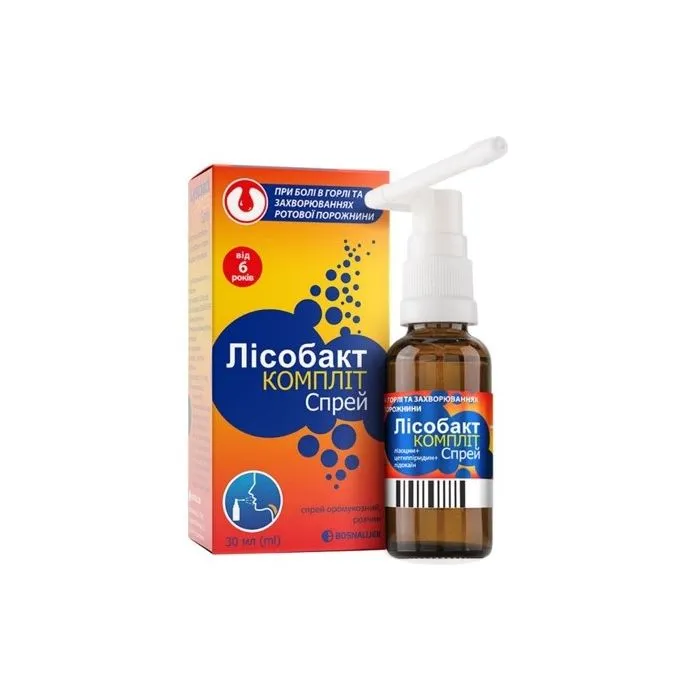
Table of Contents
INSTRUCTIONS FOR MEDICAL USE OF THE MEDICINAL PRODUCT LYSOBACT COMPLETE SPRAY®
Composition:
Active substances: lysozyme hydrochloride, cetylpyridinium chloride, lidocaine hydrochloride;
1 ml of solution contains lysozyme hydrochloride 20.0 mg, equivalent to 800,000 FIP units (Federation Internationale Pharmaceutique activity units); cetylpyridinium chloride 1.5 mg, lidocaine hydrochloride 0.5 mg;
Excipients: glycerol 85%, propylene glycol, methylparahydroxybenzoate, propylparahydroxybenzoate, peppermint flavor, sodium hydroxide, purified water.
Pharmaceutical form. Oromucosal spray, solution.
Main physicochemical properties: solution ranging from colorless to pale yellow with a peppermint aroma.
Pharmacotherapeutic group. Medicinal products used in throat disorders. Antiseptics. ATC code R02A A.
Pharmacological Properties
Pharmacodynamics
Lysozyme is a mucopolysaccharide effective against Gram-positive bacteria due to its ability to convert insoluble polysaccharides of the cell wall into soluble mucopolypeptides. It is also effective against Gram-negative bacteria, viruses, and fungi. Lysozyme exhibits local anti-inflammatory activity and enhances the body's non-specific resistance.
Cetylpyridinium is an antiseptic belonging to the group of quaternary ammonium compounds. It exerts a bactericidal effect against a broad spectrum of Gram-positive and Gram-negative bacteria. It penetrates the bacterial cell membrane and causes leakage of cellular contents, disrupts cellular metabolism, and inhibits bacterial growth, ultimately leading to bacterial cell death. Cetylpyridinium possesses surface-active properties and is particularly active in the mucous membranes of the oral cavity and throat.
Lidocaine is a local anesthetic of the amide type. Like other local anesthetics, lidocaine reduces the generation and conduction of nerve impulses by slowing down depolarization. This occurs due to blockade of the large transient increase in cell membrane permeability to sodium ions, which leads to initial membrane depolarization. Lidocaine also reduces the permeability of potassium and sodium ions in resting neurons.
Pharmacokinetics
The medicinal product is applied locally and acts locally on the oral cavity and throat.
The local anesthetic lidocaine may penetrate the mucous membranes of the oral cavity and pharynx. However, lidocaine undergoes significant metabolism before entering the systemic circulation. Due to the extensive pre-systemic metabolism of lidocaine, its bioavailability after oral administration is only about 35%.
There are no available published data on the pharmacokinetics of lysozyme and cetylpyridinium.
Clinical characteristics
Indications
- Local treatment of acute inflammatory diseases of the oral mucosa (including stomatitis, gingivitis, aphthous stomatitis, etc.).
- As part of combination therapy for local treatment of pain, irritation, and inflammation of the throat (including pharyngitis, pharyngolaryngitis, tonsillitis, tonsillopharyngitis, etc.).
- Upon physician's recommendation, local treatment during pre- and post-operative periods following surgical procedures such as tonsillectomy, oral and throat injuries or abscesses, as well as after tooth extraction.
Contraindications
Hypersensitivity to lysozyme hydrochloride, cetylpyridinium chloride, lidocaine hydrochloride, or other local anesthetics of the amide type, or to any of the excipients.
Hypersensitivity to chicken egg protein.
Children under 6 years of age.
Interaction with other medicinal products and other forms of interaction
During use of the medicinal product LYSOBACT COMPLETE SPRAY®, other local antiseptics for disinfection of the oral cavity and/or throat should not be used simultaneously.
Due to the presence of lidocaine, concomitant use with medicinal products for the treatment of mild forms of Alzheimer's disease (cholinesterase inhibitors) should be avoided. Although numerous interactions of lidocaine with other medicinal products are theoretically possible, they are expected to be clinically insignificant given that LYSOBACT COMPLETE SPRAY® is applied locally.
Special precautions for use
The use of the medicinal product LYSOBACT COMPLIT SPRAY® should be strictly limited to the necessity of relieving existing pain and irritation.
LYSOBACT COMPLIT SPRAY® is not intended for long-term, continuous, or repeated use.
Indications do not include the use of the medicinal product for longer than 5 days due to the risk of developing an imbalance in the normal microflora of the oral cavity and throat, with a potential risk of bacterial and fungal overgrowth.
If symptoms of the disease do not resolve within 5 days and/or body temperature remains elevated, medical advice must be sought.
The use of LYSOBACT COMPLIT SPRAY® should be avoided in patients with a pronounced predisposition to allergies. During treatment with this medicinal product, serious acute hypersensitivity reactions may occur, such as urticaria, angioedema (including respiratory tract involvement), bronchospasm, circulatory complications, and anaphylactic shock. There have also been isolated reports of serious skin reactions such as erythema multiforme and Stevens–Johnson syndrome. Some of these severe reactions may be life-threatening. If symptoms indicating hypersensitivity occur, the use of the medicinal product must be discontinued immediately.
When applying local anesthetics to the mucous membranes of the mouth or throat, local anesthesia may develop, which can cause difficulty in swallowing and thereby increase the risk of aspiration of food into the respiratory tract. Therefore, patients should be advised not to eat and/or drink for 1 hour after application of LYSOBACT COMPLIT SPRAY®. It is also recommended to avoid tooth brushing and chewing gum during the period when the oral and/or throat area is anesthetized. Patients experiencing difficulty in swallowing should consult a physician before using this medicinal product.
Contact of the solution with the eyes should be avoided. If accidental contact occurs, the eyes must be thoroughly rinsed with clean water for a prolonged period while keeping the eyes open.
Special warnings regarding excipients contained in the medicinal product:
- Glycerol 85% may cause headache, gastrointestinal irritation, and diarrhea;
- Propylene glycol may cause symptoms similar to those experienced after alcohol consumption;
- Methyl parahydroxybenzoate and propyl parahydroxybenzoate may cause allergic reactions.
LYSOBACT COMPLIT SPRAY® is sugar-free and therefore can be used by patients with diabetes mellitus.
LYSOBACT COMPLIT SPRAY® contains less than 1 mmol (23 mg) of sodium per dose, i.e., it is practically sodium-free.
Use during pregnancy or breastfeeding
Pregnancy
Clinical experience regarding the effect of the medicinal product on the fetus is insufficient. Therefore, as a precautionary measure, the product is not recommended for use during pregnancy.
Breastfeeding
Lidocaine passes into breast milk, but only in very small amounts; therefore, in general, no effect on the infant is expected when the product is used at therapeutic doses.
Since there is insufficient data on the excretion of cetylpyridinium chloride into breast milk, the use of the medicinal product during breastfeeding is not recommended.
Ability to influence reaction speed when driving or operating machinery
Data on influence are lacking.
Method of Administration and Dosage
Before using the spray, remove the plastic cap from the pump atomizer. The applicator tube should be turned upward at a right angle to its original position (Figure 1).

Figure 1
Then attach the applicator to the pump atomizer and press gently. Before first use, prime the pump atomizer by pressing it several times until a uniform spray mist is produced. The patient should open the mouth wide, then direct the applicator toward the area requiring treatment and press the pump atomizer as many times as indicated by the prescribed dosage (Figure 2).
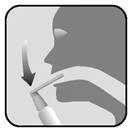
Figure 2
During the spraying procedure, the patient must hold their breath. Do not swallow. After application, return the applicator downward to lock the pump atomizer and prevent accidental spray release. To avoid the risk of infection transmission, the spray bottle should be used individually.
Dosage
One actuation of the pump atomizer releases 0.20 mL of solution containing 4 mg of lysozyme hydrochloride, 0.3 mg of cetylpyridinium chloride, and 0.1 mg of lidocaine hydrochloride.
Adults and children aged 6 years and older
For a single dose, press the atomizer 5 times. The procedure may be repeated 3–6 times daily, with a minimum interval of 2 hours between administrations.
Children. Do not use the medicinal product in children under 6 years of age.
Overdose
Symptoms and signs. Overdose with this medicinal product may potentially cause intense local anesthesia in the glottis area, possibly resulting in impaired swallowing function and risk of food aspiration into the airways.
Use of doses exceeding the recommended ones may cause irritation of the oral mucosa.
Although the bioavailability of lidocaine is low, swallowing it occasionally may lead to significant toxic effects. Regarding the medicinal product LYSOBACT COMPLIT SPRAY®, ingestion of more than 1000 mL of the product would be required to reach a dose of lidocaine (0.5 g or more) at which significant toxic effects could be expected. Extremely high blood concentrations of lidocaine may cause toxic effects on the central nervous system and/or cardiovascular system.
In case of acute overdose with lysozyme, no clinical consequences are expected.
After ingestion, cetylpyridinium chloride may cause nausea and vomiting due to irritation of the gastrointestinal mucosa.
Treatment
Management of lidocaine overdose involves maintaining airway patency and ensuring adequate lung ventilation. If necessary, ventilation should be supported with oxygen via artificial or controlled respiration. In case of seizures, appropriate treatment should be administered (e.g., thiopental, diazepam, etc.). Cardiovascular support measures are often required. In cases of ventricular fibrillation or cardiac arrest, effective cardiopulmonary resuscitation must be performed. Adrenaline (epinephrine) in repeated doses and sodium bicarbonate should be administered as soon as possible.
Adverse Reactions
The assessment of the frequency of adverse reactions is based on the following categories: very common (≥ 1/10), common (≥ 1/100 to < 1/10), uncommon (≥ 1/1,000 to < 1/100), rare (≥ 1/10,000 to < 1/1,000), very rare (< 1/10,000), frequency not known (frequency cannot be estimated from the available data).
Immune system disorders:
very rare: allergic reactions* (anaphylactic shock, anaphylactic reactions, Quincke's edema); frequency not known: allergic reactions including angioedema, skin rash, urticaria, bronchospasm, circulatory complications.
*Allergic reactions following the use of local anesthetics are very rare. Hypersensitivity reactions to lidocaine hydrochloride after local administration may present as localized edema with mild respiratory distress or generalized rash.
Skin and subcutaneous tissue disorders:
frequency not known: erythema multiforme and Stevens–Johnson syndrome (see section "Special precautions").
Reporting of suspected adverse reactions
Reporting of adverse reactions after marketing authorization is of great importance. It allows continued monitoring of the benefit-risk balance of the medicinal product. Healthcare professionals and patients, as well as their legal representatives, are encouraged to report any suspected adverse reactions and lack of efficacy of the medicinal product via the Automated Information System for Pharmacovigilance at the following link: https://aisf.dec.gov.ua.
Shelf life: 3 years.
Storage conditions
Store at a temperature not exceeding 25 °C. Do not freeze.
Keep out of reach and sight of children.
Packaging
30 ml of solution in a dark glass bottle with a pump spray and applicator, 1 bottle per cardboard box.
Supply classification: Over-the-counter (without prescription).
Manufacturer: Bosnaljek d.d.
Manufacturer's address
Yukiceva 53, 71000 Sarajevo, Bosnia and Herzegovina.
Marketing Authorization Holder: Bosnaljek d.d.
Address of the Marketing Authorization Holder
Yukiceva 53, 71000 Sarajevo, Bosnia and Herzegovina.
In case of adverse reactions or lack of efficacy of the medicinal product, please contact the representative of the Marketing Authorization Holder in Ukraine, Bosnaljek d.d., by email: [email protected]