Lidocaine-zdorovya
Ukraine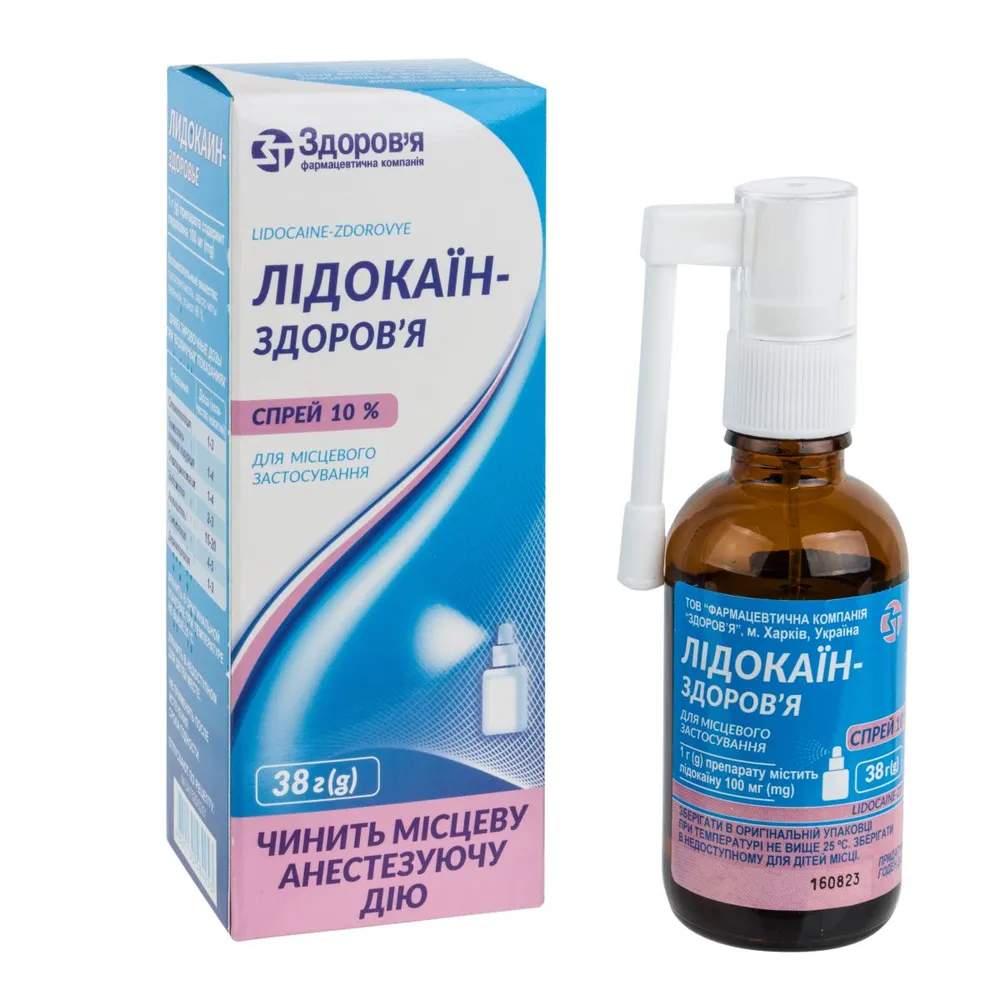
Table of Contents
INSTRUCTIONS FOR MEDICAL USE OF THE MEDICINAL PRODUCT LIDOCAINE-ZDOROV'YA
Composition:
Active substance: lidocaine;
1 g of the preparation contains lidocaine 100 mg;
Excipients: propylene glycol, peppermint oil, ethanol 96 %.
Pharmaceutical form. Topical spray.
Main physicochemical properties: clear, colorless solution with a specific odor.
Pharmacotherapeutic group. Local anesthetics. ATC code D04A B01.
Pharmacological properties.
Pharmacodynamics. Lidocaine is a membrane-stabilizing agent of the amide group used for local anesthesia. It inhibits nerve endings of the skin and mucous membranes, thus causing reversible suppression of conduction in neural tissue elements (neuron, axon, synapses).
The mechanism of action of local anesthetics involves inhibition of ion fluxes through neuronal membranes, which are essential for the generation of an impulse.
Lidocaine inhibits stimulus-induced transient increase in sodium ion permeability and, to a lesser extent, reduces passive permeability to potassium and sodium ions, thereby stabilizing neuronal membranes. Lidocaine reduces the degree of depolarization occurring in response to a physiological stimulus, as well as the amplitude of the action potential, and suppresses nerve conduction.
Among various sensory modalities, local anesthetics primarily suppress pain sensation, followed by suppression of warmth perception and tactile sensations. Lidocaine absorbed after local application may cause excitation or depression of the central nervous system. Its effects on the cardiovascular system may manifest as conduction disturbances and peripheral vasodilation.
Pharmacokinetics. After local application, lidocaine penetrates tissues and exerts local analgesic action.
The effect of lidocaine develops within 1 minute and lasts from 5 to 6 minutes. Subjective symptoms of insensitivity disappear gradually within 15 minutes.
Lidocaine is rapidly absorbed when applied to mucous membranes and damaged skin, but poorly absorbed when applied to intact skin. The rate of absorption and the amount of active substance entering the bloodstream depend on the dose, type, size, and condition of the surface to which the drug is applied (skin or mucous membrane), as well as the duration of exposure.
Transdermal administration of 500 mg of lidocaine achieves therapeutic drug levels in the blood. Maximum lidocaine concentration in blood serum is reached within 1 hour after drug application. When this dose is administered, lidocaine concentration in serum remains within the therapeutic range for 7–8 hours. The amount of active substance applied at any time should not exceed 300–350 mg.
Lidocaine is metabolized in the liver. Initially, it undergoes dealkylation, followed by hydrolysis. Both unchanged drug and its metabolites are primarily excreted by the kidneys. The elimination half-life of lidocaine is 1.6 hours.
Clinical characteristics.
Indications.
Dentistry and maxillofacial surgery. Anesthesia of the site of application prior to local anesthesia; anesthesia during incision of superficial abscesses, removal of loose deciduous teeth and bone fragments, and suturing of mucous membranes. Anesthesia of the gingiva for fixation of dental crowns or bridge prostheses. The drug may be used during manual or instrumental removal of dental calculus or during trimming of enlarged interdental papillae to reduce or suppress a hypersensitive gag reflex. When taking impressions of the dental arch or placing X-ray film, the drug may be used only if elastic impression materials are employed.
In children, the drug may be used during frenectomy and removal of salivary gland stones.
Excision of superficial benign tumors of the mucous membrane.
Otorhinolaryngology. In the treatment of nasal bleeding prior to electrocautery, septal resection, and nasal polyp resection. It may also be used prior to tonsillectomy to suppress the vomiting reflex and to anesthetize the injection site.
As an adjunctive anesthesia prior to incision of peritonsillar abscess or prior to puncture of the maxillary sinus.
Anesthesia prior to irrigation of the maxillary sinus.
Endoscopic and instrumental examinations. Pharyngeal anesthesia prior to insertion of various tubes through the nose or mouth (e.g., gastro-duodenal tube, Sengstaken tube).
Replacement of tracheostomy tube.
Obstetrics and gynecology. Anesthesia of the perineum for episiotomy. Suture removal. Anesthesia of the surgical field during vaginal surgeries or cervical procedures.
Dermatology. Anesthesia of skin and mucous membranes during minor surgical procedures.
Contraindications. Hypersensitivity to the components of the drug, as well as to other amide-type local anesthetics; in dentistry, the use of the drug is contraindicated prior to the use of plaster due to the risk of aspiration.
Special precautions. Lidocaine should not be allowed to enter the respiratory tract (risk of aspiration). When spraying the aerosol, the bottle should be held as vertically as possible. Care should be taken to avoid contact of the spray with the eyes.
Interaction with other medicinal products and other forms of interaction. Caution is required when administering lidocaine to patients receiving class IB antiarrhythmic agents (e.g., tocainide), due to the risk of cumulative toxic effects.
Concomitant use with class IA antiarrhythmic agents (including quinidine, procainamide, disopyramide) may prolong the QT interval and, in very rare cases, may lead to AV block or ventricular fibrillation.
Phenytoin enhances the cardiodepressive effect of lidocaine.
Concomitant use with procainamide may cause delirium and hallucinations.
Lidocaine may enhance the effect of drugs causing neuromuscular blockade, as the latter reduce nerve impulse conduction.
In the context of digitalis glycoside intoxication, lidocaine may exacerbate the severity of AV block.
Ethanol enhances the respiratory depressant effect of lidocaine.
Pharmaceutical interaction. The following drugs increase lidocaine serum concentration when used concomitantly: chlorpromazine, cimetidine, propranolol, pethidine, bupivacaine, quinidine, disopyramide, amitriptyline, imipramine, nortriptyline.
Special precautions for use
The drug should be applied cautiously to the posterior pharyngeal wall.
With transbuccal administration, there is a risk of developing dysphagia and subsequent aspiration, especially in children. Due to numbness of the tongue and buccal mucosa, there is a risk of trauma from biting.
Lidocaine is rapidly absorbed through mucous membranes (especially the tracheal mucosa) as well as through damaged skin. This should be taken into account, particularly when the drug is applied to large areas or used in children.
Caution should be exercised when applying the drug to damaged mucous membranes and/or infected areas.
Caution is advised when using the drug in patients with epilepsy, as well as in those with bradycardia, conduction disorders, hepatic impairment, or shock, particularly when significant systemic absorption of the drug is expected based on the administered dose and the treated surface area.
Weakened patients, elderly patients, severely ill patients, and children require reduced doses according to their age and general condition.
Propylene glycol may cause skin irritation.
Use during pregnancy or breastfeeding. Well-controlled clinical studies on the safety of the drug during pregnancy have not been conducted. However, lidocaine has been used for a long time without causing harm to the patient's health.
Preclinical studies have not revealed any toxic effects of lidocaine on fetal development.
If there is no safer alternative treatment available, the drug may also be used during pregnancy.
Lidocaine is excreted into breast milk; however, when usual therapeutic doses are applied, the amount excreted is so minimal that it does not harm the breastfed infant.
Ability to affect reaction speed when driving or operating machinery. Given that in sensitive patients, adverse reactions from the central nervous system (excitation, depression, nervousness, dizziness, somnolence, spasms, loss of consciousness, respiratory paralysis) may occur during drug use, patients should refrain from driving vehicles and performing other tasks requiring concentration during treatment with the drug.
Method of Administration and Dosage
The dose of the drug depends on the indication and the size of the surface to be anesthetized.
Each spray delivers 4.8 mg of lidocaine (1 dose) onto the surface.
To avoid high plasma concentrations of the drug, it is important to use the smallest dose that provides an adequate effect.
Usually, 1–2 sprays are sufficient, although in obstetrics 15–20 sprays or more may be used (maximum dose – 40 sprays/70 kg body weight).
Indications and Recommended Doses (number of sprays)
Stomatology 1–3
Maxillofacial surgery 1–4
Otolaryngology 1–4
Endoscopy 2–3
Obstetrics 15–20
Gynecology 4–5
Dermatology 1–3
The drug can be applied to large surfaces using a cotton swab soaked with the preparation.
Children. In dentistry or maxillofacial surgery, the drug may be administered to children using a swab, which helps avoid the risk of inhalation and the burning sensation usually associated with the drug. The drug may be used in the same way in children under 2 years of age.
For children aged 12 years and older, the maximum dose is 3 mg/kg.
Children. The drug may be used in pediatric practice (see section "Method of Administration and Dosage").
By suppressing the pharyngeal reflex and reaching the larynx and trachea (risk of aspiration), lidocaine suppresses the cough reflex, which may lead to bronchopneumonia.
In children under 2 years of age, it is advisable to apply the spray using a cotton swab soaked with lidocaine.
The drug is not recommended for local anesthesia prior to tonsillectomy or adenoidectomy in children under 8 years of age.
Overdose.
Symptoms: increased sweating, pallor, dizziness, headache, blurred vision, tinnitus, diplopia, decreased blood pressure, bradycardia, arrhythmia, drowsiness, chills, numbness of extremities, restlessness, seizures, shock, methemoglobinemia.
Treatment. If necessary, ensure access to fresh air, oxygen supply, and/or artificial ventilation.
Seizures due to overdose should be managed with succinylcholine (1 mg/kg body weight) and/or diazepam (1 mg/kg body weight IV). Since succinylcholine may cause respiratory arrest, it should be administered only by specialists experienced in endotracheal intubation and management of patients with respiratory arrest.
Short-acting barbiturates such as thiopental may also be used.
In case of cardiovascular symptoms (bradycardia, conduction disturbances), administer atropine (0.5–1 mg IV) and sympathomimetics.
In ventricular fibrillation and cardiac arrest, immediate resuscitation measures are indicated.
Dosage in children must be adjusted according to age and body weight.
Side effects.
Local effects. A sensation of burning may occur after application of the drug, which disappears after the onset of anesthetic effect (within 1 minute).
At the site of application, transient erythema, edema, and reduced sensitivity may be observed.
Allergic reactions. Including: skin rash, pruritus, urticaria, angioneurotic edema, bronchospasm, and in extremely severe cases – shock.
If hypersensitivity reactions occur, the use of the drug should be discontinued.
Systemic effects. When the drug is used according to instructions, the incidence of systemic effects is extremely low, since the amount of active substance reaching the bloodstream is very small. However, when high doses are used, or in cases of rapid absorption of lidocaine, increased sensitivity, idiosyncrasy, or reduced tolerance, the following adverse effects may develop:
Central nervous system: excitation, depression, nervousness, dizziness, drowsiness, spasms, loss of consciousness, respiratory paralysis;
Cardiovascular system: arterial hypotension, myocardial infarction, bradycardia.
Shelf life. 2 years.
Storage conditions. Store in the original packaging at a temperature not exceeding 25 °C.
Keep out of reach of children.
Incompatibility. Incompatibility of the drug in this pharmaceutical form has not been described.
Packaging. 10% spray, 38 g in a bottle equipped with a pump-valve, nozzle-sprayer for the throat or nozzle-sprayer, and protective cap, in a box.
Prescription status. Prescription only.
Manufacturer. LIMITED LIABILITY COMPANY "CORPORATION "ZDOROV'YA".
Manufacturer's address and place of business. 22 Shevchenka Street, Kharkiv, Kharkiv Oblast, 61013, Ukraine.