Lidocaine
Ukraine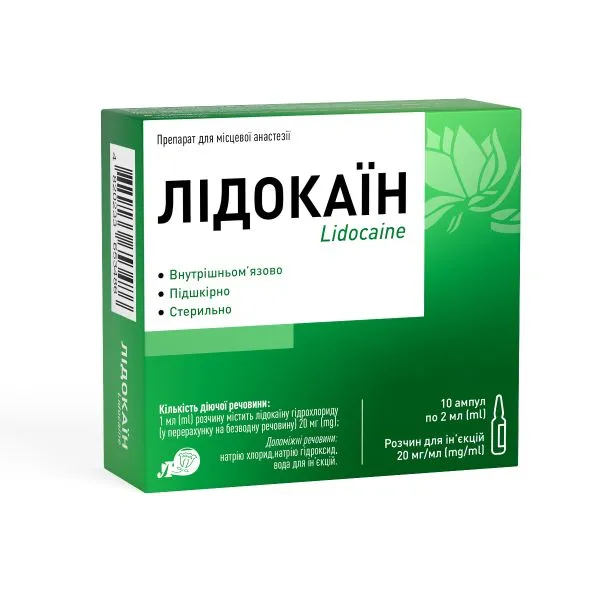
Table of Contents
INSTRUCTIONS FOR MEDICAL USE OF THE MEDICINAL PRODUCT LIDOCAINE (LIDOCAINE)
Composition:
Active substance: lidocaine hydrochloride;
1 ml of solution contains lidocaine hydrochloride − 20 mg;
Excipients: sodium chloride, sodium hydroxide, water for injections.
Pharmaceutical form. Injection solution.
Main physicochemical properties: clear, colorless or slightly colored liquid.
Pharmacotherapeutic group. Local anesthetics. Lidocaine.
ATC code N01B B02.
Pharmacological Properties
Pharmacodynamics
Lidocaine is an amide-type local anesthetic with a rapid onset of action and intermediate duration of effect. A 20 mg/mL solution provides 1½–2 hours of anesthesia with epidural administration and up to 5 hours with peripheral nerve block.
The onset and duration of local anesthetic action of lidocaine depend on the site of administration and dose. Like other local anesthetics, lidocaine causes reversible blockade of nerve impulse conduction by decreasing the permeability of the nerve cell membrane to sodium ions. Sodium channels in nerve cell membranes are considered receptors for local anesthetic molecules. As a result, the rate of depolarization decreases and the excitation threshold increases, leading to reversible local numbness.
Central nervous system (CNS) toxicity occurs at lower plasma concentrations of lidocaine than cardiac toxicity. Therefore, in cases of overdose, symptoms of CNS toxicity appear first, followed by cardiac toxicity.
The systemic effects of circulating local anesthetics on the heart may include slowed electrical excitability and conduction, negative inotropy, negative chronotropy, and hypotension. These effects rarely may lead to cardiac arrest.
Pharmacokinetics
Absorption
The plasma concentration of lidocaine depends on the dose, route of administration, and the degree of vascularity at the injection site. The onset of lidocaine's action occurs within 3–17 minutes after administration. Depending on the extent of nerve blockade, the effect lasts approximately 1–2 hours (for small nerve blocks and epidural anesthesia) or 3–4 hours (for large nerve blocks).
Lidocaine shows complete and biphasic absorption from the epidural space, with elimination half-lives of approximately 9.3 and 82 minutes, respectively. The slow rate of absorption determines the elimination of lidocaine. This explains why the apparent elimination half-life after epidural administration is longer than after intravenous administration. Absorption of lidocaine from the subarachnoid space is monophasic, with a half-life of 71 minutes.
Distribution
Typically, about 65% of lidocaine is protein-bound in plasma. Lidocaine, like other amide-type local anesthetics, binds primarily to alpha-1-acid glycoprotein (AAG) and also to albumin.
Lidocaine crosses the blood-brain barrier and the placenta, likely via passive diffusion.
Elimination
The plasma clearance of lidocaine is 0.95 L/min and occurs primarily through hepatic metabolism, depending on both hepatic blood flow and the activity of metabolizing enzymes. The hepatic extraction ratio is 65%. Approximately 90% of the administered dose of lidocaine is excreted by the kidneys as metabolites, with only 10% excreted unchanged. The main metabolites, monoethylglycinexylidide and glycinexylidide, are also pharmacologically active.
The elimination half-life of lidocaine in plasma is 0.5–2 hours, glycinexylidide – approximately 10 hours, and monoethylglycinexylidide – 2 hours. During prolonged intravenous infusion (longer than 24 hours), the clearance of lidocaine may be reduced; therefore, a reduction in the infusion rate may be required.
Pharmacokinetic/pharmacodynamic relationships
Lidocaine readily crosses the placenta, establishing equilibrium of free drug. Plasma protein binding is lower in the fetus than in the mother, which may result in lower total plasma concentrations in the fetus compared to the mother.
In patients with impaired liver function, the elimination half-life of lidocaine may be increased by two-fold or more.
Renal impairment does not affect the pharmacokinetics of lidocaine, but may lead to accumulation of metabolites.
Clinical characteristics.
Indications.
For local or regional anesthesia (infiltration anesthesia, nerve block, epidural anesthesia, and sympathetic nerve block) in adults and adolescents aged 12 years and older.
Contraindications.
Hypersensitivity to lidocaine and to other amide-type local anesthetics such as prilocaine, mepivacaine, and bupivacaine, or to any of the excipients of the product; to methyl and/or propylparahydroxybenzoate (methyl/propyl paraben) or to their metabolite para-aminobenzoic acid (PABA). Lidocaine preparations containing parabens should be avoided in patients with allergy to ester-type local anesthetics or to their metabolite PABA.
Interaction with other medicinal products and other forms of interaction.
Cimetidine and β-blockers may inhibit the metabolism of lidocaine. This interaction is considered clinically significant only during prolonged administration of high doses of lidocaine.
Lidocaine should be used with caution in patients receiving concomitant treatment with other local anesthetics or substances with similar chemical structure, such as certain antiarrhythmic agents (e.g., tocainide), since toxic effects are additive (risk of overdose). Specific studies on the interaction between lidocaine and class III antiarrhythmic agents (e.g., amiodarone) have not been conducted, but caution is recommended (see section "Special precautions").
Special precautions for use.
Warnings regarding special patient groups.
To minimize the risk of serious adverse effects, special attention should be paid to the following patient groups:
- Patients with partial or complete atrioventricular block, since local anesthetics may impair conduction;
- Elderly patients and those in poor general health. Acidosis or hypoxia in the patient increases the risk and severity of toxic reactions affecting the central nervous system or cardiovascular system (see section "Overdose");
- Patients with severe hepatic and/or renal insufficiency;
- Patients receiving class III antiarrhythmic agents (e.g., amiodarone) should be monitored and consideration given to ECG monitoring, as additive cardiac effects may occur (see section "Interaction with other medicinal products and other forms of interaction");
- Patients with acute porphyria. Injectable lidocaine solution is likely porphyrinogenic and should be administered only under strict indications to patients with severe or life-threatening acute porphyria. Appropriate precautions should be taken in all patients with porphyria.
Note! Regional anesthesia is often indicated for the above-mentioned patients. It is not recommended to reduce the recommended dose of lidocaine, as this may result in inadequate anesthesia for the procedure.
Local anesthetics should be avoided in areas of inflammation.
Warnings related to the technique of administration
Regional or local anesthesia should be performed in a properly equipped facility staffed with trained medical personnel. Medicinal products and other equipment for monitoring and resuscitation must be readily available. The possibility of arterial hypotension and bradycardia with central block should also be considered. When performing an extensive block, an intravenous catheter should be placed prior to administration of the local anesthetic.
Physicians performing the procedure must be familiar with the techniques to be used, as well as with the diagnosis and treatment of systemic toxicity and other complications that may arise from the use of local anesthetics (see section "Overdose").
Serious adverse effects have been reported with certain techniques of local anesthesia, regardless of the local anesthetic used.
For example:
- With retrobulbar injection, in isolated cases, the local anesthetic may leak into the subarachnoid space, causing toxic reactions even at low doses, including temporary blindness, cardiovascular collapse, apnea, and seizures. These complications must be promptly recognized and treated;
- With retro- and peribulbar injections of local anesthetics, there is a small risk of persistent dysfunction of the extraocular muscles. The main causes are trauma and/or local toxic effects on muscle and/or nerve tissue. The severity of tissue reaction depends on the severity of trauma, the concentration of the solution used, and the duration of exposure to the local anesthetic. Therefore, for all local anesthetics, the lowest effective concentration and dose should be used. Vasoconstrictors may enhance tissue reactions and should only be used when indicated;
- The possibility of severe arterial hypotension and bradycardia during central block should be considered, especially in patients with hypovolemia. This risk can be reduced by volume expansion with crystalloid or colloid solutions prior to anesthetic administration. Hypotension should be promptly treated with intravenous sympathomimetics, and this treatment may be repeated if necessary;
- Epidural anesthesia should be used with caution in patients with reduced cardiovascular reserve, as they may be less able to compensate for the lidocaine-induced slowing of atrioventricular conduction;
- Epidural anesthesia may lead to arterial hypotension and bradycardia. Arterial hypotension should be promptly treated with intravenous sympathomimetics, which may be repeated as needed;
- particularly, injections in the head and neck area may be accidentally administered intravascularly, potentially causing cerebral toxicity even at low doses;
- Continuous intra-articular infusions of lidocaine are not recommended. Cases of chondrolysis have been reported in patients receiving continuous intra-articular infusions of various amide-type local anesthetics postoperatively. Most reported cases of chondrolysis involved the shoulder joint. Although a causal relationship in these chondrolysis cases has not been established and no cases of chondrolysis have been specifically reported following lidocaine infusion, continuous intra-articular infusion is not recommended.
In rare cases, cardiac arrest without prior central nervous system symptoms has been reported. This cardiac arrest was likely a symptom of overdose due to accidental intravascular injection (see section "Overdose").
Other warnings
Cross-sensitivity with other amide-type local anesthetics should be considered.
Injectable lidocaine solution is not approved for intrathecal administration (subarachnoid anesthesia). Isolated cases of cauda equina syndrome with persistent paraesthesia, bowel and urinary tract dysfunction, or lower limb paralysis have been reported following intrathecal administration of lidocaine and similar agents. Most of these cases were associated with hyperbaric concentrations of lidocaine or prolonged intrathecal infusion.
Use during pregnancy or breastfeeding.
The drug is contraindicated during pregnancy.
If use of the drug is necessary, breastfeeding should be discontinued.
Ability to affect reaction speed when driving or operating machinery.
Local anesthetics may temporarily impair motor activity and alertness. They may also have a minor effect on mental function and coordination. The physician should assess the potential impact on the individual patient and provide appropriate counseling.
Method of Administration and Dosage.
Adults and children aged 12 years and older
Dosage
The table can be used as a guideline for adults with a body weight of approximately 70 kg. Dosage should be adjusted according to age, body weight, and patient's condition. The figures represent the expected range of required doses. For selecting the appropriate blockade technique for a specific patient, standard guidelines should be consulted.
The maximum dose of lidocaine corresponds to an amount equivalent to 200 mg of lidocaine hydrochloride. The smallest dose necessary to achieve adequate anesthesia should be used (see section "Special Instructions").
| Type of block |
Conc. |
Dosage |
Onset time (administration) |
Duration of block |
| mg/mL |
mg |
minutes |
hours |
|
| SURGICAL ANAESTHESIA |
||||
| Lumbar epidural block a) |
20 |
300–500 |
15–20 |
1.5–2 |
| Thoracic epidural block a) |
20 |
200–300 |
10–20 |
1.5–2 |
| Caudal epidural block a) |
20 |
300–500 |
15–30 |
1.5–2 |
| INFILTRATION ANAESTHESIA b) |
||||
| Retrobulbar block |
20 |
80 |
3–5 |
1.5–2 |
| Throat, nose, ear (except tonsillectomy) |
20 |
10–200 |
||
| MAJOR NERVE BLOCKS |
||||
| Peripheral nerve block |
20 |
30–200 60–400 |
||
| Sciatic nerve block |
20 |
300–400 |
15–30 |
2–3 |
| a) dosage determined by number of segments to be anesthetized (2–3 mL per dermatome); dose includes test dose; |
||||
Method of Administration
Extreme caution must be exercised to avoid unintentional intravascular injection. The injection should always be administered slowly and carefully. For epidural anesthesia, a test dose of 3–5 mL of a short-acting local anesthetic, preferably containing adrenaline (epinephrine), is recommended. This is because intravascular injection of adrenaline is rapidly recognized by an increase in heart rate. Intrathecal injection may be identified by signs of spinal block.
An oral contact with the patient must be maintained, and continuous monitoring of heart rate should be performed for 5 minutes after administration of the test dose. If no adverse reactions occur, proceed with administration of the full dose. The full dose should be administered slowly, with continuous communication and monitoring of the patient.
If mild toxic symptoms occur, administration should be stopped immediately.
For surgical anesthesia (e.g., epidural administration), higher concentrations and doses are generally required (higher than those used for postoperative analgesia).
However, the lowest effective concentration and dose should be used whenever possible, and the maximum dose should not be exceeded.
The volume of solution used plays a role in determining the extent of anesthetic diffusion. If a larger volume with lower concentration is required, the standard solution should be diluted with physiological saline (NaCl 0.9%). Such dilutions should be prepared immediately before administration.
Prior to injection, it is advisable to warm the solution to body temperature, as injection of cold solutions may be painful.
Children
The drug should not be used in children under 12 years of age.
Overdose
Following accidental intravascular injection, toxic effects will become apparent within seconds or a few minutes. In cases of overdose with local administration, toxic manifestations are delayed (15–60 minutes after injection) due to the slower rise in plasma concentration of the local anesthetic.
Acute Systemic Toxicity
Systemic signs of toxicity may involve both the central nervous system (CNS) and the cardiovascular system. These reactions are primarily caused by high blood concentrations of the local anesthetic, which may result from (accidental) intravascular injection, overdose, or extremely rapid absorption from highly perfused areas. Generally, cardiovascular toxicity is preceded by signs of CNS toxicity, unless the patient is under general anesthesia or receiving strong sedative agents such as benzodiazepines or barbiturates.
Central Nervous System toxicity has a gradual onset, with symptoms and signs progressively increasing in severity. Initial symptoms include perioral numbness, tongue numbness, dizziness, hyperacusis, tinnitus, and visual disturbances. Dysarthria, twitching, or tremor are more serious and may precede generalized seizures. These symptoms should not be mistaken for neurotic behavior. Loss of consciousness and generalized tonic-clonic seizures may follow, lasting from several seconds to minutes.
Due to increased muscular activity and respiratory impairment during seizures, hypoxia and hypercapnia develop rapidly. In severe cases, apnea may occur. Acidosis, hyperkalemia, hypokalemia, hypocalcemia, and hypoxia worsen and potentiate the toxic effects of local anesthetics.
Cardiovascular toxicity indicates a more severe condition and is usually preceded by signs of central nervous system toxicity. Prodromal CNS symptoms may be absent in patients under deep sedation or general anesthesia. Arterial hypotension, bradycardia, arrhythmias, and even cardiac arrest may occur due to high systemic concentrations of local anesthetics, although cardiac arrest rarely occurs without preceding CNS effects.
In children, early signs of CNS toxicity may be difficult to detect if they are under general anesthesia during the block.
Treatment of Acute Intoxication
If signs of acute toxicity occur, injection of the local anesthetic should be stopped immediately. CNS symptoms (convulsions and CNS depression) should be treated promptly with respiratory support, oxygen administration, and/or artificial ventilation, along with the use of anticonvulsant agents.
In case of circulatory arrest, immediate cardiopulmonary resuscitation (CPR) should be initiated. Optimal oxygenation, ventilation, circulatory support, and correction of acidosis are vital.
In cases of cardiovascular depression (arterial hypotension, bradycardia), appropriate treatment with intravenous fluids, vasopressors, and/or inotropic agents should be considered. Doses for children should be age- and weight-appropriate.
In cases of cardiac arrest, prolonged resuscitation is required for successful treatment.
Side effects.
Adverse reactions are listed by system organ classes and are classified according to the following frequency: very common (≥1/10), common (≥1/100, <1/10), uncommon (≥1/1000, <1/100), rare (≥1/10,000, <1/1000), very rare (<1/10,000), frequency not known (frequency cannot be estimated from the available data).
General. Side effects caused directly by the drug are difficult to distinguish from the physiological effects of nerve block (e.g., decreased blood pressure, bradycardia), side effects caused directly by the injection (e.g., nerve injury), and those indirectly caused (e.g., epidural abscess).
Nervous system disorders: common – paraesthesia, dizziness; uncommon – symptoms of CNS toxicity (convulsions, perioral paraesthesia, tongue numbness, hyperacusis, visual disturbances, tremor, CNS depression, tinnitus, dysarthria, and loss of consciousness); rare – neuropathy, peripheral nerve injury, arachnoiditis.
Cardiovascular system disorders: common – bradycardia, increased/decreased blood pressure; rare – cardiac arrest, cardiac arrhythmias.
Respiratory system disorders: rare – respiratory depression or respiratory arrest.
Eye disorders: rare – diplopia.
Immune system disorders: rare – allergic reactions, hypersensitivity reactions, including anaphylactoid reactions (including anaphylactic shock).
Gastrointestinal disorders: common – nausea, vomiting.
Blood and lymphatic system disorders: rare – methaemoglobinaemia.
Other: sensations of warmth, cold or numbness in extremities, malignant hyperthermia, oedema, weakness.
Local reactions: reactions at the site of administration, sensation of mild burning which disappears as the anaesthetic effect increases within 1 minute, thrombophlebitis, hyperaemia.
With spinal or epidural anaesthesia, back pain, leg pain, partial/complete spinal block associated with arterial hypotension, defecation disorders, involuntary urination, impotence, and loss of sensation in the perineal area may occur (the likelihood of these effects increases with higher doses or accidental intrathecal administration of lidocaine when a dose intended for epidural administration enters the intrathecal space). In individual cases, recovery of motor, sensory and/or autonomic function after such procedures may be slow (over several months) or incomplete.
Reporting of suspected adverse reactions
Reporting suspected adverse reactions after marketing authorization is important. It allows continued monitoring of the benefit-risk balance of the medicinal product. Healthcare professionals and pharmacists, as well as patients or their legal representatives, should report any suspected adverse reactions and lack of efficacy of the medicinal product via the Automated Information System for Pharmacovigilance at the following link: https://aisf.dec.gov.ua.
Shelf life. 2 years.
Storage conditions. Store in the original packaging at a temperature not exceeding 25 °C. Keep out of the reach of children.
Incompatibilities. The medicinal product must not be mixed with other medicinal products in the same syringe. The solubility of lidocaine at pH > 6.5 is limited. This should be taken into account when adding alkaline solutions such as carbonates, as precipitation may occur.
Packaging. 2 ml in a polyethylene ampoule. 10 or 50 ampoules in a cardboard pack.
2 ml in a polyethylene ampoule. 10 ampoules in a cardboard pack.
Prescription status. Prescription only.
Manufacturer. LLC "FARMASEL".
Manufacturer's address and location of its business activity.
3, Prorizna Street, Kvittneve village, Brovary district, Kyiv region, 07408, Ukraine.