Leiprorelin sandoz®
Ukraine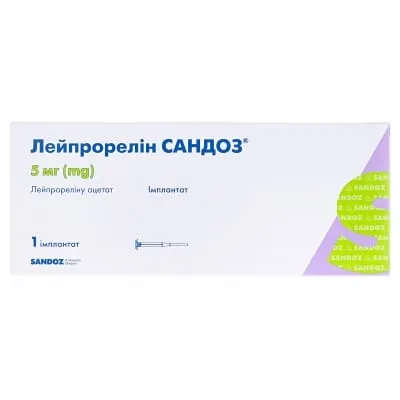
Table of Contents
INSTRUCTIONS FOR MEDICAL USE OF THE MEDICINAL PRODUCT LEUPRORELIN SANDOZ®
Composition:
Active substance: leuprorelin acetate;
1 implant contains 5 mg leuprorelin (as leuprorelin acetate);
Excipient: polylactic acid.
Pharmaceutical form. Implant.
Main physicochemical properties: implant of white to slightly yellowish color with a homogeneous surface.
Pharmacotherapeutic group. Gonadotropin-releasing hormone analogues. ATC code L02A E02.
Pharmacological properties.
Pharmacodynamics.
The active ingredient of Leiprorelin Sandoz® – leuprorelin acetate – is a synthetic analogue of the natural hypothalamic gonadotropin-releasing hormone (GnRH), which regulates the release of gonadotropin hormones LH (luteinizing hormone) and FSH (follicle-stimulating hormone) from the anterior pituitary gland. These hormones stimulate steroid synthesis in the gonads.
In contrast to the physiological GnRH, which is secreted by the hypothalamus in a pulsatile manner, leuprorelin acetate (also known as a GnRH agonist) provides continuous blockade of the pituitary GnRH receptors throughout the treatment period, resulting in the pituitary gland no longer perceiving or responding to initial transient stimulation (down-regulation). As a consequence of this feedback inhibition of gonadotropin secretion by the pituitary, testosterone levels decrease, thereby affecting the growth of prostate cancer tissue. Under normal conditions, this tissue is stimulated by dihydrotestosterone, which is produced in response to reduced testosterone levels in prostate cells.
Continuous administration of leuprorelin acetate leads to a reduction in both the number and sensitivity (so-called down-regulation) of pituitary receptors, resulting in decreased levels of LH, FSH, and DHT. This, in turn, causes testosterone levels to decline to castrate-range levels. Animal studies have demonstrated an antiandrogenic effect and inhibition of prostate carcinoma growth. According to experimental and clinical studies, a three-month course of leuprorelin acetate treatment following initial stimulation results in reduced gonadotropin secretion. In men, subcutaneous administration of leuprorelin acetate initially causes an increase in LH and FSH levels, accompanied by a transient rise in testosterone and dihydrotestosterone levels. Due to a temporary worsening of the clinical picture observed within the first 3 weeks of treatment in isolated cases, men with prostate cancer may be prescribed additional antiandrogens at the beginning of therapy. In contrast, prolonged administration of leuprorelin acetate leads to a reduction in LH and FSH levels. Androgen levels in men decrease to values comparable to those observed after surgical removal of both testes. These changes typically occur within 2–3 weeks after initiation of therapy and persist throughout the remainder of treatment. Nevertheless, when considering leuprorelin acetate therapy, the hormonal sensitivity of prostate cancer tissue and the potential therapeutic benefits of orchidectomy should be evaluated. If necessary, orchidectomy can be replaced by 3-monthly administration of leuprorelin acetate. According to available data, continuous administration of leuprorelin acetate can maintain castrate testosterone levels for over 5 years.
Pharmacokinetics.
After injection, the implant begins a continuous release of leuprorelin acetate (the active substance) from the lactic acid polymer, lasting up to 182 days (26 weeks). Over time, the polymer is absorbed similarly to surgical suture material.
Within 2 hours after a single dose, leuprorelin levels reach a peak concentration of 5216 pg/mL (5.2 ng/mL). The area under the pharmacokinetic curve during three months of treatment amounts to 32.4 ng/mL*d. The serum concentration remains detectable up to 182 days (26 weeks) after administration. The volume of distribution of leuprorelin in men is 36 L; total clearance is 139.6 mL/min.
Repeated administration leads to a sustained reduction in testosterone levels to castration (sterility) levels, except for the transient increase in testosterone levels that may occur after the first injection.
In patients with impaired renal or hepatic function, leuprorelin parameters were found to be at similar levels as in patients with healthy kidneys and liver. In some patients with chronic renal insufficiency, serum leuprorelin levels were higher. However, this observation is unlikely to have clinical significance.
Clinical characteristics.
Indications.
Treatment of progressive hormone-dependent prostate cancer.
Contraindications.
- Hypersensitivity to leuprorelin or other gonadotropin-releasing hormone analogs, or to polylactic acid.
- Hormone-independent tumors.
- Surgical castration.
- Leuprorelin Sandoz® must not be used in women and children.
Interaction with other medicinal products and other forms of interaction.
Interaction with other medicinal products is unknown.
Since antiandrogen therapy may prolong the QT interval, careful assessment of the possibility of concomitant use of Leuprorelin Sandoz® with medicinal products that prolong the QT interval or may cause torsades de pointes tachycardia is required, such as antiarrhythmic agents of class IA (e.g. quinidine, disopyramide) or class III (e.g. amiodarone, sotalol, dofetilide, ibutilide), methadone, moxifloxacin, neuroleptics, and others (see section "Special warnings and precautions for use").
Special precautions for use.
Patients with hypertension require careful monitoring. There is an increased risk of developing depression and symptoms of emotional lability, such as crying, irritability, impatience, anger, and aggression in patients receiving gonadotropin-releasing hormone (GnRH) antagonists.
At the beginning of treatment, a transient increase in serum testosterone levels often occurs, which may be accompanied by a temporary worsening of certain clinical symptoms (onset or exacerbation of bone pain, urinary obstruction with associated complications, spinal cord compression, leg weakness, lymphedema). With continued treatment, these complications usually resolve spontaneously. Allergic and anaphylactic reactions, including local reactions at the injection site as well as systemic reactions, may occur. At the initial stage of treatment, to reduce the severity of possible complications (initial testosterone surge and worsening of clinical symptoms), the concomitant use of appropriate antiandrogens may be considered.
Therapeutic efficacy should be monitored regularly through clinical examinations (digital rectal examination of the prostate, ultrasound, bone scintigraphy, computed tomography) and laboratory tests measuring serum levels of phosphatase and/or prostate-specific antigen (PSA) and testosterone.
Hypogonadism resulting from long-term treatment with GnRH analogs and/or orchiectomy may lead to osteoporosis with an increased risk of fractures. The development of osteoporosis is more pronounced after orchiectomy (with elevated cortisol levels) than after administration of GnRH analogs.
In patients at high risk, additional administration of bisphosphonates may prevent bone demineralization.
Patients with metastases in the brain or spinal cord, neurological disorders, or urinary tract obstruction require particularly careful monitoring, especially during the first few weeks of treatment. In isolated cases, spinal cord compression and renal insufficiency have been observed in such patients.
Treatment with Leiprolin Sandoz® may result in positive doping test outcomes.
Changes in glucose tolerance have been observed in some patients receiving GnRH analogs. Diabetic patients require monitoring during treatment with this medicinal product.
Antiandrogen therapy may prolong the QT interval.
In patients with a history of QT prolongation (or relevant risk factors), as well as in patients receiving concomitant medicinal products that may prolong the QT interval (see section "Interaction with other medicinal products and other forms of interaction"), physicians should assess the benefit-risk ratio, including the potential risk of torsades de pointes tachycardia, before initiating treatment with this medicinal product.
Idiopathic intracranial hypertension
Idiopathic intracranial hypertension (pseudotumor cerebri) has been reported in patients receiving leuprorelin. Patients should be informed about the signs and symptoms of idiopathic intracranial hypertension, including severe or persistent headache, visual disturbances, and tinnitus. If idiopathic intracranial hypertension occurs, discontinuation of leuprorelin should be considered.
Use during pregnancy or breastfeeding
This medicinal product is intended for use only in male patients.
Ability to affect reaction speed when driving or operating machinery
Due to the occurrence of fatigue, sometimes severe fatigue—particularly at the initial stage of treatment, which may be related to the underlying tumor disease—the medicinal product, even when used correctly, may impair reaction time and negatively affect the ability to drive a vehicle or operate complex machinery. Alcohol may intensify this adverse effect. The potential for adverse reactions affecting the nervous system and visual organs should also be taken into account.
Method of Administration and Dosage
The recommended dose is 5 mg of leuprorelin once every 3 months. If no temporary improvement or positive response is observed, continuation of treatment is not recommended.
In exceptional cases, administration of the drug may be delayed for up to 4 weeks without reducing the therapeutic effect in most patients.
The drug must be administered by a physician experienced in anticancer therapy. The implant is injected subcutaneously in the abdominal area.
Instructions for Use:
Carefully read these instructions, as the syringe supplied with this product may differ from those you have used previously.
- Disinfect the injection site on the anterior abdominal wall below the umbilical line.
- Remove the syringe from the sterile package and check for the presence of the implant in the chamber (see boxed area). If necessary, hold the syringe up to the light or gently shake it.
- Pull the syringe plunger to the extreme end position until you see the full line in the second window.
Caution: The plunger can only be pushed forward to administer the implant if it has previously been fully pulled out!
- Remove the protective cap from the needle.
- Hold the syringe barrel with one hand. With the other hand, pinch the skin of the patient’s anterior abdominal wall below the umbilical line. See illustration. Insert the needle with the bevel facing upward fully into the subcutaneous tissue at a shallow angle, almost parallel to the skin.
- Carefully withdraw the syringe approximately 1 cm backward. This creates a puncture channel for the implant.
- Administer the implant into the puncture channel by advancing the plunger forward until it locks into place and you hear a clicking sound.
- Withdraw the needle. To confirm correct administration of the implant, check that the white tip of the plunger is visible at the end of the needle.
Typically, within 3 months it can be determined whether prostate carcinoma is androgen-sensitive. The main diagnostic parameter is the measurement of prostate-specific antigen (PSA) concentration, which is usually greater than 10 ng/mL during active tumor progression. PSA levels are assessed after androgen suppression using the drug at a dose of 5 mg. However, PSA levels, as well as testosterone levels in general, should be measured before and after drug administration over a period of 3 months. Test results are considered positive if, within 3 months, testosterone concentration reaches castrate levels (< 1 ng/mL) and PSA levels have decreased. An early reduction in PSA (approximately 80% from baseline) may be considered a positive predictor of long-term response to androgen suppression. In such cases, hormonal suppression therapy is indicated.
Test results are considered negative if PSA levels remain unchanged or increase despite a decrease in testosterone. In such cases, continuation of hormonal suppression therapy is not appropriate.
However, if a clinical response is observed in the patient (e.g., reduction in pain, urinary symptoms, and restoration of normal prostate size), inconclusive or apparently negative test results should be taken into account. In such rare cases, treatment with Leuprorelin Sandoz® 5 mg should be continued for an additional 3 months, with continued monitoring of PSA levels. Additionally, the patient’s clinical symptoms should be closely monitored.
Generally, treatment of advanced hormone-dependent prostate carcinomas with this drug requires long-term therapy.
The therapeutic effect of treatment should be regularly monitored through clinical examinations (digital rectal examination of the prostate, ultrasound imaging, bone scans, computed tomography) and laboratory tests measuring phosphatase or PSA and serum testosterone levels (especially if signs of tumor progression occur despite adequate therapy).
Children
Do not use for treatment of children.
Overdose
Available data do not contain information on symptoms of intoxication.
In case of overdose, symptomatic treatment should be provided, and supportive therapy administered if necessary.
Adverse Reactions
Due to suppression of certain sex hormones, undesirable adverse effects may develop. Adverse reactions are categorized by frequency as follows: very common (≥ 1/10), common (≥ 1/100 to < 1/10), uncommon (≥ 1/1000 to < 1/100), rare (≥ 1/10,000 to < 1/1000), very rare (< 1/10,000), frequency not known (available data do not allow estimation of frequency).
The most commonly reported adverse effects of leuprorelin treatment are hot flushes and increased sweating. These occur with a frequency of 10%.
At the beginning of treatment, a transient increase in serum testosterone concentration is usually observed, which may temporarily worsen certain disease symptoms (bone pain or increased bone pain, urinary tract obstruction and its consequences, spinal cord compression, leg muscle weakness, lymphedema). This symptom exacerbation usually resolves spontaneously without the need to discontinue leuprorelin.
Central and peripheral nervous system
Uncommon: headache, dizziness, anxiety, hallucinations, depression, syncope, hypoesthesia, insomnia, lethargy, memory impairment, mood changes, nervousness, neuromuscular disorders, numbness, paresthesia, peripheral neuropathy, taste disturbance, seizures or exacerbation of pre-existing symptoms; frequency not known: idiopathic intracranial hypertension (pseudotumor cerebri).
Rare: taste disorders, olfactory disturbances, involuntary movements, insomnia, visual disturbances, skin sensory disturbances, pituitary apoplexy after the first administration of leuprorelin in patients with pituitary adenoma, cases of suicidal ideation and suicide attempts.
Respiratory system
Common: dyspnea, cough, pharyngitis.
Uncommon: shortness of breath, hemoptysis, emphysema, epistaxis, pleural effusion, pleural friction rub, pneumonia, pulmonary fibrosis, lung infiltrates, respiratory disorder, sinus congestion.
Frequency not known: interstitial lung disease.
Gastrointestinal system
Common: nausea, vomiting, diarrhea or constipation, flatulence, dry mouth, peptic ulcer, gastrointestinal disorders with possible bleeding, liver function abnormalities, increased appetite, rectal polyps, thirst.
Skin and subcutaneous tissue
Uncommon: rash, maculopapular rash, alopecia, night sweats, dermatitis, dry skin, pruritus, increased/decreased hair growth, throat tightness, pigmentation, skin damage, urticaria.
Rare: skin/ear carcinoma.
Musculoskeletal and connective tissue
Common: arthralgia.
Uncommon: ankylosing spondylitis, myalgia, pelvic fibrosis, vertebral fracture, paralysis, tenosynovitis-like symptoms, osalgia.
Urogenital and reproductive systems
Very common: decreased libido and erectile dysfunction.
Common: dysuria, nocturia, pollakiuria.
Uncommon: dysuria, hematuria, testicular pain, testicular atrophy, bladder spasms, urinary incontinence, penile dysfunction, prostate pain, urinary tract infections.
Endocrine system
Uncommon: gynecomastia, diabetes mellitus, thyroid enlargement.
Rare: cases of pituitary hemorrhage after first administration in patients with pituitary adenoma.
Metabolism and nutritional disorders
Common: increased appetite.
Uncommon: decreased appetite, metabolic changes in diabetic patients (decreased or increased blood glucose levels), pathological weight gain, hypercalcemia and hypercreatininemia, dehydration, hyperlipidemia (increased total cholesterol, low-density lipoprotein cholesterol, triglycerides), hyperphosphatemia, hypoglycemia, hypoproteinemia, hyponatremia, hyperuricemia, hyperbilirubinemia, weight loss.
Cardiovascular system
Very common: hot flushes with episodes of increased sweating, vasodilation.
Uncommon: angina pectoris, arrhythmia, palpitations, changes in blood pressure (hypertension or hypotension), bradycardia, chronic heart failure, ECG changes, auscultatory murmurs, myocardial infarction, phlebitis, pulmonary embolism, stroke, syncope, tachycardia, thrombosis, transient ischemic attacks, varicose veins.
Frequency not known: QT interval prolongation.
Blood and lymphatic system
Uncommon: anemia, ecchymoses, lymphedema, prolonged prothrombin time and partial thromboplastin time, thrombocytopenia, leukocytosis, leukopenia, eosinophilia.
General disorders and administration site conditions
Rare: fatigue, photosensitivity reactions, temporal swelling, jaundice, local skin reactions, particularly erythema at the injection site, which usually resolves during continued treatment.
Uncommon: injection site reactions including pain, inflammation, sterile abscess, tissue induration, hematoma.
Immune system
Rare: systemic allergic reactions (fever, pruritus, skin rash), anaphylaxis.
Eye disorders
Uncommon: visual disturbances, amblyopia, blurred vision, ophthalmic disorders, dry eye.
Ear and labyrinth disorders
Uncommon: hearing disturbances, tinnitus.
Neoplasms
Uncommon: unexpected exacerbation of prostate cancer, aggravation of prostate cancer.
Laboratory investigations
Uncommon: increased levels of enzymes such as lactate dehydrogenase (LDH) and alkaline phosphatase (ALP), as well as transaminases, including serum alanine aminotransferase (ALT), serum aspartate aminotransferase (AST), and γ-GT; elevated blood creatine phosphokinase, elevated triglycerides, prolonged prothrombin time, prolonged blood coagulation time.
Frequency not known: in isolated cases, abscess at the injection site.
Note.
Response to treatment can be monitored by measuring serum testosterone, acid phosphatase, and PSA levels. At the beginning of therapy, testosterone levels usually rise initially and then decrease within 2 weeks. Within 2–4 weeks, testosterone levels reach values comparable to those after castration and remain at this level throughout further treatment.
During treatment with the drug, bone mineral density may decrease. Reactive bone changes can be monitored by bone scintigraphy.
In the initial phase of treatment, a transient increase in acid phosphatase levels may occur. Usually, values return to normal within a few weeks.
Shelf life. 4 years.
Storage conditions.
Store at temperatures not exceeding 30 °C.
Keep out of reach of children.
Packaging.
1 clear pre-filled syringe with implant and metal needle with polyethylene protective cap, in an aluminum pouch. Packs of 1, 3, or 6 pouches in a cardboard box.
Prescription category.
Prescription only.
Manufacturer.
- Ever Pharma Jena GmbH (production "inbulk", packaging, batch release).
- Ever Pharma Jena GmbH (secondary packaging, quality control, batch release).
- EBEWE Pharma Ges.m.b.H. Nfg. KG (batch release).
- Sandoz GmbH – Manufacturing Division Anti-Infectives GLZ and Chemical Operations Kundl (AIO GLZ Kundl) (batch release).
Manufacturer's location and address of place of business.
- Otto-Schott-Strasse 15, 07745 Jena, Germany.
- Brüsseler Strasse 18, 07747 Jena, Lobeda, Germany.
- Mondseestrasse 11, 4866 Unterach am Attersee, Austria.
- Biochemiestrasse 10, 6250 Kundl, Austria.