Levoksimed
Ukraine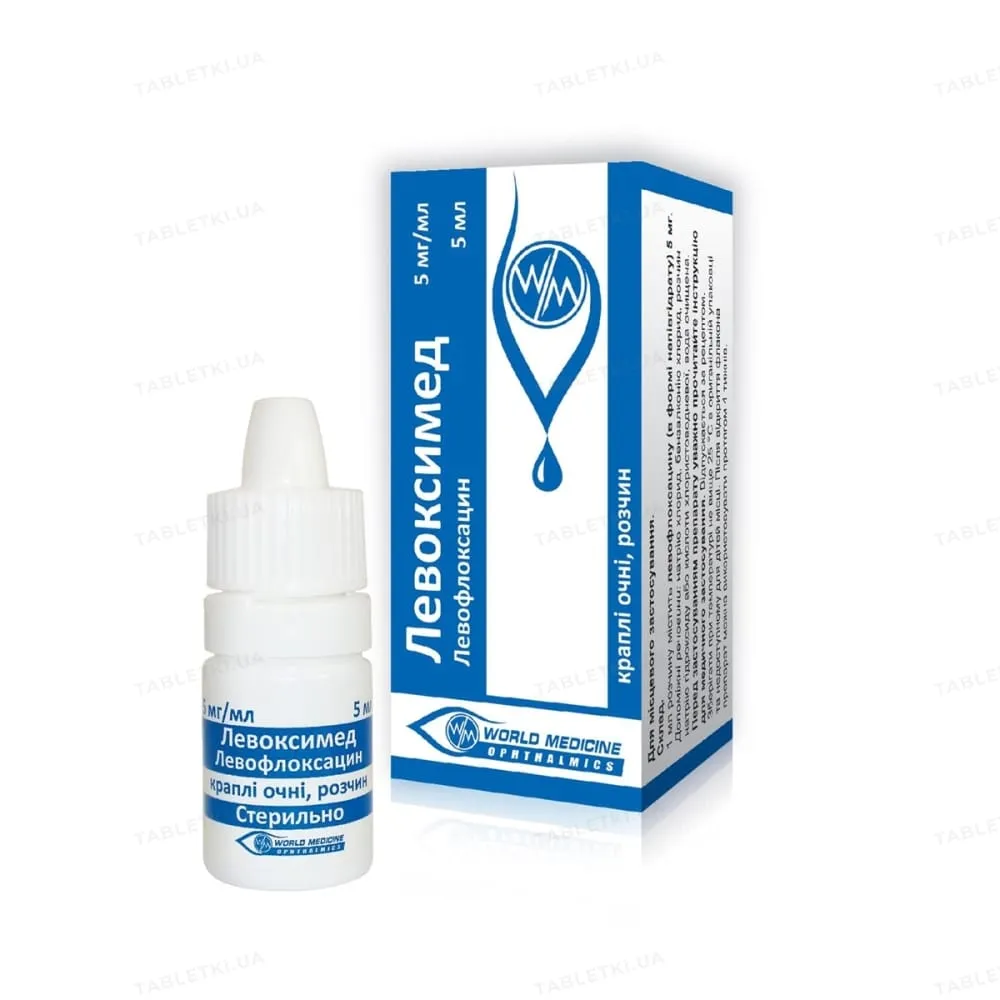
Table of Contents
INSTRUCTIONS FOR MEDICAL USE OF THE MEDICINAL PRODUCT LEVOXIMED (LEVOXIMED)
Composition:
Active substance: levofloxacin;
1 ml of solution contains levofloxacin (as hemihydrate) 5 mg;
Excipients: sodium chloride, benzalkonium chloride, sodium hydroxide solution or concentrated hydrochloric acid, purified water.
Pharmaceutical form. Eye drops, solution.
Main physico-chemical properties: clear light-yellow or greenish-yellow solution.
Pharmacotherapeutic group
Ophthalmologicals. Antibacterials. Fluoroquinolones. Levofloxacin. ATC code S01AE05.
Pharmacological Properties
Pharmacodynamics
Levofloxacin is the L-isomer of the racemic medicinal substance ofloxacin. The antibacterial activity is primarily exerted by the L-isomer of ofloxacin.
Mechanism of action
Levofloxacin is a fluoroquinolone antibacterial agent that inhibits bacterial type II topoisomerases—DNA gyrase and topoisomerase IV. The action of levofloxacin in Gram-negative bacteria is primarily directed against DNA gyrase, whereas in Gram-positive bacteria it targets topoisomerase IV.
Mechanisms of resistance development
There are two main mechanisms by which bacterial resistance to levofloxacin develops: reduced intracellular concentration of the drug and alterations in the enzyme targets of levofloxacin. These changes occur as a result of chromosomal mutations in genes encoding DNA gyrase (gyrA and gyrB) and topoisomerase IV (parC and parE; grlA and grlB in Staphylococcus aureus). Causes of resistance due to reduced intracellular concentration of levofloxacin include alterations in outer membrane porins (OmpF), which reduce the ability of fluoroquinolones to penetrate into Gram-negative bacteria, or efflux pumps that promote drug expulsion. Efflux-mediated resistance has been described in pneumococci (PmrA), staphylococci (NorA), and anaerobic as well as Gram-negative bacteria. Resistance to quinolones mediated by plasmid DNA (encoded by the qnr gene) has been reported in Klebsiella pneumoniae and E. coli.
Cross-resistance
Cross-resistance among fluoroquinolones may occur. Single mutations do not usually lead to clinical resistance, but multiple mutations typically result in clinical resistance to all agents within the fluoroquinolone class. Alterations in outer membrane porins and efflux systems may have broad substrate specificity, affecting multiple classes of antibacterial agents and leading to the development of multidrug resistance.
Breakpoints
The minimum inhibitory concentration (MIC) breakpoints that distinguish susceptible and moderately resistant organisms from resistant ones according to EUCAST (European Committee on Antimicrobial Susceptibility Testing) are as follows:
Pseudomonas spp., Staphylococcus spp., Streptococcus A, B, C, G:
susceptible ≤ 1 mg/L, resistant > 2 mg/L;
Streptococcus pneumoniae: susceptible ≤ 2 mg/L, resistant > 2 mg/L;
Haemophilus influenzae, Moraxella catarrhalis: susceptible ≤ 1 mg/L, resistant > 1 mg/L.
All other pathogenic microorganisms: susceptible ≤ 1 mg/L, resistant > 2 mg/L.
Antibacterial spectrum
The prevalence of acquired resistance in specific bacterial species may vary geographically and over time; therefore, local resistance data are desirable, especially when treating severe infections. Thus, the information provided below offers only approximate guidance and recommendations regarding potential microbial susceptibility to levofloxacin. If local resistance rates are such that the benefit of using the medicinal product against at least some types of infections is questionable, expert consultation should be sought when necessary. The table below includes only bacterial species commonly associated with external ocular infections such as conjunctivitis.
Antibacterial spectrum – susceptibility categories and resistance characteristics according to EUCAST criteria
| Category I: Commonly susceptible organisms |
|
| Aerobic gram-positive microorganisms: |
|
| Staphylococcus aureus (MSSA)* |
|
| Streptococcus pneumoniae |
|
| Streptococcus pyogenes |
|
| Viridans group streptococci |
|
| Aerobic gram-negative microorganisms: |
|
| Escherichia coli |
|
| Haemophilus influenzae |
|
| Moraxella catarrhalis |
|
| Pseudomonas aeruginosa |
(Isolates from community settings) |
| Other microorganisms: |
|
| Chlamydia trachomatis |
(When treating patients with chlamydial conjunctivitis, systemic antimicrobial therapy should be administered concurrently) |
| Category II: Organisms for which acquired resistance may pose a problem |
|
| Aerobic gram-positive microorganisms: |
|
| Staphylococcus aureus (MRSA)** |
|
| Staphylococcus epidermidis |
|
| Aerobic gram-negative microorganisms: |
|
| Pseudomonas aeruginosa |
(Hospital isolates) |
* MSSA = methicillin-susceptible Staphylococcus aureus strains.
** MRSA = methicillin-resistant Staphylococcus aureus strains.
The resistance data presented in the table are based on results from a multicenter surveillance study (ophthalmological study) on the prevalence of resistance among bacterial isolates obtained from patients with ocular infections in Germany (June–November 2004).
Microorganisms were classified as susceptible to levofloxacin based on in vitro susceptibility testing and plasma concentrations following systemic therapy. Higher maximum concentrations than those in plasma were achieved with topical administration. However, it is unknown whether the ocular pharmacokinetics of levofloxacin after topical ocular instillation may alter its antibacterial activity and, if so, how.
Paediatric population
Pharmacodynamic properties are similar in adults and children aged 1 year and older.
Pharmacokinetics
After ocular instillation, levofloxacin is well maintained in the tear film.
In a study conducted in healthy volunteers, mean concentrations of levofloxacin in the tear film measured at 4 and 6 hours after topical dosing were 17.0 and 6.6 µg/mL, respectively. Four hours after dosing, concentrations were ≥2 µg/mL in 5 out of 6 subjects studied. This concentration was still observed at 6 hours after dosing in 4 out of 6 subjects studied.
Plasma concentrations of levofloxacin were measured in 15 healthy adult volunteers at various time points during a 15-day treatment course. The mean plasma concentration of levofloxacin one hour after dosing ranged from 0.86 ng/mL on Day 1 to 2.05 ng/mL on Day 15. The highest peak plasma concentration of levofloxacin—2.25 ng/mL—was recorded on Day 4, following two days of dosing every 2 hours (total of 8 doses per day). Peak plasma concentrations of levofloxacin increased from 0.94 ng/mL on Day 1 to 2.15 ng/mL on Day 15, which is 1000-fold lower than concentrations reported after administration of standard oral doses of levofloxacin.
Plasma concentrations of levofloxacin achieved after administration of the medicinal product into the affected eye are unknown.
Clinical characteristics
Indications
Local treatment of external bacterial eye infections in patients aged 1 year and older, caused by microorganisms sensitive to levofloxacin.
Contraindications
Hypersensitivity to levofloxacin, to other quinolones, or to any of the excipients of the medicinal product, such as benzalkonium chloride.
Interaction with other medicinal products and other forms of interaction
No specific studies on interactions of topically applied levofloxacin with other medicinal products have been conducted.
Since maximum plasma concentrations of levofloxacin after ocular instillation are at least 1000 times lower than those observed after standard oral doses, interactions reported for systemic administration are unlikely to be clinically significant with topical use of levofloxacin.
Paediatric population
No drug interaction studies have been conducted.
Special precautions for use
The medicinal product must not be administered under the conjunctiva. The solution should not be injected directly into the anterior chamber of the eye.
As with antimicrobial medicinal products, prolonged use of levofloxacin may result in overgrowth of nonsusceptible microorganisms, including fungi. If the patient's condition worsens due to infection or if there is no clinical improvement within an appropriate period of time, treatment with the medicinal product should be discontinued and alternative therapy initiated.
When clinically indicated, patients should be examined using magnification techniques, such as slit-lamp biomicroscopy, and, if necessary, fluorescein staining.
Administration of systemic fluoroquinolones has been associated with hypersensitivity reactions, even after a single dose. If hypersensitivity reactions occur, the medicinal product should be discontinued.
With systemic use of fluoroquinolones, including levofloxacin, tendinitis and tendon rupture may occur, particularly in elderly patients and those concurrently receiving corticosteroids. Caution should be exercised during treatment, and the medicinal product should be discontinued at the first sign of tendon inflammation (see section "Adverse reactions").
The medicinal product contains benzalkonium chloride as a preservative. Contact lenses should be removed prior to instillation and at least 15 minutes should elapse before reinserting them. Benzalkonium chloride may change the color of soft contact lenses.
Patients with bacterial external ocular infections should not wear contact lenses.
Benzalkonium chloride has also been reported to cause ocular irritation, symptoms of dry eye, and may affect the tear film and corneal surface. The medicinal product should be used with caution in patients with dry eye and in those who may have compromised corneal integrity. Patients should be monitored during prolonged use.
Use during pregnancy or breastfeeding
Pregnancy
There are insufficient data on the use of levofloxacin in pregnant women. Animal studies do not indicate direct or indirect harmful effects with regard to reproductive toxicity. The potential risk to humans is unknown. The medicinal product should be used during pregnancy only if the expected benefit to the mother outweighs the potential risk to the fetus.
Breastfeeding
Levofloxacin is excreted in breast milk. However, when used at therapeutic doses, no effect on the breastfed infant is expected. The medicinal product should be used during breastfeeding only if the expected benefit to the mother outweighs the potential risk to the infant.
Fertility
Levofloxacin did not impair fertility in rats at exposures significantly exceeding the maximum human exposure following ophthalmic administration.
Effects on ability to drive and use machines
The medicinal product has a negligible influence on the ability to drive or operate machinery. If any transient effect on vision occurs, patients should wait until vision clears before driving or operating machinery.
Dosage and Administration
The medicinal product is intended for ophthalmic use.
Instill 1–2 drops into the affected eye(s) every 2 hours up to 8 times daily during the first 2 days (immediately after awakening), from day 3 to day 5 – 4 times daily.
The duration of treatment depends on the severity of the condition as well as the clinical and bacteriological course of the disease. Usually, treatment lasts for 5 days.
To prevent contamination of the dropper tip and solution, the tip of the dropper must not come into contact with the eyelids or surrounding areas of the eye.
When using different topical ophthalmic medicinal products simultaneously, the interval between instillations should be at least 15 minutes.
Elderly Patients
Dosage adjustment is not required for elderly patients.
Children
The doses used in adults and children aged 1 year and older are similar.
The safety and efficacy of levofloxacin ophthalmic drops have been established in children aged 1 year and older. Specific warnings and precautions for use are the same for adults and children aged 1 year and older.
The safety and efficacy of levofloxacin ophthalmic drops in children under 1 year of age have not yet been established. There are no adequate data available.
The safety and efficacy of the medicinal product for the treatment of corneal ulceration and neonatal ophthalmia have not been established.
Due to the lack of safety and efficacy data, the medicinal product is not recommended for use in children under 1 year of age.
Overdose
The total amount of levofloxacin in the ophthalmic drop bottle is too small to cause toxic effects following accidental oral ingestion. If necessary, the patient should be clinically monitored and supportive measures administered. After local overdose of the medicinal product, the eyes should be rinsed with clean water at room temperature.
Pediatric Patients
Management in case of overdose is similar to that in adults.
Side effects
Adverse reactions can be expected in approximately 10% of patients. These reactions are usually mild or moderate and transient, primarily limited to the eye area.
Since the medicinal product contains benzalkonium chloride, the active substance of this preservative may cause contact dermatitis and/or irritation.
The adverse reactions listed below have been identified as definitely, probably, or possibly related to treatment and have been reported during clinical trials and post-marketing surveillance.
Criteria for assessing the frequency of adverse reactions: very common (≥ 1/10); common (≥ 1/100, < 1/10); uncommon (≥ 1/1000, < 1/100); rare (≥ 1/10,000, < 1/1000); very rare (< 1/10,000); frequency not known (cannot be estimated from available data).
Immune system disorders:
Rare – extracocular ocular allergic reactions, including skin rash; very rare – anaphylaxis.
Nervous system disorders:
Uncommon – headache.
Eye disorders:
Common – burning sensation in eyes, blurred vision, and presence of mucus strands; uncommon – eyelid crusting, chemosis, conjunctival papillary reaction, blepharitis with symptoms of eyelid swelling and erythema, eye discomfort, eye itching, eye pain, conjunctival infection, conjunctival hyperemia, conjunctival follicles, dry eyes, eyelid erythema, and photophobia.
Corneal deposits were not observed during clinical trials.
Respiratory, thoracic and mediastinal disorders:
Uncommon – rhinitis; very rare – laryngeal edema.
Paediatric population
The frequency, type, and severity of adverse reactions in children are expected to be similar to those occurring in adults.
Additional adverse reactions observed with systemic administration of the active substance (levofloxacin) that may potentially occur during use of this medicinal product.
Tendon ruptures of the shoulder, hand, Achilles tendon, and other tendons requiring surgical intervention or leading to prolonged disability have been reported in patients receiving systemic fluoroquinolones. Post-marketing studies and clinical experience with systemic quinolones have shown that the risk of tendon rupture may be increased in patients receiving corticosteroids, particularly in elderly patients and in tendons under high stress, including the Achilles tendon (see section "Special precautions").
Reporting suspected adverse reactions
Reporting of suspected adverse reactions after medicinal product authorization is important. It allows ongoing monitoring of the benefit-risk balance of the medicinal product. Healthcare professionals and patients, as well as their legal representatives, should report any suspected adverse reactions and lack of efficacy via the Automated Pharmacovigilance Information System at the following link: https://aisf.dec.gov.ua.
Shelf life
3 years.
After opening the bottle, the product may be used for up to 28 days.
Storage conditions
Store at temperatures not exceeding 25 ºC. Keep out of the reach of children.
Packaging
5 ml in polymer dropper bottles; 1 dropper bottle in a cardboard box.
Prescription status
Prescription only.
Manufacturer
WORLD MEDICINE ILAC SAN. VE TIC. A.S. /
WORLD MEDICINE ILAC SAN. VE TIC. A.S.
Manufacturer's address and location of operations
15 Temmuz Mahallesi Cami Yolu Caddesi No:50 Gunesli Bagcilar/Istanbul, Turkey /
15 Temmuz Mahallesi Cami Yolu Caddesi No:50 Gunesli Bagcilar/Istanbul, Turkey.
Marketing Authorization Holder
WORLD MEDICINE, LLC, Ukraine /
WORLD MEDICINE, LLC, Ukraine.