Lesphal®
Ukraine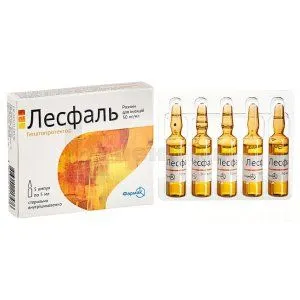
Table of Contents
INSTRUCTIONS FOR MEDICAL USE OF THE MEDICINAL PRODUCT LESFAL® (LESFAL)
Composition:
Active substance: 1 ml of solution contains 50 mg of soybean phosphatidylcholine;
Excipients: benzyl alcohol, deoxycholic acid, sodium chloride, sodium hydroxide, riboflavin (E 101), water for injections.
Pharmaceutical form. Solution for injection.
Main physico-chemical properties: clear yellow solution.
Pharmacotherapeutic group.
Hepatoprotectives. ATC code A05B A.
Pharmacological properties.
Pharmacodynamics.
In liver diseases, hepatocyte membranes and their organelles are always damaged, which may lead to changes in the activity of membrane-bound enzymes and receptor systems, disruption of the cell's metabolic function, and reduced intensity of liver regeneration.
The phospholipids contained in the drug Lesfal® are chemically similar to endogenous phospholipids but significantly surpass them due to their high content of polyunsaturated (essential) fatty acids. These high-energy molecules are predominantly incorporated into cellular membrane structures and facilitate the restoration of damaged liver tissue. Because the cis-double bonds of these polyene acids hinder the parallel alignment of hydrocarbon chains in membrane phospholipids, the packing density of phospholipid structures decreases, thereby increasing the rate of substance influx and efflux. Membrane-bound enzymes form functional units that can enhance their activity and ensure the physiological course of key metabolic processes. Phospholipids influence impaired lipid metabolism by regulating lipoprotein metabolism, resulting in the conversion of neutral fats and cholesterol into transportable forms, particularly due to increased ability of high-density lipoproteins (HDL) to bind cholesterol, directing them toward further oxidation. During excretion of phospholipids through the biliary tract, the lithogenic index decreases and bile stabilization occurs.
Pharmacokinetics.
After oral administration, more than 90% of the drug is absorbed in the small intestine. The majority is cleaved by phospholipase A into 1-acyl-lysophosphatidylcholine, about 50% of which is immediately reacylated into polyunsaturated phosphatidylcholine during absorption in the small intestine. Polyunsaturated phosphatidylcholine enters the bloodstream via lymphatic pathways and is subsequently transported primarily in complex with HDL to the liver. The maximum concentration of phosphatidylcholine in blood, achieved 6–24 hours after oral administration, averages 20%.
The elimination half-life is 66 hours for the choline component and 32 hours for saturated fatty acids.
In human kinetic studies, less than 5% of each administered isotope of 3H and 14C was excreted in feces.
Clinical characteristics.
Indications.
Non-alcoholic steatohepatitis, alcoholic steatohepatitis, acute and chronic hepatitis of various etiologies, liver cirrhosis, pre- and postoperative treatment in surgical interventions on the liver and biliary tract, pregnancy toxemia, psoriasis, radiation syndrome.
Contraindications.
Hypersensitivity to any component of the drug.
Lesphal**®** should not be administered to newborns and premature infants, as the formulation contains benzyl alcohol.
Interaction with other medicinal products and other forms of interaction.
Solutions of electrolytes should not be used for dilution of the drug.
Special precautions for use.
When diluting Lesfal**®** to prepare an infusion solution (in case the patient's own blood cannot be used), electrolyte-free solutions should be used, namely: 5% or 10% glucose solution (in a 1:1 ratio), 5% xylitol solution.
Use only clear solutions.
The drug is incompatible with electrolyte solutions (sodium chloride physiological solution, Ringer's solution, etc.).
Do not mix with other medicinal products in the same syringe.
Warning: the solution contains 5.02 mg/mL of alcohol.
Each 1 mL of Lesfal**®** contains 0.1 mmol of sodium. When administering a 10 mL dose, the sodium content amounts to 1.0 mmol (25.8 mg), which should be taken into consideration by patients on a sodium-restricted diet.
For intravenous use only. The drug should be administered slowly.
Lesfal**®** solution must not be administered intramuscularly, as it may cause local irritation.
Use during pregnancy or breastfeeding.
Due to limited clinical data on use in pregnant women and the presence of benzyl alcohol in the formulation, which can cross the placental barrier, the use of Lesfal**®** is not recommended during pregnancy or breastfeeding.
Ability to affect driving performance or operating machinery.
Not observed.
Method of Administration and Dosage
For adults and children aged 12 years and older, administer intravenously slowly at a dose of 5–10 mL per day; in severe cases, the dose may be increased to 10–20 mL per day. A volume of 10 mL of the drug may be administered at one time. If diluted, it is recommended to use the patient's own blood to dilute the drug in a 1:1 ratio. Intravenous infusion is generally administered for up to 10 days.
Parenteral therapy should be supported (supplemented) as early as possible with oral administration of agents containing phosphatidylcholine.
The total treatment course lasts 3–6 months.
Psoriasis treatment should begin with oral administration of phosphatidylcholine for 2 weeks. This should be followed by 10 intravenous injections of 5 mL each, administered concurrently with PUVA therapy.
After completion of the injection course, resume oral administration of phosphatidylcholine and continue treatment for 2 months.
Children. Lesfalph**®** solution for intravenous injections must not be administered to newborns and premature infants, as the formulation contains benzyl alcohol. Administration of benzyl alcohol-containing products to neonates and premature infants has been associated with the development of respiratory distress syndrome leading to fatal outcomes ("gasping syndrome"), characterized by sudden onset of respiratory distress, arterial hypotension, bradycardia, and cardiovascular collapse.
The drug is indicated for use in children aged 12 years and older, and with an approximate body weight of 43 kg (see section "Method of Administration and Dosage").
Overdose.
No cases of overdose have been reported.
Adverse reactions.
In individual cases, gastrointestinal disturbances (diarrhea) are possible when using higher doses of Lesphal**®**.
In rare cases, hypersensitivity reactions, rash, pruritus, urticaria, and reactions at the injection site may occur.
Shelf life.
3 years.
Do not use the medicinal product after the expiry date stated on the packaging.
Storage conditions.
Store in a light-protected place at a temperature between 2 °C and 8 °C.
Keep out of reach of children.
Packaging. 5 ml in a vial. 5 or 10 vials per pack.
5 vials in a blister. 1 or 2 blisters per pack.
Prescription status. Prescription only.
Manufacturer.
JSC "Farmak".
Address of the manufacturer and place of business.
74, Kyrylivska Street, Kyiv, 04080, Ukraine.