Lazoryn
Ukraine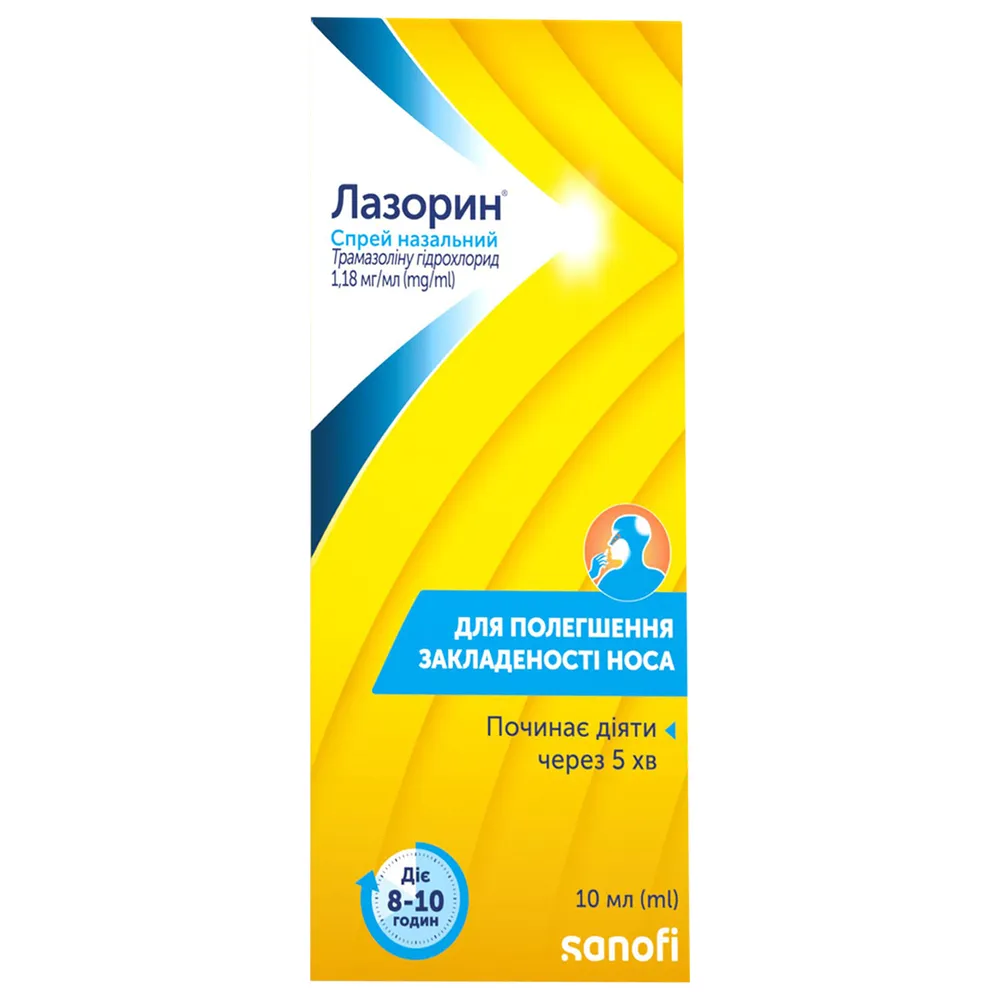
Table of Contents
INSTRUCTIONS FOR MEDICAL USE OF THE MEDICINAL PRODUCT LAZORIN® (LASORIN®)
Composition:
Active substance: tramazoline;
1 ml of solution contains tramazoline hydrochloride monohydrate 1.265 mg, equivalent to 1.18 mg of tramazoline hydrochloride;
Excipients: citric acid monohydrate, sodium hydroxide, benzalkonium chloride, hydroxypropylmethylcellulose, povidone, glycerol (85 %), magnesium sulfate heptahydrate, magnesium chloride hexahydrate, calcium chloride dihydrate, sodium hydrocarbonate, sodium chloride, eucalyptol, menthol, camphor, purified water.
Pharmaceutical form. Nasal spray.
Main physicochemical properties: clear, slightly yellowish solution with a eucalyptus odor.
Pharmacotherapeutic group.
Anti-edematous and other agents for local use in nasal cavity diseases. Simple sympathomimetics.
ATC code R01A A09.
Pharmacological properties.
Pharmacodynamics.
Xylometazoline is an imidazoline derivative. Xylometazoline is an α-sympathomimetic that directly stimulates α-adrenergic receptors of the sympathetic nervous system, but has little or no effect on β-adrenergic receptors. Intranasal administration of xylometazoline leads to constriction of dilated arterioles, resulting in reduced blood flow in the mucous membrane, decreased swelling, and improved nasal breathing.
After intranasal administration, vasoconstriction begins within 5 minutes and lasts for 8–10 hours.
Pharmacokinetics.
Absorption
Pharmacokinetic studies in humans have not been conducted. The pharmacokinetic characteristics of xylometazoline have been studied in rats, rabbits, and primates. It has been found that 50–80% of the dose is absorbed following oral and intranasal administration.
After intranasal administration, the amount of absorbed drug may sometimes be sufficient to cause systemic effects, particularly affecting the central nervous and cardiovascular systems.
Distribution
Xylometazoline and its metabolites are distributed into all internal organs. The highest concentrations are consistently observed in the liver.
Metabolism
After oral and topical administration, three main metabolites have been detected in urine.
Excretion
The terminal half-life of xylometazoline and its metabolites from blood is 5–7 hours.
Xylometazoline and its metabolites are primarily excreted by the kidneys.
Clinical characteristics.
Indications.
For relief of nasal congestion associated with acute rhinitis, vasomotor rhinitis, and allergic rhinitis.
For facilitation of secretion drainage in sinusitis and secretory otitis media, associated with acute rhinitis.
Contraindications.
Hypersensitivity to tramazoline hydrochloride, camphor, eucalyptol, levomenthol, or to any of the excipients of the medicinal product.
Closed-angle glaucoma.
Dry rhinitis.
History of transnasal intracranial surgery.
Lazoryn® is not recommended for use in children under 6 years of age.
Interaction with other medicinal products and other forms of interaction.
Concomitant use of Lazoryn® with monoamine oxidase inhibitors, tricyclic antidepressants, or other potential vasoconstrictor agents may affect the cardiovascular system and may cause increased blood pressure.
Concomitant use with tricyclic antidepressants may also cause arrhythmia.
Interaction with antihypertensive medicinal products, especially those affecting the sympathetic nervous system, may be complex and may result in various cardiovascular effects.
Special precautions for use
Due to the potential risk of systemic absorption, Lazoren® should be used with caution and only under medical supervision in patients with elevated intraocular pressure, severe cardiovascular disorders (e.g., ischemic heart disease or arterial hypertension), prostate hyperplasia, pheochromocytoma, metabolic disorders (e.g., hyperthyroidism or diabetes mellitus), or porphyria, only after a careful benefit-risk assessment.
The drug should be used with caution and only under medical supervision in patients receiving monoamine oxidase inhibitors (MAOIs), tricyclic antidepressants, vasoconstrictors, or antihypertensive agents (see section "Interaction with other medicinal products and other forms of interaction").
If symptoms do not resolve after 7 days of using Lazoren®, the patient should consult a physician regarding the appropriateness of continuing treatment with this medication.
Prolonged use of locally acting nasal vasoconstrictors in nasal cavity disorders may lead to chronic mucosal edema, resulting in nasal congestion and eventually in atrophy of the nasal mucosa.
After the therapeutic effect diminishes, rebound symptoms may occur, characterized by pronounced nasal mucosal swelling (nasal congestion).
Contact of Lazoren® with the eyes should be avoided to prevent irritation.
Lazoren® contains benzalkonium chloride as an excipient, which may cause irritation or swelling of the nasal mucosa, particularly with prolonged use.
In sensitized patients, camphor, eucalyptol, or levomenthol may cause hypersensitivity reactions (including dyspnea).
Use during pregnancy or breastfeeding.
Pregnancy
Preclinical studies have not shown any evidence of embryotoxic effects of the drug. Clinical studies during pregnancy have not been conducted. Lazoren® should not be used during the first trimester of pregnancy. During the second and third trimesters, the drug should be used only under medical supervision.
Breastfeeding period
There are no data regarding the excretion of the active substance in breast milk. The safety of using the drug during breastfeeding has not been evaluated. During breastfeeding, the drug should be used only under medical supervision.
Fertility
Clinical studies on the effect of tramazoline on human fertility have not been conducted. Preclinical data do not provide evidence that tramazoline affects fertility.
Ability to influence reaction speed when driving vehicles or operating machinery.
No studies have been conducted on the ability of the drug to affect reaction speed during driving or operating machinery.
However, patients should be informed that use of Lazoren® may cause adverse effects such as hallucinations, drowsiness, sedative effect, dizziness, and increased fatigue. Therefore, caution is advised when driving vehicles or operating machinery. If patients experience any of the aforementioned adverse effects after using the drug, they should avoid potentially hazardous activities such as driving or operating machinery.
Dosage and Administration.
Lazoren® should be used in adults and children aged 6 years and older.
Administer 1 dose into each nostril up to 3 times daily as needed. Dosage should be adjusted according to individual sensitivity and clinical response.
Lazoren® should be used only for short-term treatment of acute symptoms for no more than 5–7 days. In all other cases according to indications, and for all indications in children, a physician must evaluate the benefit-risk ratio. A break of several days should be taken between separate treatment periods.
Instructions for Use.
Before each administration, follow the recommendations below.
Thoroughly clean the nose before using Lazoren®.
- Before each use, remove the transparent protective cap.
- Before the first use of the dosing device, press the pump several times until a uniform aerosol spray appears (Fig. 1).
|
|
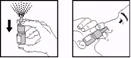
Fig. 1 Fig. 2
With continued use, the dosing device operates immediately. Re-preparation of the dosing device is not required.
- Insert the nozzle into one nostril and press the dosing device once (Fig. 2). After administering the spray, gently inhale through the nose. Then repeat the procedure by inserting the nozzle into the other nostril.
- It is recommended to rinse the dosing device with tap water after use.
After use, close the bottle with the protective cap.
Children. Use in children aged 6 years and older.
Overdose.
Symptoms
Elevated blood pressure and tachycardia may be followed by decreased blood pressure, shock, vascular collapse, reflex bradycardia, and decreased body temperature, especially in children.
Similar to other α-sympathomimetic agents, the clinical picture of intoxication with Lazolin® may be mixed, as phases of excitation and depression of the central nervous system (CNS) and cardiovascular system may alternate.
Overdose, particularly in children, may lead to CNS disturbances causing seizures, coma, bradycardia, and respiratory depression. Symptoms of CNS excitation include restlessness, agitation, hallucinations, and seizures. Symptoms of CNS depression include decreased body temperature, lethargy, drowsiness, and coma.
In addition, the following symptoms may occur: mydriasis; miosis; increased sweating; fever; pallor; cyanosis of the lips; cardiovascular disturbances, including cardiac arrest; respiratory disorders, including respiratory failure and respiratory arrest; psychiatric disturbances.
Overdose may result in an intensification of adverse reactions.
Treatment.
In case of nasal overdose, nasal lavage and thorough nasal cleansing are recommended as emergency measures. Symptomatic treatment may be required.
Adverse reactions
Adverse reactions are listed by system organ class and frequency of occurrence: very common (≥ 1/10), common (≥ 1/100 to < 1/10), uncommon (≥ 1/1000 to < 1/100), rare (≥ 1/10,000 to < 1/1000), very rare (< 1/10,000), frequency not known (cannot be estimated from the available data).
The following adverse reactions may be associated with the use of Lazoryn®.
Immune system disorders:
Uncommon – hypersensitivity reactions.
Psychiatric disorders:
Uncommon – anxiety;
Frequency not known – hallucinations, insomnia.
Nervous system disorders:
Uncommon – headache;
Rare – dizziness, taste disturbances;
Frequency not known – somnolence, sedative effect.
Cardiac disorders:
Uncommon – tachycardia;
Frequency not known – arrhythmia, tachycardia.
Respiratory, thoracic and mediastinal disorders:
Common – burning sensation of nasal mucosa;
Uncommon – nasal congestion, dryness of nasal mucosa, rhinorrhea, sneezing;
Rare – epistaxis.
Gastrointestinal disorders:
Uncommon – nausea.
Skin and subcutaneous tissue disorders:
Frequency not known – rash, pruritus, angioneurotic edema*.
General disorders and administration site conditions:
Frequency not known – nasal mucosal swelling*, increased fatigue.
Investigations:
Frequency not known – increased blood pressure.
* as a symptom of hypersensitivity reaction.
Reporting of suspected adverse reactions
Reporting of suspected adverse reactions after approval of the medicinal product is an important procedure. It allows continuous monitoring of the benefit-risk balance of the medicinal product. Healthcare professionals are requested to report any suspected adverse reactions via the national pharmacovigilance system.
Shelf life. 3 years.
Shelf life after opening of the packaging – 12 months.
Storage conditions.
Store at a temperature not exceeding 25 ºC. Keep out of the reach of children.
Packaging.
10 ml in a glass bottle with a dosing device; 1 bottle in a cardboard box.
Category of release. Over-the-counter.
Manufacturer.
Istituto de Angeli S.r.l., Italy.
Manufacturer's address and location of manufacturing site.
Localita Prulli n. 103/c - 50066 Reggello (FI), Italy.
Marketing authorization holder.
LLC "Opella Health Ukraine".
Address of the marketing authorization holder and/or its representative.
48-50A Zhylianska St., Kyiv, 01033, Ukraine.