Lasolvan® for infusion
Ukraine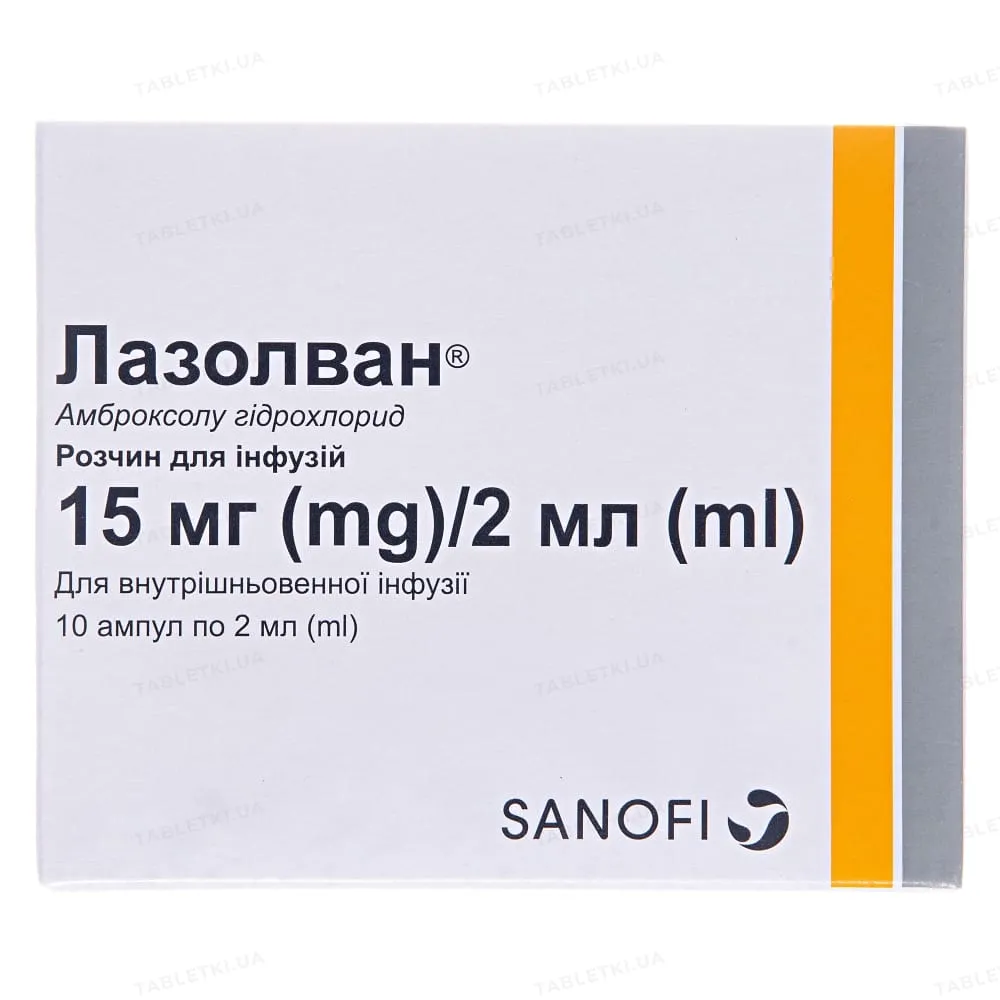
Table of Contents
INSTRUCTIONS FOR MEDICAL USE OF THE MEDICINAL PRODUCT LasolvanÒ for infusions (LasolvanÒ for infusions)
Composition:
Active substance: ambroxol hydrochloride (ambroxol hydrochloride);
Each ampoule contains 15 mg of ambroxol hydrochloride;
Excipients: citric acid, monohydrate (E 330); sodium hydrogen phosphate, dihydrate; sodium chloride; water for injections.
Pharmaceutical form. Solution for infusion.
Main physicochemical properties: a clear, colourless solution, practically free from particles.
Pharmaco-therapeutic group. Medicinal products used for cough and colds. Mucolytic agents. ATC code R05C B06.
Pharmacological Properties.
Pharmacodynamics.
Ambroxol hydrochloride, a substituted benzylamine, is a metabolite of bromhexine. It differs from bromhexine by the absence of a methyl group and the presence of a hydroxyl group in the para-trans-position of the cyclohexyl ring.
Ambroxol exerts a secretolytic and secretomotor effect in the bronchial tract.
In preclinical studies, it increased the serous component of bronchial secretion. Ambroxol facilitates mucus elimination by reducing its viscosity and activating the ciliated epithelium.
Ambroxol activates the surfactant system through a direct effect on type II pneumocytes in the alveoli and Clara cells in the region of the small airways. It enhances the formation and release of surfactant material in the alveoli and bronchial tree of both fetus and adult. These effects have been demonstrated in various biological species, in cell cultures, and in vivo.
Furthermore, antioxidant effects of ambroxol have been demonstrated in various preclinical studies.
Pharmacokinetics.
After intravenous administration, the bioavailability of the drug is by definition 100%. Following intravenous administration, the pharmacokinetics of ambroxol within the therapeutic dose range of 15–90 mg show linear dose-dependency. Even after intravenous administration of 1.0 g, no significant deviations from linearity are observed.
Distribution
Approximately 85% (80–90%) of the drug is bound to plasma proteins. After parenteral administration, ambroxol reaches higher concentrations in lung tissue than in plasma. Ambroxol can penetrate into cerebrospinal fluid, cross the placental barrier, and is excreted in breast milk.
Biotransformation
Metabolite formation capable of entering the kidneys (e.g., dibromanthranilic acid, glucuronide) occurs in the liver.
Elimination
Approximately 90% of the drug is excreted by the kidneys as metabolites formed in the liver. Less than 10% of ambroxol is excreted unchanged by the kidneys. Due to the high degree of protein binding, large volume of distribution, and slow redistribution of the drug from tissues into blood, significant elimination of ambroxol by dialysis or forced diuresis is unlikely.
The terminal elimination half-life from plasma is 7–12 hours. The elimination half-life of ambroxol and its metabolites from plasma is approximately 22 hours.
After intravenous administration to healthy patients, total clearance was 660 ml/min, with renal clearance accounting for approximately 4.5% of total clearance.
Patients with hepatic or renal impairment
In patients with severe hepatic disorders, ambroxol clearance is reduced by 20–40%. In patients with severe renal impairment, accumulation of ambroxol metabolites should be considered. In adult patients with hepatic impairment, elimination of ambroxol hydrochloride is reduced, resulting in 1.3–2 times higher plasma concentrations. However, since the therapeutic range of ambroxol hydrochloride is sufficiently wide, dosage adjustment is not required.
Children
In neonates receiving repeated intravenous doses of ambroxol, the elimination half-life was approximately doubled, indicating reduced clearance.
Clinical characteristics.
Indications.
To enhance pulmonary surfactant production in premature infants and newborns with respiratory distress syndrome.
Contraindications.
Known hypersensitivity to ambroxol hydrochloride or any other components of the medicinal product.
Interaction with other medicinal products and other forms of interaction.
Clinically significant interactions of this medicinal product with other drugs have not been established to date.
Concomitant administration of Lazolvan**®** for infusion and cough suppressants may result in excessive mucus accumulation due to suppression of the cough reflex. Such combination should be used only after careful assessment by a physician of the benefit-risk ratio.
Laboratory tests
Concomitant administration of ambroxol and antibiotics (amoxicillin, cefuroxime, doxycycline, and erythromycin) leads to increased antibiotic concentrations in bronchopulmonary secretions and sputum.
Special precautions for use
There have been reports of severe skin reactions associated with the use of ambroxol hydrochloride, including: erythema multiforme, Stevens-Johnson syndrome/toxic epidermal necrolysis, and acute generalized exanthematous pustulosis. If symptoms of progressive skin rash (sometimes associated with blistering or mucosal lesions) occur, ambroxol hydrochloride treatment must be discontinued immediately and medical advice sought.
If intravenous administration is performed too rapidly, very rare cases of headache, increased fatigue, exhaustion, and a feeling of heaviness in the legs may occur.
Since ambroxol may enhance mucus secretion, Lazolvan**®** for infusion, infusion solution, should be used with caution in patients with impaired bronchial motility and increased mucus secretion (e.g. in rare conditions such as primary ciliary dyskinesia).
This medicinal product contains less than 1 mmol (23 mg) of sodium per dose, i.e. essentially "sodium-free". Each ampoule contains 6.598 mg of sodium.
Lazolvan**®** for infusion, infusion solution, should be used with caution in patients with renal impairment or severe hepatic disease. As with any active substance metabolized in the liver and subsequently excreted by the kidneys, accumulation of metabolites formed in the liver may be expected in patients with severe renal insufficiency.
Use during pregnancy or breastfeeding
Data are lacking due to absence of indications.
Ability to influence reaction rate while driving or operating machinery
Not applicable, as the medicinal product is administered to premature infants and newborns.
Method of administration and dosage
For intravenous infusion.
Dosage
30 mg per kg of body weight per day, divided into 4 single doses.
Dosage in renal and/or hepatic impairment
In severe renal impairment or severe hepatic impairment, the maintenance dose should be appropriately reduced or the interval between doses extended.
The solution should be administered using an infusion pump as a short-term infusion lasting at least 5 minutes. Lasolvan® for infusion can also be administered as a drip infusion. The following solutions are suitable for this purpose: physiological saline, Ringer's solution.
Duration of treatment – 5 days.
The contents of 1–6 ampoules should be diluted in 250–500 ml of physiological saline or Ringer's solution. The solution diluted with physiological saline or Ringer's solution is physically and chemically stable for 24 hours at 15–25 °C. The stability of the final solution has been confirmed within the concentration range of 0.03 mg/ml to 0.34 mg/ml. From a microbiological standpoint, if opening the ampoules and dilution involves a risk of microbial contamination, the solution should be used immediately after preparation. If not, the responsibility for storage conditions and duration lies with the user. If neither of these diluents is available, 5% glucose solution may be used as an alternative. When using 5% glucose solution, the contents of the ampoules should be diluted immediately before use. If the solution is not used immediately after preparation, it must be discarded.
Children
Administered to premature infants and newborns as indicated.
Overdose
Currently, there are no reports of specific symptoms of overdose. Symptoms observed in cases of accidental overdose or medical error are similar to the known adverse reactions occurring with recommended doses and may require symptomatic treatment.
Side effects.
The following classification was used to assess the frequency of side effects:
| very common |
≥ 10 %; |
| common |
≥ 1 – < 10 %; |
| uncommon |
≥ 0,1 – < 1 %; |
| rare |
≥ 0,01 – < 0,1 %; |
| very rare |
< 0,01 %; |
| not known |
cannot be estimated from the available data. |
Immune system disorders:
Rare – hypersensitivity reactions;
Not known – anaphylactic reactions, including anaphylactic shock, angioneurotic edema, and pruritus.
Skin and subcutaneous tissue disorders:
Uncommon – erythema;
Rare – rash, urticaria;
Not known – serious skin adverse reactions (including erythema multiforme, Stevens-Johnson syndrome/toxic epidermal necrolysis, and acute generalized exanthematous pustulosis).
Gastrointestinal disorders:
Uncommon – dry mouth, constipation, hypersalivation, dry throat;
Not known – nausea, vomiting, diarrhea, dyspepsia, abdominal pain.
Respiratory, thoracic and mediastinal disorders:
Uncommon – rhinorrhea, dyspnea (as a symptom of hypersensitivity reaction).
Renal and urinary disorders:
Uncommon – urinary disorders.
General disorders and administration site conditions:
Uncommon – increased body temperature and chills, mucosal reactions.
Reporting suspected adverse reactions
Reporting suspected adverse reactions after authorization of the medicinal product is important. It allows continuous monitoring of the benefit/risk balance of the medicinal product. Healthcare professionals and patients, as well as their legal representatives, should report any suspected adverse reactions and lack of efficacy of the medicinal product through the Automated Information System for Pharmacovigilance at the following link: https://aisf.dec.gov.ua.
Shelf life. 3 years.
Storage conditions. Store in the original packaging at a temperature not exceeding 25 °C, in a place inaccessible to children.
Incompatibilities.
Lazolvan**®** for infusion, solution for infusion, should not be mixed with other solutions except physiological saline and Ringer's solution.
Packaging.
2 ml in glass ampoules; 10 ampoules per cardboard box.
Prescription status.
Prescription only.
Manufacturer.
SANOFI S.R.L., Italy.
Address of the manufacturer and site of manufacturing activity.
Via Valcanello, 4 – 03012 ANAGNI (FR), Italy.
Marketing Authorization Holder.
LLC "Opella HealthCare Ukraine", Ukraine.
Address of the Marketing Authorization Holder.
48-50A Zhylianska St., Kyiv, 01033, Ukraine.