Lazolex
Ukraine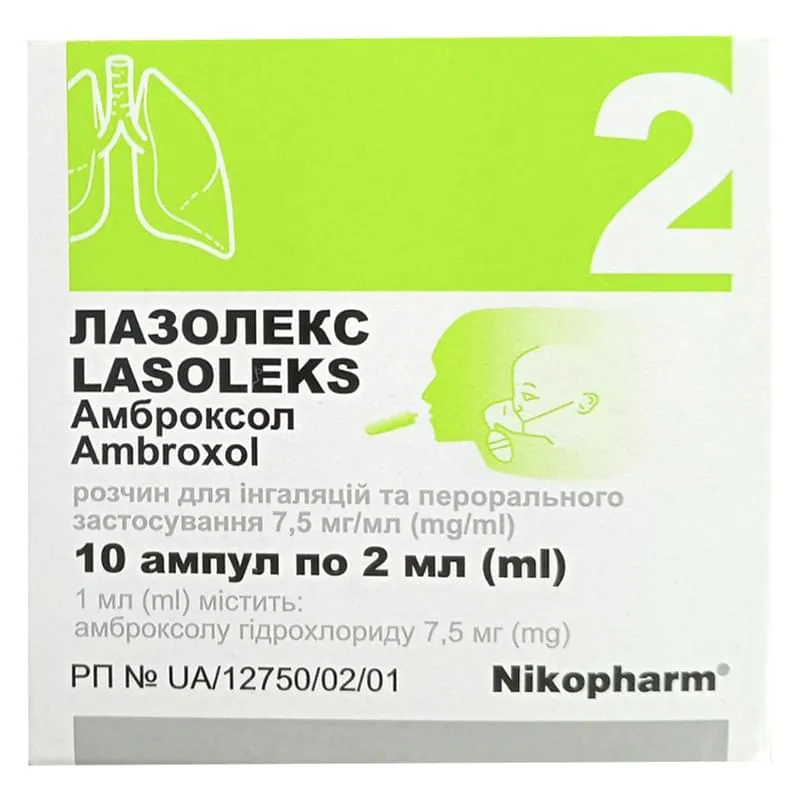
Table of Contents
INSTRUCTION FOR MEDICAL USE OF THE MEDICINAL PRODUCT LASOLEKS (LASOLEKS)
Composition:
Active substance: ambroxol hydrochloride;
1 ml of the preparation contains 7.5 mg of ambroxol hydrochloride;
Excipients: sodium chloride, citric acid monohydrate, disodium phosphate dodecahydrate, water for injections.
Medicinal form. Solution for inhalation and oral use.
Main physicochemical properties: clear, colorless or slightly brownish solution.
Pharmacotherapeutic group.
Agents used for cough and colds. Mucolytic agents.
ATC code R05C B06.
Pharmacological properties.
Pharmacodynamics.
The active substance, ambroxol hydrochloride, is a substituted benzylamine and a metabolite of bromhexine. It differs from bromhexine by the absence of a methyl group and the presence of a hydroxyl group in the para-trans-position of the cyclohexyl ring.
Studies have demonstrated the secretolytic and secretomotor effects of ambroxol hydrochloride in the bronchial tract.
After oral administration, the effect begins on average within 30 minutes and lasts 6–12 hours, depending on the individual dose.
Preclinical studies have shown that ambroxol hydrochloride increases the serous component of bronchial secretion. Ambroxol enhances mucus clearance by reducing viscosity and activating ciliary epithelium.
Ambroxol activates the surfactant system through a direct effect on Clara cells in the area of the small airways and type II pneumocytes in the alveoli. It promotes the formation and release of surfactant material in the alveoli and bronchial tree of both fetal and adult organisms. These effects have been demonstrated in various biological species, in cell cultures, and in vivo.
In addition, antioxidant effects of ambroxol have been demonstrated in various preclinical trials.
Pharmacokinetics.
Absorption. Ambroxol is almost completely absorbed after oral administration. Tmax after oral administration is 1–3 hours. Absolute bioavailability of ambroxol after oral administration is reduced by approximately one-third due to presystemic metabolism.
Distribution. Approximately 85% (80–90%) of the drug is bound to plasma proteins. In lung tissue, ambroxol reaches higher concentrations than in plasma after parenteral administration. Ambroxol can penetrate into cerebrospinal fluid, cross the placental barrier, and enter breast milk.
Metabolism. The formation of metabolites capable of entering the kidneys (e.g., dibromoanthranilic acid, glucuronide) occurs in the liver.
Elimination. Nearly 90% of the drug is excreted by the kidneys in the form of metabolites produced in the liver. Less than 10% of ambroxol is excreted unchanged by the kidneys. Due to the high degree of protein binding, large volume of distribution, and slow redistribution of the drug from tissues into blood, significant elimination of ambroxol during dialysis or forced diuresis is unlikely.
The terminal elimination half-life from plasma is 7–12 hours. The elimination half-life of ambroxol and its metabolites from plasma is approximately 22 hours.
Pharmacokinetics in specific patient groups.
In patients with severe hepatic impairment, ambroxol clearance is reduced by 20–40%. In patients with severe renal impairment, accumulation of ambroxol metabolites may occur.
Clinical characteristics.
Indications.
Mucolytic therapy in acute and chronic bronchopulmonary diseases associated with impaired bronchial secretion and reduced mucus transport.
Contraindications.
Lazolex, solution for inhalation and oral use, must not be administered to patients with hypersensitivity to ambroxol hydrochloride or to any of the excipients of the medicinal product.
Interaction with other medicinal products and other forms of interaction.
Concomitant use of ambroxol and antitussive agents may lead to excessive mucus accumulation due to suppression of the cough reflex. Therefore, such combination should be used only after careful evaluation by a physician of the benefit-risk ratio.
Concomitant administration of ambroxol and antibiotics (amoxicillin, cefuroxime, doxycycline, and erythromycin) results in increased antibiotic concentrations in bronchopulmonary secretions and sputum.
Special precautions for use
Serious skin reactions have been reported, including erythema multiforme, Stevens-Johnson syndrome/toxic epidermal necrolysis, and acute generalized exanthematous pustulosis, associated with the use of ambroxol hydrochloride. If signs of progressive skin rash (sometimes associated with blistering or mucosal lesions) occur, treatment with ambroxol hydrochloride should be discontinued immediately and medical advice should be sought.
Ambroxol should be used with caution in patients with impaired bronchial motility and increased mucus secretion (e.g., in rare conditions such as primary ciliary dyskinesia) due to the risk of mucus accumulation.
Patients with renal impairment or severe hepatic insufficiency should take ambroxol only after consultation with a physician. When ambroxol, like any active substance metabolized in the liver and subsequently excreted by the kidneys, is administered, metabolites formed in the liver may accumulate in patients with severe renal impairment.
The medication Lazolex, solution for inhalation and oral use, contains 40.96 mg of sodium in the recommended daily dose. This should be taken into account by patients on a controlled sodium diet.
Use during pregnancy or breastfeeding
Pregnancy. Ambroxol crosses the placental barrier. Clinical studies have shown no adverse effects on the fetus or the course of pregnancy when the drug is used after the 28th week of gestation. Animal studies have not revealed any direct or indirect harmful effects on pregnancy, embryonal/fetal development, delivery, or postnatal development. However, usual precautions regarding medication use during pregnancy should be observed. Particularly during the first trimester of pregnancy, ambroxol is not recommended.
Breastfeeding. Ambroxol passes into breast milk. Ambroxol should not be administered to women during breastfeeding.
Fertility. Preclinical studies do not indicate any direct or indirect adverse effects on fertility.
Ability to influence reaction speed while driving or operating machinery
There is no data available regarding the effect of ambroxol on reaction speed while driving or operating machinery. Studies on the influence of ambroxol on reaction speed during driving or operating machinery have not been conducted.
Method of Administration and Dosage
Inhalation Solution
Adults and children aged 6 years and older: 1–2 inhalations of 2–3 mL solution per day.
Children under 6 years of age: 1–2 inhalations of 2 mL solution per day.
Lazolex inhalation solution can be used with all modern inhalation devices (except steam inhalers).
After opening the ampoule – the contents must be used immediately; any unused portion of the solution should be discarded.
Lazolex inhalation solution should be diluted in a 1:1 ratio with physiological saline to ensure optimal humidification of the air delivered by the device.
Lazolex inhalation solution must not be mixed with cromoglycic acid. It should also not be mixed with other solutions where the resulting mixture has a pH exceeding 6.3, for example, alkaline inhalation salt (Emser Salt). An increase in pH may lead to precipitation of the free base of ambroxol hydrochloride or clouding of the solution.
The inhalation solution is generally recommended to be warmed to body temperature before starting inhalation.
If only one inhalation per day is possible, additional oral administration of Lazolex should be used.
Since the inhalation process itself may provoke coughing, patients are advised to breathe normally during inhalation.
Patients with bronchial asthma should use bronchodilators prior to inhalation to open the airways.
Oral Solution
Adults and children aged 12 years and older: 4 mL three times daily for the first 2–3 days, equivalent to 90 mg ambroxol per day, then reduce to 2 mL three times daily, equivalent to 45 mg ambroxol per day.
The dosage of 4 mL three times daily may be continued after consultation with a physician.
Children aged 6–12 years: 2 mL two to three times daily, equivalent to 30–45 mg ambroxol per day.
Children aged 2 to 6 years: 1 mL three times daily, equivalent to 22.5 mg ambroxol per day.
Children under 2 years of age: 1 mL twice daily, equivalent to 15 mg ambroxol per day.
Dosing in patients with renal and/or hepatic impairment
In patients with severe renal or severe hepatic impairment, Lazolex should be administered only after consultation with a physician, as it may be necessary to reduce the maintenance dose or prolong the dosing interval.
Lazolex inhalation and oral solution should not be used for longer than 4–5 days without consulting a physician.
In acute conditions, consult a physician if symptoms persist or worsen despite treatment with Lazolex.
Lazolex oral solution may be diluted with water, tea, fruit juice, or milk. Lazolex can be taken independently of food intake.
The secretolytic effect of Lazolex is supported by adequate fluid intake.
Children
Lazolex can be used in children. In children under 2 years of age, the medication should be used only as directed by a physician.
Overdose
There are currently no reports of ambroxol overdose. Symptoms described in isolated cases of overdose and/or accidental ingestion correspond to the known adverse effects of ambroxol at recommended doses and require symptomatic treatment.
Adverse Reactions
The following classification was used to assess the frequency of adverse reactions: very common (≥1/10), common (≥1/100, <1/10), uncommon (≥1/1,000, <1/100), rare (≥1/10,000, <1/1,000), very rare (<1/10,000, including isolated cases), not known (frequency cannot be estimated from the available data).
Immune system disorders: rare – hypersensitivity reactions; not known – anaphylactic reactions, including anaphylactic shock, angioneurotic edema, and pruritus.
Skin and subcutaneous tissue disorders: rare – rash, urticaria; not known – serious skin adverse reactions (including erythema multiforme, Stevens-Johnson syndrome/toxic epidermal necrolysis, and acute generalized exanthematous pustulosis).
Nervous system disorders: common – dysgeusia (taste disturbances).
Gastrointestinal disorders: common – nausea, oral paresthesia; uncommon – vomiting, diarrhea, dyspepsia, abdominal pain, dry mouth; rare – throat dryness; very rare – hypersalivation.
Respiratory, thoracic and mediastinal disorders: common – pharyngeal hypoesthesia; very rare – dyspnea and bronchospasm; not known – dyspnea (as a symptom of hypersensitivity reaction).
General disorders: uncommon – fever, mucosal reactions.
Reporting of suspected adverse reactions
Reporting of suspected adverse reactions after drug registration is of great importance. It allows continuous monitoring of the benefit-risk balance of the medicinal product. Medical and pharmaceutical professionals, as well as patients or their legal representatives, are encouraged to report all suspected adverse reactions and lack of efficacy via the Automated Pharmacovigilance Information System at the following link: https://aisf.dec.gov.ua
Shelf life: 2 years.
Storage conditions.
Store in the original packaging at a temperature not exceeding 25 °C.
Keep out of reach and sight of children.
Packaging. 1 mL, 2 mL, or 4 mL in an ampoule. Packs of 5, 10, or 20 ampoules in a cardboard carton.
Release category: Over-the-counter (without prescription).
Manufacturer: LLC "PHARMASEL".
Manufacturer's address and place of business:
3, Prorizna Street, Kvitneve, Brovary District, Kyiv Oblast, 07408, Ukraine.