Lamicon® dermgel
Ukraine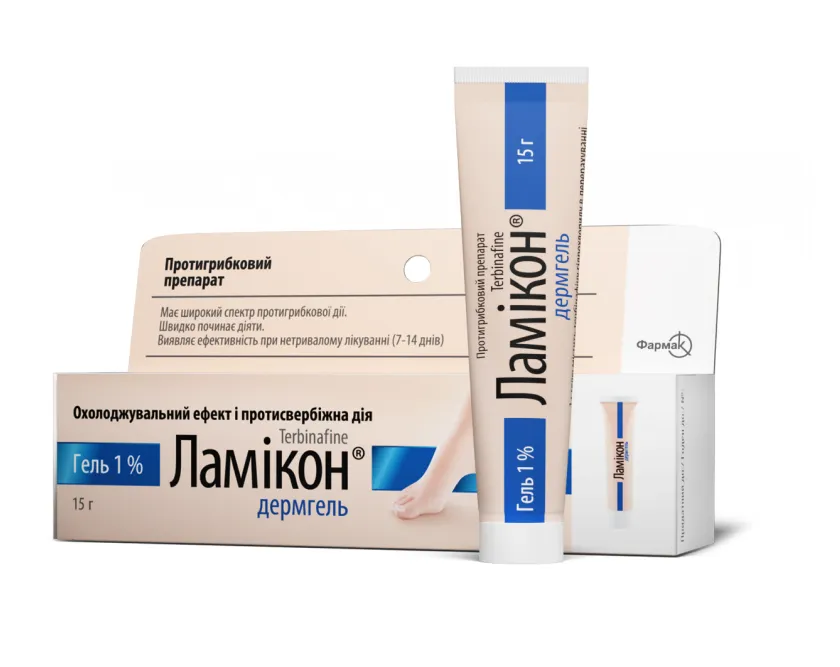
Table of Contents
INSTRUCTIONS FOR MEDICAL USE OF THE MEDICINAL PRODUCT LAMICON® DERMGEL (LAMICONDERMGEL)
Composition:
Active substance: terbinafine;
1 g of gel contains 10 mg of terbinafine hydrochloride, equivalent to 100 % dry substance of terbinafine;
Excipients: butylhydroxytoluene (E 321), benzyl alcohol, sorbitan laurate, polysorbate 20, isopropyl myristate, ethanol 96 %, carbomer 974P, sodium hydroxide, purified water.
Pharmaceutical form. Gel.
Main physicochemical properties: white or almost white gel with a weak specific odor.
Pharmacotherapeutic group.
Antifungal agents for topical use.
ATC code D01AE15.
Pharmacological Properties
Pharmacodynamics
Terbinafine is an allylamine with a broad spectrum of antifungal activity against skin infections caused by dermatophytes such as Trichophyton (e.g., T. rubrum, T. mentagrophytes, T. verrucosum, T. violaceum), Microsporum canis, and Epidermophyton floccosum. Terbinafine exerts a fungicidal effect against dermatophytes and molds at low concentrations. Activity against yeasts is either fungicidal (e.g., Pityrosporum orbiculare or Malassezia furfur) or fungistatic, depending on the species.
Terbinafine specifically inhibits an early step in sterol biosynthesis within the fungal cell membrane. This leads to ergosterol deficiency and intracellular accumulation of squalene, resulting in fungal cell death. Terbinafine acts by inhibiting the enzyme squalene epoxidase in the fungal cell membrane. This enzyme is not part of the cytochrome P450 system. Terbinafine does not affect hormone metabolism or the metabolism of other medicinal drugs.
The product provides a local cooling effect, thereby exerting an antipruritic action. The product acts rapidly and is effective with short-term treatment (7–14 days). In most patients with tinea pedis, no recurrences or reinfections were observed within 2 months after one-week treatment with Lamicon® derm gel.
Pharmacokinetics
When applied topically, less than 5% of the applied dose is absorbed, resulting in negligible systemic exposure to terbinafine. Fungicidal concentrations of terbinafine in the stratum corneum persist for up to 7 days after discontinuation of treatment following 7 days of application.
In animal studies, terbinafine showed no effect on fertility.
Clinical characteristics.
Indications.
Fungal skin infections caused by dermatophytes such as Trichophyton (e.g., T. rubrum, T. mentagrophytes, T. verrucosum, T. violaceum), Microsporum canis, and Epidermophyton floccosum, for example, interdigital tinea pedis (athlete's foot), tinea cruris (jock itch), tinea corporis (ringworm). Pityriasis versicolor caused by Pityrosporum orbiculare (also known as Malassezia furfur).
Contraindications.
Hypersensitivity to terbinafine or to any of the components of the medicinal product.
Interaction with other medicinal products and other forms of interaction.
Interaction is unknown; however, as a precautionary measure, other medicinal products should not be applied to the treated areas.
Special precautions for use.
Lamicon® Dermgel should be used with caution in skin conditions where alcohol may cause irritation during treatment.
The product is intended for topical use only. It may cause irritation upon contact with the eyes. If the gel accidentally gets into the eyes, they should be thoroughly rinsed with running water. If irritation persists, medical advice should be sought.
Do not apply to the face.
To prevent re-infection with fungal infections of the skin, the following precautions should be observed: change underwear daily, as fungi may be present on clothing that has been in contact with infected skin areas; avoid wearing tight-fitting or poorly ventilated clothing; thoroughly dry affected skin areas after washing; use a clean personal towel every day. In case of tinea pedis (athlete's foot), walking barefoot should be avoided. In addition to topical treatment once daily, it is recommended to spray Lamicon® spray inside socks or footwear.
Lamicon® Dermgel contains butylhydroxytoluene, which may cause local skin reactions (e.g., contact dermatitis) or irritation of the eyes and mucous membranes.
Use during pregnancy or breastfeeding.
Animal studies have not shown terbinafine to have embryotoxic effects. However, because clinical experience with topical use of terbinafine gel in pregnant women is limited, Lamicon® Dermgel should not be used during pregnancy unless, in the opinion of the physician, the expected benefit to the mother outweighs the potential risk to the fetus.
Terbinafine passes into breast milk in small amounts; therefore, the product should not be used during breastfeeding. Direct contact between infants and any area of skin treated with the product should be avoided.
Effect on the ability to drive or operate machinery. No effect.
Method of Administration and Dosage.
Lamicon® dermgel should be applied to the skin once daily. Before applying the gel, the affected areas must be thoroughly cleaned and dried. Apply a thin layer of the gel to the affected skin areas and adjacent regions, and gently rub in. In infections accompanied by intertriginous lesions (under the breasts, interdigital, between the buttocks, in the groin area), the areas treated with the gel may be covered with gauze, especially at night.
Duration and Frequency of Treatment.
Tinea pedis (interdigital): once daily for 1 week.
Tinea cruris and tinea corporis: once daily for 1 week.
Pityriasis versicolor: once daily for 1 week.
Dose adjustment is not required for elderly patients.
Symptom relief usually occurs within a few days. Irregular use of the medication or premature discontinuation of treatment may lead to relapse.
Children. Due to insufficient experience with use, Lamicon® dermgel is not recommended for use in children.
Overdose.
The low systemic absorption of terbinafine with topical application results in an extremely low risk of overdose. Accidental ingestion of the contents of one 30-g tube of Lamicon® dermgel (containing 300 mg of terbinafine) is comparable to taking one 250-mg Lamicon® tablet (an oral dosage form). If a larger amount of Lamicon® dermgel is accidentally ingested, adverse effects would be similar to those seen with an overdose of Lamicon® tablets (headache, nausea, epigastric pain, and dizziness). In case of accidental ingestion, the presence of ethanol in the medicinal product (28.8% v/v) should be taken into account.
Treatment of overdose following accidental ingestion consists of removing the active substance, primarily by administering activated charcoal, and providing symptomatic therapy as necessary.
Adverse reactions.
Local reactions such as itching, scaling, or burning of the skin, pain and irritation at the application site, pigmentary disturbances, erythema, and crusting may occur at the site of application. These mild reactions should be differentiated from hypersensitivity reactions, including rash, which have been reported in isolated cases and require discontinuation of treatment. In case of accidental contact with eyes, terbinafine may cause eye irritation. The presence of butylhydroxytoluene may cause irritation of mucous membranes.
In rare cases, a latent fungal infection may worsen.
Possible adverse effects:
Immune system disorders:
Frequency unknown (cannot be estimated from available data): hypersensitivity reactions*.
Eye disorders:
Rare (≥1/10,000, <1/1,000): eye irritation.
Skin and subcutaneous tissue disorders:
Common (≥ 1/100, < 1/10): skin scaling, itching.
Uncommon (≥ 1/1,000, < 1/100): skin injury, crusting, skin lesions, pigmentary disturbances, erythema, sensation of skin burning.
Rare (≥1/10,000, <1/1,000): sensation of dry skin, contact dermatitis, eczema.
Frequency unknown (cannot be estimated from available data): rash*.
General disorders and administration site conditions:
Uncommon (≥ 1/1,000, < 1/100): pain, pain at application site, irritation at application site.
Rare (≥1/10,000, <1/1,000): worsening of symptoms.
*Data obtained from post-marketing surveillance.
Shelf life.
2 years.
Do not use the medicinal product after the expiry date stated on the packaging.
Storage conditions.
Store at a temperature not exceeding 25 °C. Freezing is not allowed. Keep out of the reach of children.
Packaging.
15 g or 30 g in a tube. 1 tube in a carton.
Prescription status.
Over-the-counter.
Manufacturer.
JSC "Farmak".
Manufacturer's location and address of place of business.
74, Kyrylivska Street, Kyiv, 04080, Ukraine.
INSTRUCTION
on medical use of medicinal product
LAMICON DERMGEL
(LAMICONDERMGEL)
Composition:
Active substance: terbinafine;
1 g of gel contains 10 mg of terbinafine hydrochloride, calculated as 100% anhydrous terbinafine;
Excipients: butylhydroxytoluene (E 321), benzyl alcohol, sorbitan laurate, polysorbate 20, isopropyl myristate, ethanol 96%, carbomer 974P, sodium hydroxide, purified water.
Pharmaceutical form. Gel.
Main physicochemical properties: white or almost white gel with a weak specific odor.
Pharmacotherapeutic group.
Antifungal agents for topical use.
ATC code D01AE15.
Pharmacological properties.
Pharmacodynamics.
Terbinafine is an allylamine with broad-spectrum antifungal activity against skin infections caused by dermatophytes such as Trichophyton (e.g., T. rubrum, T. mentagrophytes, T. verrucosum, T. violaceum), Microsporum canis, and Epidermophyton floccosum. Terbinafine exerts a fungicidal effect at low concentrations against dermatophytes and molds. Its activity against yeasts is either fungicidal (e.g., Pityrosporum orbiculare or Malassezia furfur) or fungistatic, depending on the species.
Terbinafine specifically inhibits an early step in sterol biosynthesis in the fungal cell membrane. This leads to ergosterol deficiency and intracellular accumulation of squalene, resulting in fungal cell death. Terbinafine acts by inhibiting the enzyme squalene epoxidase in the fungal cell membrane. This enzyme does not belong to the cytochrome P450 system. Terbinafine does not affect hormone metabolism or that of other medicinal products.
The product provides a local cooling effect and thus has an antipruritic action. The product acts rapidly and is effective with short-term treatment (7–14 days). In most patients with tinea pedis, no recurrences or reinfections were observed for up to 2 months after one week of treatment with LAMICON DERMGEL.
Pharmacokinetics. When applied topically, less than 5% of the administered dose is absorbed; therefore, systemic exposure to terbinafine is minimal. Fungicidal concentrations of terbinafine in the stratum corneum persist for up to 7 days after treatment discontinuation, following 7 days of application.
In animal studies, no effect of terbinafine on fertility was observed.
Clinical characteristics.
Indications.
Fungal skin infections caused by dermatophytes such as Trichophyton (e.g., T. rubrum, T. mentagrophytes, T. verrucosum, T. violaceum), Microsporum canis, and Epidermophyton floccosum, for example, interdigital tinea pedis (athlete's foot), tinea cruris (jock itch), tinea corporis (ringworm). Pityriasis versicolor caused by Pityrosporum orbiculare (also known as Malassezia furfur).
Contraindications.
Hypersensitivity to terbinafine or to any of the excipients of the product.
Interaction with other medicinal products and other forms of interaction. Interactions are unknown; however, as a precaution, other medicinal products should not be applied to treated areas.
Special precautions.
LAMICON DERMGEL should be used with caution in skin lesions where alcohol may cause irritation.
The product is intended for external use only. It may cause irritation upon contact with eyes. In case of accidental contact with eyes, rinse thoroughly with running water. If irritation persists, consult a physician. Do not apply to the face.
To prevent reinfection with dermatomycoses, the following measures are recommended: change underwear daily, as fungi may persist on clothing that has been in contact with infected skin areas; avoid wearing tight or poorly ventilated clothing; dry affected skin areas thoroughly after washing; use a clean individual towel daily. In case of tinea pedis, do not walk barefoot. In addition to topical treatment, it is recommended to treat socks or the inside of shoes once daily with LAMICON spray.
LAMICON DERMGEL contains butylhydroxytoluene, which may cause local skin reactions (e.g., contact dermatitis) or irritation of the eyes and mucous membranes.
Use during pregnancy or breastfeeding.
In animal studies, no embryotoxic effects of terbinafine were observed. Since clinical experience with the use of terbinafine gel in pregnant women is limited, LAMICON DERMGEL should not be used during pregnancy except when, in the physician’s opinion, the expected benefit to the mother outweighs the potential risk to the fetus.
Terbinafine passes into breast milk in small amounts; therefore, the product should not be used during breastfeeding. Direct contact of newborns with any skin area treated with the product should be avoided.
Ability to influence reaction rate when driving or operating machinery. No effect.
Method of administration and dosage.
Apply LAMICON DERMGEL to the skin once daily. Before application, thoroughly clean and dry the affected areas. Apply a thin layer of gel to the affected skin and adjacent areas and gently rub in. For infections associated with maceration of skin folds (under breasts, interdigital, between buttocks, in the groin area), the treated areas may be covered with gauze, especially at night.
Duration and frequency of treatment.
Tinea pedis (interdigital): once daily for 1 week.
Tinea cruris and tinea corporis: once daily for 1 week.
Pityriasis versicolor: once daily for 1 week.
Dose adjustment is not required for elderly patients.
Symptom relief is usually observed within a few days. Irregular use of the product or premature discontinuation of treatment may lead to recurrence.
Children.
Due to insufficient experience, LAMICON DERMGEL is not recommended for use in children.
Overdose.
Low systemic absorption of terbinafine following topical application results in an extremely low risk of overdose. Accidental ingestion of the contents of one 30 g tube of LAMICON DERMGEL (containing 300 mg of terbinafine) is comparable to taking one 250 mg LAMICON tablet (an oral dosage form). Accidental ingestion of larger amounts of LAMICON DERMGEL may cause adverse effects similar to those seen with overdose of LAMICON tablets (headache, nausea, epigastric pain, and dizziness). In case of accidental ingestion, the ethanol content of the medicinal product (28.8% v/v) should be taken into account.
Treatment of overdose after accidental ingestion consists of removal of the active substance, primarily by administration of activated charcoal, and symptomatic therapy if necessary.
Adverse effects.
Local reactions such as itching, scaling, or burning of the skin, pain and irritation at the application site, pigmentary disturbances, erythema, and crusting may occur at the site of application. These mild reactions should be differentiated from hypersensitivity reactions, including rash, which have been reported in isolated cases and require discontinuation of treatment. In case of accidental contact with eyes, terbinafine may cause eye irritation. The presence of butylhydroxytoluene may cause irritation of mucous membranes.
In rare cases, a latent fungal infection may worsen.
Possible adverse effects:
Immune system disorders:
Frequency unknown (cannot be estimated from available data): hypersensitivity reactions*.
Eye disorders:
Rare (≥1/10,000, <1/1,000): eye irritation.
Skin and subcutaneous tissue disorders:
Common (≥ 1/100, < 1/10): skin scaling, itching.
Uncommon (≥ 1/1,000, < 1/100): skin injury, crusting, skin lesions, pigmentary disturbances, erythema, sensation of skin burning.
Rare (≥1/10,000, <1/1,000): sensation of dry skin, contact dermatitis, eczema.
Frequency unknown (cannot be estimated from available data): rash*.
General disorders and administration site conditions:
Uncommon (≥ 1/1,000, < 1/100): pain, pain at application site, irritation at application site.
Rare (≥1/10,000, <1/1,000): worsening of symptoms.
*Data obtained from post-marketing surveillance.
Shelf life. 2 years.
Do not use the medicinal product after the expiry date stated on the packaging.
Storage conditions.
Store at a temperature not exceeding 25 °C. Freezing is not allowed. Keep out of the reach of children.
Packaging.
15 g or 30 g in a tube. 1 tube in a carton.
Prescription status. Over-the-counter.
Manufacturer.
JSC "Farmak".
Manufacturer's location and address of place of business.
74, Kyrylivska Street, Kyiv, 04080, Ukraine.