Lactiol-istok®
Ukraine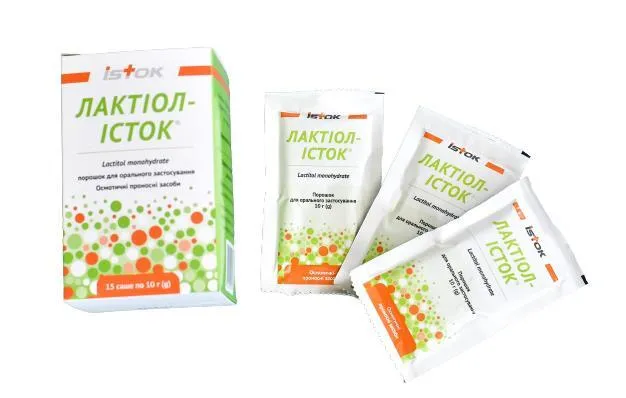
Table of Contents
INSTRUCTION FOR MEDICAL USE OF THE MEDICINAL PRODUCT LACTIOL-ISTOK® (LACTIOL-ISTOK)
Composition:
Active ingredient: lactitol monohydrate;
1 sachet contains 5 g or 10 g of lactitol monohydrate;
1 plastic container contains 200 g or 500 g of lactitol monohydrate.
Pharmaceutical form.
Oral powder.
Main physicochemical characteristics: white or almost white crystalline powder.
Pharmacotherapeutic group. Osmotic laxatives.
ATC code A06AD12.
Pharmacological properties.
Pharmacodynamics.
Lactitol is a derivative of a disaccharide composed of galactose and sorbitol, which is not hydrolyzed by disaccharidases in the small intestine. As a result, it passes through the small intestine with minimal absorption and reaches the colon unchanged. In the colon, under the influence of the intestinal microflora (mainly Bacteroides and Lactobacilli), lactitol is metabolized primarily into acetic, propionic, and butyric acids. Acidification of the colonic contents reduces ammonia absorption. Conversion of lactitol into short-chain fatty acids increases the osmotic pressure in the colon. This leads to an increase in water content and volume of fecal matter, which accounts for its laxative effect.
In hepatic encephalopathy, the effect is achieved through the migration of ammonia from the blood into the colon (due to decreased pH and increased osmotic pressure in the intestinal lumen), as well as elimination of retained ammonium ions and other nitrogen-containing toxic substances from the colon.
As a prebiotic, lactitol enhances the growth of beneficial bacteria such as bifidobacteria and lactobacilli, while suppressing the growth of proteolytic bacteria. This promotes an increase in the dry mass of intestinal contents, favorably influencing bowel evacuation.
Lactitol poses no risk to dental enamel.
Pharmacokinetics.
Lactitol is not absorbed in the small intestine and acts in the colon, where it is broken down by the colonic flora. Lactitol is minimally absorbed. Up to 2% is excreted unchanged in urine. Lactitol has no systemic effects.
Clinical characteristics.
Indications.
Use for symptomatic treatment of constipation and conditions requiring facilitation of defecation (after surgery on the colon and anorectal area, in hemorrhoids).
For the treatment of chronic or acute hepatic encephalopathy.
Contraindications.
- Hypersensitivity to the active substance.
- Inflammatory bowel disease (ulcerative colitis, Crohn's disease).
- Intestinal obstruction, obstructive or subobstructive syndrome.
- Presence of ileostomy or enterostomy.
- Perforation of the gastrointestinal tract or suspicion of perforation.
- Presence of any symptoms or suspicion of organic gastrointestinal tract lesions, abdominal pain syndrome, and/or rectal bleeding.
- Coprostasis should be treated by other methods before using laxatives.
- Contraindicated in breastfed infants and in infants with autosomal recessive hereditary fructose intolerance.
- Galactosemia (incomplete metabolism of lactitol may lead to fructosemia and galactosemia and associated complications).
- Pre-existing hydro-electrolyte imbalance.
Interaction with other medicinal products and other types of interactions.
When using the medicinal product "Lactiol-Istok®" with pH-dependent, enteric-coated drugs, it should be considered that lactitol lowers intestinal pH.
When lactitol is used concomitantly with neomycin, the latter may neutralize the acidifying effect of lactitol on intestinal contents; therefore, this combination is not recommended for patients with cirrhosis and hepatic encephalopathy. However, neomycin does not alter the laxative effect of the medicinal product in patients with constipation.
"Lactiol-Istok®", like other laxatives, may increase potassium loss induced by other drugs (e.g., thiazide diuretics, corticosteroids, carbenoxolone, amphotericin B). In potassium deficiency, the risk of toxic effects of cardiac glycosides increases during concomitant therapy.
Antibacterial agents (medicinal products used for the treatment of infections) and oral antacids reduce the effect of the medicinal product "Lactiol-Istok®" on intestinal bacterial flora.
Laxatives should not be taken simultaneously with other medicinal products: it is not recommended to use "Lactiol-Istok®" within 2 hours after taking other medicinal products.
Special precautions for use.
Prolonged continuous use of laxatives is not recommended. In all cases of chronic constipation, a laxative should be used only if other measures have failed: consumption of a high-fiber diet, adequate fluid intake, and physical activity. To prevent diarrhea caused by excessive doses of laxatives from disturbing the electrolyte balance, the physician must determine the optimal dose to achieve one soft bowel movement per day in patients with constipation and two bowel movements per day in patients with cirrhosis.
In elderly and debilitated patients receiving long-term treatment with the medicinal product "Lactiol-Istok®", serum electrolytes should be monitored regularly. Before initiating treatment with any laxative, any pre-existing electrolyte imbalance should be corrected. When using the medicinal product "Lactiol-Istok®", hydrogen may accumulate in the intestine. If such a patient requires electrocautery, the bowel must first be cleansed with non-fermentable solutions.
Patients with rare hereditary conditions of galactose or fructose intolerance, galactosemia, lactase deficiency, or glucose-galactose malabsorption should not take "Lactiol-Istok®".
In patients experiencing nausea, "Lactiol-Istok®" should be taken during meals.
"Lactiol-Istok®" is not recommended in patients with ileostomy or colostomy.
"Lactiol-Istok®" has a low caloric value (2 kcal/g or 8.5 kJ/g) and does not affect serum insulin or glucose levels; therefore, it can be used in patients with diabetes mellitus.
To prevent the occurrence of flatulence, treatment should be initiated at the lowest dose, gradually increasing the dose until the desired effect is achieved. If flatulence occurs, the dose should be reduced or treatment discontinued.
A physician should be consulted if the therapeutic effect is insufficient after several days of treatment.
Use during pregnancy or breastfeeding.
Pregnancy. Animal studies do not indicate any direct or indirect toxic effects of lactitol monohydrate on reproductive function.
Due to the lack of data on the effects of "Lactiol-Istok®" in pregnant women, the use of this medicinal product during the first trimester of pregnancy is recommended only under a physician's supervision, when the expected benefit to the mother outweighs the potential risk to the fetus or infant.
Breastfeeding. Excretion of lactitol monohydrate in breast milk has not been studied.
No effects on newborns/infants who are breastfed are expected, since the systemic exposure to lactitol monohydrate is negligible.
Ability to influence reaction rate while driving or operating machinery.
No effect.
Dosage and Administration
The medicinal product can be added to food that needs sweetening (e.g., beverages, yogurt, porridge, etc.).
For symptomatic treatment of constipation or conditions requiring facilitation of defecation
Take "Lactiol-Istok®" orally once daily in the morning or evening, during a meal, preferably mixed with food or liquid. After each dose, it is recommended to drink 1–2 glasses of liquid (200 mL each). The time of administration (morning or evening) should be selected according to the patient's needs, as the laxative effect usually develops several hours after intake. However, the first laxative effect may occur on the second or third day of treatment.
The recommended doses of "Lactiol-Istok®" are listed below. Since patients may respond differently, an individual dose should be selected to achieve daily bowel movement.
Adults (including elderly patients): initial daily dose is 0.3 g/kg body weight, approximately 20 g (2 sachets of 10 g or 4 teaspoons of powder) — the entire daily dose should be taken once, either in the morning or evening. After several days, the daily dose may be reduced to 10 g (1 sachet of 10 g or 2 teaspoons of powder).
If no laxative effect is observed, the maximum initial daily dose of 30 g (6 teaspoons of powder) may be used.
Children: initial average daily dose is 0.25 g/kg body weight:
- from 1 to 6 years of age: 2.5 to 5 g per day (½ or 1 sachet of 5 g or ½–1 teaspoon of powder);
- from 6 to 12 years of age: 5 to 10 g per day (1 or 2 sachets of 5 g or 1–2 teaspoons of powder);
- from 13 to 16 years of age: 10 to 20 g per day (1 to 2 sachets of 10 g or 2–4 teaspoons of powder).
One teaspoon contains approximately 5 g of lactitol.
For the treatment of chronic or acute hepatic encephalopathy.
The dosage of the medicinal product should be individually adjusted for each patient based on individual response (aiming for 2 soft bowel movements per day).
Oral administration: the initial daily dose is 0.5–0.7 g/kg body weight, divided into 3 doses taken during meals.
Administration via nasogastric tube or retention enema using a rectal balloon catheter in hospitalized patients
Preparation of a 40% solution of the medicinal product
Add 200 g of "Lactiol-Istok®" to 200 mL of hot distilled water, stirring continuously until the powder dissolves; then adjust the volume to 500 mL with distilled water.
When administered as a retention enema, this volume of solution may be given 4 to 6 times daily.
When administered via nasogastric tube or orally, the initial daily dose is 1 to 2 mL/kg body weight of the 40% solution prepared as described above, corresponding to 0.4–0.8 g/kg body weight per day of lactitol monohydrate.
Children.
May be used in children from 1 year of age under physician's recommendation.
Overdose.
Symptoms
Excessive doses may cause abdominal pain and diarrhea. Diarrhea is a sign of overdose and may also lead to changes in serum electrolyte levels.
Treatment
Reduce or discontinue the medicinal product. Correct electrolyte imbalances caused by excessive fluid loss due to diarrhea.
Adverse reactions.
At the beginning of treatment with the drug, abdominal discomfort, flatulence, pain, and nausea may occur. These symptoms usually diminish or disappear after a few days of treatment.
Depending on individual sensitivity, diarrhea may develop when the drug is used at recommended doses. In such cases, the dose should be reduced.
With prolonged use of high therapeutic doses in the treatment of hepatic encephalopathy, patients may develop electrolyte imbalance due to diarrhea.
The following classification is used to describe the frequency of adverse reactions: very common (≥1/10), common (≥1/100 to <1/10), uncommon (≥1/1000 to <1/100), rare (≥1/10,000 to <1/1000), very rare (<1/10,000), frequency not known (cannot be estimated from available data).
Gastrointestinal disorders: very rare – vomiting, abdominal pain or discomfort, diarrhea, bloating, anal itching, nausea, flatulence; frequency not known – abdominal rumbling.
Shelf life. 2 years.
Storage conditions.
Store in the original packaging at a temperature not exceeding 25 °C.
Keep out of reach of children.
Packaging.
5 g of powder in sachets, 20 sachets in a cardboard box.
10 g of powder in sachets, 15 sachets in a cardboard box.
200 g or 500 g of powder in a plastic container.
Availability. Over-the-counter (without prescription).
Manufacturer.
LLC "Istok-Plus".
Manufacturer's address and place of business.
4 Makarenko Street, Zaporizhzhia, Ukraine, 69032.