Laxers
Ukraine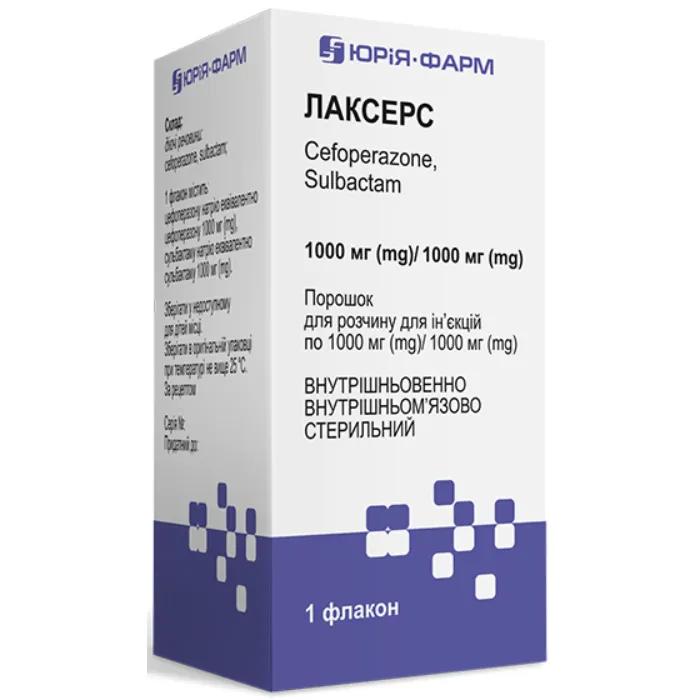
Table of Contents
INSTRUCTIONS FOR MEDICAL USE OF THE MEDICINAL PRODUCT LAXERS (LAXERS)
Composition:
Active substances: cefoperazone, sulbactam;
One vial contains sodium cefoperazone equivalent to cefoperazone 1000 mg, sodium sulbactam equivalent to sulbactam 1000 mg.
Excipients: none.
Pharmaceutical form. Powder for solution for injection.
Main physico-chemical properties: white or almost white powder.
Pharmacotherapeutic group. Antibacterial agents for systemic use. Other β-lactam antibiotics. Third-generation cephalosporins.
ATC code J01DD62.
Pharmacological properties.
Pharmacodynamics.
Laxers is a combination of sulbactam sodium and cefoperazone sodium.
Cefoperazone sodium is a semi-synthetic, broad-spectrum, third-generation cephalosporin antibiotic intended for parenteral use only.
Sulbactam sodium is a derivative of the basic penicillin nucleus. It is an irreversible inhibitor of β-lactamase and is used parenterally only.
Mechanism of action
The antibacterial component of the medicinal product Laxers is cefoperazone—a third-generation cephalosporin that acts against susceptible microorganisms during active multiplication by inhibiting the biosynthesis of the bacterial cell wall mucopeptide. Sulbactam has no significant intrinsic antibacterial activity, except for activity against Neisseriaceae and Acinetobacter. However, biochemical studies on cell-free bacterial systems have shown that sulbactam is an irreversible inhibitor of key β-lactamases produced by microorganisms resistant to β-lactam antibiotics.
The potential of sulbactam to prevent the degradation of penicillins and cephalosporins by resistant microorganisms has been confirmed in studies using whole microorganisms and resistant strains, during which sulbactam demonstrated pronounced synergy with penicillins and cephalosporins. Since sulbactam also binds to certain penicillin-binding proteins, susceptible strains often become more vulnerable to the action of Laxers than to cefoperazone alone.
The combination of sulbactam and cefoperazone is active against all microorganisms susceptible to cefoperazone. In addition, synergistic action is observed (reduction of minimum inhibitory concentrations of the combination against microorganisms by approximately fourfold compared to each component alone), with the most pronounced effect against the following microorganisms: Haemophilus influenzae, species of Bacteroides, species of Staphylococcus, Acinetobacter calcoaceticus, Enterobacter aerogenes, Escherichia coli, Proteus mirabilis, Klebsiella pneumoniae, Morganella morganii, Citrobacter freundii, Enterobacter cloacae, Citrobacter diversus.
Laxers demonstrates in vitro activity against a broad spectrum of clinically significant microorganisms.
Gram-positive microorganisms:
- Staphylococcus aureus (strains producing or not producing penicillinase);
- Staphylococcus epidermidis;
- Streptococcus pneumoniae (former name Diplococcus pneumoniae);
- Streptococcus pyogenes (group A β-hemolytic streptococci);
- Streptococcus agalactiae (group B β-hemolytic streptococci);
- most other strains of β-hemolytic streptococci;
- many strains of Streptococcus faecalis (enterococci).
Gram-negative microorganisms:
- Escherichia coli;
- species of Klebsiella;
- species of Enterobacter;
- species of Citrobacter;
- Haemophilus influenzae;
- Proteus mirabilis;
- Proteus vulgaris;
- Morganella morganii (former name Proteus morganii);
- Providencia rettgeri (former name Proteus rettgeri);
- species of Providencia;
- species of Serratia (including S. marcescens);
- species of Salmonella and Shigella;
- Pseudomonas aeruginosa and some other Pseudomonas species;
- Acinetobacter calcoaceticus;
- Neisseria gonorrhoeae;
- Neisseria meningitidis;
- Bordetella pertussis;
- Yersinia enterocolitica.
Anaerobic microorganisms:
- gram-negative bacilli (including Bacteroides fragilis, other Bacteroides species, and Fusobacterium species);
- gram-positive and gram-negative cocci (including Peptococcus, Peptostreptococcus, and Veillonella species);
- gram-positive bacilli (including Clostridium, Eubacterium, and Lactobacillus species).
The following range of susceptibility to Laxers has been established.
Minimum inhibitory concentrations (MICs) (μg/mL, expressed as cefoperazone concentrations)
| Susceptible |
≤ 16 |
| Intermediate |
17–63 |
| Resistant |
≥ 64 |
Disk size of the inhibition zone (mm, Kirby-Bauer test)
| Sensitive |
≥ 21 |
| Intermediate |
16–20 |
| Resistant |
≤ 15 |
For determining the MIC, serial dilutions of the medicinal product Laxers can be used by means of the agar or broth dilution method. It is recommended to use a disk susceptibility test containing 30 mcg sulbactam and 75 mcg cefoperazone. A laboratory report of "susceptible" indicates that therapy with the medicinal product Laxers is likely to have an effective effect on the causative agent of infection, whereas a report of "resistant" indicates that such an effective effect is unlikely. An "intermediate" response means that the microorganism may be susceptible to the medicinal product Laxers when administered at higher doses or if the infection has developed in those tissues or body fluids where high antibiotic concentrations are achieved.
Recommended quality control limits for susceptibility disks containing sulbactam/cefoperazone 30 mcg / 75 mcg
| Control strain |
Zone size (mm) |
| Acinetobacter species ATCC 43498 |
26–32 |
| Pseudomonas aeruginosa ATCC 27853 |
22–28 |
| Escherichia coli ATCC 25922 |
27–33 |
| Staphylococcus aureus ATCC 25923 |
23–30 |
Pharmacokinetics.
Distribution
Maximum serum concentrations of sulbactam and cefoperazone after 5-minute intravenous administration of a single 2 g dose (in a 1:1 ratio) of the drug (1 g sulbactam + 1 g cefoperazone) in healthy volunteers were 130 and 236.8 mcg/mL, respectively. This indicates a larger volume of distribution of sulbactam (Vd = 18.0–27.6 L) compared to cefoperazone (Vd = 10.2–11.3 L).
Maximum serum concentrations of sulbactam and cefoperazone after 15-minute intravenous administration of a single 4.5 g dose (in a 1:2 ratio) of the drug (1.5 g sulbactam + 3 g cefoperazone) in healthy volunteers were 88.3 mcg/mL and 416.1 mcg/mL, respectively.
Maximum serum concentrations of sulbactam and cefoperazone after the first intramuscular administration of 1.5 g of the drug (0.5 g sulbactam + 1 g cefoperazone) in healthy volunteers were 11 mcg/mL and 45.3 mcg/mL, and 29.9 mcg/mL and 58.4 mcg/mL, respectively, after administration of the seventh dose when the drug was administered every 12 hours.
Elimination
Approximately 84% of the sulbactam dose and 25% of the cefoperazone dose are excreted by the kidneys following administration of the drug. Most of the remaining cefoperazone dose is excreted via bile. After administration of the drug, the mean elimination half-life of sulbactam is approximately 1 hour and that of cefoperazone is 1.7 hours. Plasma concentrations are proportional to the administered dose. These data are consistent with previously published pharmacokinetic studies of sulbactam and cefoperazone administered separately.
After intramuscular administration of 1.5 g of the drug (0.5 g sulbactam and 1 g cefoperazone), maximum plasma concentrations of sulbactam and cefoperazone were achieved between 15 minutes and 2 hours after administration. Mean values of maximum plasma concentrations were 19 and 64.2 mcg/mL for sulbactam and cefoperazone, respectively.
No significant changes in the pharmacokinetics of the drug components or their accumulation were reported after multiple dosing when administered every 8–12 hours.
Patients with hepatic impairment
See section "Dosage and Administration".
Patients with renal impairment
In patients with varying degrees of renal impairment who received the drug, total systemic clearance of sulbactam strongly correlated with creatinine clearance. In patients with non-functioning kidneys, the elimination half-life of sulbactam was considerably prolonged (on average 6.9 and 9.7 hours, according to different studies). Hemodialysis significantly alters the elimination half-life, total systemic clearance, and volume of distribution of sulbactam. No significant differences in cefoperazone pharmacokinetics were observed in patients with renal insufficiency.
Elderly patients
The pharmacokinetics of the drug were studied in elderly patients with impaired renal and hepatic function. Both components of the drug, sulbactam and cefoperazone, exhibited a longer elimination half-life, lower clearance, and larger volume of distribution compared to corresponding values in healthy volunteers. Pharmacokinetic data for sulbactam correlate well with the degree of renal impairment, whereas data for cefoperazone correlate well with the degree of hepatic impairment.
Children
Studies conducted in children demonstrated no significant differences in the pharmacokinetics of the drug components compared to data in adult patients. In children, the mean elimination half-life of sulbactam ranged from 0.91 to 1.42 hours, and that of cefoperazone ranged from 1.44 to 1.88 hours.
Sulbactam and cefoperazone are well distributed into various tissues and body fluids, including bile, gallbladder, skin, appendix, fallopian tubes, ovaries, uterus, and others.
There is no evidence of pharmacokinetic interaction between sulbactam and cefoperazone when co-administered in the form of the drug Laxers.
Cefoperazone does not displace bilirubin from plasma protein binding sites.
Clinical characteristics.
Indications.
The medicinal product Laxers is indicated for the treatment of infections caused by susceptible strains of microorganisms:
- respiratory tract infections (upper and lower);
- urinary tract infections (upper and lower);
- peritonitis, cholecystitis, cholangitis, and other intra-abdominal infections;
- septicemia;
- meningitis;
- skin and soft tissue infections;
- bone and joint infections;
- pelvic inflammatory disease, endometritis, gonorrhea, and other genital infections.
Contraindications.
Laxers is contraindicated in patients with hypersensitivity to the active substances (sulbactam, cefoperazone), β-lactam antibiotics, or to any of the excipients.
Interaction with other medicinal products and other forms of interaction.
Combination therapy
Due to its broad spectrum of activity, the medicinal product Laxers can be used to treat most infections. However, under certain indications, the drug may be used in combination with other antibiotics. When used concomitantly with aminoglycosides (see section "Method of administration and dosage"), renal function should be monitored throughout the course of therapy (see section "Incompatibilities").
Alcohol
Reactions such as facial flushing, sweating, headache, and tachycardia have been reported when alcohol is consumed during treatment with cefoperazone and within 5 days after its administration. Similar reactions have also been observed with some other cephalosporins. Patients should be warned about possible adverse reactions if alcoholic beverages are consumed during treatment with Laxers. When using artificial nutrition (oral or parenteral), solutions containing ethanol must not be used.
Interaction with substances used in laboratory tests False-positive urine glucose reactions may occur when using Benedict's or Fehling's solution.
Special precautions for use.
Hypersensitivity
Severe, and sometimes fatal, hypersensitivity reactions (anaphylactic reactions) have been reported in patients receiving therapy with β-lactam or cephalosporin antibiotics, including sulbactam/cefoperazone. The occurrence of such reactions is more likely in individuals with a history of hypersensitivity to multiple allergens.
Prior to initiating therapy with sulbactam/cefoperazone, the patient’s history of hypersensitivity reactions to cephalosporins, penicillins, or other drugs should be carefully reviewed (see section "Contraindications"). Antibiotics should be administered with caution to patients with any form of allergy, especially to drugs.
If an allergic reaction occurs, the drug should be discontinued immediately and appropriate therapy initiated. Severe anaphylactic reactions require immediate administration of epinephrine. Oxygen therapy, intravenous corticosteroids, and measures to ensure airway patency, including intubation, should be provided as needed (see section "Adverse reactions").
Cases of severe skin reactions, sometimes fatal, including toxic epidermal necrolysis, Stevens–Johnson syndrome, and exfoliative dermatitis, have been reported in patients receiving sulbactam/cefoperazone. If a severe skin reaction occurs, therapy with sulbactam/cefoperazone should be discontinued and appropriate treatment initiated (see section "Adverse reactions").
Use in hepatic impairment
Cefoperazone is predominantly excreted via bile. In patients with hepatic disease and/or biliary obstruction, the serum half-life of cefoperazone is usually prolonged, and renal excretion increases. Even in cases of severe hepatic dysfunction, therapeutic concentrations of cefoperazone in bile are maintained, with only a 2- to 4-fold prolongation of the elimination half-life.
Dose adjustment may be necessary in cases of severe biliary obstruction, severe liver disease, or concomitant renal impairment associated with any of these conditions.
In patients with hepatic impairment and concomitant renal dysfunction, serum cefoperazone concentrations should be monitored, and dosage adjusted as needed. If serum concentration monitoring is not performed, the cefoperazone dose should not exceed 2 g/day.
General warnings
Serious, sometimes fatal, bleeding events have been reported during treatment with sulbactam/cefoperazone. As with other antibiotics, vitamin K deficiency leading to coagulopathy has been observed in patients receiving sulbactam/cefoperazone. This is likely due to suppression of intestinal bacterial flora normally responsible for vitamin K synthesis. Patients at risk include those with poor nutrition, malabsorption, and those receiving prolonged parenteral (intravenous) nutrition. In such patients and in those receiving oral anticoagulants, prothrombin time (or international normalized ratio) should be monitored to detect potential bleeding, thrombocytopenia, and hypoprothrombinemia, and vitamin K supplementation should be administered if indicated. If prolonged bleeding occurs and no other cause is identified, sulbactam/cefoperazone should be discontinued.
As with other antibiotics, prolonged use of the medicinal product Laxers may result in overgrowth of non-susceptible microorganisms. Patients should be closely monitored during therapy. As with other potent systemic agents, periodic monitoring for signs of organ system dysfunction—including renal, hepatic, and hematopoietic systems—is recommended during prolonged treatment with Laxers, especially in premature infants and other neonates.
Clostridium difficile-associated diarrhea has been reported with the use of nearly all antibacterial agents, including sodium sulbactam/sodium cefoperazone. The severity of disease may range from mild diarrhea to fatal colitis. Antibacterial agents alter the normal gut flora, leading to overgrowth of C. difficile.
C. difficile produces toxins A and B, which contribute to the development of C. difficile-associated diarrhea. Hyper-toxin-producing strains of C. difficile are associated with increased morbidity and mortality, as these infections may be resistant to antibacterial therapy and may require colectomy. This diagnosis should be considered in all patients who develop diarrhea following antibacterial therapy. Careful medical history is essential, as cases of C. difficile-associated diarrhea have been reported up to two months after completion of antibacterial therapy.
Children
Laxers is effectively used in infants; however, comprehensive studies on its use in premature or full-term neonates have not been conducted. Therefore, the potential benefits and risks of the drug should be carefully evaluated before initiating treatment in premature or full-term neonates.
In neonates with pathological jaundice, cefoperazone does not displace bilirubin from plasma protein binding sites.
Sodium content
One vial containing 2 g of the medicinal product Laxers (1000 mg / 1000 mg) contains 5.86 mmol (or 134.65 mg) of sodium. Caution should be exercised when administering this product to patients on a sodium-restricted diet.
Use during pregnancy or breastfeeding
Pregnancy
Reproductive toxicity studies conducted in rats at doses 10 times higher than the human dose revealed no evidence of impaired fertility or teratogenic effects. Sulbactam and cefoperazone cross the placental barrier, but comprehensive and well-controlled studies in pregnant women have not been conducted. Since animal reproductive studies do not always predict human response, the medicinal product should be used during pregnancy only if clearly needed.
Breastfeeding
Only a small portion of the administered dose of sulbactam and cefoperazone passes into breast milk. Laxers should be administered to breastfeeding women with caution, despite the fact that both components of the drug are excreted in breast milk in negligible amounts.
Ability to affect reaction speed when driving or operating machinery
The effect of the medicinal product on the ability to drive or operate machinery is unlikely.
Method of Administration and Dosage.
Laxers (the combination of sulbactam sodium / cefoperazone sodium) is supplied in vials and is administered only by the parenteral route.
Adults
The usual dose of the medicinal product for adults is 2–4 g per day (i.e., 1–2 g of cefoperazone per day) administered intravenously or intramuscularly in evenly divided doses every 12 hours.
| Ratio |
Sulbactam/ cefoperazone (g) |
Dose of sulbactam (g) |
Dose of cefoperazone (g) |
| 1:1 |
2–4 |
1–2 |
1–2 |
For severe or refractory infections, the daily dose of the drug may be increased to 8 g (i.e., the dose of cefoperazone is 4 g), administered intravenously in evenly divided doses every 12 hours. The recommended maximum daily dose of sulbactam is 4 g (8 g of the drug).
Patients with impaired liver function
See section "Special precautions for use".
Patients with impaired renal function
The dosage regimen of the drug should be adjusted in patients with significantly reduced renal function (creatinine clearance less than 30 mL/min) to compensate for the reduced clearance of sulbactam. The maximum dose for patients with creatinine clearance of 15–30 mL/min is 1 g of sulbactam every 12 hours (maximum daily sulbactam dose: 2 g); for patients with creatinine clearance less than 15 mL/min, the maximum dose is 500 mg of sulbactam every 12 hours (maximum daily sulbactam dose: 1 g). In severe infections, additional separate administration of cefoperazone may be required.
The pharmacokinetic profile of sulbactam is significantly altered during hemodialysis.
The serum half-life of cefoperazone is slightly reduced during hemodialysis. Therefore, the dosage regimen should be adjusted according to the dialysis schedule.
Elderly patients
See section "Pharmacological properties. Pharmacokinetics".
Children
The usual dose of the drug for children is 40 to 80 mg/kg body weight/day (i.e., 20–40 mg cefoperazone/kg body weight/day), evenly divided into 2–4 doses.
| Ratio |
Sulbactam/ cefoperazone (mg/kg body weight/day) |
Dose of sulbactam (mg/kg body weight/day) |
Dose of cefoperazone (mg/kg body weight/day) |
| 1:1 |
40–80 |
20–40 |
20–40 |
In severe or refractory infections, the daily dose may be increased up to 160 mg/kg body weight/day (80 mg of cefoperazone/kg body weight/day), evenly divided into 2–4 doses (see section "Dosage and Administration").
Neonates
For neonates during the first week of life, the medicinal product should be administered every 12 hours. The maximum daily dose of sulbactam in pediatric patients must not exceed 80 mg/kg body weight/day (160 mg/kg body weight/day of the medicinal product). If a dose of cefoperazone exceeding 80 mg/kg body weight/day is required, the additional cefoperazone dose should be administered separately (see section "Dosage and Administration").
Route of administration
Intravenous administration
For intravenous infusion, the contents of each vial of Laxers medicinal product should be reconstituted with an appropriate volume of 5% aqueous dextrose solution, 0.9% sodium chloride injection solution, or water for injections, and then diluted to 20 mL with the same solution. Administer over 15–60 minutes.
Reconstitution
| Total dose (g) |
Equivalent dose Sulbactam + cefoperazone (g) |
Solvent volume |
Maximum final concentration (mg/ml) |
| 2 |
1+1 |
6.7 |
125+125 |
Lactated Ringer's solution is an acceptable diluent for intravenous infusion, but not for primary reconstitution (see section "Incompatibilities").
For intravenous injection, the contents of each vial should be diluted as described above and administered over at least 3 minutes.
Intramuscular administration
Laxerse has been found to be compatible with the following diluents: Water for Injections, 5% Dextrose Injection, 0.9% Sodium Chloride Injection, 5% Dextrose Injection in 0.225% Sodium Chloride Injection, and 5% Dextrose Injection in 0.9% Sodium Chloride Injection. Cefoperazone is compatible at concentrations ranging from 10 mg to 250 mg per 1 mL of diluent. Sulbactam is compatible at concentrations ranging from 5 to 125 mg per 1 mL of diluent.
Lactated Ringer's solution
Sterile Water for Injections should be used for reconstitution (see section "Incompatibilities"). A two-step dilution process using Sterile Water for Injections is required (see table above); the resulting solution should then be further diluted with Lactated Ringer's solution to achieve a sulbactam concentration of 5 mg/mL (add 2 mL or 4 mL of initially diluted solution to 50 mL or 100 mL of Lactated Ringer's solution, respectively).
Lidocaine
2% Lidocaine Hydrochloride solution is an acceptable diluent for preparing a solution for intramuscular administration, but not for primary reconstitution. Sterile Water for Injections should be used for reconstitution (see section "Incompatibilities").
Any unused product or waste material should be disposed of in accordance with local requirements.
Children
The medicinal product may be administered to children (see section "Dosage and administration").
Overdose
Information on acute toxicity of sodium cefoperazone and sodium sulbactam in humans is limited. Overdose is expected to produce manifestations that are principally an extension of the adverse effects reported during normal use of the medicinal product. It should be noted that high concentrations of β-lactam antibiotics in cerebrospinal fluid may cause neurological reactions, including seizures. Since cefoperazone and sulbactam are removed from the circulation by hemodialysis, this procedure may enhance drug elimination in cases of overdose in patients with impaired renal function.
Adverse reactions.
The medicinal product is generally well tolerated. Most adverse reactions are of mild or moderate severity and have a favorable course during long-term treatment.
Adverse reactions reported during treatment are listed below, with the following frequency categories: very common (≥ 1/10); common (from ≥ 1/100 to < 1/10); uncommon (from ≥ 1/1000 to < 1/100); rare (from ≥ 1/10000 to < 1/1000); very rare (< 1/10000); frequency not known (cannot be estimated from the available data).
| Organ systems |
Frequency |
Adverse reactions |
| Blood and lymphatic system |
Very common |
Neutropenia†, leukopenia†, direct Coombs test positive†, decreased hemoglobin level†, decreased hematocrit†, thrombocytopenia† |
| Common |
Coagulopathy*, eosinophilia† |
|
| Frequency unknown |
Hypoprothrombinemia |
|
| Immune system |
Frequency unknown |
Anaphylactic shock٭§, anaphylactic reaction*§, anaphylactoid reaction§, including shock*, hypersensitivity*§ |
| Nervous system |
Uncommon |
Headache |
| Vascular |
Frequency unknown |
Bleeding (including fatal outcome), vasculitis*, arterial hypotension* |
| Gastrointestinal tract |
Common |
Diarrhea, nausea, vomiting |
| Frequency unknown |
Pseudomembranous colitis* |
|
| Hepatic and biliary |
Very common |
Increased blood levels of alanine aminotransferase†, aspartate aminotransferase†, alkaline phosphatase† |
| Common |
Increased blood bilirubin levels† |
|
| Frequency unknown |
Jaundice* |
|
| Skin and subcutaneous tissue |
Uncommon |
Pruritus, urticaria |
| Frequency unknown |
Toxic epidermal necrolysis*§, Stevens-Johnson syndrome*§, exfoliative dermatitis*§, maculopapular rashes |
|
| Renal and urinary |
Frequency unknown |
Hematuria* |
| General disorders and administration site reactions |
Uncommon |
Phlebitis at injection site, injection site pain, pyrexia, chills |
* Adverse reactions reported during the post-marketing period.
† The frequency calculations for adverse reactions related to laboratory parameter deviations from normal included all available laboratory values, including those from patients with abnormalities at baseline. This conservative approach was adopted because the initial data do not allow differentiation between patient subgroups with baseline abnormalities, patients who experienced clinically significant changes in laboratory parameters related to treatment, and patients who did not experience such changes. Abnormalities in parameters such as leukocyte, neutrophil, platelet, hemoglobin, and hematocrit levels were observed only during clinical trials. Increases and decreases in levels were not differentiated.
§ Reports of fatal outcomes have been received.
Reporting of suspected adverse reactions
Reporting suspected adverse reactions after medicinal product authorization is of great importance. It enables ongoing monitoring of the benefit-risk balance of the medicinal product. Healthcare and pharmaceutical professionals, as well as patients or their legal representatives, should report all cases of suspected adverse reactions and lack of efficacy via the Automated Pharmacovigilance Information System at the following link: https://aisf.dec.gov.ua.
Shelf life. 2 years (from the date of manufacture of the in bulk form).
Storage conditions.
Store in the original packaging at a temperature not exceeding 25 °C.
Keep out of the reach of children.
Incompatibilities.
Aminoglycosides
Solutions of the medicinal product Laxers and aminoglycosides should not be mixed directly due to physical incompatibility. If combined therapy with Laxers and aminoglycosides is necessary, sequential separate intravenous infusions should be administered using a separate secondary intravenous infusion system. The primary intravenous infusion system must be thoroughly flushed with an approved solution between infusions of these agents. It is also advisable to maximize, as much as possible, the time intervals between administration of Laxers and aminoglycosides within a 24-hour period.
Lactated Ringer’s solution
Primary dilution with lactated Ringer’s solution is not recommended, as these substances have been shown to be incompatible. However, a two-step dilution process, in which the initial diluent is water for injections, allows avoidance of incompatibility when further dilution with lactated Ringer’s solution is performed (see section “Instructions for use and dosage”).
Lidocaine
Primary dilution with 2% lidocaine solution is not recommended due to incompatibility. However, a two-step dilution process, in which the initial diluent is water for injections, allows avoidance of incompatibility when further dilution with 2% lidocaine hydrochloride solution is performed (see section “Instructions for use and dosage”).
Packaging.
Vial with powder. 1 or 10 vials per cardboard pack.
Prescription category. Prescription only.
Manufacturer.
LLC "Yuria-Pharm"
(packaging of the in bulk form by the manufacturer NPS Hebei Huamin Pharmaceutical Company Limited, China).
Manufacturer's address and location of operations.
Ukraine, 18030, Cherkasy region, Cherkasy, Kobzarska St., 108. Tel.: (044) 281-01-01.