Labium
Ukraine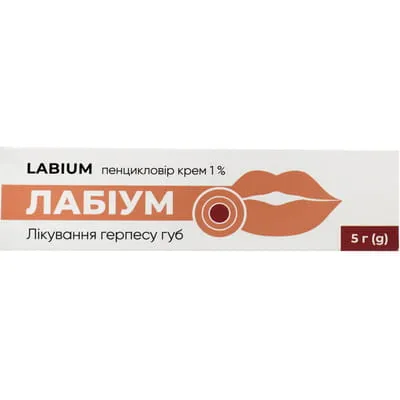
Table of Contents
INSTRUCTIONS FOR MEDICAL USE OF THE MEDICINAL PRODUCT LABIUM (LABIUM)
Composition:
Active substance: penciclovir;
1 g of cream contains penciclovir (calculated as 100 % dry substance) 10 mg;
Excipients: propylene glycol, cetyl stearyl alcohol, macrogol 20 cetyl stearyl ether, white soft paraffin, mineral oil, purified water.
Pharmaceutical form. Cream.
Main physicochemical properties: white cream.
Pharmacotherapeutic group. Chemotherapeutic agents for topical use. Antiviral agents. ATC code D06B B06.
Pharmacological properties.
Pharmacodynamics.
Penciclovir demonstrates high selectivity in vivo and in vitro against human herpes viruses Herpes simplex (types 1 and 2), including acyclovir-resistant strains with altered DNA polymerase, Varicella zoster virus, as well as Epstein-Barr virus and cytomegalovirus. In virus-infected cells, penciclovir is rapidly converted into penciclovir triphosphate (with the participation of virus-induced thymidine kinase). Penciclovir triphosphate is retained in virus-infected cells for over 12 hours, where it inhibits viral DNA replication—significantly longer than acyclovir. By blocking viral replication, penciclovir substantially shortens the healing time, even after the development of papules and vesicles, reduces pain, and shortens the duration of crust desquamation resulting from viral activity. The half-life is 9, 10, and 20 hours in cells infected with Varicella zoster, Herpes simplex type 1, and Herpes simplex type 2 viruses, respectively. In uninfected cells treated with penciclovir, the concentration of penciclovir triphosphate is practically undetectable. Thus, penciclovir does not affect uninfected cells.
Pharmacokinetics.
When applied topically as a 1% cream, the concentration of penciclovir in blood plasma and urine is not quantitatively detectable.
Clinical characteristics.
Indications. Herpes labialis (Herpes labialis).
Contraindications. Hypersensitivity to penciclovir, famciclovir, or other components of the medicinal product (e.g., propylene glycol). Should not be used in patients with immunodeficiency.
Interaction with other medicinal products and other forms of interaction.
No interactions were observed during clinical studies with concomitant administration of penciclovir and other medicinal products (local or systemic).
Special precautions for use
The cream should only be applied to herpes-affected areas on the lips or skin around the mouth. Application of the cream to mucous membranes (e.g., eyes, mouth, nose, or genital organs) is not recommended. Particular caution should be exercised to avoid getting the cream into the eyes or onto the surrounding areas.
If symptoms have not resolved after 4 days of treatment with the cream, consult a physician.
To prevent the spread of the virus to other parts of the body and transmission to other people, the following measures should be observed:
- always wash hands before and after touching the affected area;
- store the tube of cream in its original packaging and do not allow other people to use the cream;
- avoid rupturing the blisters that form as a result of prolonged viral activity;
- avoid touching the eyes (the virus may infect the cornea);
- avoid kissing, especially children;
- avoid sharing items through which the virus may spread, such as towels, cups, cutlery, and cigarettes.
The cream contains cetyl stearyl alcohol, which may cause local skin reactions (e.g., contact dermatitis). The cream also contains propylene glycol, which may cause skin irritation.
Patients with immunodeficiency (e.g., those with AIDS or bone marrow transplant recipients) should consult their physician to determine whether systemic (oral) antiviral therapy is required.
Use during pregnancy or breastfeeding
Clinical studies have shown minimal systemic absorption of penciclovir following topical application; therefore, there are no major concerns regarding the use of the cream during pregnancy or breastfeeding. However, since the safety of penciclovir during pregnancy or breastfeeding has not been fully established, the product should only be used during these periods after consultation with a physician, when the expected benefit to the mother outweighs the potential risk to the fetus/infant.
There is no information available on the passage of penciclovir into breast milk.
Fertility
There are no data on the effect of penciclovir on human fertility. Studies in animals have not shown any effect on fertility following topical application of penciclovir.
Ability to affect reaction speed when driving or operating machinery
The medicinal product has no reported effect on the ability to drive or operate machinery.
Dosage and Administration.
For adults (including elderly patients) and children aged 12 years and older.
The cream should be applied every 2 hours (except during sleep). The treatment course lasts 4 days. Treatment should begin as early as possible at the first signs of infection development. Hands should be washed before applying the cream.
The cream should be applied with a clean finger in an amount corresponding to the size of the affected skin area.
Children.
The effect of the medicinal product on children under 12 years of age has not been studied.
Overdose.
With topical application, overdose is unlikely. Even in case of accidental oral ingestion of the entire package contents, adverse effects will not occur due to the low oral absorption of penciclovir. However, some irritation of the oral cavity may occur. No specific therapeutic measures are required in case of accidental oral ingestion of the entire package contents.
Adverse reactions
The frequency of adverse reactions is defined according to the following classification: very common (≥ 1/10), common (≥ 1/100 to < 1/10), uncommon (≥ 1/1000 to < 1/100), rare (≥ 1/10,000 to < 1/1000), very rare (< 1/10,000), frequency not known (cannot be estimated from the available data).
In clinical trials, penciclovir cream was well tolerated. The most commonly reported adverse reactions were application site reactions.
General disorders and administration site conditions:
Common: application site reactions (including pain at application site, hypoesthesia, burning sensation, prickling, numbness).
During post-marketing surveillance, the following adverse reactions have been identified (all reactions were local or generalized). The frequency of adverse reactions based on post-marketing data is difficult to calculate and is therefore estimated as not known.
Immune system disorders:
Frequency not known: hypersensitivity reactions, urticaria.
Skin and subcutaneous tissue disorders:
Frequency not known: allergic dermatitis (including rash, pruritus, vesicles, and swelling).
Additionally, cases of contact dermatitis (as a reaction to cetyl stearyl alcohol) and irritation at the application site (as a reaction to propylene glycol) are possible. During clinical trials of penciclovir cream, no cases of increased photosensitivity (pigmentation due to exposure of cream-treated skin areas to ultraviolet radiation) were observed.
Reporting of adverse reactions after medicinal product registration is of great importance. It enables ongoing monitoring of the benefit-risk balance of the medicinal product. Healthcare and pharmaceutical professionals, as well as patients or their legal representatives, are encouraged to report all suspected adverse reactions and lack of efficacy through the Automated Pharmacovigilance Information System at the following link: https://aisf.dec.gov.ua.
Shelf life. 3 years.
Storage conditions. Store at a temperature not exceeding 30 °C. Do not freeze. Keep out of reach of children.
Packaging. 5 g of cream in a tube; 1 tube per carton.
Supply category. Over-the-counter.
Manufacturer.
LLC "DKP "Pharmaceutical Factory".
Manufacturer's address and location of manufacturing activities.
4 Korolyova St., v. Stanishivka, Zhytomyr district, Zhytomyr region, 12430, Ukraine.