Nicotinic acid
Ukraine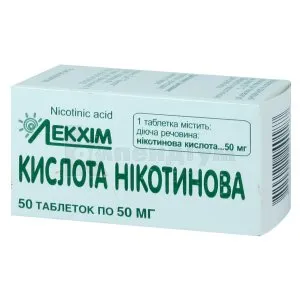
Table of Contents
INSTRUCTIONS FOR MEDICAL USE OF THE MEDICINAL PRODUCT NICOTINIC ACID (NICOTINIC ACID)
Composition:
Active substance: nicotinic acid;
1 tablet contains 50 mg of nicotinic acid;
Excipients: glucose monohydrate, magnesium stearate.
Pharmaceutical form. Tablets.
Main physicochemical properties: single-layer, round-shaped tablets, white or almost white in color, with a score line, convex on both upper and lower surfaces. Under magnification, a relatively homogeneous structure is visible at the break.
Pharmacotherapeutic group. Peripheral vasodilators. Nicotinic acid and its derivatives. ATC code C04AC01.
Pharmacological properties.
Pharmacodynamics.
Nicotinic acid is a prosthetic group of the enzymes dehydrogenase I and dehydrogenase II – enzymes that transfer hydrogen and mediate redox processes. Dehydrogenase II also participates in phosphate transport. Deficiency of nicotinic acid leads to the development of pellagra. Nicotinic acid improves carbohydrate metabolism, dilates blood vessels. It has lipoproteinemic activity and, in hypercholesterolemia, reduces the cholesterol/phospholipid ratio.
Pharmacokinetics.
Absorbed over 6–8 hours, as nicotinic acid is gradually and evenly released from the tablet. Approximately 50 % is absorbed within the first hour, and about 96 % by the eighth hour. Metabolized in the liver, kidneys, and muscles. Metabolites are excreted by the kidneys.
Clinical characteristics.
Indications.
- Prevention and treatment of pellagra (vitamin PP deficiency);
- atherosclerosis;
- hypochlorhydric gastritis;
- vascular spasms (of the brain, kidneys, limbs);
- facial nerve neuritis;
- slowly healing ulcers and wounds of various locations and origins.
Contraindications.
Hypersensitivity to nicotinic acid or to other components of the medicinal product. Arterial hypertension (severe forms), peptic ulcer of the stomach and duodenum (in the stage of exacerbation), significant impairment of liver function, including cirrhosis, active hepatitis.
Decompensated diabetes mellitus, urolithiasis, hyperuricemia, gout.
Recent myocardial infarction, history of sudden decrease in peripheral vascular resistance.
Interaction with other medicinal products and other types of interactions.
Oral contraceptives and isoniazid reduce the conversion of tryptophan to nicotinic acid and thus may increase the requirement for nicotinic acid.
Nicotinic acid reduces the efficacy and toxicity of probenecid, neomycin, barbiturates, antituberculosis agents, sulfonamides.
Antibiotics may enhance skin flushing caused by nicotinic acid.
Acetylsalicylic acid reduces the skin flushing effect induced by nicotinic acid.
Lovastatin, pravastatin – due to increased risk of adverse reactions, combination with nicotinic acid is not recommended. Cases of rhabdomyolysis have been reported when nicotinic acid was used with lovastatin.
Caution is required when combining with antihypertensive agents (possible enhancement of hypotensive effect), anticoagulants, acetylsalicylic acid (due to risk of hemorrhage).
The drug potentiates the action of fibrinolytic agents, spasmolytics, and cardiac glycosides, and enhances the toxic effect of alcohol on the liver.
Concomitant use with methyldopa or β-adrenoreceptor blockers leads to a significant decrease in arterial pressure; with antidiabetic agents – to reduction of their hypoglycemic effect.
Nicotinic acid is incompatible with vitamins В1, В12, В6, euphyllin, salicylates, tetracycline, sympathomimetics, hydrocortisone.
Concomitant use of alcohol during treatment with nicotinic acid may result in acute vascular insufficiency.
Special precautions for use.
To minimize adverse effects and improve treatment tolerance, it is recommended:
- to monitor blood glucose levels and liver function during treatment in order to detect adverse effects of nicotinic acid;
- to take nicotinic acid only with food, which promotes gradual absorption of the drug and reduces adverse effects;
- not to take nicotinic acid with hot beverages (especially coffee) or alcohol;
- not to take a hot shower (bath) immediately after taking the drug.
Use with caution in patients with hemorrhagic disorders, glaucoma, renal insufficiency, moderate arterial hypotension, hyperacid gastritis, and peptic ulcer disease of the stomach and duodenum (in remission phase). Nicotinic acid should be used with caution in individuals who abuse alcohol, and in patients with unstable angina pectoris and acute myocardial infarction who are receiving nitrates, calcium channel antagonists, and beta-blockers.
Prolonged use of nicotinic acid in high doses may lead to hepatic steatosis; therefore, liver function monitoring is required.
Regular monitoring of blood uric acid levels is necessary due to possible increase as a result of long-term therapy.
To prevent hepatic complications, it is recommended to include methionine-rich foods in the diet (e.g. cheese), or to use methionine and other lipotropic agents.
The drug contains glucose, which should be taken into account in patients with diabetes mellitus.
It is not advisable to use nicotinic acid for correction of dyslipidemia in patients with diabetes mellitus.
Use during pregnancy or breastfeeding.
The drug is not recommended during pregnancy or breastfeeding.
Ability to influence reaction rate when driving or operating machinery.
Studies on the effect of the drug on reaction speed have not been conducted; however, possible occurrence of dizziness and drowsiness during nicotinic acid administration should be taken into account.
Dosage and Administration
Take orally after meals.
For pellagra: in adults, administer 100 mg 2–4 times daily for 15–20 days; in children aged 12 years and older, 50 mg twice daily. Maximum: three times daily.
For other conditions: in adults, administer 50 mg (up to 100 mg) twice daily; in children aged 12 years and older, 25 mg (tablet with score line) twice daily.
Maximum doses for adults: single dose – 100 mg, daily dose – 500 mg.
Maximum doses for children: single dose – 50 mg, daily dose – 200 mg.
In atherosclerosis (in the absence of adverse effects), the single dose may be gradually increased up to 500 mg–1 g, and the daily dose up to 2–3 g.
Children.
The medicinal product is not recommended for children under 12 years of age.
Overdose.
Symptoms. High doses of nicotinic acid may cause peripheral vasodilation, skin flushing, nausea, vomiting, heartburn, diarrhea, increased liver enzyme activity, brown skin pigmentation, rarely hyperuricemia, skin itching, headache, arterial hypotension, loss of consciousness, dizziness, skin paresthesias (tingling, burning sensation, hot flashes, crawling sensation), impaired glucose metabolism, visual disturbances, cholestatic jaundice.
Treatment. Discontinue the drug. Symptomatic therapy is required.
Adverse Reactions.
Cardiovascular system: sensation of flushing, which may be accompanied by dyspnea, tachycardia, palpitations, sweating, chills, edema.
Central and peripheral nervous system: paresthesia, dizziness, headache.
Skin: facial and upper trunk skin hyperemia with tingling and burning sensation, dryness of the skin and ocular mucous membrane, exhausting pruritus, skin rash.
Liver and biliary tract: with prolonged use – fatty liver degeneration, increased blood levels of aspartate aminotransferase (AST), lactate dehydrogenase (LDH), alkaline phosphatase.
Metabolism: with prolonged use in high doses – decreased glucose tolerance, increased blood glucose levels, increased blood uric acid levels, hypophosphatemia.
Other: allergic reactions (including urticaria).
Very rarely, during nicotinic acid administration in patients with ischemic heart disease, an increased frequency of atrial arrhythmias and acanthosis (brownish skin patches with velvety surface) may occur. Rarely, retinal edema may develop. These symptoms are transient and disappear after discontinuation of the drug.
With high-dose administration: hyperpigmentation, cramps, diarrhea, nausea, vomiting, anorexia, peptic ulcer exacerbation, jaundice, amblyopia, decreased platelet count, prolonged prothrombin time. Insomnia, myalgia, arterial hypotension, and rhinitis may occur. Visual disturbances, eyelid edema, myopathy, exfoliative dermatitis are possible. Cases of rhabdomyolysis have been reported with concomitant use of nicotinic acid and lovastatin.
Shelf life. 4 years.
Storage conditions.
Store in original packaging at a temperature not exceeding 25°C.
Packaging.
50 tablets in a container. 1 container in a cardboard box.
Prescription status.
Over-the-counter.
Manufacturer.
JSC "Tekhnologiya".
Manufacturer's location and address of business activity.
8 Stara Prorizna Street, Uman, Cherkasy region, 20300, Ukraine.