Quertin
Ukraine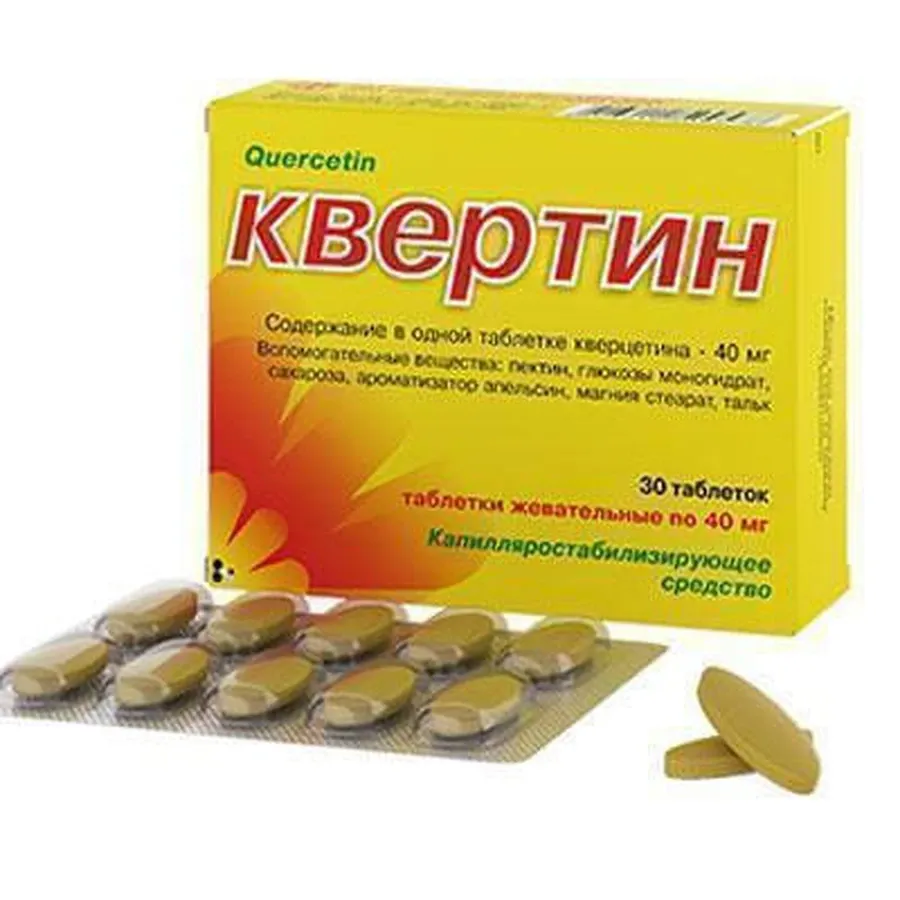
Table of Contents
INSTRUCTIONS FOR MEDICAL USE OF THE MEDICINAL PRODUCT Kvertin (Quertin)
Composition:
Active substance: quercetin;
1 tablet contains quercetin (calculated as 100% dry substance) – 40 mg;
Excipients: pectin, glucose monohydrate, sucrose, orange flavor, magnesium stearate, talc.
Pharmaceutical form. Chewable tablets.
Main physicochemical properties: oval-shaped tablets of yellow color with a greenish tint, with speckles, having a biconvex surface. The tablets have a specific taste and odor.
Pharmacotherapeutic group. Angioprotectors. Other capillary-stabilizing agents.
ATC Code C05CX.
Pharmacological Properties
Pharmacodynamics
The flavonoid quercetin is an aglycone of numerous plant flavonoid glycosides, including rutin. The pharmacological properties of quercetin are due to its pronounced antioxidant activity. Thanks to its capillary-stabilizing effects related to antioxidant and membrane-stabilizing actions, the drug reduces capillary permeability. Quercetin exerts an anti-inflammatory effect, mediated by blockade of the lipoxygenase pathway of arachidonic acid metabolism, reduced synthesis of leukotrienes, serotonin, and other inflammatory mediators. Quercetin has a gastroprotective effect.
Cardioprotective properties of quercetin are associated with enhanced energy supply to cardiomyocytes due to its antioxidant effect and improved blood circulation.
The positive effect of quercetin on brain function rehabilitation in adults during the early recovery period after ischemic stroke is manifested by reduced post-stroke disability, restoration of impaired neurological functions, regression of cognitive deficit, reduced anxiety, improved mood, and a positive attitude of patients toward improved quality of life.
The reparative properties of quercetin accelerate wound healing. The drug may influence bone tissue remodeling processes and has sustained immunomodulatory activity.
Diuretic, spasmolytic, and anti-atherosclerotic properties have also been experimentally established. Quercetin can normalize arterial blood pressure, stimulate insulin release, inhibit thromboxane synthesis, and slow platelet aggregation.
Quercetin also binds to estrogen receptors. Due to its estrogen-like properties (influencing prolidase hydroxylase, inhibiting tumor necrosis factor, and interleukin synthesis), the drug has anti-osteoclastic effects.
Clinical Studies
A study evaluating the efficacy of sequential use of Corvitin and Quertin as pathogenetic treatment agents for pneumonia associated with coronavirus infection COVID-19, in addition to standard therapy, was conducted within the framework of the clinical trial: "Open, multicenter, randomized study to evaluate the efficacy of Corvitin®, lyophilized powder for injection solution 0.5 g, manufactured by JSC SPC "Borshchahivskiy Chemical-Pharmaceutical Plant", followed by Quertin®, chewable tablets 40 mg, manufactured by JSC SPC "Borshchahivskiy Chemical-Pharmaceutical Plant", in patients with pneumonia associated with 2019-nCoV acute respiratory disease, on top of standard therapy." The study included 200 adult patients of both sexes.
The study results demonstrated superior efficacy regarding the primary endpoint, defined as time to normalization of most disease symptoms. Thus, adding Corvitin® and Quertin® to standard therapy led to increased saturation levels and faster recovery (by 2 days) compared to the control group.
Due to membrane-stabilizing, antioxidant, and endothelial-protective effects, the use of Corvitin followed by Quertin, in addition to standard therapy, contributes to stabilization of blood D-dimer levels in patients with pneumonia associated with coronavirus disease.
A study evaluating the efficacy of Quertin used in addition to standard therapy for chronic ischemic heart disease (stable angina pectoris, functional class II–III) in the setting of hypertensive disease stages I–II with 1–2 degrees of arterial hypertension in patients aged 60–75 years inclusive was conducted within the framework of the clinical trial: "Multicenter, randomized, single-blind, placebo-controlled study to evaluate the efficacy and safety of Quertin®, chewable tablets, manufactured by JSC SPC "Borshchahivskiy Chemical-Pharmaceutical Plant", in elderly patients with chronic ischemic heart disease in the setting of hypertensive disease." The study included 200 adult patients of both sexes.
The results of this clinical trial demonstrated superior efficacy of Quertin compared to placebo in treating elderly patients with chronic ischemic heart disease in the setting of hypertensive disease.
The claim of superior efficacy is based on the assessment of the primary efficacy endpoint: after treatment, a statistically significantly higher number of patients in the main group (standard therapy + Quertin) were categorized as "treatment effective" (93%) compared to the control group (33%).
Comparison of Seattle Angina Questionnaire scores between the two patient groups during treatment revealed statistically significant, more favorable positive dynamics in all scales in the main group compared to the control group.
Analysis of treatment effects on Doppler flowmetry parameters in patients of both main and control groups allowed establishing statistically significant increases in maximum volumetric skin blood flow velocity (OShShKmax) and trelax in the main group (standard therapy + Quertin), while no changes in these parameters were observed in the control group (standard therapy + placebo). These results indicate improved microvascular endothelial vasomotor function under the influence of Quertin.
Based on analysis of systolic and diastolic arterial pressure dynamics, a reduction in both parameters was observed after treatment in both main and control groups. However, a statistically significant reduction in systolic arterial pressure after treatment was observed in the main group (standard therapy + Quertin) compared to the control group (standard therapy + placebo).
No statistically significant differences between groups were found regarding the atherogenic coefficient.
Thus, evaluation results of primary and secondary efficacy endpoints allow drawing a general conclusion on the superior efficacy of course treatment with Quertin at a daily dose of 240 mg in elderly patients with chronic IHD in the setting of hypertensive disease.
Pharmacokinetics
Not studied.
Clinical characteristics.
Indications.
As part of complex therapy:
- ischemic heart disease, exertional angina II–III functional class;
- chronic ischemic heart disease (stable exertional angina II–III functional class) against the background of hypertensive disease stage I–II in patients aged 60–75 years;
- early recovery period after ischemic stroke in adults;
- pneumonia caused by coronavirus infection COVID-19 in adults;
- neurocirculatory dystonia;
- prevention of erosive-ulcerative lesions of the upper gastrointestinal tract caused by nonsteroidal anti-inflammatory drugs;
- purulent-inflammatory diseases of soft tissues;
- climacteric, vertebro-radicular pain syndrome;
- neuroreflex manifestations of spinal osteochondrosis;
- chronic glomerulonephritis.
Contraindications.
Hypersensitivity to quercetin and to other components of the drug, as well as to drugs with P-vitamin activity.
Interaction with other medicinal products and other types of interactions.
When using quercetin:
- with preparations of ascorbic acid, summation of effects is observed;
- with nonsteroidal anti-inflammatory agents, anti-inflammatory action of the latter is enhanced with reduction of ulcerogenic effects;
- with digoxin, maximum serum concentration and total area under the concentration-time curve of digoxin are increased;
- with cyclosporine, bioavailability and blood concentration of cyclosporine are increased;
- with paclitaxel – effect on the metabolism of the latter;
- with verapamil, bioavailability of the latter is increased;
- with tamoxifen, bioavailability of the latter is increased, metabolism and elimination are reduced.
Special precautions for use.
Since the formulation contains sucrose and glucose, the drug should not be administered to patients with hereditary fructose intolerance, glucose-galactose malabsorption, or sucrose-isomaltase deficiency.
Quertin, chewable tablets, should be used with caution in patients wearing removable dentures.
The drug should be used with caution in patients with diabetes mellitus.
In the treatment of pneumonia caused by coronavirus infection COVID-19, Quertin is used sequentially after the medicinal product Corvitin® and in combination with basic therapy drugs.
Use during pregnancy or breastfeeding.
The drug is not recommended during pregnancy or breastfeeding.
If use of the drug is necessary, breastfeeding should be discontinued during the treatment period.
Ability to affect reaction rate when driving or operating machinery.
No effect.
Method of Administration and Dosage
The medication should be taken orally, 30 minutes before meals. Chew the tablets and swallow with a small amount of water.
In the early recovery period following an ischemic stroke of the brain, as part of complex therapy, the drug should be prescribed to adults according to the following regimen: 1 tablet 3 times daily for 60 days. Further courses are determined by the physician.
As part of complex treatment of chronic ischemic heart disease on the background of hypertension in elderly patients, the drug should be administered at a dose of 2 tablets 3 times daily for 12 weeks.
In the complex treatment of ischemic heart disease, neuroreflex manifestations of spinal osteochondrosis, chronic glomerulonephritis, as well as for prevention of ulcerogenic effects of nonsteroidal anti-inflammatory drugs, the drug should be prescribed to adult patients at a dose of 1 tablet 3 times daily. In the complex treatment of soft tissue purulent-inflammatory diseases, administer 1 tablet 2 times daily. When used concomitantly with nonsteroidal anti-inflammatory drugs, adults should take Quertin orally at a dose of 2 tablets 3 times daily.
In neurocirculatory dystonia, the drug should be taken orally, 2 tablets twice daily for one month.
In the complex treatment of climacteric and vertebrogenic pain syndrome, the recommended dosage is 1 tablet 3 times daily. The treatment duration is 6 months.
As part of complex treatment of pneumonia caused by coronavirus infection COVID-19, the drug should be prescribed to adults at a dose of 2 tablets 3 times daily for 10 days, following prior administration of the medicinal product Corvitin, lyophilisate for injection solution, according to the following regimen: days 1–4: 0.5 g twice daily at 12-hour intervals; days 5–10: 0.5 g once daily.
Children.
There is no experience with the use of Quertin in children under 12 years of age; therefore, the drug is not recommended for this age group.
Overdose.
No reports of quercetin overdose have been received. Overdose may enhance the manifestations of adverse reactions.
Treatment is symptomatic.
Side effects.
May occur: headache, sensation of tingling in the extremities, nausea, hypersensitivity reactions, including rash, itching.
Shelf life. 4 years.
Storage conditions.
Store in the original packaging at a temperature not exceeding 25 °C.
Keep out of the reach of children.
Packaging.
10 tablets in a blister, 3 blisters in a pack; 90 tablets in a container.
90 tablets in a container, 1 container in a pack.
Category of release. Over-the-counter.
Manufacturer.
Public joint-stock company "Scientific and Production Center "Borshchagov Chemical and Pharmaceutical Plant".
Location of manufacturer and its business address.
17 Miru Street, Kyiv, 03134, Ukraine.