Kutimvait
Ukraine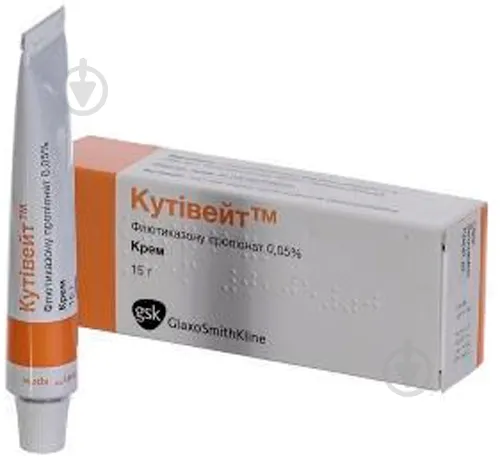
Table of Contents
INSTRUCTIONS FOR MEDICAL USE OF THE MEDICINAL PRODUCT KUTIVEYT (CUTIVATE)
Composition:
Active substance: fluticasone propionate;
1 g of cream contains 500 mcg of fluticasone propionate;
Excipients: mineral oil, cetostearyl alcohol, isopropyl myristate, cetomacrogol 1000, propylene glycol, imidourea, sodium hydrogen phosphate dodecahydrate, citric acid monohydrate, purified water.
Pharmaceutical form. Cream.
Main physicochemical properties: homogeneous soft cream of white or almost white color.
Pharmacotherapeutic group. Corticosteroids for dermatological use. Potent corticosteroids (group III). ATC code D07AC17.
Pharmacological Properties.
Pharmacodynamics.
Fluticasone propionate is a glucocorticoid agent with high anti-inflammatory activity and very low potential for suppression of the hypothalamic-pituitary-adrenal (HPA) axis when administered topically, resulting in one of the widest therapeutic indices among currently available topical corticosteroids.
Fluticasone propionate exhibits high systemic activity after subcutaneous administration, but very low activity following oral administration, likely due to extensive metabolic inactivation. In vitro studies have demonstrated its high affinity for human glucocorticoid receptors.
Fluticasone propionate does not exhibit unexpected hormonal effects or significant effects on the central or peripheral nervous systems, gastrointestinal, cardiovascular, or respiratory systems.
Pharmacokinetics.
Absorption.
Following topical or oral administration, bioavailability is very low due to limited absorption through the skin or from the gastrointestinal tract, as well as extensive first-pass metabolism. Oral bioavailability approaches zero; therefore, systemic effects of fluticasone propionate following any internal use of the cream are expected to be minimal.
Distribution.
Studies have shown that only a negligible amount of orally administered fluticasone propionate reaches systemic circulation, and it is rapidly eliminated via bile and excreted in feces. Fluticasone propionate does not accumulate in any tissues and does not bind to melanin.
Metabolism.
Pharmacokinetic studies in animals indicate that fluticasone propionate is rapidly eliminated and undergoes extensive metabolic clearance. In humans, metabolic clearance is extensive, resulting in rapid elimination. Any drug that penetrates the skin into systemic circulation is quickly inactivated. The primary metabolic pathway is hydrolysis to the carboxylic acid metabolite, which has very low glucocorticoid and anti-inflammatory activity.
Excretion.
Animal studies indicate that the route of excretion is independent of the route of administration of fluticasone propionate. It is excreted predominantly in feces, and elimination is complete within 48 hours.
Clinical characteristics.
Indications.
Adults.
Dermatoses responsive to corticosteroid therapy, such as:
- atopic dermatitis;
- nummular dermatitis (discoid eczema);
- lichen nodularis;
- psoriasis (except generalized plaque psoriasis);
- chronic simple lichen (neurodermatitis), lichen planus;
- seborrheic dermatitis;
- irritant or allergic contact dermatitis;
- discoid lupus erythematosus;
- generalized erythroderma (as an adjunctive agent);
- insect bite reactions;
- erythema toxicum.
Children.
Treatment of atopic dermatitis in children aged 3 months and older when treatment with less potent corticosteroids has been ineffective.
Contraindications.
Hypersensitivity to the active substance or to any of the excipients.
Untreated skin infections.
Rosacea.
Acne vulgaris.
Perioral dermatitis.
Perianal and genital pruritus.
Pruritus without inflammation.
Dermatoses in children under 3 months of age, including diaper dermatitis and diaper rash.
Interaction with other medicinal products and other forms of interaction.
Concomitant use with agents that may inhibit CYP3A4 (e.g., ritonavir, itraconazole) has been shown to inhibit corticosteroid metabolism, potentially leading to increased systemic effects. The clinical significance of such interaction depends on the dose of the corticosteroid, the route of administration, and the potency of the CYP3A4 inhibitor.
Special precautions for use
The drug should be used with caution in patients who have previously experienced local hypersensitivity reactions to corticosteroids or any excipients. Local hypersensitivity reactions (see section "Adverse reactions") may resemble symptoms of the disease being treated.
Manifestations of hypercorticism (Cushing's syndrome) and reversible suppression of the hypothalamic-pituitary-adrenal (HPA) axis with adrenal gland function suppression in some individuals may result from increased systemic absorption of topical steroids. If any of the above symptoms occur, treatment with the drug should be gradually discontinued by reducing the frequency of application or switching to a less potent corticosteroid. Sudden discontinuation of treatment may lead to glucocorticosteroid insufficiency (see section "Adverse reactions").
Risk factors for systemic effects include:
- Potency and formulation of the topical corticosteroid;
- Duration of treatment;
- Application over a large skin surface area;
- Use on skin surfaces in apposition (e.g., intertriginous areas) or under occlusive dressings (in infants, diapers may act as occlusive dressings);
- Increased hydration of the stratum corneum;
- Application to areas with thin skin, such as the face;
- Application to damaged skin or under other conditions involving impaired skin barrier function.
Compared to adults, children and adolescents may absorb a proportionally greater amount of topical corticosteroid and are therefore more susceptible to systemic adverse effects. This is due to children having an underdeveloped skin barrier and a larger skin surface area relative to body mass compared to adults.
Children.
Prolonged daily use of topical corticosteroids in children under 12 years of age should be avoided whenever possible, as they have a higher risk of developing adrenal suppression.
Psoriasis treatment.
Topical corticosteroids should be used with caution in the treatment of psoriasis, as relapses, development of tolerance, risk of generalized pustular psoriasis, and symptoms of local or systemic toxicity due to impaired skin barrier function have been reported. When used for psoriasis treatment, patients should be under close medical supervision.
Application of cream to the face.
Prolonged application of cream to facial skin is not recommended, as this area is more susceptible to atrophic changes.
Application to eyelids.
When applying cream to the eyelids, care should be taken to avoid contact with the eyes, as repeated exposure may lead to cataract and glaucoma.
Visual disturbances.
Visual disturbances may occur with both systemic and topical use of corticosteroids. If a patient experiences symptoms such as blurred vision or other visual disturbances, they should be referred to an ophthalmologist for evaluation of possible causes, which may include cataract, glau游戏副本
Method of Administration and Dosage
Adults and children aged 3 months and older
The cream is particularly suitable for treating moist or weeping skin surfaces.
Apply the medication as a thin layer to affected skin areas once or twice daily. With daily use, treatment duration should not exceed 4 weeks until improvement occurs, after which the frequency of application should be reduced or treatment should be switched to a less potent agent. After applying the cream, allow sufficient time for the medication to be absorbed before applying an emollient.
Once control of the disease is achieved, the frequency of topical corticosteroid use should be gradually reduced until complete discontinuation, with emollients used for maintenance therapy.
Relapse of the underlying condition may occur following abrupt discontinuation of topical corticosteroids, especially potent ones.
Treatment duration in adults and elderly patients
If the condition worsens or no improvement is observed within 2–4 weeks, the diagnosis and treatment regimen should be reassessed.
Children aged 3 months and older
Children are at higher risk of developing local or systemic adverse reactions when using topical corticosteroids; therefore, they are generally prescribed shorter treatment courses and less potent agents than adults.
Cutiwate cream should be used with caution to ensure the minimum effective amount is applied.
Treatment duration in children
If no improvement is observed after 7–14 days of treatment with the cream in children, treatment should be discontinued and the child should be further evaluated. If disease control is achieved within 7–14 days, the minimum effective doses should be used for the shortest possible duration. Daily treatment should not exceed 4 weeks.
Elderly patients
Clinical studies have not shown differences in treatment response between elderly and younger patients. However, elderly patients are more likely to have impaired renal or hepatic function, which may lead to delayed elimination of the drug in case of systemic absorption. Therefore, the minimum effective doses should be used for the shortest duration necessary to achieve the desired therapeutic effect.
Hepatic/Renal Impairment
In cases of systemic absorption (e.g., with application over large areas or prolonged use), metabolism and elimination of the drug may be slowed, increasing the risk of systemic toxicity. Therefore, the minimum effective doses should be used for the shortest possible duration to achieve the desired outcome.
Children – Indicated for treatment of children aged 3 months and older.
Overdose
Symptoms
Fluticasone propionate may be absorbed in sufficient amounts during topical application to produce systemic effects. Acute overdose is highly unlikely. Signs of hypercortisolism may occur in cases of chronic overdose or misuse (see section "Adverse Reactions").
Treatment
In case of overdose, the cream should be gradually discontinued by reducing the frequency of application or switching to a less potent topical corticosteroid, considering the risk of developing glucocorticosteroid insufficiency. Further management should be based on the patient's clinical condition.
Adverse Reactions
Adverse reactions are classified by system organ class and frequency of occurrence: very common (>1/10), common (>1/100, <1/10), uncommon (>1/1,000, <1/100), rare (>1/10,000, <1/1,000), very rare (<1/10,000), including isolated cases, and not known (frequency cannot be estimated from available data).
Infections and infestations
Very rare: opportunistic infections.
Immune system disorders
Very rare: hypersensitivity.
Endocrine system disorders
Very rare: suppression of the hypothalamic-pituitary-adrenal (HPA) axis:
- weight gain/obesity;
- weight gain delay/growth retardation in children;
- Cushingoid signs (e.g., moon face, central obesity);
- decreased endogenous cortisol levels;
- hyperglycemia/glycosuria;
- arterial hypertension;
- osteoporosis;
- cataract;
- glaucoma.
Skin and subcutaneous tissue disorders
Common: pruritus.
Uncommon: sensation of local skin burning.
Very rare: skin atrophy, skin thinning, striae, telangiectasia, pigmentary changes, hypertrichosis, allergic contact dermatitis, exacerbation of underlying symptoms, pustular psoriasis, erythema, rash, urticaria.
Not known: withdrawal syndrome – skin redness which may spread beyond the initially treated area, sensation of prickling or burning, pruritus, skin desquamation, pustules with exudate (see section "Special precautions for use").
Eye disorders
Not known: visual blurring (see section "Special precautions for use").
Shelf life. 2 years.
Storage conditions. Store below 30 °C. Keep out of reach of children.
Packaging. 15 g of cream in an aluminum tube internally coated with lacquer, with a protective membrane and a polypropylene cap, in a cardboard box.
Prescription status. Prescription only.
Manufacturer. Delpharm Poznan S.A., Poland / Delpharm Poznan S.A., Poland.
Manufacturer's address and place of business.
189, Grunwaldzka Str., 60-322 Poznan, Poland /
189 Grunwaldzka Str., 60-322 Poznan, Poland.