Kurosurf®
Ukraine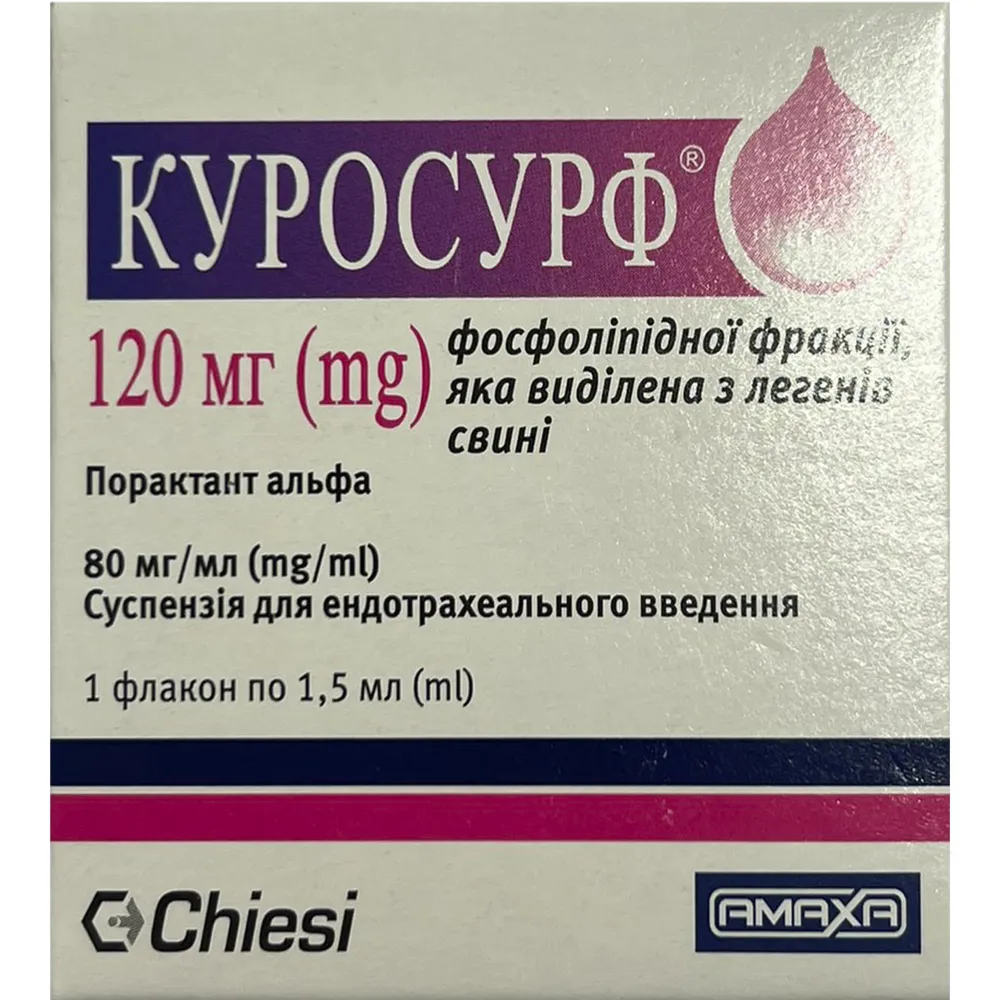
|
INSTRUCTION for medical use of the medicinal product CUROSURF® (CUROSURF®) Composition: Active substance: poractant alfa (BAN); 1.5 mL of suspension contains 120 mg of phospholipid fraction isolated from pig lungs; Excipients: sodium chloride, water for injections. Pharmaceutical form. Suspension for endotracheal administration. Main physicochemical properties: white to yellow suspension. Pharmacotherapeutic group. Pulmonary surfactants. Natural phospholipids. ATC code R07A A02. Pharmacological properties. Pharmacodynamics. Pulmonary surfactant replenishes deficiency of endogenous pulmonary surfactant with exogenous surfactant. It coats the alveolar inner surface; reduces surface tension in the lungs, stabilizes alveoli, prevents their collapse at the end of expiration, and supports adequate gas exchange maintained throughout the entire respiratory cycle. It distributes evenly in the lungs and spreads over alveolar surfaces. In preterm infants, oxygenation levels are restored, requiring a reduction in the concentration of inhaled oxygen in the gas mixture; reduces mortality and respiratory morbidity. Clinical efficacy and safety In a spontaneous clinical trial (NINSAPP), administration of the medicinal product Curosurf ® via the LISA method was compared with standard administration (intubation, administration, and mechanical ventilation) in two groups of preterm newborns with RDS and gestational age from 23 to 27 weeks (LISA group: N = 108, control group: N = 105). The LISA method was non-inferior to the standard method on the primary endpoint of the study (survival without bronchopulmonary dysplasia at 36 weeks' gestation). On the secondary endpoint, the LISA method was more effective in survival without serious complications and reduced the frequency of other diseases associated with prematurity. The need for mechanical ventilation was significantly reduced when using the LISA method. Pharmacokinetics. After intratracheal administration, the majority is found in the lungs. The elimination half-life is 67 hours. Outside the lungs (in blood serum and other organs), only trace amounts of surfactant lipids are detected 48 hours after administration. Clinical characteristics. Indications.
Contraindications. Hypersensitivity to the components of the product. Interaction with other medicinal products and other types of interactions. Not established. Special precautions. The product should be administered only in hospital settings by physicians experienced in the treatment and resuscitation of preterm infants. Infants born after prolonged rupture of membranes (more than 3 weeks) may respond poorly to replacement therapy with the product, possibly due to pulmonary hypoplasia. At the beginning of treatment with Curosurf ® , correction of acidosis, arterial hypotension, anemia, hypoglycemia, and hypothermia must be performed. In case of reflux, administration of Curosurf® should be stopped and, if necessary, peak inspiratory pressure on the ventilator should be increased until the endotracheal tube is cleared. In newborns in whom ventilation is significantly impaired during or shortly after administration of the product, endotracheal tube obstruction by mucus may occur, especially if pulmonary secretion occurred prior to administration. Pre-administration suctioning of mucus from the newborn may reduce the likelihood of mucus obstruction of the endotracheal tube. If obstruction of the endotracheal tube is suspected and suctioning attempts fail to relieve the obstruction, the endotracheal tube should be immediately removed. However, tracheal suctioning of secretions is not recommended for at least 6 hours after administration of the product, except in life-threatening situations. During administration of the product, bradycardia, arterial hypotension, and decreased blood oxygen saturation may occur. Administration of the product should be paused, and necessary measures taken to normalize heart rate, after which treatment may continue with continued monitoring of the newborn's condition. After administration of Curosurf ® , rapid increase in lung compliance and distensibility (lung vital capacity) may occur, requiring adjustment of mechanical ventilation parameters. Increased alveolar gas exchange may lead to rapid rise in arterial oxygen concentration; therefore, inhaled oxygen concentration should be promptly adjusted to prevent hyperoxia. To maintain desired blood oxygenation levels, in addition to periodic blood gas analysis, continuous transcutaneous monitoring of PaO2 or oxygen saturation is recommended. Prolonged nasal positive airway pressure may be used for further treatment, but only if specially equipped units are available for this technique. Newborns receiving surfactant therapy should be under close surveillance for timely detection of infection. Appropriate antibiotic therapy should be initiated immediately upon first signs of infection. In case of inadequate response to Curosurf® therapy or rapidly recurring relapse, before administering the next dose, consider possible presence of other complications related to fetal immaturity, such as patent ductus arteriosus or other lung diseases such as pneumonia. Newborns born after prolonged rupture of membranes (more than three weeks) may have some degree of pulmonary hypoplasia, and therefore optimal response to exogenous surfactant administration may not be observed. Administration of the product significantly reduces the severity of respiratory distress syndrome and risk of its occurrence; however, therapy with the product cannot be considered to fully prevent mortality and diseases associated with preterm birth, as other complications due to immaturity may occur in preterm infants. After administration of Curosurf®, suppression of brain electrical activity has been observed, occurring from 2 to 10 minutes after administration and being reversible. This was observed in only one case, and a causal relationship has not been established. When Curosurf® is administered using the LISA method, increased frequency of bradycardia, apnea, and decreased oxygen saturation has been reported. These events are typically short-lived, without consequences during administration, and easily managed. If these events become serious, discontinue surfactant therapy and treat complications. There is no available information on the efficacy of other initial doses except 100 or 200 mg/kg, or on administration frequency more often than every 12 hours or initiation of Curosurf® administration later than 15 hours after diagnosis of RDS. Administration of Curosurf® to preterm newborns with severe hypotension has not been studied. Prophylactic use of Curosurf® should be performed only if appropriate equipment is available in the delivery room and according to the following recommendations:
Considering other risk factors, prophylaxis is also recommended for preterm newborns with the following risk factors for developing respiratory distress syndrome: perinatal asphyxia, maternal diabetes, multiple pregnancy, male sex of the infant, hereditary predisposition to respiratory distress syndrome, cesarean section. Use during pregnancy or breastfeeding. Administered to newborns. Ability to influence reaction rate when driving or operating machinery. Administered to newborns. Method of administration and dosage. Emergency treatment. Recommended initial dose – 100–200 mg/kg (1.25–2.5 mL/kg), administered as a single dose as soon as RDS is diagnosed. Additional doses of 100 mg/kg (1.25 mL/kg) every 12 hours may be administered if RDS is the cause of further deterioration in the newborn's respiratory function (maximum total dose – 300–400 mg/kg). Prophylaxis. A single dose of 100 to 200 mg/kg should be administered as soon as possible after birth (preferably within 15 minutes). Subsequent doses of 100 mg/kg may be administered 6–12 hours after the first dose, then every 12 hours, if the newborn continues to show symptoms of RDS and dependence on mechanical ventilation (maximum total dose – 300–400 mg/kg). Curosurf ® should be administered by an experienced specialist in neonatal resuscitation and stabilization. Curosurf® is administered endotracheopulmonary to newborns under continuous monitoring of heart rate, oxygen concentration, and saturation, as routinely performed in neonatal units. Curosurf ® stored in a refrigerator at 2–8 °C is ready for use. Immediately before administration, the vial should be warmed to room temperature, for example, by holding it in hands and gently inverting it several times to obtain a homogeneous suspension, without shaking. The suspension should be withdrawn from the vial using a sterile needle and syringe. An appropriate catheter should be used for administration of Curosurf ® into the lungs. Methods of administration of Curosurf ® a) With disconnection from the ventilator. Immediately disconnect the infant from the ventilator and administer a bolus of 1.25 to 2.5 mL/kg of suspension directly into the lower part of the trachea via the endotracheal tube. Perform manual ventilation, then reconnect the infant to the ventilator with the same ventilation parameters used before administration. Subsequent required doses (1.25 mL/kg) are administered in the same manner as described above. b) Without disconnection from the ventilator. Administer a single bolus of 1.25 to 2.5 mL/kg of suspension directly into the lower part of the trachea using a catheter inserted through the suction port and endotracheal tube. Subsequent required doses (1.25 mL/kg) are administered in the same manner as described above. OR c) Intubation–Surfactant–Extubation (INSURE) A third method involves administration via endotracheal tube in the delivery room before initiation of mechanical ventilation, using bag ventilation or extubation to perform continuous positive airway pressure (CPAP) therapy in the delivery room or later after transfer to the neonatal unit (Intubation–Surfactant–Extubation = INSURE). d) Less invasive surfactant administration via thin catheter (LISA) As an alternative during spontaneous breathing of preterm infants, Curosurf ® can also be administered via less invasive surfactant administration (LISA) using a thin catheter. Doses are the same as specified for administration methods a), b), and c). A small-diameter catheter is placed into the trachea of infants receiving continuous positive airway pressure (CPAP), ensuring continuous spontaneous breathing, with direct visualization of vocal cords via laryngoscopy. Curosurf ® is administered as a single bolus within 0.5–3 minutes. After administration of Curosurf ® , the catheter is immediately removed. CPAP therapy should be continued throughout the procedure. Thin CE-marked catheters designated for this intended use should be used for adsorption of surface-active substances. After administration of Curosurf ® , respiratory functional parameters change rapidly, requiring prompt adjustment of ventilator settings. Improved alveolar ventilation may lead to rapid changes in arterial blood oxygen concentration; therefore, prompt changes in ventilation parameters help prevent hyperoxia. To avoid hyperoxia, transcutaneous arterial oxygenation (PaO2) or oxygen saturation monitoring is recommended. Special patient groups Renal or hepatic impairment: Safety and efficacy of Curosurf ® in patients with impaired kidney or liver function have not been evaluated. Special requirements for use of the medicinal product . Before administration, the vial should be warmed to room temperature, then gently inverted without shaking to obtain a homogeneous suspension. The suspension should be withdrawn from the vial using a sterile syringe and needle. To withdraw the suspension, follow these instructions:
The vial is for single use only. Do not use any remaining product from the vial. Unused portions of the product must not be stored for later use. An unopened, unused vial of Curosurf ® that has been warmed to room temperature may be returned once for further storage for up to 24 hours under cool conditions for potential subsequent use. Children. The product is used in preterm newborns for treatment of RDS and in infants at risk of developing RDS. Overdose. No cases of overdose have been reported following administration of Curosurf ® . However, in case of overdose and only if clear clinical disturbances in respiration, ventilation, or oxygenation occur, maximal possible aspiration of excess product from the lungs should be performed, along with therapy aimed at maintaining fluid and electrolyte balance. Adverse reactions. Unwanted adverse events identified during clinical trials and post-marketing period are listed in the table by organ systems (presented according to MedDRA terminology system) and frequency of occurrence: very common (≥ 1/10); common (≥1/100 to <1/10); uncommon (≥1/1,000 to <1/100); rare (≥1/10,000 to <1/1,000); very rare (<1/10,000); unknown (cannot be estimated from available data).
As a consequence of preterm birth, apnea and sepsis may occur in newborns. Intracranial hemorrhage following administration of Curosurf® has been associated with decreased arterial blood pressure and early peaks in arterial oxygenation (PaO2). High PaO2 levels should be avoided by adjusting mechanical ventilation parameters immediately after drug administration. According to clinical studies, a slight tendency toward increased incidence of patients with patent ductus arteriosus receiving Curosurf® treatment has been observed. This phenomenon has also been confirmed with other exogenous surfactants and is related to hemodynamic changes caused by rapid lung expansion during surfactant administration. The development of antibodies against protein components of Curosurf® has also been detected, though without clinically significant manifestations. Preterm infants are at high risk of cerebral hemorrhages and ischemia, manifested as periventricular leukomalacia, and hemodynamic congenital abnormalities such as patent ductus arteriosus and persistent fetal circulation, despite intensive supportive care. These infants are also at high risk of infections such as pneumonia and bacteremia (septicemia). Seizures may also occur during the perinatal period. Hematological and electrolyte disorders frequently develop in preterm infants, which may be exacerbated by severe illness and mechanical ventilation. In preterm infants, severity of disease, use of mechanical ventilation, and the need for reoxygenation may lead to pneumothorax, interstitial emphysema, and pulmonary hemorrhage. Prolonged exposure to high oxygen concentrations and mechanical ventilation are associated with the development of bronchopulmonary dysplasia and retinopathy in preterm infants. LISA Method In clinical studies, certain short-term, mild adverse events without sequelae during administration were more frequently observed in LISA groups compared to standard control treatment groups; specifically: oxygen desaturation (57.4% in LISA group vs. 26.6% in standard group), apnea (21.8% vs. 12.8%), bradycardia (11.9% vs. 2.8%), oral foam (21.8% vs. 2.8%), coughing (7.9% vs. 0.9%), dyspnea (6.9% vs. 1.8%), and sneezing (5% vs. 0). This difference between the two groups may be explained by less frequent use of sedative therapy in LISA groups compared to standard medical care. Most of these events were easily manageable. During a spontaneous comparative clinical trial (NINSAPP), necrotizing enterocolitis was reported in some cases (8.4% in the LISA group vs. 3.8% in the standard intubation/ventilation group) and focal interstitial perforations requiring surgical intervention (11.2% in the LISA group and 10.6% in the standard group), with no statistically significant difference between groups. These events may be complications of prematurity or consequences of other treatments in preterm neonates. Reporting of suspected adverse reactions It is important to report suspected adverse reactions after marketing authorization of the medicinal product. This enables continuous monitoring of the benefit-risk balance of the drug. Please report any suspected adverse reactions through the national reporting system. Shelf life. 18 months. Storage conditions. Store at +2 to +8°C in the original packaging! Keep out of reach of children! Packaging. 1.5 mL of the product in a vial. One vial per cardboard box. Prescription status. Prescription only. Manufacturer. Chiesi Farmaceutici S.p.A., Italy / Chiesi Farmaceutici S.p.A., Italy. Chiesi Pharmaceuticals GmbH, Austria / Chiesi Pharmaceuticals GmbH, Austria. Manufacturer's address and place of business. Via San Leonardo 96, 43122, Parma, Italy / Via San Leonardo 96 – 43122, Parma, Italy. Gonzagagasse 16/16, 1010 Vienna, Austria / Gonzagagasse 16/16, 1010 Wien, Austria. |