Kulento
Ukraine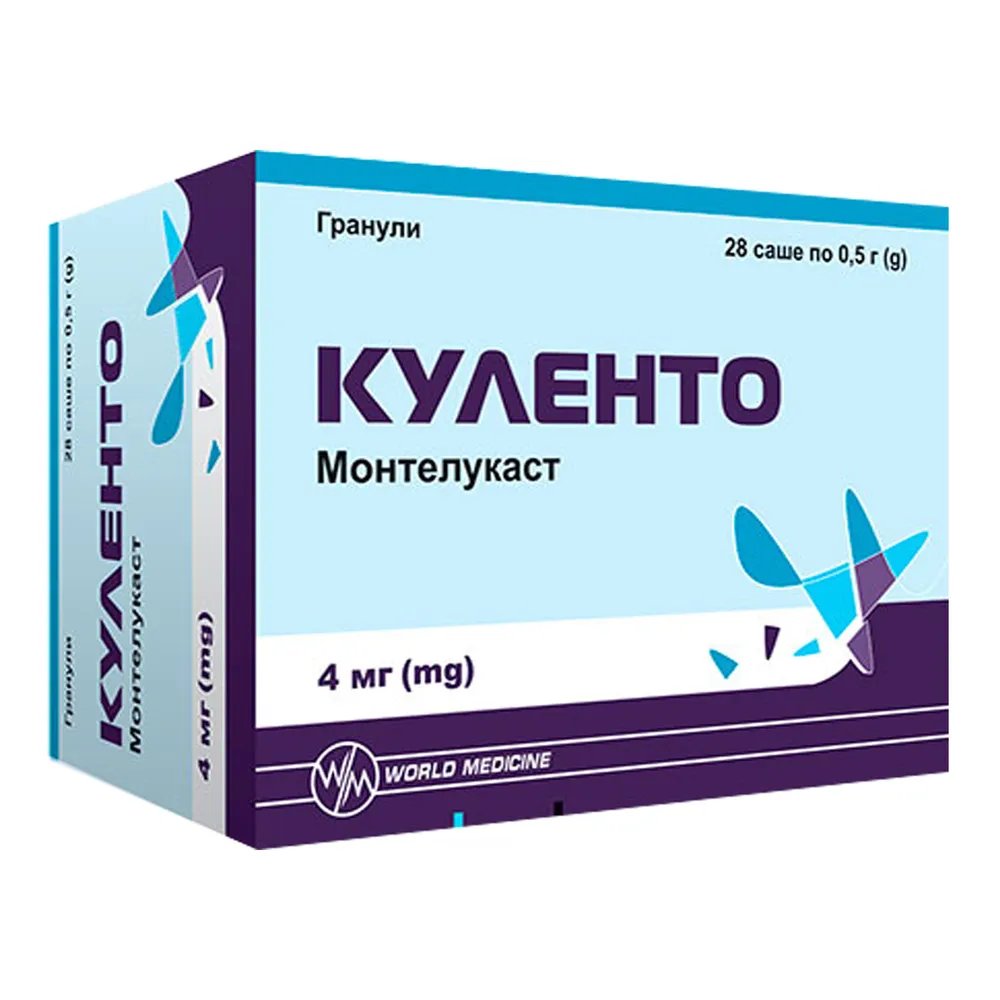
Table of Contents
INSTRUCTIONS FOR MEDICAL USE OF THE MEDICINAL PRODUCT KULENTO (CULENTO)
Composition:
Active substance: montelukast;
One sachet contains montelukast (as montelukast sodium) 4 mg;
Excipients: mannitol (E 421), low-substituted hydroxypropylcellulose, magnesium stearate.
Pharmaceutical form. Granules.
Main physicochemical properties: homogeneous granular powder, white or almost white.
Pharmacotherapeutic group.
Agents for systemic use in obstructive respiratory tract diseases. Leukotriene receptor antagonists. ATC code: R03DC03.
Pharmacological Properties.
Pharmacodynamics.
Cysteinyl leukotrienes (LTC4, LTD4, LTE4) are potent inflammatory eicosanoids released by various cells, including mast cells and eosinophils. These important pro-asthmatic mediators bind to cysteinyl leukotriene receptors (CysLT) present in human airways and induce responses such as bronchoconstriction, mucus secretion, increased vascular permeability, and recruitment of eosinophils.
Oral montelukast is an active compound that binds with high selectivity and affinity to CysLT1 receptors. Clinical studies have shown that montelukast at a 5 mg dose inhibits LTD4-induced bronchoconstriction following inhalation. Bronchodilation is observed within 2 hours after oral administration, and this effect is additive to that induced by β-agonists. Montelukast treatment suppresses both early and late phases of bronchoconstriction triggered by antigen stimulation. Compared to placebo, montelukast reduces peripheral blood eosinophil counts in both adult and pediatric patients. In a separate study, montelukast significantly reduced eosinophil counts in the airways (measured in sputum). In adults and children aged 2 to 14 years, montelukast, compared to placebo, reduces peripheral blood eosinophil counts and improves clinical asthma control.
In studies involving adults, montelukast at a dose of 10 mg once daily demonstrated significant improvement compared to placebo in morning forced expiratory volume in 1 second (FEV1) (change from baseline: 10.4% vs. 2.7%, respectively), morning peak expiratory flow rate (PEFR) (change from baseline: 24.5 L/min vs. 3.3 L/min, respectively), and significantly reduced overall use of β-agonists (change from baseline: –26.1% vs. –4.6%, respectively). Improvement in patient-reported daytime and nighttime asthma symptoms was significantly better than with placebo.
Studies in adults have demonstrated montelukast's ability to complement the clinical effect of inhaled corticosteroids (change (%) from baseline for inhaled beclomethasone with montelukast vs. beclomethasone alone for FEV1: 5.43% vs. 1.04%; β-agonist use: –8.70% vs. 2.64%). Compared to inhaled beclomethasone (200 µg twice daily, via spacer device), montelukast showed a faster initial response, although over the 12-week study period, beclomethasone produced a greater average therapeutic effect (change from baseline for montelukast vs. beclomethasone for FEV1: 7.49% vs. 13.3%; β-agonist use: –28.28% vs. –43.89%). However, a similar clinical response (i.e., improvement in FEV1 of approximately 11% or more from baseline) was achieved in a greater proportion of patients receiving montelukast compared to beclomethasone (50% of patients on beclomethasone vs. 42% on montelukast).
In an 8-week study involving children aged 6 to 14 years, montelukast at a dose of 5 mg once daily significantly improved respiratory function compared to placebo (change from baseline in FEV1: 8.71% vs. 4.16%; change in PEFR: 27.9 L/min vs. 17.8 L/min) and reduced the frequency of as-needed β-agonist use (change from baseline: –11.7% vs. +8.2%).
In a 12-month comparative study of montelukast and inhaled fluticasone for asthma control in children aged 6 to 14 years with mild persistent asthma, montelukast demonstrated non-inferior efficacy compared to fluticasone in increasing the percentage of days without use of rescue medication (primary endpoint). Over the 12-month treatment period, the percentage of days without rescue medication increased from 61.6% to 84.0% in the montelukast group and from 60.9% to 86.7% in the fluticasone group. The between-group difference in least squares (LS) mean percentage increase in days without rescue medication was statistically significant (–2.8 with 95% CI –4.7; –0.9), but within the pre-specified margin for clinical non-inferiority.
Montelukast and fluticasone also improved asthma control relative to secondary endpoints assessed over the 12-month treatment period.
FEV1 increased from 1.83 L to 2.09 L in the montelukast group and from 1.85 L to 2.14 L in the fluticasone group. The between-group LS mean difference in FEV1 increase was –0.02 L (95% CI –0.06; 0.02). The mean percentage increase from baseline predicted FEV1 was 0.6% in the montelukast group and 2.7% in the fluticasone group. The LS mean difference from baseline predicted FEV1 was significant: –2.2% (95% CI –3.6; –0.7).
The proportion of days with β-agonist use decreased from 38.0% to 15.4% in the montelukast group and from 38.5% to 12.8% in the fluticasone group. The between-group LS mean difference in percentage of days with β-agonist use was significant: 2.7 (95% CI 0.9; 4.5).
The proportion of patients experiencing an asthma exacerbation (defined as a worsening of asthma requiring oral steroids, unplanned physician visit, emergency care, or hospitalization) was 32.2% in the montelukast group and 25.6% in the fluticasone group; the risk ratio (95% CI) was significant: 1.38 (1.04; 1.84).
The proportion of patients requiring systemic (mainly oral) corticosteroids during the study period was 17.8% in the montelukast group and 10.5% in the fluticasone group. The between-group LS mean difference was significant: 7.3% (95% CI 2.9; 11.7).
In a 12-week, placebo-controlled study involving children aged 2 to 5 years, montelukast at a dose of 4 mg once daily improved asthma control measures compared to placebo, regardless of concomitant controller therapy (inhaled/nebulized corticosteroids, inhaled/nebulized sodium cromoglycate). Sixty percent of patients did not receive other controller therapy. Montelukast improved daytime symptoms (including cough, wheezing, shortness of breath, and activity limitation) and nighttime symptoms compared to placebo. Montelukast also reduced the frequency of as-needed β-agonist use and emergency use of corticosteroids during asthma exacerbations compared to placebo. Patients receiving montelukast had more days without asthma symptoms than those receiving placebo. Therapeutic effect was achieved after the first dose.
In a 12-month, placebo-controlled study involving children aged 2 to 5 years with mild asthma and episodic exacerbations, montelukast at a dose of 4 mg once daily significantly reduced (p ≤ 0.001) the annual rate of asthma exacerbations (AEs) compared to placebo (1.60 AEs vs. 2.34 AEs, respectively) [Asthma exacerbations defined as ≥3 consecutive days of daytime symptoms requiring β-agonist or corticosteroid (oral or inhaled) use, or hospitalization for asthma treatment]. The percentage reduction in annual AE rate was 31.9% (95% CI 16.9; 44.1).
In a placebo-controlled study involving children aged 6 months to 5 years with intermittent (but not persistent) asthma, montelukast treatment was administered for 12 months either continuously at 4 mg once daily or in 12-day courses initiated at the onset of intermittent symptoms. No significant difference was observed between patients receiving 4 mg montelukast and those receiving placebo in the number of asthma episodes progressing to asthma attacks (defined as an asthma episode requiring unplanned physician visit, emergency department visit, or hospitalization; or treatment with oral, intravenous, or intramuscular corticosteroids).
The efficacy of montelukast in patients aged 6 months to 2 years is supported by extrapolation of efficacy data from patients aged 2 years and older with bronchial asthma, based on similar pharmacokinetic data and the assumption that disease course, pathophysiology, and response to montelukast are similar across these age groups.
Significant reduction in exercise-induced bronchoconstriction (EIB) was demonstrated in a 12-week study in adults (maximum FEV1 decrease: 22.33% for montelukast vs. 32.40% for placebo; time to recovery within 5% of baseline FEV1: 44.22 min vs. 60.64 min). This effect was maintained throughout the 12-week study period. Reduction in EIB was also demonstrated in a short-term study in children aged 6 to 14 years (maximum FEV1 decrease: 18.27% vs. 26.11%; time to recovery within 5% of baseline FEV1: 17.76 min vs. 27.98 min). The effect in both studies was demonstrated at the end of the dosing interval with once-daily administration.
In patients with aspirin sensitivity receiving ongoing therapy with inhaled and/or oral corticosteroids, montelukast treatment compared to placebo resulted in significant improvement in asthma control (change from baseline in FEV1: 8.55% vs. –1.74%; change from baseline in total β-agonist use: –27.78% vs. 2.09%).
Pharmacokinetics.
Absorption.
After oral administration, montelukast is rapidly absorbed. Following administration of 10 mg film-coated tablets on an empty stomach to adults, the mean peak plasma concentration (Cmax) is reached within 3 hours (Tmax). The mean oral bioavailability is 64%. A normal meal does not affect bioavailability or Cmax following oral administration. Safety and efficacy have been confirmed in clinical trials with 10 mg film-coated tablets administered regardless of meal timing.
For 5 mg chewable tablets, Cmax in adults is reached within 2 hours after administration on an empty stomach. Mean oral bioavailability is 73%, decreasing to 63% when taken with a standard meal.
After administration of 4 mg chewable tablets on an empty stomach to children aged 2 to 5 years, Cmax is reached within 2 hours. Mean Cmax is 66% higher and mean Cmin lower than in adults after administration of 10 mg tablets.
In adults administered montelukast on an empty stomach, the granule formulation (4 mg) and chewable tablets (4 mg) have been shown to be bioequivalent. After oral administration of 4 mg montelukast granules to patients aged 6 months to 2 years, Cmax is reached within 2 hours; Cmax values are approximately twice as high as in adults receiving 10 mg film-coated tablets. When montelukast granules are administered orally with apple puree or high-fat meal, its pharmacokinetics are not clinically significantly altered based on area under the concentration-time curve (AUC) (1225.7 and 1223.1 ng*h/mL with and without apple puree, respectively; 1191.8 and 1148.5 ng*h/mL with and without high-fat meal, respectively).
Distribution.
Over 99% of montelukast is protein-bound in plasma. The mean steady-state volume of distribution is 8 to 11 liters. In rat studies using radiolabeled montelukast, passage across the blood-brain barrier was minimal. Furthermore, concentrations of radiolabeled material in all other tissues 24 hours after dose administration were also minimal.
Metabolism.
Montelukast is extensively metabolized. In studies using therapeutic doses, plasma concentrations of montelukast metabolites at steady state in adults and pediatric patients are undetectable.
Cytochrome P450 2C8 is the primary enzyme involved in montelukast metabolism. Additionally, CYP 3A4 and 2C9 play minor roles. However, itraconazole (a CYP 3A4 inhibitor) did not alter the pharmacokinetics of montelukast in healthy volunteers receiving 10 mg daily. In vitro studies using human liver microsomes indicate that therapeutic plasma concentrations of montelukast do not inhibit cytochrome P450 3A4, 2C9, 1A2, 2A6, 2C19, or 2D6. The contribution of metabolites to the therapeutic effect of montelukast is minimal.
Excretion.
Plasma clearance of montelukast in healthy adult volunteers averages 45 mL/min. Following oral administration of radiolabeled montelukast, 86% is excreted in feces within 5 days and less than 0.2% in urine. Combined with oral bioavailability, this indicates that montelukast and its metabolites are almost entirely eliminated via bile.
Pharmacokinetics in Specific Patient Populations.
Dose adjustment is not required in patients with mild to moderate hepatic impairment. Studies in patients with renal impairment have not been conducted. Since montelukast and its metabolites are excreted via bile, dose adjustment in patients with renal impairment is not considered necessary. Pharmacokinetic data in patients with severe hepatic impairment (Child-Pugh score >9) are lacking.
Administration of high doses of montelukast (20 and 60 times the recommended adult dose) has been associated with decreased plasma theophylline concentrations. This effect is not observed at the recommended dose of 10 mg once daily.
Clinical characteristics.
Indications.
- Adjunctive therapy in bronchial asthma in patients aged 6 months to 5 years with mild to moderate persistent asthma that is not adequately controlled with inhaled corticosteroids, as well as in cases of insufficient clinical control of asthma with short-acting β-adrenoceptor agonists used as needed.
- Alternative therapy to low-dose inhaled corticosteroids in patients aged 2 to 5 years with mild persistent asthma who have not experienced severe asthma attacks requiring oral corticosteroids in the recent past, and who are unable to use inhaled corticosteroids (see section "Dosage and administration").
- Prophylaxis of asthma in which bronchospasm induced by physical exertion is the predominant component, in patients aged 2 years and older.
Contraindications.
Hypersensitivity to the active substance and/or to any of the excipients of the medicinal product.
Interaction with other medicinal products and other forms of interaction.
The medicinal product can be used concomitantly with other medicinal products commonly used for the prevention or long-term treatment of asthma. In drug interaction studies, the recommended clinical dose of montelukast had no clinically significant effect on the pharmacokinetics of the following medicinal products: theophylline, prednisone, prednisolone, oral contraceptives (ethinylestradiol/norethindrone 35/1), terfenadine, digoxin, and warfarin.
In patients concurrently taking phenobarbital, the AUC of montelukast was reduced by approximately 40%. Since montelukast is metabolized via CYP 3A4, 2C8, and 2C9, caution should be exercised, especially in children, when using it concomitantly with inducers of CYP 3A4, 2C8, and 2C9, such as phenytoin, phenobarbital, and rifampicin.
In vitro studies have shown that montelukast is a potent inhibitor of CYP 2C8. However, clinical drug interaction studies involving montelukast and rosiglitazone (a marker substrate; a drug metabolized via CYP 2C8) have demonstrated that montelukast is not an inhibitor of CYP 2C8 in vivo. Therefore, montelukast does not significantly affect the metabolism of drugs metabolized by this enzyme (e.g., paclitaxel, rosiglitazone, and repaglinide).
In vitro studies have established that montelukast is a substrate of CYP 2C8 and, to a lesser extent, of CYP 2C9 and 3A4. In a clinical drug interaction study using montelukast and gemfibrozil (an inhibitor of CYP 2C8 and 2C9), gemfibrozil increased systemic exposure to montelukast by 4.4-fold. When used concomitantly with gemfibrozil or other potent inhibitors of CYP 2C8, dosage adjustment of montelukast is not required; however, physicians should be aware of the increased risk of adverse reactions.
Based on in vitro data, clinically significant interactions with weaker inhibitors of CYP 2C8 (e.g., trimethoprim) are not expected. Concomitant administration of montelukast with itraconazole, a strong inhibitor of CYP 3A4, did not result in a significant increase in systemic exposure to montelukast.
Special precautions for use.
The diagnosis of persistent bronchial asthma in children aged 6 months to 2 years must be established by a pediatrician or pulmonologist.
Patients should be advised that montelukast must never be used for the treatment of acute asthma attacks, and that they should always have a suitable emergency medication available. In case of an acute attack, short-acting inhaled β-agonists should be used. Patients should seek medical advice as soon as possible if they require a greater amount of short-acting β-agonist than usual.
A sudden replacement of inhaled or oral corticosteroids with this medicinal product is not recommended.
There are no data confirming that the dose of oral corticosteroids can be reduced when montelukast is used concomitantly.
Psychoneuropsychiatric reactions have been reported in adults, adolescents, and children treated with montelukast (see section "Side effects"). Patients and physicians should be alert to such psychoneuropsychiatric reactions. Patients and/or caregivers should be instructed to inform their physician if such reactions occur. Physicians should carefully evaluate the risks and benefits of continuing the medication if such reactions develop.
In rare cases, systemic eosinophilia, sometimes accompanied by clinical signs of vasculitis (Churg-Strauss syndrome), has been observed in patients receiving anti-asthma medications, including montelukast. This condition is treated with systemic corticosteroid therapy. These cases usually (but not always) occurred in association with a reduction in dose or discontinuation of corticosteroid therapy. The possibility that leukotriene receptor antagonists may be linked to the occurrence of Churg-Strauss syndrome cannot be definitively ruled out or confirmed. Physicians should be aware of the potential for eosinophilia, vasculitic rash, worsening of pulmonary symptoms, or cardiac and/or neurological complications in patients. Patients who develop such symptoms should be re-evaluated and their treatment regimen reviewed.
Montelukast treatment does not allow patients with aspirin-sensitive asthma to take acetylsalicylic acid or other nonsteroidal anti-inflammatory drugs.
The medicinal product contains less than 1 mmol (23 mg) of sodium per sachet, i.e., it is practically sodium-free.
Use during pregnancy or breastfeeding.
This medicinal formulation is intended for use in children aged 6 months to 5 years.
Effect on ability to drive and use machines.
This medicinal formulation is intended for use in children aged 6 months to 5 years.
Method of Administration and Dosage
The medicinal product is intended for oral administration.
The medicinal product must be administered to children under adult supervision.
Dosage.
For children aged 6 months to 5 years, the medicinal product should be administered at a dose of 1 sachet (4 mg) once daily in the evening. Dose adjustment is not required for patients in this age group.
Clinical data on the efficacy of montelukast in patients with bronchial asthma aged 6 months to 2 years are limited.
If there is no response to treatment, administration of the medicinal product should be discontinued.
Method of Administration.
The granules should be taken orally, either swallowed directly or mixed in a spoon with soft food at cold or room temperature (e.g., apple puree, ice cream, carrots, and rice).
The sachet should be opened immediately before use, and the entire dose should be taken promptly (within 15 minutes) after opening.
When mixed with food, the medicinal product must not be stored for later use.
The contents of the sachet should not be diluted in liquid; however, after oral administration, it may be followed by a drink.
The medicinal product may be administered regardless of food intake.
General Recommendations.
The therapeutic effect of montelukast on asthma control parameters occurs within 1 day. Patients should be advised to continue taking the medicinal product even if asthma control is achieved, as well as during asthma exacerbations.
Dose adjustment is not necessary for patients with renal impairment or mild to moderate hepatic impairment. There are no data available for patients with severe hepatic impairment. Dosage is the same for boys and girls.
As an alternative treatment to low-dose inhaled corticosteroids in mild persistent asthma.
Montelukast is not recommended as monotherapy for patients with moderate persistent asthma. The use of montelukast as an alternative to low-dose inhaled corticosteroids in children aged 2 to 5 years with mild persistent asthma should only be considered for patients who have not experienced severe asthma attacks requiring oral corticosteroids in the recent past and who are unable to use inhaled corticosteroids (see section "Indications"). Mild persistent asthma is defined as asthma symptoms occurring more than once per week but less than once per day, nocturnal symptoms occurring more than twice per month but less than once per week, and normal lung function between episodes. If adequate asthma control is not achieved, the need for additional or alternative anti-inflammatory therapy should be evaluated within a follow-up period (usually within 1 month), based on a stepwise asthma treatment approach. Patients should be periodically assessed for asthma control.
Prevention of asthma in patients aged 2 to 5 years in whom exercise-induced bronchoconstriction is the primary component of asthma.
Montelukast is recommended for patients aged 2 to 5 years for the prevention of exercise-induced bronchoconstriction, which may be the predominant manifestation of persistent asthma requiring inhaled corticosteroid therapy. Patients should be evaluated after 2–4 weeks of treatment with montelukast. If an adequate response is not achieved, additional or alternative therapy should be considered.
Use of the medicinal product in combination with other asthma treatments.
When montelukast is used as add-on therapy to inhaled corticosteroids, inhaled corticosteroids should not be abruptly discontinued (see section "Special Warnings and Precautions for Use").
Children.
The medicinal product is not recommended for children under 6 months of age, as the safety and efficacy of montelukast in this age group have not been established.
Overdose.
There is no specific information on the treatment of montelukast overdose. In clinical trials of chronic asthma, montelukast was administered at doses up to 200 mg/day in adult patients for 22 weeks and up to 900 mg/day in short-term studies for approximately one week, without clinically significant adverse reactions.
During post-marketing use and clinical trials, reports of acute montelukast overdose have been received. These included ingestion by adults and children at doses exceeding 1000 mg (approximately 61 mg/kg in a 42-month-old child). The observed clinical and laboratory findings were consistent with the safety profile in adult and pediatric patients. In most cases, no adverse reactions were reported. The most commonly observed adverse reactions were consistent with the safety profile of montelukast and included abdominal pain, somnolence, thirst, headache, vomiting, and psychomotor hyperactivity.
It is unknown whether montelukast is eliminated by peritoneal dialysis or hemodialysis.
Adverse Reactions
During clinical studies of montelukast in children aged 6 months to 5 years, the following adverse reactions were frequently observed (≥ 1/100 to < 1/10):
Nervous system disorders:
Hyperkinesia.
Respiratory, thoracic and mediastinal disorders:
Asthma.
Gastrointestinal disorders:
Abdominal pain, diarrhea.
Skin and subcutaneous tissue disorders:
Eczematous dermatitis, rash.
General disorders and administration site conditions:
Thirst.
Adverse reactions reported during the post-marketing period are listed below by system organ class and frequency: very common (≥1/10), common (≥1/100 to <1/10), uncommon (≥1/1000 to <1/100), rare (≥1/10,000 to <1/1000), very rare (<1/10,000).
Infections and infestations:
Very common – upper respiratory tract infections*.
Blood and lymphatic system disorders:
Rare – tendency to increased bleeding; very rare – thrombocytopenia.
Immune system disorders:
Uncommon – hypersensitivity reactions, including anaphylaxis; very rare – hepatic eosinophilic infiltration.
Psychiatric disorders:
Uncommon – sleep disorders, including nightmares, insomnia, somnambulism, anxiety, agitation, including aggressive behavior or hostility, depression, psychomotor hyperactivity (including irritability, restlessness, tremor§); rare – attention disorders, memory impairment, tic; very rare – hallucinations, disorientation, suicidal thoughts and behavior (suicidality), obsessive-compulsive disorders, dysphemia.
Nervous system disorders:
Uncommon – dizziness, somnolence, paresthesia/hypoesthesia, convulsions.
Cardiac disorders:
Rare – palpitations.
Respiratory, thoracic and mediastinal disorders:
Uncommon – epistaxis; very rare – Churg-Strauss syndrome (see section "Special Warnings and Precautions for Use"), pulmonary eosinophilia.
Gastrointestinal disorders:
Common – diarrhea**, nausea**, vomiting**; uncommon – dry mouth, dyspepsia.
Hepatobiliary disorders:
Common – increased plasma transaminase levels (ALT, AST); very rare – hepatitis (including cholestatic, hepatocellular, and mixed liver injury).
Skin and subcutaneous tissue disorders:
Common – rash**; uncommon – bruising, urticaria, pruritus; rare – angioneurotic edema; very rare – nodular erythema, erythema multiforme.
Musculoskeletal and connective tissue disorders:
Uncommon – arthralgia, myalgia, including muscle cramps.
Renal and urinary disorders:
Uncommon – enuresis in children.
General disorders and administration site conditions:
Common – pyrexia**; uncommon – asthenia/fatigue, malaise, swelling.
*This adverse reaction was observed with a "very common" frequency in patients receiving montelukast as well as in patients receiving placebo during clinical trials.
**This adverse reaction was observed with a "common" frequency in patients receiving montelukast as well as in patients receiving placebo during clinical trials.
§Rare.
Reporting of suspected adverse reactions.
Reporting suspected adverse reactions after product authorization is important. It allows continued monitoring of the benefit-risk balance of the medicinal product. Healthcare professionals are encouraged to report any suspected adverse reactions via the national pharmacovigilance system.
Shelf life.
3 years.
Storage conditions.
Store at temperatures not exceeding 25 °C in the original packaging and in a place inaccessible to children.
Packaging.
0.5 g of granules in sachets; 28 sachets in a cardboard box.
Prescription status.
Prescription only.
Manufacturer.
UORLDMEDICIN ILAC SAN. VE TIC. A.S. /
WORLD MEDICINE ILAC SAN. VE TIC. A.S.
Manufacturer's address and location of operations.
15 Temmuз Mahallesi Cami Yolu Caddesi No:50 Guneyli Bagcilar/Istanbul, Turkey /
15 Temmuz Mahallesi Cami Yolu Caddesi No:50 Gunesli Bagcilar/Istanbul, Turkey.
Marketing Authorization Holder.
LLC "WORLD MEDICINE", Ukraine /
WORLD MEDICINE, LLC, Ukraine.