Xavron
Ukraine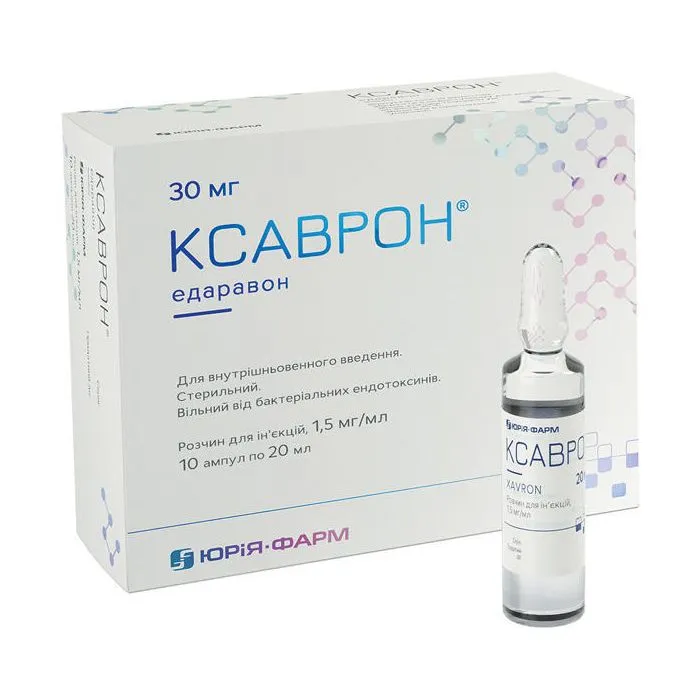
Table of Contents
INSTRUCTION FOR MEDICAL USE OF THE MEDICINAL PRODUCT KSAVRON (XAVRON)
Composition:
Active substance: edaravone;
1 ml of solution contains 1.5 mg of edaravone;
Excipients: sodium metabisulfite (E 223), sodium chloride, sodium hydroxide, phosphoric acid, water for injections.
Pharmaceutical form. Solution for injection.
Main physicochemical properties: clear colorless or slightly yellowish liquid.
Pharmacotherapeutic group. Other agents acting on the nervous system. Edaravone.
ATC code N07XX14.
Pharmacological Properties
Pharmacodynamics
Free radicals, such as hydroxyl radicals (OH), are among the main factors contributing to cerebrovascular disorders associated with ischemia. During ischemia or hemorrhage, reperfusion leads to abnormal overproduction of arachidonic acid, which increases the generation of free radicals. These free radicals induce lipid peroxidation of unsaturated fatty acids present in cell membrane lipids, causing membrane damage and resulting in impaired brain function.
In the acute phase of ischemic cerebral infarction, the medicinal product demonstrates a protective effect by suppressing the development of ischemic cerebrovascular disorders such as cerebral edema, neurological symptoms, and delayed neuronal death.
The etiology of onset and progression of amyotrophic lateral sclerosis (ALS) has not yet been definitively established. However, it has been hypothesized that oxidative stress caused by free radicals may be an etiological factor in this pathology. Edaravone, due to its inhibitory effect on lipid peroxidation via scavenging free radicals, demonstrates suppression of disease progression by reducing oxidative damage to brain cells (vascular endothelial cells / nerve cells).
Moreover, oxidative stress has recently been identified as a key factor in the pathogenesis of coronavirus disease (COVID-19).
Approximately 5% of patients with coronavirus disease develop severe lung injury and/or multiorgan dysfunction. According to animal studies, edaravone attenuates lipopolysaccharide-induced acute respiratory distress syndrome (LPS extracted from the membrane of Escherichia coli 0111:B4), associated with early lung fibrosis, by reducing oxidative stress and transforming growth factor β1 / Smad3 signaling.
In addition, critically ill patients with COVID-19 frequently develop typical clinical manifestations of shock, metabolic acidosis, and abnormal coagulation parameters, indicating microcirculatory dysfunction.
Systemic inflammatory response occurring in bacterial and viral infections, trauma (especially polytrauma), major surgical procedures, ischemia and reperfusion of any organ, and malignant neoplasms is also a major factor in the development of coagulopathy associated with COVID-19, supporting the concept of thromboinflammation. Coronavirus disease is associated with both thromboinflammatory and autoimmune issues. Currently, severe COVID-19 is considered a systemic thromboinflammatory syndrome characterized by the development of micro- and macrovascular venous and arterial thromboses.
There may be common pathogenetic mechanisms of coagulopathy in COVID-19 and immune-inflammatory rheumatic diseases, related to dysregulation of pro-inflammatory cytokine synthesis, complement system activation, overproduction of anti-phospholipid antibodies, etc.
Clinical Efficacy and Safety
A clinical study of Xavron was conducted to evaluate its efficacy and safety as part of combination therapy for conditions arising from systemic inflammatory response in infectious diseases, including coronavirus disease (COVID-19). The study was carried out at five qualified centers in Ukraine. A total of 150 patients were randomized in a 1:1 ratio to either the standard therapy group supplemented with Xavron or the standard therapy group supplemented with placebo.
Xavron was administered twice daily via intravenous infusion over 30 minutes. The total treatment duration did not exceed 14 days. The primary efficacy endpoint was time to discontinuation of oxygen therapy within the observation period from day 0 to day 28. Statistically significant differences were observed between the Xavron and placebo groups in favor of the Xavron group for the primary endpoint "time to discontinuation of oxygen therapy in hours (p = 0.016, one-sided) and days (p = 0.021, one-sided)." The adjusted one-sided p-value, accounting for body mass index (BMI) as a covariate, was 0.008 (one-sided) and 0.011 (one-sided), respectively. These results indicate superior efficacy of therapy in the Xavron group compared to the placebo group.
During the study, no serious adverse events were recorded. Most of the reported adverse events were mild to moderate in severity in both the placebo and Xavron groups. No negative impact on vital parameters was observed in either group.
Pharmacokinetics
The pharmacokinetics of the medicinal product were studied in five healthy male volunteers and five healthy elderly male volunteers. Measurements were taken 30 minutes after repeated intravenous administration of the drug at a dose of 0.5 mg/kg twice daily for 2 days. The plasma concentration of unchanged drug decreased similarly in both groups, with no signs of accumulation.
| Pharmacokinetic parameters |
Healthy male volunteers (n = 5) |
Healthy elderly male volunteers (n = 5) |
| C max (ng/mL) |
888 ± 171 |
1041 ± 106 |
| t ½ α (h) |
0.27 ± 0.11 |
0.17 ± 0.03 |
| t ½ β (h) |
2.27 ± 0.80 |
1.84 ± 0.17 |
The plasma protein and serum albumin binding levels of edaravone are 92% and 89–91%, respectively (in vitro).
In blood plasma, the main metabolites of edaravone are sulfate conjugates; glucuronide conjugates were also detected. In urine, glucuronides were predominantly found, with smaller amounts of sulfates.
Twelve hours after administration, 0.7–0.9% of the drug is excreted unchanged in urine, and 71.0–79.9% is excreted as metabolites.
Clinical characteristics.
Indications.
Alleviation of neurological symptoms, manifestations of impaired daily functioning, and functional disorders associated with acute ischemic stroke.
Slowing progression of functional disorders in patients with amyotrophic lateral sclerosis.
As part of complex treatment of the condition arising from systemic inflammatory response in coronavirus disease (COVID-19).
Contraindications.
Severe renal impairment.
Hypersensitivity to the components of the medicinal product.
Interaction with other medicinal products and other forms of interaction.
When edaravone is administered concomitantly with antibiotics excreted via the kidneys (e.g., sodium cefazolin, cefotiam hydrochloride, piperacillin sodium, etc.), there is a possibility of enhanced renal dysfunction. Careful monitoring of renal function is required in such combined use.
Before administration, Xavron should be dissolved in 100 ml of sodium chloride physiological solution. Mixing with other intravenous solutions containing various sugars may lead to decreased edaravone concentration.
The medicinal product should not be mixed with parenteral nutrition solutions and/or solutions containing amino acids, and should not be administered through the same infusion systems.
Xavron should not be mixed with anticonvulsant drugs, including diazepam, sodium phenytoin, etc., due to the possibility of precipitation. Also, do not mix with potassium canrenoate.
Special precautions for use
The use of the medicinal product Xavron should be carried out under strict supervision by physicians experienced in the use of this drug.
During therapy, worsening of acute renal failure or renal dysfunction, severe hepatic dysfunction and/or disseminated intravascular coagulation (DIC) may occur, which could be fatal.
There have been few cases of administration of this medicinal product to patients with severe forms of ALS above grade 4 or to patients whose forced vital capacity (FVC) is less than 70% of the predicted normal value; therefore, its efficacy and safety have not been established. When prescribing Xavron to such patients, a careful benefit-risk assessment should be made.
Cases of recurrence of cerebral embolism or intracranial hemorrhage during or after administration of the drug have been reported.
At the beginning of treatment with the drug, levels of blood urea nitrogen (BUN), creatinine, aspartate aminotransferase (AST), alanine aminotransferase (ALT), lactate dehydrogenase (LDH), creatine kinase, erythrocytes should be determined, and kidney function tests and platelet analysis should be performed.
During edaravone administration, liver and kidney function tests and blood analyses should be performed regularly. If abnormal test results or oliguria occur, drug administration should be discontinued immediately and appropriate measures taken. In addition, careful monitoring of the patient's condition should continue even after completion of the infusions.
In patients with amyotrophic lateral sclerosis (ALS), as the disease progresses, serum creatinine levels may decrease due to muscle atrophy. Therefore, instead of comparing a single serum creatinine value with a reference value, changes in serum creatinine levels should be monitored to determine whether there is a trend towards deterioration.
Furthermore, since BUN values vary depending on the body's hydration status, instead of comparing a single BUN value with a reference value, changes in BUN should be monitored to determine whether there is a trend towards deterioration.
In patients with muscle atrophy, in addition to measuring serum creatinine and BUN before and during infusions, renal function should be assessed using tests independent of changes in muscle mass, such as estimation of glomerular filtration rate based on serum cystatin C or calculation of creatinine clearance in urine.
If renal dysfunction occurs during infusion, administration of the drug should be discontinued immediately and appropriate measures taken in collaboration with physicians experienced in managing renal dysfunction.
If complications such as infection occur during infusion and additional antibiotic therapy is required, careful consideration should be given to whether continuing the infusion is necessary. If treatment is continued, laboratory parameters should be monitored particularly closely. Furthermore, even after completion of drug administration, a thorough evaluation and careful monitoring should be conducted (see details in section "Interaction with other medicinal products and other forms of interaction").
Because fever, cough, dyspnea, and acute lung dysfunction accompanied by abnormalities on chest X-ray may occur during treatment, careful monitoring of the patient is required. If such symptoms appear, drug administration should be discontinued and appropriate measures taken, such as administration of corticosteroids.
Elderly patients require particularly careful monitoring, as a number of fatal cases have been reported in this patient group.
Xavron should be used with caution in the following patient groups:
- Patients with renal dysfunction and/or dehydration (due to high risk of developing acute renal failure);
- Patients with infection (renal failure may worsen due to deterioration of the patient's general condition);
- Patients with hepatic dysfunction (possible worsening of liver failure);
- Patients with heart disease (possible worsening of cardiac condition and development of renal failure);
- Patients with severe impairment of consciousness (patients do not respond to external stimuli);
- Elderly patients (fatal cases have been reported in this patient group).
Use during pregnancy or breastfeeding
The safety of using this medicinal product during pregnancy has not been established. Administration to pregnant women is not recommended.
Women should avoid breastfeeding during treatment with this medicinal product, as the drug is excreted in breast milk.
Ability to affect reaction speed when driving or operating machinery
The medicinal product is intended for use in a hospital setting; therefore, such data are not available.
Method of Administration and Dosage.
Neurological symptoms associated with acute ischemic stroke, manifestations of impaired daily activities, alleviation of various dysfunctions: 30 mg of edaravone (1 vial) twice daily, in the morning and evening, administered by intravenous infusion over 30 minutes. Prior to administration, the contents of the vial should be dissolved in 100 mL of 0.9% sodium chloride. Treatment should be initiated within 24 hours from symptom onset; the treatment duration should be at least 14 days.
Inhibitory effect on the progression of dysfunction in amyotrophic lateral sclerosis (ALS): administer 60 mg of edaravone (2 vials) once daily by intravenous infusion over 60 minutes. Prior to administration, the contents of the vials should be dissolved in an adequate volume of 0.9% sodium chloride. Typically, the administration period and the rest period together constitute 28 days and are considered one treatment cycle, which is repeated. The first cycle consists of 14 consecutive days of drug administration followed by a 14-day rest period. Subsequent cycles consist of 10 days of drug administration within a 14-day period, followed by a 14-day rest period.
In patients with acute ischemic stroke, the treatment duration may be shortened depending on the patient's clinical condition.
Use as part of combination therapy for conditions arising from systemic inflammatory response in coronavirus disease (COVID-19): 30 mg of edaravone (1 vial) twice daily, in the morning and evening, administered by intravenous infusion over 30 minutes. Prior to administration, the contents of the vial should be dissolved in 100 mL of 0.9% sodium chloride. The total treatment duration should not exceed 14 days.
Elderly patients.
As elderly patients generally have reduced physiological functions, if adverse reactions occur, administration of the drug should be discontinued and appropriate measures should be taken. Numerous published data indicate that fatal outcomes occur frequently in elderly patients; therefore, monitoring should be especially careful.
Children.
The safety of the drug in children has not been established.
There is limited experience with use in children with acute ischemic stroke. There is no clinical experience with use in children for ALS or as part of combination therapy for conditions arising from systemic inflammatory response in coronavirus disease (COVID-19).
Overdose.
Cases of overdose have not been reported.
Side effects.
Urinary system: acute renal failure, nephrotic syndrome.
Skin: rash, redness, swelling, itching sensation, erythema.
Hepatobiliary system: liver function disorders, liver failure, fulminant hepatitis, jaundice.
Nervous system: insomnia, headache.
Cardiovascular system: increased blood pressure.
Blood: agranulocytosis, DIC syndrome (disseminated intravascular coagulation), decreased erythrocyte count, leukocytosis, leukopenia, reduced hematocrit level, decreased hemoglobin level, thrombocytosis, thrombocytopenia.
Respiratory system: acute lung injury syndrome, accompanied by pyrexia, cough, dyspnea, abnormalities on chest X-ray.
Gastrointestinal system: nausea, vomiting.
Musculoskeletal system: rhabdomyolysis.
Immune system: shock, anaphylaxis (urticaria, decreased blood pressure, breathing difficulties, etc.).
Laboratory test changes: increased levels of ALT, AST, LDH, ɣ-glutamyltransferase, alkaline phosphatase, bilirubin, creatinine, uric acid in blood serum; glucosuria, hematuria, proteinuria.
Injection site reactions: redness at injection site, swelling at injection site.
General disorders: hyperthermia.
Reporting of side effects
Reporting of adverse reactions after drug registration is of great importance. It enables continuous monitoring of the benefit-risk balance of the medicinal product. Healthcare and pharmaceutical professionals, as well as patients or their legal representatives, are encouraged to report all suspected adverse reactions and lack of efficacy via the Automated Pharmacovigilance Information System at the following link: https://aisf.dec.gov.ua
Shelf life. 2 years.
Storage conditions.
Store at a temperature not exceeding 25 °C, in the original packaging.
Keep out of reach of children.
Incompatibilities.
Do not mix with other medicinal products except those specified in the section "Instructions for use and dosage".
Packaging.
Glass ampoules of 20 ml.
2 ampoules in a blister pack, 1 blister pack per cardboard box.
5 ampoules in a blister pack, 2 blister packs per cardboard box.
Prescription status. Prescription only.
Manufacturer.
LLC "Yuria-Pharm".
Manufacturer's address and location of business activity.
108, Kozbirska St., Cherkasy, Cherkasy region, 18030, Ukraine. Tel.: (044) 281-01-01.