Covifor
Ukraine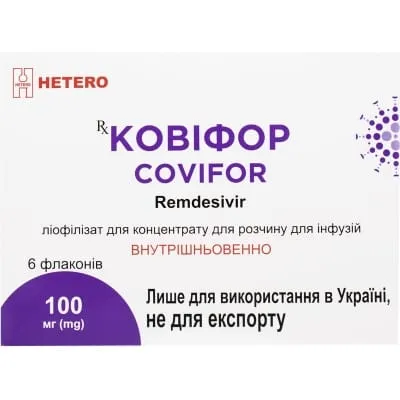
Table of Contents
INSTRUCTIONS FOR MEDICAL USE OF THE MEDICINAL PRODUCT COVIFOR (COVIFOR)
Composition:
active substance: remdesivir;
1 vial contains 50 mg of remdesivir;
1 ml of prepared (reconstituted) solution contains 5 mg of remdesivir;
excipients: sodium salt of sulfobutyl ether of beta-cyclodextrin, hydrochloric acid, sodium hydroxide.
Pharmaceutical form. Lyophilisate for concentrate for solution for infusion.
Main physicochemical properties: white to almost white or yellow lyophilized mass or powder.
Pharmacotherapeutic group. Antiviral agents for systemic use, direct-acting antiviral agents, other antiviral agents.
ATC code J05A.
Pharmacological properties.
Pharmacodynamics.
Remdesivir is a prodrug of an adenosine nucleotide analogue that is distributed into cells where it is metabolized to form the pharmacologically active nucleoside triphosphate metabolite. Conversion of remdesivir to remdesivir triphosphate has been demonstrated in several cell types. Remdesivir triphosphate acts as an adenosine triphosphate (ATP) analogue and competes with the natural ATP substrate for incorporation into nascent RNA chains by the SARS-CoV-2-dependent RNA polymerase, resulting in delayed chain termination during viral RNA replication. Remdesivir triphosphate is a weak inhibitor of mammalian DNA- and RNA-polymerases, suggesting a low likelihood of mitochondrial toxicity.
Pharmacokinetics.
The pharmacokinetics of remdesivir were evaluated in adults in several phase 1 studies. After single intravenous infusions over 2 hours of remdesivir solution at doses ranging from 3 to 225 mg, remdesivir exhibited linear pharmacokinetic profiles. After single intravenous infusions over 2 hours of remdesivir at doses of 75 and 150 mg, both lyophilized and solution formulations provided similar pharmacokinetic parameters (AUCinf, AUClast, and Cmax), indicating comparable formulation performance. Remdesivir 75 mg—lyophilized formulation administered intravenously over 30 minutes—resulted in similar exposure of the active triphosphate metabolite GS-443902 in peripheral blood mononuclear cells (PBMCs) compared to remdesivir 150 mg—lyophilized formulation administered intravenously over 2 hours. After a single 150 mg intravenous dose of [14C]-remdesivir, the mean total recovery of the administered dose exceeded 92%, with approximately 74% and 18% recovered in urine and feces, respectively. The majority of remdesivir dose excreted in urine consisted of the metabolite GS-441524 (49%), while 10% was excreted as remdesivir.
Clinical characteristics.
Indications.
Treatment of coronavirus disease (COVID-19) in adults who have pneumonia and require supplemental oxygen therapy (low or high flow oxygen or other non-invasive ventilation at the start of treatment).
Contraindications.
Hypersensitivity to the active substance or to any of the excipients of the medicinal product.
Interaction with other medicinal products and other forms of interaction.
Studies on drug interactions between remdesivir and other concomitant medicinal products have not been conducted. The overall potential for interactions is currently unknown. Patients should remain under close monitoring for 24 hours after administration of remdesivir. Due to antagonism observed in vitro, concomitant use of remdesivir with chloroquine phosphate or hydroxychloroquine sulfate is not recommended.
Effect of other concomitant medicinal products on remdesivir
In vitro, remdesivir is a substrate for enzymes metabolizing medicinal products CYP2C8, CYP2D6, and CYP3A4, as well as a substrate for organic anion transporting polypeptides 1B1 (OATP1B1) and P-glycoprotein (P-gp) transporters. The potential for interaction of remdesivir with esterase inhibitors/inducers or CYP2C8, 2D6, or 3A4 has not been studied. The risk of clinically significant interaction is unknown. Strong inhibitors may cause reduced remdesivir exposure. The use of strong inducers, such as rifampicin, is not recommended, as it may lead to decreased plasma concentrations of remdesivir.
Dexamethasone has been shown to be a moderate inducer of CYP3A and P-gp. Induction is dose-dependent and occurs after repeated administration. It is unknown whether dexamethasone will have a clinically significant effect on remdesivir, as remdesivir has a moderately high hepatic extraction ratio and is used short-term in the treatment of COVID-19. In vitro, remdesivir is an inhibitor of CYP3A4, OATP1B1, OATP1B3, BSEP, MRP4, and NTCP. The clinical significance of these in vitro findings has not been established.
Effect of remdesivir on other medicinal products
In vitro, remdesivir is an inhibitor of CYP3A4, OATP1B1, and OATP1B3. The clinical significance of these in vitro interactions has not been established. Remdesivir may transiently increase plasma concentrations of medicinal products that are substrates of CYP3A or OATP1B1/1B3. It may be assumed that medicinal products which are substrates of CYP3A4 or OATP1B1/1B3 should be administered at least 2 hours after remdesivir. Remdesivir induced CYP1A2 and potentiated CYP3A in vitro. Concomitant use of remdesivir with substrates of CYP1A2 or CYP3A4 having a narrow therapeutic index may result in loss of their efficacy.
Dexamethasone is a substrate of CYP3A4, and although remdesivir inhibits CYP3A4, due to the rapid clearance of remdesivir after intravenous administration, remdesivir is unlikely to have a significant effect on the action of dexamethasone.
Special precautions for use.
There are limited clinical data on the use of remdesivir. Serious and unexpected adverse reactions, previously unreported, may occur during treatment with remdesivir.
Infusion-related reactions
Infusion-related reactions observed and/or temporally associated with remdesivir administration include hypotension, hypertension, tachycardia, bradycardia, hypoxia, fever, dyspnea, wheezing, angioedema, rash, nausea, vomiting, sweating, and tremor. A slower infusion rate (up to 120 minutes) is considered to help avoid these signs and symptoms. If signs or symptoms of a clinically significant infusion-related reaction occur, administration of remdesivir should be discontinued immediately and appropriate treatment initiated. Remdesivir is contraindicated in patients with known hypersensitivity to remdesivir.
Increased risk of transaminase elevation
Elevations in transaminases have been observed in clinical trials of remdesivir (in healthy volunteers and patients with COVID-19). In most healthy volunteers receiving up to 150 mg daily for 14 days, elevations in alanine aminotransferase (ALT) levels were observed, including a 10-fold increase from baseline in one subject without signs of clinical hepatitis; adverse events of grade ≥3 severity were not observed. Transaminase elevations have also been reported in patients with COVID-19 receiving remdesivir, including one patient with ALT levels increasing to 20 times the upper limit of normal (ULN). Since transaminase elevations have been reported in some patients as a symptom of COVID-19, the contribution of remdesivir to transaminase elevations in this patient population remains uncertain.
Liver function tests should be performed in all patients prior to initiating remdesivir and daily during treatment. Remdesivir should not be administered to patients who have baseline ALT levels ≥5 times ULN.
Remdesivir administration should be discontinued in patients who:
- Develop ALT levels ≥5 times ULN during treatment. Remdesivir may be resumed if ALT levels return to <5 times ULN.
- Experience ALT elevations accompanied by signs or symptoms of hepatic inflammation, or with increased levels of conjugated bilirubin, alkaline phosphatase, or international normalized ratio (INR).
Renal impairment
Renal toxicity of remdesivir was observed in animal studies. The mechanism of renal toxicity is not fully understood. The relevance of these findings to humans cannot be excluded. All patients should have their estimated glomerular filtration rate (eGFR) assessed prior to administration of remdesivir. The use of remdesivir is contraindicated in patients with eGFR <30 mL/min.
Excipients
Remdesivir contains sodium sulfobutylether beta-cyclodextrin, which is renally cleared and may accumulate in patients with impaired renal function, potentially leading to adverse effects on kidney function. Therefore, remdesivir should not be administered to patients with eGFR <30 mL/min.
Risk of reduced antiviral activity when used concomitantly with chloroquine or hydroxychloroquine
Concomitant use of remdesivir with chloroquine phosphate or hydroxychloroquine sulfate is not recommended, based on in vitro studies demonstrating an antagonistic effect of chloroquine on the intracellular metabolic activation and antiviral activity of remdesivir.
Use during pregnancy or breastfeeding.
Pregnancy
No adequate and well-controlled studies of remdesivir use in pregnant women have been conducted. Animal studies are insufficient to assess reproductive toxicity. Remdesivir should not be used during pregnancy except when the woman's clinical condition requires treatment with remdesivir. Women of childbearing potential should use effective contraception during treatment with remdesivir.
Breastfeeding
It is unknown whether remdesivir is excreted in human milk, and its effects on breastfeeding and milk production are also unknown. In animal studies, a metabolite analog (GS-441524) was detected in the plasma of lactating rats administered remdesivir. Therefore, excretion of remdesivir and its metabolites into breast milk is possible. Due to the potential for adverse reactions in nursing infants, the risk of transmission of SARS-CoV-2 to the infant, and the importance of therapy, breastfeeding should be discontinued or remdesivir therapy avoided, taking into account the benefits of treatment and breastfeeding.
Fertility
There are no data on the effects of remdesivir on fertility in humans.
Ability to affect reaction speed when driving or operating machinery.
Remdesivir is expected to have no or negligible effect on the ability to drive or operate machinery.
Method of Administration and Dosage
Remdesivir should be administered in healthcare settings where patients are under close observation (see section "Special Warnings and Precautions for Use").
Adult Patients
Day 1: a single loading dose of remdesivir is 200 mg, administered by intravenous infusion.
Day 2 and onwards: 100 mg once daily, administered by intravenous infusion.
The total duration of treatment should be at least 5 days and no more than 10 days.
Geriatric Patients
No dose adjustment of remdesivir is required for patients aged 65 years and older.
Patients with Renal Impairment
The pharmacokinetics of remdesivir have not been evaluated in patients with renal impairment. Patients with eGFR ≥30 mL/min do not require dose adjustment of remdesivir for the treatment of COVID-19. Remdesivir should not be used in patients with eGFR <30 mL/min.
Patients with Hepatic Impairment
The pharmacokinetics of remdesivir have not been evaluated in patients with hepatic impairment. It is unknown whether dose adjustment is needed in patients with hepatic impairment; therefore, remdesivir should be used in patients with impaired liver function only if the expected benefit outweighs the potential risk. Liver laboratory testing should be performed in all patients before initiation of remdesivir treatment and daily during remdesivir administration.
Administration Method
Remdesivir is intended for intravenous infusion after reconstitution and further dilution. The medicinal product must not be administered by intramuscular injection.
The infusion solution should be prepared under aseptic conditions immediately prior to administration. Before administration, the solution should be visually inspected for the presence of particulate matter or discoloration; if such are present, the solution should be discarded and a new one prepared.
Remdesivir should be reconstituted with 19 mL of sterile water for injection and further diluted in 0.9% (9 mg/mL) sodium chloride injection solution, and administered by intravenous infusion over 30–120 minutes.
Reconstitution Instructions
Retrieve the required number of single-dose vials from storage. For each vial:
- Reconstitute the lyophilized remdesivir powder by adding 19 mL of sterile water for injection under aseptic conditions, using a syringe and needle of appropriate size for each vial.
- Discard the vial if vacuum prevents the sterile water for injection from entering the vial.
- Immediately shake the vial for 30 seconds.
- Allow the vial contents to stand for 2–3 minutes. A clear solution should form.
- If the vial contents are not completely dissolved, shake the vial again for 30 seconds and allow the contents to stand for 2–3 minutes. Repeat this procedure as necessary until the contents are fully dissolved.
- After reconstitution, each vial contains 100 mg/20 mL (5 mg/mL) of remdesivir solution.
- Parenteral medicinal products should be visually inspected for particulate matter and discoloration prior to administration, whenever solution and container permit.
- Dilute the solution immediately after reconstitution.
Dilution Instructions
Exercise caution during mixing to avoid inadvertent microbial contamination. Since this product contains no preservatives or bacteriostatic agents for the preparation of a parenteral solution, aseptic technique must be followed during preparation of the medicinal product.
Whenever possible, intravenous medicinal products should be administered immediately after preparation.
- Use Table 1 to determine the volume of 0.9% saline solution to be withdrawn from the infusion bag.
Table 1
Recommended dilution instructions for remdesivir, lyophilized powder for injection solution, for adults
| Remdesivir dose |
0.9% Sodium chloride infusion bag used |
Volume of sodium chloride solution to be withdrawn from the 0.9% sodium chloride infusion bag |
Required volume of reconstituted remdesivir for injection |
| 200 mg (2 vials) |
250 ml |
40 ml |
2 × 20 ml |
| 100 ml |
40 ml |
2 × 20 ml |
|
| 100 mg (1 vial) |
250 ml |
20 ml |
20 ml |
| 100 ml |
20 ml |
20 ml |
NOTE: 100 ml should be reserved for patients with strict fluid restriction, for example in acute respiratory distress syndrome (ARDS) or renal failure.
- Withdraw the required volume of saline from the infusion bag using a syringe and needle of appropriate size. Discard the saline withdrawn from the bag.
- Withdraw the required volume of reconstituted remdesivir for injection from the vial using a syringe of appropriate size (see Table 1). Any unused volume remaining in the remdesivir vial should be discarded.
- Inject the required volume of reconstituted remdesivir for injection into the selected infusion bag.
- Gently rotate the bag 20 times to mix the solution. Do not shake.
- The prepared diluted solution remains stable for 4 hours at room temperature (20–25°C) or for 24 hours under refrigeration (2–8°C).
Table 2
Recommended infusion rate of diluted remdesivir, lyophilized powder for concentrate for solution for infusion, in adults
| Infusion bag volume, ml |
Infusion time, min |
Infusion rate, ml/min |
| 250 |
30 |
8.33 |
| 60 |
4.17 |
|
| 120 |
2.08 |
|
| 100 |
30 |
3.33 |
| 60 |
1.67 |
|
| 120 |
0.83 |
Children. Not used in the pediatric population.
Overdose.
Experience with acute remdesivir overdose in humans is lacking. Management of remdesivir overdose should consist of general supportive measures, including monitoring of vital signs and observation of the patient's clinical status. There is no specific antidote for remdesivir overdose.
Adverse reactions.
Classification of adverse reactions by frequency of occurrence: very common (≥ 1/10); common (≥1/100, <1/10); uncommon (≥1/1000, <1/100); rare (≥1/10,000, <1/1000); very rare (<1/10,000); frequency not known (cannot be estimated based on available data).
Immune system disorders:
rare – hypersensitivity reactions;
frequency not known – anaphylactic reaction.
Nervous system disorders:
common – headache.
Cardiovascular system disorders:
frequency not known – sinus bradycardia*.
Gastrointestinal disorders:
common – nausea.
Hepatobiliary disorders:
very common – increased transaminases.
Skin and subcutaneous tissue disorders:
common – rash.
Investigations:
very common – prolonged prothrombin time.
Procedural complications:
rare – infusion reaction.
* Reported during the post-marketing period; usually resolves within 4 days after the last dose of remdesivir without additional intervention.
Reporting suspected adverse reactions after the medicine is authorized is important. It allows continued monitoring of the benefit-risk balance of the medicine. Healthcare professionals should report any suspected adverse reactions via the national reporting system.
Shelf life: 2 years.
The reconstituted infusion solution can be stored for up to 4 hours at temperatures below 25 °C or for 24 hours in a refrigerator (2 °C–8 °C).
Storage conditions:
Store in the original packaging at a temperature not exceeding 30 °C.
Keep out of the reach of children.
Packaging:
1 vial per cardboard box, 6 cardboard boxes in an outer cardboard box.
Prescription status: Prescription only.
Manufacturer:
Aspiro Pharma Limited / Aspiro Pharma Limited.
Manufacturer's address and place of business:
Sy.No.321, Biotech park, Phase-III, Karkapatla Village, Markook Mandal, Siddipet Dist-502281, Telangana State, India.
Marketing Authorization Holder:
Hetero Labs Limited / Hetero Labs Limited.