Corvitin
Ukraine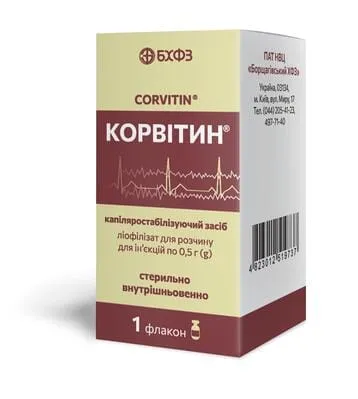
Table of Contents
INSTRUCTIONS FOR MEDICAL USE OF THE MEDICINAL PRODUCT KORVITIN® (CORVITIN®)
Composition:
Active substance: corvitin, which is a complex of quercetin with povidone;
1 vial contains corvitin, which is a complex of quercetin with povidone – 0.5 g, prepared according to the formula: quercetin (calculated as 100 % dry substance) – 0.05 g, povidone with molecular weight 7100–11000 (calculated as anhydrous substance) – 0.45 g;
Excipient: sodium hydroxide.
Pharmaceutical form. Lyophilisate for solution for injection.
Main physicochemical properties: dry, porous mass of light yellow to yellow color with a greenish tint, hygroscopic.
Pharmacotherapeutic group. Capillary-stabilizing agents. ATC Code C05CX.
Pharmacological Properties
Pharmacodynamics
Quercetin, a component of the drug, acts as a modulator of various enzymes involved in phospholipid degradation (phospholipases, phosphogenases, cyclooxygenases), which influence free radical processes and are responsible for cellular biosynthesis of nitric oxide and proteases. The inhibitory effect of quercetin on membrane-associated enzymes, particularly 5-lipoxygenase, results in suppression of leukotriene LTC4 and LTВ4 synthesis. In addition, quercetin dose-dependently increases nitric oxide levels in endothelial cells, explaining its cardioprotective effect in ischemic and reperfusion injuries of the heart. The drug also possesses antioxidant and immunomodulatory properties, reduces production of cytotoxic superoxide anion, normalizes activation of lymphocyte subpopulations, and decreases their activation level. By inhibiting the production of pro-inflammatory cytokines IL-1β and IL-8, the drug contributes to reducing the area of necrotized myocardium and enhancing reparative processes.
The protective mechanism of the drug is also associated with prevention of increased intracellular calcium concentration in platelets and inhibition of platelet aggregation, thereby suppressing thrombogenesis.
The drug restores regional blood flow and microcirculation without significant changes in vascular tone, increasing microvessel reactivity.
Corvitin® normalizes cerebral hemodynamics in ischemic lesions and reduces the asymmetry coefficient of cerebral blood flow in ischemic stroke.
Clinical Studies
A study evaluating the efficacy of sequential use of Corvitin and Quertin as pathogenetic treatment agents for pneumonia associated with coronavirus infection COVID-19, in addition to standard therapy, was conducted within the framework of a clinical trial: "Open, multicenter, randomized study to evaluate the efficacy of Corvitin®, lyophilized powder for preparation of injection solution 0.5 g, manufactured by JSC NVC "Borshchahivskiy CHP", followed by administration of Quertin, chewable tablets 40 mg, manufactured by JSC NVC "Borshchahivskiy CHP", in patients with pneumonia associated with 2019-nCoV acute respiratory disease, against the background of standard therapy." The study included 200 adult patients of both sexes.
The study results demonstrated superior efficacy on the primary endpoint, defined as time to normalization of the majority of disease symptoms. Thus, adding Corvitin® and Quertin to standard therapy led to increased saturation levels and faster recovery (by 2 days) compared to the control group.
Due to membrane-stabilizing, antioxidant, and endothelioprotective effects, the use of Corvitin followed by Quertin, in addition to standard therapy, contributes to stabilization of D-dimer levels in patients with pneumonia associated with coronavirus disease.
Pharmacokinetics
Clinical studies in healthy volunteers
The therapeutic efficacy of the investigational drug Corvitin® is determined by pharmacological effects of quercetin (free, total, conjugated) and its active metabolites (free, total, and conjugated isorhamnetin). Free quercetin undergoes conjugation by 32.5% within 20 minutes after administration. Isorhamnetin also undergoes conjugation by 70% within 25–30 minutes. Tmax of total and free quercetin is 0.25 hours; Tmax of free isorhamnetin is 0.27 hours.
The half-life (T½) of free quercetin is 1.08 hours; that of free isorhamnetin is 0.18 hours. T½ values for total quercetin, conjugated quercetin, total isorhamnetin, conjugated isorhamnetin, and the combined concentration of quercetin and isorhamnetin are significantly longer (6.92; 6.90; 4.39; 4.40; and 5.80 hours, respectively). Elimination rate constants (Kel) of quercetin and its metabolites show inversely proportional values. The highest Cmax was observed in the combined concentration of quercetin and isorhamnetin, reaching 3870.9 ng/mL, while the lowest Cmax was observed for free isorhamnetin (251.6 ng/mL). After parenteral administration of Corvitin®, the investigational drug was excreted in urine in the form of quercetin and isorhamnetin conjugates.
Thus, the pharmacokinetic parameters of the drug can be considered as follows:
| Cmax (ng/ml) |
Tmax (hours) |
AUC0—t |
AUC0—∞ |
AUC0—t (%) |
Ke |
T1/2 (hours) |
| 3870.9 |
0.25 |
4136.8 |
4595.9 |
90.87 |
5.23 |
6.92 |
Clinical characteristics.
Indications.
- Complex therapy in acute coronary circulation disorders and myocardial infarction.
- Complex therapy in decompensated chronic heart failure.
- Complex therapy in acute ischemic cerebral circulation disorders (ischemic stroke, transient ischemic attacks) and chronic ischemic cerebrovascular diseases.
- Treatment and prevention of reperfusion syndrome in surgical treatment of patients with occlusive atherosclerosis of the abdominal aorta and peripheral arteries.
- As part of complex treatment of pneumonia caused by coronavirus infection COVID-19 in adults.
Contraindications.
- Individual hypersensitivity to quercetin and/or other components of the drug;
- Increased sensitivity to agents with P-vitamin activity;
- Marked arterial hypotension.
Interaction with other medicinal products and other types of interactions.
In combination with organic nitrates, Corvitin® may cause arterial hypotension. Concurrent use of the drug with fibrinolytics leads to increased efficacy of thrombolytic therapy.
Do not use glucose solutions, reopoliglyukin, or other solutions as solvents for Corvitin®.
The drug is used in combination with antianginal, antiarrhythmic, antiplatelet, and fibrinolytic agents.
When using the drug:
- with preparations of ascorbic acid – summation of effects is observed;
- with nonsteroidal anti-inflammatory drugs – anti-inflammatory action of the latter is enhanced, with a reduction in ulcerogenic effects;
- with digoxin – maximum serum concentration and total area under the concentration-time curve of digoxin increase;
- with cyclosporine – bioavailability and blood concentration of cyclosporine increase;
- with paclitaxel – effect on the metabolism of the latter;
- with verapamil – bioavailability of the latter increases;
- with tamoxifen – bioavailability increases, metabolism and elimination of the latter decrease.
Special precautions for use.
Administer intravenously by drip infusion.
Corvitin® must not be administered simultaneously with other medicinal solutions!
The drug is used in combination with antianginal, antiarrhythmic, antiplatelet, and fibrinolytic agents.
In the treatment of patients with pneumonia caused by coronavirus infection COVID-19, Corvitin® is used in combination with basic therapy drugs, followed by transition to oral administration of the drug Quertin.
Use during pregnancy or breastfeeding.
The use of the drug during pregnancy is not recommended.
If it is necessary to use the drug during treatment, breastfeeding should be discontinued.
Ability to influence reaction rate while driving or operating machinery.
There is no information available regarding the ability of Corvitin® to affect reaction speed while driving or operating machinery.
Method of Administration and Dosage
Preparation of the Solution
The solution is prepared in two steps:
Step 1 – for initial dissolution of the drug, inject 15 mL of 0.9% sodium chloride solution into the vial containing Corvitin® using a syringe, and shake the vial until complete dissolution of the lyophilized powder is achieved.
Step 2 – transfer the resulting solution into a container with 0.9% sodium chloride solution; the total volume of the final solution should be 50–100 mL, depending on the indication.
If administration of 1 g of Corvitin® is required, the initially dissolved contents from two vials should be transferred into a container with 0.9% sodium chloride solution to obtain a final solution volume of 50–100 mL.
Do not mix with other solutions or medicinal products! Do not use syringes or intravenous administration sets that have previously been used for other drugs.
Corvitin® should be reconstituted immediately before administration! It is not recommended to use a solvent volume exceeding 100 mL, as increasing the solvent volume may increase the potential risk of reduced stability of the prepared solution.
Administration Schemes of Corvitin® in Comprehensive Therapy
| Indications |
Day 1 |
Days 2–3 |
Days 4–5 |
Days 6–10 inclusive |
| Acute myocardial infarction (solution volume per administration – 50 ml; administer over 15–20 minutes) |
1st administration – 0.5 g after hospitalization, 2nd administration – 0.5 g after 2 hours, 3rd administration – 0.5 g 12 hours after the last administration |
0.5 g twice daily with a 12-hour interval |
0.5 g once daily |
- |
| Decompensation of chronic heart failure (solution volume per administration – 50–100 ml; administer over 15–20 minutes) |
1st administration – 1 g after hospitalization, 2nd administration – 0.5 g after 12 hours |
0.5 g twice daily with a 12-hour interval |
0.5 g once daily |
- |
| Acute ischemic stroke (solution volume per administration – 50–100 ml; administer over 15–20 minutes) |
1st administration – 0.5 g after hospitalization, 2nd administration – 0.5 g after 2 hours, 3rd administration – 0.5 g 12 hours after the last administration |
0.5 g twice daily with a 12-hour interval |
0.5 g once daily |
0.5 g once daily |
| Reperfusion syndrome in surgical treatment of patients with obliterating atherosclerosis of the abdominal aorta and peripheral arteries (solution volume per administration – 100 ml; administer over 15–20 minutes) |
1st administration – 0.5 g 10 minutes before removing the aortic clamp, 2nd administration – 0.5 g after 12 hours |
0.5 g twice daily with a 12-hour interval |
0.5 g twice daily with a 12-hour interval |
- |
| Pneumonia caused by coronavirus infection COVID-19 (solution volume per administration – 50–100 ml; administer over 15–20 minutes) |
0.5 g twice daily with a 12-hour interval |
Day 4: 0.5 g twice daily with a 12-hour interval; Day 5: 0.5 g once daily |
0.5 g once daily* |
|
* - With subsequent transition to the use of the medicinal product Quertin according to the regimen.
Children.
There is no experience with the use of the drug in children.
Overdose.
Cases of overdose with CorvitinÒ have not been reported. An increase in the manifestations of adverse reactions is possible.
Adverse reactions.
Transient moderate arterial hypotension may occur with rapid intravenous administration or when used in combination with organic nitrates. Other adverse reactions reported include:
- Nervous system: dizziness, headache, tongue numbness, tremor, chills, tinnitus, excitement or general weakness, paresthesia (tingling sensation) in extremities;
- Immune system, skin and subcutaneous tissue: allergic reactions, including rash (including urticarial), pruritus, anaphylactic shock;
- Cardiovascular system: tachycardia, chest pain, facial flushing;
- Other: dyspnea, shortness of breath, nausea, vomiting, hyperthermia, local reactions at the injection site (hyperemia).
Shelf life. 2 years.
The diluted solution remains stable at 25 °C for 12 hours when diluted in 50 mL of 0.9 % sodium chloride solution, and for 6 hours when diluted in 100 mL.
Storage conditions.
In original packaging at a temperature not exceeding 25 °C.
Keep out of reach of children.
Incompatibility.
Glucose solutions and reopoliglyukin should not be used as solvents for Corvitin®. Only 0.9 % sodium chloride solution should be used as a diluent.
Corvitin® must not be administered simultaneously with other medicinal solutions.
Packaging.
1 vial per carton.
5 vials in a cassette, 1 cassette in a tray.
Prescription category. Prescription only.
Manufacturer.
Public joint-stock company "Scientific and Production Center "Borshchahivskyy Chemical and Pharmaceutical Plant".
Manufacturer's address and place of business.
03134, Kyiv, Miru Street, 17, Ukraine.