Korglikon
Ukraine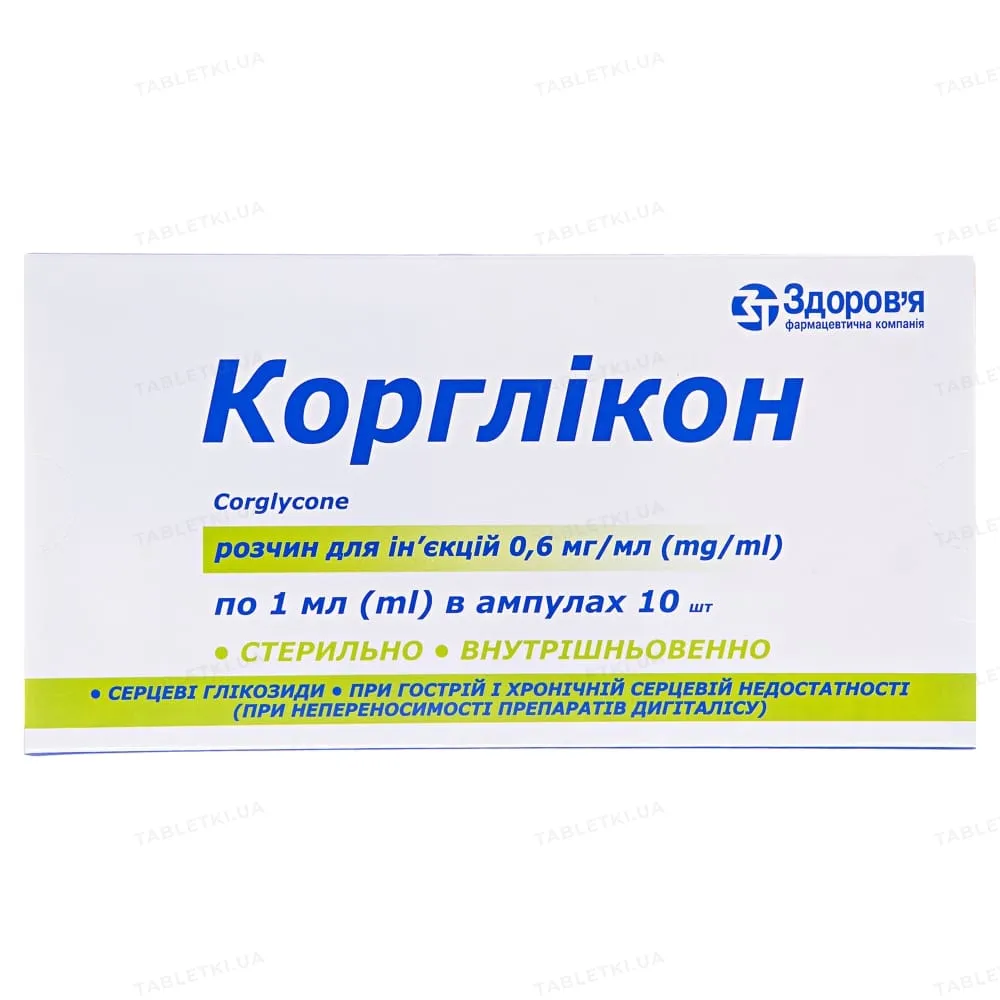
Table of Contents
INSTRUCTIONS FOR MEDICAL USE OF THE MEDICINAL PRODUCT KORGLIKON
Composition:
Active substance: 1 ml of solution contains 0.6 mg of korglikon;
Excipients: chlorobutanol hemihydrate, water for injections.
Pharmaceutical form. Injection solution.
Main physicochemical characteristics: clear, slightly yellowish liquid with a weak specific odor.
Pharmacotherapeutic group. Cardiac glycosides. ATC code C01AX.
Pharmacological Properties
Pharmacodynamics
Corglikon belongs to the group of cardiac glycosides and, in terms of its specific effect, is similar to strophanthin, but has a longer duration of action. The mechanism of action of Corglikon is associated with inhibition of Na+-K+-ATPase in cardiomyocytes and affects the energy supply of the contractile process in myofibrils. The drug exerts a positive inotropic effect and negative chronotropic and dromotropic effects, slightly slowing heart rate and conduction through the bundle of His. The drug improves hemodynamics and reduces the activity of the sympathoadrenal system. Corglikon also produces a sedative effect on the central nervous system.
Pharmacokinetics
The effect of the drug after intravenous administration appears within 3–5 minutes and reaches its maximum within 30 minutes. The drug does not bind to plasma proteins and is not metabolized in the body. It is excreted unchanged, primarily via the urine. It has practically no cumulative effect. The elimination half-life (mainly via the kidneys) is approximately 28 hours.
Clinical characteristics.
Indications. Acute and chronic heart failure (in patients with intolerance to digitalis preparations).
Contraindications. Hypersensitivity to the components of the drug, as well as to other cardiac glycosides. Heart failure due to impaired diastolic function, acute myocardial infarction, atrioventricular block of any degree, bradycardia, extrasystole, sinoatrial node weakness syndrome without implanted pacemaker, unstable angina pectoris, carotid sinus hypersensitivity syndrome, acute myocarditis, endocarditis, hypertrophic obstructive cardiomyopathy, constrictive pericarditis, thoracic aortic aneurysm, isolated mitral stenosis, WPW syndrome, hypercalcemia, hypokalemia, glycoside intoxication.
Interaction with other medicinal products and other types of interactions.
Adrenergic agents. Concurrent use of ephedrine hydrochloride, adrenaline hydrochloride, or noradrenaline hydrotartrate, as well as selective beta-adrenergic agents, with cardiac glycosides may provoke cardiac arrhythmias.
Calcium antagonists (especially verapamil), quinidine, erythromycin, tetracycline, amiodarone slow down elimination and increase the plasma concentration of the drug. If concomitant use is necessary, the dose of Cor glycoside (Corglikon) should be reduced by half.
Chlorpromazine and other phenothiazine derivatives. The effect of cardiac glycosides is reduced.
Anticholinesterase agents. When anticholinesterase agents are used concurrently with cardiac glycosides, bradycardia is intensified. If necessary, it can be eliminated or alleviated by administration of atropine sulfate.
Glucocorticosteroids. Hypokalemia resulting from prolonged glucocorticosteroid therapy may increase adverse effects of cardiac glycosides.
Diuretics. When diuretics are used concurrently with cardiac glycosides, the effect of the latter is enhanced. Optimal dosing must be maintained during their combined use.
Potassium preparations. Undesirable effects of cardiac glycosides are reduced under the influence of potassium preparations.
Calcium preparations. Parenteral administration of calcium preparations during treatment with cardiac glycosides is dangerous because cardiotoxic effects are intensified.
Insulin. Concurrent use with insulin increases the risk of glycoside intoxication.
Disodium edetate (ethylene diamine tetraacetic acid, EDTA). A decrease in the efficacy and toxicity of cardiac glycosides is observed.
Corticotropin preparations. The action of cardiac glycosides may be enhanced under the influence of corticotropin.
Xanthine derivatives. Preparations containing caffeine or theophylline increase the risk of cardiac rhythm disturbances.
Sodium adenosine triphosphate. Sodium adenosine triphosphate should not be administered concurrently with cardiac glycosides.
Ergocalciferol. In cases of ergocalciferol-induced hypervitaminosis, the effect of cardiac glycosides may be enhanced due to the development of hypercalcemia.
Narcotic analgesics. The combination of fentanyl and cardiac glycosides may cause arterial hypotension.
Paracetamol. The clinical significance of this interaction has not been sufficiently studied, but data exist indicating reduced renal excretion of cardiac glycosides under the influence of paracetamol.
Special precautions.
Dosage should be carefully adjusted in patients with impaired renal function, elderly patients, debilitated patients, and those with implanted cardiac pacemakers. Electrolyte balance should be monitored during administration of Corglycon. The dose should be reduced in patients with impaired renal excretory function to prevent development of glycoside intoxication. The risk of glycoside intoxication is also increased in the presence of hypokalemia, hypomagnesemia, hypercalcemia, marked cardiac chamber dilation, cor pulmonale, alkalosis, and in elderly patients.
Rapid intravenous administration may lead to the development of bradyarrhythmia, ventricular tachycardia, atrioventricular block, and cardiac arrest. To prevent these effects, the daily dose may be divided into 2–3 administrations. Treatment should be carried out under continuous electrocardiographic monitoring. Caution is advised when prescribing the drug in thyrotoxicosis and atrial extrasystole due to the possibility of transition into atrial fibrillation.
Use during pregnancy or breastfeeding. The drug is contraindicated during pregnancy and breastfeeding.
Ability to affect reaction rate when driving or operating machinery. Driving vehicles or operating machinery requiring rapid psychomotor reactions is not recommended during Corglycon administration.
Administration and Dosage
Korglikon should be administered intravenously. It should be given slowly over 5–6 minutes (the drug should be diluted only in 10–20 ml of 0.9% sodium chloride solution), 1–2 times daily. The single dose for adults is 0.5–1 ml; for children aged 2 to 5 years – 0.2–0.5 ml; for children aged 6 to 12 years – 0.5–0.75 ml. When administered twice daily, the interval between injections should be 8–12 hours.
Maximum intravenous doses for adults: single dose – 1 ml, daily dose – 2 ml.
Children. May be used in children aged 2 years and older.
Overdose.
Symptoms:
Cardiovascular system: arrhythmias, including bradycardia, atrioventricular block, ventricular tachycardia or extrasystoles, ventricular fibrillation;
Gastrointestinal tract: anorexia, nausea, vomiting, diarrhea;
Central nervous system and sensory organs: headache, increased fatigue, dizziness, rarely – color vision disturbances, decreased visual acuity, scotomas, macropsia and micropsia, very rarely – confusion, syncope.
Treatment. In case of developing glycoside intoxication and arrhythmias, potassium preparations should be administered intravenously by drip infusion, preferably without insulin (infusion should be discontinued when serum potassium concentration reaches 5 mEq/L). Potassium preparations are contraindicated in case of AV conduction disturbances. In pronounced bradycardia, administer atropine sulfate solution. Oxygen therapy is indicated. As an antidote, unithiol should be administered (during the first 2 days, subcutaneously at a dose of 0.05 g of the drug (1 ml of 5% solution) per 10 kg body weight, 3–4 times daily, then 1–2 times daily until cardiotoxic effects of Korglikon cease). Symptomatic therapy is also required.
Adverse reactions.
Cardiovascular system: the drug may cause cardiac rhythm disturbances due to its effects on automaticity and conductivity, especially with rapid administration (extrasystoles, atrioventricular block, bradyarrhythmia, ventricular arrhythmias, slowing of AV conduction).
Gastrointestinal tract: nausea, vomiting, diarrhea, dry mouth, anorexia, epigastric discomfort and pain.
Nervous system and sensory organs: confusion, pain and paresthesia in limbs, apathy, weakness, insomnia, dizziness, headache, color vision disturbances; with prolonged use – visual field defects, decreased visual acuity.
Skin: rash.
Immune system: allergic reactions, including urticaria, pruritus, anaphylactic shock.
Other: hypokalemia, gynecomastia (with prolonged use), local reactions at the site of administration.
Shelf life. 4 years.
Storage conditions. Store at a temperature not exceeding 25 °C in the original packaging.
Keep out of reach of children.
Incompatibility. Should not be mixed with other medicinal products in the same container.
Packaging. 1 ml in ampoules, pack of 10; 10, 5x2 in blisters in a pack.
Prescription status. Prescription only.
Manufacturer.
Limited Liability Company "Experimental Plant "GNCLS".
LIMITED LIABILITY COMPANY "CORPORATION "ZDOROVTYA".
Manufacturer's location and address of business activity.
8 Vorobiova Street, Kharkiv, Kharkiv region, 61057, Ukraine.
(Limited Liability Company "Experimental Plant "GNCLS")
22 Shevchenka Street, Kharkiv, Kharkiv region, 61013, Ukraine.
(LIMITED LIABILITY COMPANY "CORPORATION "ZDOROVTYA")