Copaxone 40
Ukraine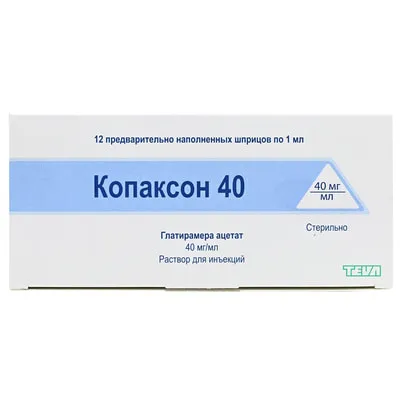
Table of Contents
INSTRUCTIONS FOR MEDICAL USE OF THE MEDICINAL PRODUCT Copaxone 40 (Copaxone® 40)
Composition:
Active substance: glatiramer acetate;
1 ml of solution for injection contains 40 mg glatiramer acetate;
Excipients: mannitol (E 421), water for injections.
*Glatiramer acetate is an acetate salt of synthetic polypeptides containing four naturally occurring amino acids: L-glutamic acid, L-alanine, L-tyrosine, and L-lysine, with molar fractions of 0.129–0.153, 0.392–0.462, 0.086–0.100, and 0.300–0.374, respectively. The average molecular weight of glatiramer acetate is 5000–9000 Da.
40 mg of glatiramer acetate is equivalent to 36 mg of glatiramer base.
Pharmaceutical form. Solution for injection.
Main physicochemical properties: the solution is practically free from visible particles.
Pharmacotherapeutic group. Antineoplastic and immunomodulating agents, other immunostimulants. ATC code L03AX13.
Pharmacological Properties.
Pharmacodynamics.
The mechanisms by which glatiramer acetate exerts its effects in patients with multiple sclerosis (MS) are not fully understood. However, it is believed to act through modification of the immune process, which is currently thought to be responsible for the pathogenesis of MS. This hypothesis is supported by data from studies investigating the pathogenesis of experimental allergic encephalomyelitis (EAE)—a condition induced in several animal species by immunization with central nervous system tissue containing myelin, and which is frequently used as an experimental animal model of MS. Studies in animals and in patients with MS indicate that administration of glatiramer acetate induces and activates peripherally glatiramer acetate-specific suppressor T-cells.
Relapsing-remitting MS
Data on the efficacy of Copaxone 40 administered as subcutaneous injections at a dose of 40 mg/mL three times per week to reduce relapse frequency were obtained from a 12-month placebo-controlled study. The total number of confirmed relapses was selected as the primary efficacy endpoint. Secondary MRI endpoints measured at month 6 and month 12 included total number of lesions and contrast enhancement on T2-weighted images, and total number of lesions and contrast enhancement on T1-weighted images.
A total of 1404 patients were randomized in a 2:1 ratio to receive Copaxone 40 (40 mg/mL) (n=943) or placebo (n=461). Both treatment groups were comparable with respect to baseline patient characteristics, clinical disease profile, and MRI parameters. Patients had a mean of 2.0 relapses in the 2 years prior to the screening period.
Treatment with Copaxone 40 (40 mg/mL) resulted in a 34.4% reduction (p<0.0001) in the total number of relapses, with a relative risk of 0.656 and a 95% confidence interval (CI) [0.539–0.799].
Significant and statistically significant changes in both primary and secondary efficacy endpoints were observed with Copaxone 40 (40 mg/mL), consistent with the efficacy of Copaxone®-Teva (20 mg/mL) administered once daily.
The table below presents the values of primary and secondary efficacy endpoints in the group of patients who were randomized.
| Outcome measures |
Adjusted mean values |
P-value |
|
| Copaxone 40 |
Placebo (N=461) |
||
| Number of confirmed relapses during the 12-month placebo-controlled phase of the study |
0.331 |
0.505 |
<0.0001 |
| Absolute risk reduction* |
-0.174 [from -0.2841 to -0.0639] |
||
| Total number of new lesions and contrast enhancement on T2-weighted images at month 6 and month 12 of the study |
3.650 |
5.592 |
<0.0001 |
| Relative risk** (95% confidence interval) |
0.653 [from 0.546 to 0.780] |
||
| Total number of lesions and contrast enhancement on T1-weighted images at month 6 and month 12 of the study |
0.905 |
1.639 |
<0.0001 |
| Relative risk** (95% confidence interval) |
0.552 [from 0.436 to 0.699] |
||
* Absolute risk reduction was defined as the difference between the adjusted number of confirmed relapses over 12 months with glatiramer acetate 40 mg administered three times weekly and the adjusted number of confirmed relapses over 12 months with placebo.
** Relative risk was defined as the ratio of the adjusted mean risk with glatiramer acetate 40 mg administered three times weekly to the adjusted mean risk with placebo.
A direct comparison of safety between Copaxone®-Teva (20 mg/mL) administered once daily and Copaxone 40 (40 mg/mL) administered three times weekly has not been conducted in a single study.
In this 12-month study, there was no evidence that treatment with Copaxone 40 affects the progression of disability or the duration of relapses.
Currently, there are no data available on the use of Copaxone 40 in patients with primary or secondary progressive disease.
Pharmacokinetics.
Pharmacokinetic studies in patients have not been conducted. In vitro data and limited data from studies in healthy volunteers indicate that following subcutaneous administration of glatiramer acetate, the active substance is readily absorbed, and a large portion of the dose is rapidly broken down into smaller fragments within the subcutaneous tissue.
Clinical characteristics.
Indications.
Copaxone 40 is indicated for the treatment of relapsing forms of multiple sclerosis.
Copaxone 40 is not indicated for primary or secondary progressive multiple sclerosis.
Contraindications.
Hypersensitivity to the active substance (glatiramer acetate) or to any of the excipients.
Special precautions.
The pre-filled syringe is intended for single use only. Any unused medicinal product or waste material must be disposed of in accordance with local requirements.
Interaction with other medicinal products and other forms of interaction.
Interaction between Copaxone 40 and other medicinal products has not been sufficiently studied.
There are no data on interaction with beta-interferon.
An increased frequency of injection site reactions has been observed in patients receiving Copaxone 40 concomitantly with corticosteroid therapy.
In vitro studies indicate that glatiramer acetate in blood is highly bound to plasma proteins, but does not displace or is displaced by phenytoin or carbamazepine. However, since theoretically Copaxone 40 may affect the distribution of protein-bound drugs, concomitant administration of such medicinal products should be carefully monitored.
Special precautions for use
Copaxone 40 must be administered only by subcutaneous injection. The drug must not be administered intravenously or intramuscularly.
Post-injection reactions and anaphylactic reactions may occur during treatment with glatiramer acetate (see section "Side effects").
Post-injection reactions
The treating physician should inform the patient that a reaction associated with at least one of the following symptoms—vasodilatation (flushing), chest pain, dyspnea, palpitations, or tachycardia—may occur within minutes after injection of Copaxone 40 (see section "Side effects"). Most of these symptoms are transient and resolve spontaneously without consequences. In case of a serious adverse reaction, the patient should immediately discontinue use of Copaxone 40 and consult a physician. Symptomatic treatment may be prescribed by the physician if necessary.
There is no evidence of an increased risk of these adverse reactions in any specific patient group. Nevertheless, Copaxone 40 should be used with caution in patients with a history of cardiac disorders. Such patients should be monitored regularly throughout treatment.
Anaphylactic reactions
Anaphylactic reactions may occur immediately or shortly after administration of glatiramer acetate. However, such anaphylactic reactions may also occur several months or even years after initiation of treatment (see section "Side effects"). Fatal cases have been reported. Some signs and symptoms of anaphylactic reactions may partially overlap with post-injection reactions.
All patients receiving Copaxone 40 and their caregivers should be informed about the signs and symptoms characteristic of anaphylactic reactions and the need to seek immediate emergency medical assistance if such symptoms occur (see section "Side effects").
If an anaphylactic reaction occurs, treatment with Copaxone 40 must be discontinued (see section "Contraindications").
Antibodies reactive to glatiramer acetate have been detected in the serum of patients during daily continuous therapy with Copaxone. Peak levels were reached on average after 3–4 months of treatment, after which they declined and stabilized at a level slightly above baseline.
There are no data indicating that these glatiramer acetate-reactive antibodies are neutralizing or that their formation affects the clinical efficacy of Copaxone 40.
Renal function should be monitored in patients with renal impairment during treatment with Copaxone 40. Although there is no evidence of glomerular deposition of immune complexes, this possibility cannot be excluded.
Rare cases of severe hepatic injury (including hepatitis with jaundice, liver failure, and in isolated cases liver transplantation) have been observed. Hepatic injury occurred from several days to several years after initiation of Copaxone treatment. In most cases, severe liver injury resolved upon discontinuation of treatment. In some cases, these reactions occurred in patients with excessive alcohol consumption, pre-existing or history of liver disease, or concomitant use of other potentially hepatotoxic medicinal products. Patients should be monitored regularly for signs of liver injury, and should be advised to seek immediate medical attention if symptoms of liver injury occur. In case of clinically significant liver injury, discontinuation of Copaxone should be considered.
Use during pregnancy or breastfeeding
Pregnancy. A moderate amount of data from pregnant women (300–1000 pregnancy outcomes) indicates no fetotoxic/neonatal toxicity or developmental abnormalities. Animal studies have not revealed reproductive toxicity. Use of Copaxone 40 during pregnancy may be considered if clinically needed.
Breastfeeding. The physicochemical properties of glatiramer acetate and its low oral bioavailability suggest minimal exposure of the newborn/infant via breast milk. A non-interventional retrospective study involving 60 infants breastfed by mothers exposed to glatiramer acetate, compared to 60 infants breastfed by mothers not exposed to any disease-modifying therapy, along with limited post-marketing data, indicate no negative effects of glatiramer acetate. Copaxone 40 may be used during breastfeeding.
Ability to influence the speed of reactions when driving or operating machinery
The ability to influence reaction speed when driving or operating machinery has not been studied.
Method of Administration and Dosage
Initiation of therapy with Copaxone 40 should be performed under the supervision of a neurologist or a physician experienced in the treatment of multiple sclerosis.
The recommended dose for adults is 40 mg of glatiramer acetate (one pre-filled syringe), administered as a subcutaneous injection three times per week. There should be a minimum interval of 48 hours between injections. It is recommended to use the medication on the same days each week.
The duration of treatment with Copaxone 40 has not yet been established.
The decision regarding the duration of treatment is made individually by the physician for each patient.
Elderly patients. The use of Copaxone 40 in elderly patients has not been specifically studied.
Patients with renal impairment. Specific studies on the use of Copaxone 40 in patients with renal impairment have not been conducted (see section "Special Instructions for Use").
Patients should be provided with instructions on the technique of self-injection and be supervised by a physician during the first self-administration and for 30 consecutive minutes thereafter.
To reduce the likelihood of irritation or pain at the injection site, each subsequent injection should be administered at a different site. The medication may be injected into the abdomen, arms, thighs, or buttocks.
General Recommendations for Use
When administering Copaxone 40, it is important to follow the rules listed below:
- administer the medication only subcutaneously;
- use only the dose prescribed by the physician;
- use each pre-filled syringe only once; dispose of any unused medication or remnants;
- do not mix or administer Copaxone 40 simultaneously with other medications;
- if particulate matter is present in the solution, do not use this pre-filled syringe; take another package instead.
Instructions for Use
- Before administering the medication, ensure that all necessary items for injection are available:
- one blister pack of Copaxone 40 containing a pre-filled syringe;
- a disposal container for used syringes and needles.
- Take one blister pack with a pre-filled syringe from the outer packaging. All unused syringes must be stored in their original packaging.
- If the medication has been stored in the refrigerator, allow the blister pack with the pre-filled syringe to reach room temperature by leaving it at room temperature for at least 20 minutes. Ensure that it has warmed to room temperature before use.
- Wash hands thoroughly with soap and water before administering the medication.
- Select an injection site. Figure 1 indicates seven possible injection sites on the body: arms, thighs, buttocks, and abdomen (avoiding the area immediately around the navel). Each injection area contains multiple potential injection points. A different injection point should be used each time to reduce the likelihood of irritation or pain at the injection site.
Injection sites should be rotated systematically within each specific area.
Do not administer injections into the same site repeatedly.
Do not use painful areas, discolored skin, or areas with lumps or nodules for injections.
It is recommended to plan a rotation schedule for injection sites and record each injection in an injection diary. Some body areas may be difficult to inject without assistance (e.g., arms). In such cases, help from another person may be required.
| Area 1 Periumbilical area Administer injections at least 5 cm away from the navel |
| Section 4 Left hand Muscular part of the upper posterior region |
| Section 5 Right hand Muscular part of the upper posterior region |
| Section 7 Right buttock Muscle area above the thigh, always below the waist |
| Area 3 Left thigh Approximately 5 cm above the knee and 5 cm below the groin |
| Area 2 Right thigh Approximately 5 cm above the knee and 5 cm below the groin |
| Area 6 Left buttock Muscular part above the thigh, always below the waist |
V – top; M – middle; B – bottom.
Fig. 1
- Remove the syringe from its protective blister packaging by peeling off the paper label.
- Hold the syringe in the hand you write with, gripping it like a pencil. Remove the protective needle cap.
- Gently pinch the skin into a fold using the thumb and index finger (Fig. 2).
- Insert the needle into the skin (Fig. 3). Inject the medication by steadily pressing down the syringe plunger until it is completely emptied.
Fig. 2 Fig. 3
- Remove the syringe with the needle by moving straight upward vertically.
- Place the used syringe into a disposal container.
Children.
The safety and efficacy of glatiramer acetate in children and adolescents have not been established. There is insufficient information on the use of Copaxone 40 in children (under 18 years of age) to provide any recommendations for its use. Therefore, Copaxone 40 should not be used in this age group.
Overdose.
There have been several reported cases of overdose with Copaxone (administration of up to 300 mg of glatiramer acetate). These cases were not associated with any reactions other than those listed in the section "Adverse Reactions."
In case of overdose, the patient should be observed and appropriate symptomatic and supportive therapy should be administered.
Adverse Reactions
The majority of safety data on glatiramer acetate administration are based on the subcutaneous use of Copaxon®-Teva (20 mg/mL) once daily. The safety data for glatiramer acetate presented below were obtained from four placebo-controlled studies of Copaxon®-Teva (20 mg/mL) administered once daily and one placebo-controlled study of Copaxon 40 (40 mg/mL) administered three times per week.
A direct comparison of safety between Copaxon®-Teva (20 mg/mL) once daily and Copaxon 40 (40 mg/mL) three times per week has not been conducted in a single study.
Copaxon®-Teva (20 mg/mL) once daily
In all clinical trials, the most common adverse reactions with Copaxon®-Teva (20 mg/mL) were injection site reactions, observed in the majority of patients receiving the drug. In controlled studies, the proportion of patients experiencing these reactions at least once was higher with Copaxon®-Teva (20 mg/mL) (70%) than with placebo injections (37%). Injection site reactions most frequently observed with Copaxon®-Teva (20 mg/mL) compared to placebo included erythema, pain, nodules, pruritus, swelling, inflammation, and hypersensitivity.
A reaction associated with at least one of the following symptoms—vasodilation (flushing), chest pain, dyspnea, palpitations, or tachycardia—was described as an immediate post-injection reaction. This reaction may occur within minutes after Copaxon injection. At least one symptom of immediate post-injection reaction (individual symptoms of immediate post-injection reaction with frequency specified below) was observed in 31% of patients treated with Copaxon®-Teva (20 mg/mL), compared to 13% of patients receiving placebo.
Adverse reactions identified during clinical studies and the post-marketing period are listed below. Clinical study data were obtained from four randomized, double-blind, placebo-controlled clinical trials involving a total of 512 patients treated with Copaxon®-Teva (20 mg/day) and 509 patients treated with placebo over 36 months. Three of the studies included 269 patients with relapsing-remitting MS and 271 placebo-treated patients over 35 months. The fourth clinical trial included patients with a first clinical episode who were considered at high risk for developing clinically definite MS. In this study, 243 patients received Copaxon®-Teva (20 mg/day) and 238 patients received placebo over 36 months.
The adverse reactions listed below are classified by system organ class and frequency: very common (≥1/10); common (≥1/100, <1/10); uncommon (≥1/1000, <1/100); rare (≥1/10,000, <1/1000); frequency not known (cannot be estimated from available data).
Infections and infestations
Very common: infections, influenza.
Common: bronchitis, gastroenteritis, herpes simplex, otitis media, rhinitis, dental abscess, vaginal candidiasis*.
Uncommon: abscess, cellulitis, furunculosis, herpes zoster, pyelonephritis.
Benign, malignant and unspecified neoplasms (including cysts and polyps)
Common: benign skin tumors, neoplasms.
Uncommon: skin cancer.
Blood and lymphatic system disorders
Common: lymphadenopathy*.
Uncommon: leukocytosis, leukopenia, splenomegaly, thrombocytopenia, abnormal lymphocyte morphology.
Immune system disorders
Common: hypersensitivity.
Uncommon: anaphylactic reaction.
Endocrine disorders
Uncommon: goiter, hyperthyroidism.
Metabolism and nutrition disorders
Common: anorexia, weight gain*.
Uncommon: alcohol intolerance, gout, hyperlipidemia, increased blood sodium levels, decreased plasma ferritin.
Psychiatric disorders
Very common: anxiety*, depression.
Common: nervousness.
Uncommon: abnormal dreams, confusion, euphoria, hallucinations, hostility, mania, personality disorder, suicide attempt.
Nervous system disorders
Very common: headache.
Common: dysgeusia, hypertonia, migraine, speech disorder, syncope, tremor*.
Uncommon: carpal tunnel syndrome, cognitive disorder, convulsions, dysgraphia, dyslexia, dystonia, motor dysfunction, myoclonus, neuritis, neuromuscular blockade, nystagmus, paralysis, peroneal nerve paralysis, stupor, visual field defect.
Eye disorders
Common: diplopia, eye disorders*.
Uncommon: cataract, corneal lesion, dry eyes, eye hemorrhage, ptosis of upper eyelid, mydriasis, optic nerve atrophy.
Ear and labyrinth disorders
Common: ear disorders.
Cardiac disorders
Very common: vasodilation*.
Common: palpitations*, tachycardia*.
Uncommon: extrasystoles, sinus bradycardia, paroxysmal tachycardia, varicose veins.
Respiratory, thoracic and mediastinal disorders
Very common: dyspnea*.
Common: cough, seasonal rhinitis.
Uncommon: apnea, epistaxis, hyperventilation, laryngospasm, lung disease, suffocation sensation.
Gastrointestinal disorders
Very common: nausea*.
Common: anorectal disorders, constipation, dental caries, dyspepsia, dysphagia, fecal incontinence, vomiting*.
Uncommon: colitis, intestinal polyp, enterocolitis, eructation, esophageal ulcer, periodontitis, rectal bleeding, salivary gland enlargement.
Hepatobiliary disorders
Common: abnormal liver function tests.
Uncommon: cholelithiasis, hepatomegaly.
Rare: toxic hepatitis, hepatic injury.
Frequency not known: hepatic failure#.
Skin and subcutaneous tissue disorders
Very common: rash*.
Common: ecchymoses, hyperhidrosis, pruritus, skin disorders*, urticaria.
Uncommon: angioedema, contact dermatitis, erythema nodosum, skin nodules.
Musculoskeletal and connective tissue disorders
Very common: arthralgia, back pain*.
Common: neck pain.
Uncommon: arthritis, bursitis, flank pain, muscle atrophy, osteoarthritis.
Renal and urinary disorders
Common: urinary urgency, polyuria, urinary retention.
Uncommon: hematuria, nephrolithiasis, urinary tract disorders, abnormal urinalysis.
Reproductive system and breast disorders
Uncommon: breast engorgement, erectile dysfunction, pelvic organ prolapse, priapism, prostate disorders, abnormal cervical smear, testicular disorders, vaginal bleeding, vulvovaginal disorders.
General disorders and administration site conditions
Very common: asthenia, chest pain*, injection site reactions*^, pain*.
Common: chills*, facial swelling*, injection site atrophy◊, local reaction*, peripheral edema, edema, hyperthermia.
Uncommon: cyst, hangover syndrome, hypothermia, immediate post-injection reaction, inflammation, injection site necrosis, mucosal disorders.
Injury, poisoning and procedural complications
Uncommon: post-vaccination syndrome.
*Number of cases was greater than 2% (>2/100) in the Copaxon 40 group compared to the placebo group. Adverse reactions without the * symbol indicate a difference of less than 2% or equivalent to 2%.
^The term "injection site reactions" (various types) includes all adverse reactions occurring at the injection site, except injection site atrophy and injection site necrosis, which are listed separately.
◊Includes terms related to localized lipodystrophy at the injection site.
Several cases of liver transplantation have been reported.
In the fourth study mentioned above, an open-label treatment phase followed the placebo-controlled period. No changes in the known safety profile of Copaxon®-Teva (20 mg/mL) were observed during the subsequent 5-year open-label study.
Copaxon 40 (40 mg/mL), administered three times per week
The safety of Copaxon 40 (40 mg/mL) was evaluated in a double-blind, placebo-controlled study in patients with relapsing-remitting multiple sclerosis. During the study, 943 patients received Copaxon 40 (40 mg/mL) three times per week, and 461 patients received placebo for 12 months.
Overall, the adverse reactions observed in patients treated with Copaxon 40 (40 mg/mL) (three times per week) were the same and occurred at similar frequencies as those observed with Copaxon®-Teva (20 mg/mL) (daily).
Specifically, injection site reactions and immediate post-injection reactions in patients treated with Copaxon 40 (40 mg/mL) (three times per week) occurred less frequently than in patients treated with Copaxon®-Teva (20 mg/mL) (daily) (35.5% vs. 70% for injection site reactions and 7.8% vs. 31% for immediate post-injection reactions, respectively).
Injection site reactions were observed in 36% of patients treated with Copaxon 40 (40 mg/mL), compared to 5% of patients receiving placebo. Immediate post-injection reactions were observed in 8% of patients treated with Copaxon 40 (40 mg/mL), compared to 2% of patients receiving placebo.
Several specific adverse reactions were reported:
- Anaphylactic reactions—immediate or shortly after administration—may occur following glatiramer acetate injection. However, such anaphylactic reactions may also occur several months or even years after initiation of treatment (see section "Special precautions").
- No reports of injection site necrosis have been documented.
- Skin erythema and limb pain, not observed with Copaxon®-Teva (20 mg/mL), occurred in 2.1% of patients treated with Copaxon 40 (40 mg/mL) (common: ≥1/100, <1/10).
- Drug-induced liver injury and toxic hepatitis were observed during treatment with Copaxon 40 (40 mg/mL), each in one patient (0.1%) (uncommon: ≥1/1000, <1/100).
In uncontrolled clinical studies and during post-marketing use, hypersensitivity reactions (including anaphylactic reactions) and elevated liver enzymes without clinically significant consequences have also been reported in patients with MS treated with glatiramer acetate.
Reporting suspected adverse reactions. All suspected adverse reactions and lack of drug efficacy should be reported via the following link: https://aisf.dec.gov.ua
Shelf life. 3 years.
Storage conditions.
Store in the original packaging to protect from light at 2–8 °C (in a refrigerator). Do not freeze. Keep out of reach of children.
If pre-filled syringes cannot be stored in a refrigerator, they may be stored at 15–25 °C for up to 1 month.
If pre-filled syringes containing Copaxon 40 solution remain unused after this one-month period and are still in their original packaging, they must be stored in a refrigerator at 2–8 °C.
Incompatibilities.
The medicinal product should not be mixed with other medicinal products, as compatibility studies have not been conducted.
Packaging. 1 mL of solution in a pre-filled syringe; 1 syringe per blister (with or without labeling); 12 syringes per cardboard box.
Prescription status. Prescription only.
Manufacturers.
Teva Pharmaceutical Industries Ltd.
Norton Healthcare Ltd. T/A IVAX Pharmaceuticals UK.
Manufacturer locations and addresses of business operations.
18 Hulog Street, Industrial Zone, Kfar Saba, Israel.
Aston Lane North, Whitehouse Way Industrial Estate, Runcorn, WA7 3FA, United Kingdom.