Colldan
Ukraine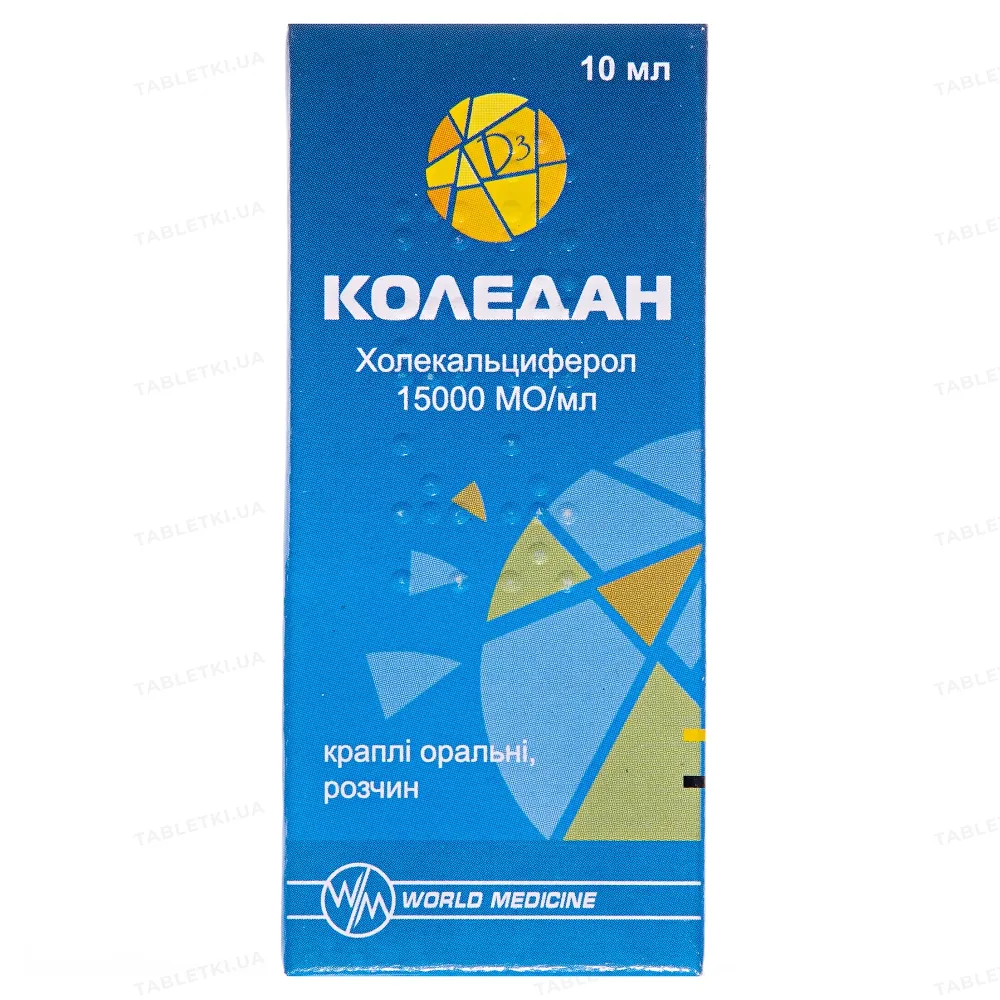
Table of Contents
INSTRUCTIONS FOR MEDICAL USE OF THE MEDICINAL PRODUCT COLEDAN (COLEDAN)
Composition:
Active substance: cholecalciferol;
1 ml of solution contains cholecalciferol 15000 IU;
Excipients: polyoxyl 35 ricinus oil; sucrose; citric acid, monohydrate; benzyl alcohol; flavouring agent "Tutti-Frutti"; sodium hydrogen phosphate, anhydrous; purified water.
Pharmaceutical form. Oral drops, solution.
Main physicochemical characteristics: clear, homogeneous, colourless or slightly yellowish solution.
Pharmacotherapeutic group.
Vitamins. Vitamin D and analogues. Cholecalciferol. ATC code A11C C05.
Pharmacological Properties
Pharmacodynamics
Cholecalciferol (Vitamin D3) is the active antirachitic factor. The most important function of vitamin D is regulation of calcium and phosphate metabolism, which promotes proper skeletal mineralization and growth.
Vitamin D3 is the natural form of vitamin D produced in humans under the influence of sunlight. Compared to vitamin D2, it has approximately 25% higher biological activity.
It is essential for the function of the parathyroid glands, intestines, kidneys, and skeletal system. Cholecalciferol plays a crucial role in the absorption of calcium and phosphates from the intestine, in the transport of mineral salts, and in the process of bone calcification, as well as in regulating renal excretion of calcium and phosphates. The presence of calcium ions in physiological concentrations in the blood ensures maintenance of skeletal muscle tone, myocardial function, facilitates nerve impulse conduction, and regulates blood coagulation. Vitamin D also participates in immune system function by influencing lymphokine production.
Deficiency of vitamin D3 in the diet, impaired absorption, calcium deficiency, and insufficient exposure to sunlight during periods of rapid growth in children lead to rickets; in adults, to osteomalacia; and in pregnant women, to symptoms of tetany and defective enamel formation in infants.
Women during menopause, who are frequently affected by osteoporosis due to hormonal imbalances, require increased doses of vitamin D3.
Pharmacokinetics
Absorption. After oral administration, cholecalciferol is absorbed in the small intestine. The aqueous solution of vitamin D3 is better absorbed than the oily solution. In premature infants, insufficient bile production and secretion into the intestine impair the absorption of fat-soluble vitamins, including oily formulations.
Vitamin D3 begins to participate in the regulation of phosphorus and calcium metabolism within the body 6 hours after administration.
A significant increase in plasma cholecalciferol levels is observed as early as 48 hours after vitamin D3 intake.
Distribution. Cholecalciferol crosses the placental barrier and is excreted into breast milk.
Metabolism. Cholecalciferol is metabolized in the liver and kidneys, converting into its active metabolite—calcitriol—which binds to a carrier protein and is transported to target organs (intestines, bones, kidneys). The elimination half-life from plasma is several days and may be prolonged in the case of kidney disease.
Excretion. Cholecalciferol is excreted in urine and feces.
Clinical characteristics.
Indications.
- Prophylaxis of rickets, including in premature newborns.
- Prophylaxis of vitamin D3 deficiency in patients with malabsorption.
- Prophylaxis of vitamin D3 deficiency in high-risk patients without absorption disorders.
- Supportive treatment of osteoporosis.
Contraindications.
- Hypersensitivity to the active substance and/or any of the excipients of the medicinal product.
- Hypercalcemia and/or hypercalciuria.
- Hypervitaminosis D.
- Sarcoidosis.
- Severe renal insufficiency.
- Nephrolithiasis, nephrocalcinosis.
- Tuberculosis.
- Pseudohypoparathyroidism (vitamin D requirement may be lower than during normal vitamin sensitivity).
- Rare hereditary fructose intolerance, glucose-galactose malabsorption, sucrase-isomaltase deficiency.
- Additional intake of vitamin D (may lead to overdose).
Interaction with other medicinal products and other forms of interaction.
Concomitant use of cholecalciferol with other medicinal products may result in the following interactions.
Aluminum- and magnesium-containing antacids.
Concomitant use may enhance intestinal absorption of the above-mentioned agents and increase their plasma levels, leading to enhanced toxic effects of aluminum on bones and increased risk of hypermagnesemia in patients with renal insufficiency. Prolonged and excessive concomitant use of cholecalciferol with aluminum- and magnesium-containing antacids should be avoided.
Agents containing high doses of calcium or phosphorus.
Concomitant use increases the risk of hyperphosphatemia and hypercalcemia. In case of concomitant use, regular monitoring of calcium and phosphate levels in plasma is recommended.
Ketoconazole.
Concomitant use reduces the activity of cholecalciferol by inhibiting the conversion of 25-hydroxyvitamin D to 1,25-dihydroxyvitamin D by the renal enzyme 25-hydroxyvitamin-D-1-hydroxylase.
Metabolites and analogs of vitamin D.
Concomitant use increases the risk of toxic effects. Concomitant administration of these agents is possible only exceptionally and only with monitoring of plasma calcium levels.
Antiepileptic agents (phenytoin, barbiturates).
Concomitant use may reduce the level of 25-hydroxycholecalciferol and enhance conversion to inactive metabolites due to induction of hepatic enzymes, thus potentially reducing the therapeutic effect of vitamin D.
Rifampicin, isoniazid.
Concomitant use enhances the metabolism of cholecalciferol, thereby reducing its effectiveness.
Agents affecting fat absorption (e.g., orlistat), ion-exchange resins (such as cholestyramine), laxatives (such as mineral oils), rifampicin, neomycin.
Concomitant use reduces the absorption of cholecalciferol.
Cardiac glycosides.
Concomitant use enhances the toxic effects of cardiac glycosides (increased risk of cardiac arrhythmias). Concomitant use of these agents should be performed with caution. During therapy, regular ECG monitoring and assessment of plasma and urinary calcium levels are required, as well as determination of digoxin or digitoxin plasma concentration if possible.
Thiazides.
Concomitant use increases the risk of hypercalcemia. Concomitant use of these agents should be performed with caution. During therapy, plasma and urinary calcium levels should be monitored, especially during long-term concomitant treatment.
Agents used in hypercalcemia (such as calcitonin, etidronate, pamidronate).
Concomitant use may lead to antagonism with vitamin D. Administration of cholecalciferol should be discontinued in case of hypercalcemia requiring active treatment.
Glucocorticoids.
Concomitant use may reduce the effectiveness of cholecalciferol due to increased metabolic conversion.
Special precautions for use.
Individual vitamin D supplementation should take into account all possible sources of this vitamin.
The determination of a child's daily requirement for vitamin D and the method of administration should be established individually and verified during regular check-ups, especially during the first months of life.
Dosages of the medicinal product should be considered when prescribing other medicinal products containing vitamin D. Additional doses of vitamin D or calcium should only be administered under medical supervision with monitoring of plasma and urinary calcium levels. Concomitant use of cholecalciferol with high doses of calcium is not recommended.
Excessively high doses of the medicinal product used long-term or administered as bolus doses may lead to chronic vitamin D3 hypervitaminosis. The recommended doses of the medicinal product should not be exceeded.
During treatment with the medicinal product in patients with mild to moderate renal impairment, monitoring of calcium and phosphate levels in blood plasma is recommended. The risk of soft tissue calcification should be considered. In patients with severe renal impairment, cholecalciferol is not normally metabolized, and therefore other forms of vitamin D may be required.
The medicinal product should not be used in patients with a predisposition to calcium-containing kidney stones.
The medicinal product should be used with caution in patients:
- with impaired renal excretion of calcium and phosphates;
- receiving thiazide diuretics (see section "Interaction with other medicinal products and other forms of interaction");
- immobilized patients;
- receiving cardiac glycosides—due to increased toxicity of the latter. Additional monitoring is recommended in such cases (see section "Interaction with other medicinal products and other forms of interaction").
Such patients have an increased risk of developing hypercalcemia; therefore, calcium levels in blood plasma and urine should be monitored.
The medicinal product should be used with particular caution in infants born with a small anterior fontanelle.
During long-term treatment with doses exceeding 1000 IU (25 mcg) of cholecalcifer0l, calcium levels in blood plasma and urine should be monitored, and renal function should be assessed, especially in elderly patients and in patients receiving cardiac glycosides or diuretics (see section "Interaction with other medicinal products and other forms of interaction"). If hypercalcemia, signs of worsening renal function, or hypercalciuria (7.5 mmol (300 mg) calcium/24 hours) occur, the dose should be reduced or the medicinal product discontinued.
Treatment should be discontinued if symptoms of hypervitaminosis appear, such as fatigue, nausea, diarrhea, or polyuria. Since these symptoms are nonspecific, medical advice should be sought to determine whether they may be related to vitamin D excess.
Use during pregnancy or breastfeeding.
Pregnancy.
Data on the use of cholecalciferol during pregnancy are limited.
Currently, there are no data indicating risks associated with the use of the maximum daily dose of 600 IU (15 mcg cholecalciferol). However, vitamin D should be administered during pregnancy only if deficiency is present and with caution. The daily dose should not exceed 500 IU unless otherwise prescribed by a physician.
Prolonged use of high doses of vitamin D during pregnancy should be avoided, as prolonged hypercalcemia resulting from such use may adversely affect physical and mental development and may cause supravalvular aortic stenosis and retinopathy in the child.
Period of breastfeeding.
Vitamin D and its metabolites pass into breast milk. This should be considered when supplementing infants who are breastfed. No signs of overdose have been observed in infants whose mothers took vitamin D. During breastfeeding, the medicinal product should be used only as prescribed by a physician.
Fertility.
No effects on reproductive function or fertility were observed in studies with cholecalciferol. The benefit-risk balance in humans remains unknown.
Ability to affect reaction speed when driving or operating machinery.
There are no data on the effect on the ability to drive or operate machinery. When using the medicinal product, caution is recommended, taking into account the possibility of adverse reactions affecting the nervous system.
Method of Administration and Dosage
Method of Administration
The medicinal product is intended for oral use.
Adults and older children should take the medicinal product in a spoon with liquid.
For infants, drops should be given in a spoonful of water, milk, or porridge. The medicinal product should be added to food immediately before consumption.
1 drop contains 500 IU of vitamin D3. To accurately measure the dose, the bottle should be held at a 45-degree angle during administration.
It is considered that absorption of vitamin D is more effective when taken together with dietary fats; therefore, it is advisable to take the medicinal product after one of the main meals.
Dosage
Adults
Prophylaxis of rickets
The recommended dose of the medicinal product is 1 drop (approximately 500 IU of vitamin D3) daily.
Prophylaxis of vitamin D3 deficiency in patients with malabsorption and high-risk patients without absorption disorders
The recommended dose of the medicinal product is 1 drop (approximately 500 IU of vitamin D3) daily.
Supportive treatment of osteoporosis
The recommended dose of the medicinal product is 2 drops (approximately 1000 IU of vitamin D3) daily.
Children
The medicinal product should be used starting from the second week of life.
The general recommended dose for prophylaxis of rickets in premature newborns is 2 drops (approximately 1000 IU of vitamin D3) daily.
The general recommended dose for treatment of vitamin D3 deficiency in children, including infants, is 2–10 drops (approximately 1000–5000 IU of vitamin D3) daily.
The duration of treatment depends on the course and severity of the disease and is determined individually by the physician.
During the second year of life, there may be a need for continued use of cholecalciferol, especially during winter months. Prophylactic and therapeutic doses and duration of treatment are determined individually by the physician.
Children
The medicinal product should be administered to children from 2 weeks of age.
Overdose
Vitamin D overdose may cause hypercalcemia. If the administered dose exceeds the body's requirements, plasma concentrations of the active metabolite do not increase, because negative feedback limits metabolic activation when intake exceeds the body's needs.
Symptoms
High doses of vitamin D may cause hypercalcemia: from asymptomatic elevation of plasma calcium levels to life-threatening hypercalcemic syndrome. Symptoms of intoxication are nonspecific and may include fatigue, muscle weakness, anorexia, weight loss, nausea, vomiting, constipation, diarrhea, polyuria, pancreatitis, nocturia, sweating, headache, thirst, dehydration, hypertension, drowsiness, dizziness, restlessness, irritability, psychiatric disorders, depression, and pyrexia. Typical biochemical findings include hypercalcemia, hypercalciuria, and elevated levels of 25-hydroxyvitamin D. Arrhythmias may occur in severe cases, while extreme hypercalcemia may even lead to coma or death. Consequences of persistent hypercalcemia include nephrolithiasis, nephrocalcinosis, impaired kidney function up to renal failure, and soft tissue calcification (e.g., heart, blood vessels, kidneys). Individual sensitivity to vitamin D varies significantly. Infants and children are more susceptible to its toxic effects.
Patients undergoing prolonged treatment with high doses should be informed about the symptoms of possible overdose.
Treatment
There is no specific antidote. In case of overdose, intake of vitamin D from any source should be discontinued. Patient rehydration is recommended. A diet low in calcium and phosphorus is recommended. Treatment with glucocorticoids, loop diuretics, calcitonin, or bisphosphonates should be considered depending on the severity of hypercalcemia. Oral or intravenous bisphosphonates have proven effective in treating vitamin D overdose.
Hypercalcemia may persist for a prolonged period after vitamin D overdose. The patient should be monitored due to the risk of recurrent intoxication.
Adverse Reactions
Adverse reactions are generally not observed when the product is used at recommended doses. However, with rare individual hypersensitivity to the drug or with prolonged use of very high doses, vitamin D toxicity (hypervitaminosis D) may occur.
Metabolism and nutrition disorders:
Hypercholesterolemia, weight loss, polydipsia, hypercalcemia, hypercalciuria.
Psychiatric disorders:
Depression, decreased libido, psychiatric disturbances.
Nervous system disorders:
Headache, somnolence.
Eye disorders:
Conjunctivitis, photophobia.
Cardiovascular system disorders:
Arrhythmia, arterial hypertension.
Gastrointestinal disorders:
Loss of appetite, nausea, vomiting, constipation, dry mouth, flatulence, abdominal pain, diarrhea, dyspepsia, pancreatitis.
Hepatobiliary disorders:
Increased aminotransferase activity.
Immune system and subcutaneous tissue disorders:
Hypersensitivity reactions, including urticaria, rash, pruritus, angioneurotic edema, dyspnea, and anaphylactoid reactions (due to the presence of benzyl alcohol in the formulation).
Musculoskeletal and connective tissue disorders:
Myalgia, arthralgia, muscle weakness.
Renal and urinary disorders:
Elevated calcium levels in blood plasma and/or urine, nephrolithiasis and tissue calcification, uremia, polyuria.
General disorders:
Increased sweating.
Cases of rhinorrhea and hyperthermia have also been reported.
Reporting of suspected adverse reactions
Reporting of adverse reactions after marketing authorization is of great importance. It allows continuous monitoring of the benefit-risk balance of the medicinal product. Healthcare professionals and pharmacists, as well as patients or their legal representatives, are encouraged to report all suspected adverse reactions and lack of efficacy through the Automated Pharmacovigilance Information System at the following link: https://aisf.dec.gov.ua.
Shelf life
3 years.
After opening the vial, the medicinal product can be used for up to 6 months.
Storage conditions
Store at temperatures not exceeding 25 °C, in the original packaging, in a place inaccessible to children.
Packaging
10 ml of solution in an amber glass dropper bottle with dropper; 1 bottle per cardboard box.
Prescription status
Prescription only.
Manufacturer
UORLД MEDICIN ILAC SAN. VE TIC. A.S. /
WORLD MEDICINE ILAC SAN. VE TIC. A.S.
Manufacturer's address
15 Temmuz Mahallesi Cami Yolu Caddesi No:50 Gunesli Bagcilar/Istanbul, Turkey / 15 Temmuz Mahallesi Cami Yolu Caddesi No:50 Gunesli Bagcilar/Istanbul, Turkey.
Marketing Authorization Holder
LLC "WORLD MEDICINE", Ukraine /
WORLD MEDICINE, LLC, Ukraine.