Cofex™
Ukraine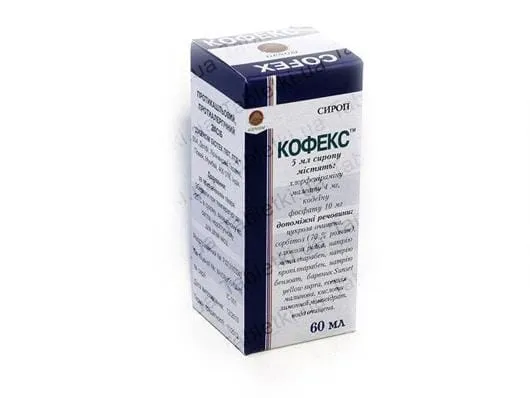
Table of Contents
INSTRUCTIONS FOR MEDICAL USE OF THE MEDICINAL PRODUCT COFEX™ (COFEX)
Composition:
Active substances:
5 ml of syrup contains: chlorpheniramine maleate 4 mg, codeine phosphate 10 mg;
Excipients: sucrose; sorbitol solution, non-crystallizing (E 420); glucose solution; sodium methylparahydroxybenzoate (E 219); sodium propylparahydroxybenzoate (E 217); sodium benzoate (E 211); citric acid monohydrate; colouring agent Sunset Yellow FCF (E 110); raspberry flavouring; purified water.
Pharmaceutical form. Syrup.
Main physicochemical properties: orange-coloured, clear syrup with a pleasant odour and taste.
Pharmacotherapeutic group.
Cough and cold preparations. Cough suppressants, excluding combinations with expectorants. Opioid alkaloids and derivatives.
ATC code R05DA.
Pharmacological Properties
Pharmacodynamics
Chlorpheniramine, a component of Cofex™, is an antiallergic agent and an H1-histamine receptor blocker. Chlorpheniramine maleate counteracts the effects of endogenously released histamine, which cause tissue edema and vascular reactions, and reduces symptoms associated with allergic rhinitis and hay fever. It produces a moderately pronounced sedative effect and has anticholinergic activity.
Codeine is an alkaloid of the phenanthrene series derived from opium and acts as a centrally-acting antitussive agent. It is an opioid receptor agonist. Its properties are similar to those of morphine, although its analgesic effect is considerably weaker. By stimulating opioid receptors of brain neurons, it reduces excitation of the cough center. It suppresses the respiratory center and intestinal peristalsis to a lesser extent than morphine, but prolonged use may cause constipation.
Pharmacokinetics
The metabolism of radiolabeled chlorpheniramine was studied in healthy volunteers. Single oral doses of chlorpheniramine maleate of 12 mg administered to each of six volunteers resulted in a mean peak plasma concentration of chlorpheniramine of approximately 17 mg/mL at 2 hours after administration, with a half-life of 12–15 hours. Chlorpheniramine metabolites were present in plasma for at least 48 hours. On average, nearly 34% of the dose was excreted in urine within 48 hours; less than 1% was excreted in feces. Two volunteers received single 4 mg intravenous doses, and the plasma half-life was approximately 15 minutes during the initial elimination phase and 28 hours during the second metabolic phase. After oral administration, about one-third of the dose was excreted in urine within 48 hours, with only a minimal amount found in feces. Comparison of metabolite levels in fecal excretions after oral and intravenous administration suggests that chlorpheniramine may undergo enterohepatic circulation. Chlorpheniramine is actively excreted in urine as unchanged drug, as well as in the form of monodesmethyl- and didesmethylchlorpheniramine, and unidentified compounds. In vitro studies have shown that chlorpheniramine is approximately 72% bound to plasma proteins. The mean biological half-life of chlorpheniramine in five healthy volunteers was 30.3 hours (ranging from 20.6 to 42.5 hours) after administration of 8 mg chlorpheniramine maleate orally on an empty stomach, which was significantly longer than previously reported elimination half-lives.
Codeine is rapidly absorbed from the gastrointestinal tract. Antitussive activity following therapeutic dose administration begins within 2 hours and lasts for 4–6 hours. Codeine rapidly distributes into body tissues, primarily accumulating in parenchymal organs such as the liver, spleen, and kidneys.
Codeine is metabolized in the liver to morphine and norcodeine. Nearly 90% of codeine is excreted within 24 hours, predominantly by the kidneys. Urinary excretion products include free or glucuronide-conjugated codeine (approximately 70%), free or conjugated norcodeine (approximately 10%), normorphine (less than 4%), and hydromorphone (less than 1%). Residual amounts of the drug are found in feces.
Clinical characteristics.
Indications.
Symptomatic treatment of dry, irritating, exhausting cough of allergic or infectious origin associated with diseases of the upper respiratory tract.
Contraindications.
Hypersensitivity to chlorpheniramine or other antihistamines, codeine or other opioids, or to any of the excipients of the medicinal product. Obstructive respiratory diseases, emphysema, pneumonia, bronchial asthma, acute respiratory depression, head injuries, increased intracranial pressure, postoperative states following biliary tract surgery, paralytic ileus, alcohol intoxication, decompensated heart failure, severe arterial hypertension, arrhythmias, epilepsy, severe hepatic or renal impairment, hypocoagulation, closed-angle glaucoma, benign prostatic hyperplasia with urinary retention, pyloroduodenal stenosis or bladder neck obstruction, hyperthyroidism. Do not use concomitantly with monoamine oxidase inhibitors (MAOIs) or within 2 weeks after discontinuation of MAOIs.
Do not use in children under 12 years of age. Medicinal products containing codeine are contraindicated in children under 12 years for the treatment of cough and cold due to the risk of serious adverse effects, including respiratory problems. Patients of any age with hypersensitivity to codeine, as well as those who are "ultra-rapid metabolizers"—meaning they convert codeine into morphine very quickly—are at increased risk of adverse effects when using codeine for cough and cold treatment.
Codeine-containing medicines are not recommended for use in children with impaired respiratory function, including neuromuscular disorders, severe cardiac and/or respiratory insufficiency, upper respiratory tract or lung infections, multiple traumas, or major surgical procedures. These factors may worsen symptoms of morphine toxicity.
General symptoms of opioid toxicity are similar to overdose symptoms and include confusion, drowsiness, shallow breathing, nausea, vomiting, constipation, and loss of appetite. In severe cases, circulatory and respiratory disturbances may occur, which can be life-threatening and may even lead to fatal outcomes (very rare).
Interaction with other medicinal products and other forms of interaction.
Chlorpheniramine maleate
Alcoholic beverages or medicinal products that depress the central nervous system may enhance the CNS depressant effects of antihistamines such as chlorpheniramine, potentially leading to overdose symptoms.
Monoamine oxidase inhibitors (MAOIs), including furazolidone (an antibacterial agent) and procarbazine (an antineoplastic agent): concomitant use is not recommended, as they may prolong and intensify the anticholinergic effects and central nervous system depression typical of antihistamines.
Tricyclic antidepressants or maprotiline (a tetracyclic antidepressant) and other anticholinergic agents: the anticholinergic effects of these drugs or antihistamines such as chlorpheniramine may be enhanced. If gastrointestinal side effects occur, medical advice should be sought promptly, as this may lead to paralytic ileus.
Ototoxic agents may mask symptoms of ototoxicity such as tinnitus, dizziness, and syncope.
Photosensitizing agents may cause additional photosensitizing effects.
Chlorpheniramine maleate may reduce the effect of anticoagulants.
Codeine phosphate
Concomitant use with codeine should be approached with caution: anticholinergics (e.g., atropine), antidiarrheal agents (e.g., loperamide, kaolin) – increased risk of acute constipation, which may lead to intestinal obstruction; metoclopramide and domperidone – possible antagonism of effect; anesthetics and antipsychotics – possible enhancement of sedative and hypotensive effects; antihypertensive agents – enhanced hypotensive effect; tricyclic antidepressants – enhanced sedative effect; quinidine – reduced analgesic effect of codeine.
Concomitant use of codeine with opioid antagonists (e.g., buprenorphine, naloxone, naltrexone) may cause withdrawal symptoms.
Concomitant use with ciprofloxacin should be avoided – opioids reduce plasma concentration of the drug; ritonavir may increase codeine plasma levels; cimetidine inhibits the metabolism of opioid analgesics, leading to increased plasma concentration of codeine. When used concomitantly, absorption of mexiletine is delayed.
Special precautions for use.
Do not exceed recommended doses.
Kofeks™ should be prescribed with caution to patients with chronic obstructive pulmonary disease when mucus clearance is impaired, and to patients with cardiovascular diseases or arterial hypertension.
The product contains sodium methyl parahydroxybenzoate (E 219) and sodium propyl parahydroxybenzoate (E 217), which may cause allergic reactions (possibly delayed).
The product contains sodium benzoate (E 211), which may mildly irritate mucous membranes.
The product contains the colouring agent Sunset Yellow FCF (E 110), which may cause allergic reactions.
The product contains sucrose and glucose; this should be taken into account when prescribing the drug to patients with diabetes mellitus. The product should not be taken by patients with rare hereditary fructose intolerance, glucose-galactose malabsorption syndrome, or sucrase-isomaltase deficiency. May be harmful to teeth. Since the product contains sorbitol, it should not be used in patients with rare hereditary fructose intolerance. It may also have a mild laxative effect.
Alcohol consumption should be avoided during treatment with this medicine.
Codeine is metabolized in the liver to morphine by the CYP2D6 enzyme. If a patient has a deficiency or complete absence of this enzyme, adequate efficacy will not be achieved. However, if a patient is an "extensive" or "ultra-rapid metabolizer" of codeine, there is an increased risk of opioid toxicity (symptoms of overdose), even when therapeutic doses are used. In these patients, codeine is rapidly converted to morphine, leading to a sharp increase in serum morphine levels.
Codeine is not recommended for use in children with impaired respiratory function, including neuromuscular disorders, severe cardiac and/or respiratory insufficiency, multiple trauma, or major surgical procedures. These factors may exacerbate symptoms of codeine/morphine toxicity.
Use during pregnancy or breastfeeding.
The product should not be used during pregnancy.
If treatment with this medicine is necessary, breastfeeding should be discontinued.
Ability to affect reaction speed when driving or operating machinery.
During treatment with this medicine, driving or operating machinery should be avoided.
Method of Administration and Dosage
Take orally after meals. The syrup should be taken with water.
For dosing the syrup, use the measuring cap provided, which has markings for 2.5 mL, 5 mL, or 10 mL.
Adults and children aged 12 years and older: 5 mL four times daily.
The duration of treatment is determined individually by a physician. Usually, the treatment duration is 3 days.
Codeine-containing medicines used for cough treatment in patients aged 12 years and older should be administered only under continuous medical supervision (in a hospital setting), at the lowest therapeutic dose (depending on age), and for the shortest possible duration, in cases where non-opioid antitussive treatments have proven ineffective.
Children.
Do not use in children under 12 years of age due to the risk of serious adverse effects, including breathing problems (as reported by the European Union review, which may occur when treating cough or cold in children).
For children aged 12 years and older, the medicine should be used only as prescribed by a physician.
Codeine-containing medicines used for cough treatment in patients aged 12 years and older should be administered only under continuous medical supervision (in a hospital setting), at the lowest therapeutic dose (depending on age), and for the shortest possible duration, in cases where non-opioid antitussive treatments have proven ineffective.
Overdose.
In case of overdose, the following may occur: dryness of the skin and mucous membranes, increased adverse reactions, gastrointestinal disturbances, increased intraocular pressure, headache, dizziness, central nervous system stimulation, and urinary retention.
General symptoms of opioid toxicity are similar to overdose symptoms and include confusion, drowsiness, shallow breathing, nausea, vomiting, constipation, and loss of appetite. In severe cases, circulatory and respiratory disturbances may develop, which can be life-threatening and very rarely result in fatal outcomes.
Symptoms of chlorpheniramine overdose:
Central nervous system: sedative effect, apnea, insomnia, hallucinations, tremor, seizures, dizziness;
Cardiovascular system: cardiovascular failure, decreased arterial blood pressure;
Other: tinnitus, ataxia, blurred vision, dry mouth, dilated pupils, flushing, hyperthermia, and gastrointestinal disturbances.
Overdose caused by chlorpheniramine maleate may lead to increased sweating, irritability, restlessness, drowsiness, nausea, vomiting, impaired consciousness, cardiac arrhythmias, tachycardia, extrasystoles, hyperreflexia, increased arterial blood pressure, seizures, and coma.
In cases of chlorpheniramine maleate overdose, anticholinergic-like symptoms may occur: mydriasis, photophobia, dryness of the skin and mucous membranes, elevated body temperature, and intestinal atony. Central nervous system depression is accompanied by respiratory depression and cardiovascular dysfunction (decreased pulse rate, decreased arterial blood pressure up to vascular collapse).
Treatment: gastric lavage and bowel decontamination, administration of laxatives. Symptomatic therapy is required. In cases of severe arterial hypertension, β-adrenoblockers should be used.
Symptomatic treatment: do not use stimulants ( analeptics ).
Symptoms of codeine overdose: respiratory depression (reduced respiratory rate or tidal volume, Cheyne-Stokes respiration, cyanosis), pinpoint pupils, excessive drowsiness progressing to stupor or coma, skeletal muscle flaccidity, cold and clammy skin; sometimes bradycardia and arterial hypotension.
Treatment: symptomatic therapy. Particular attention should be paid to restoring adequate respiratory gas exchange by ensuring airway patency and instituting assisted or artificial ventilation. The specific antidote is naloxone hydrochloride (administered intravenously); additional doses of the antidote may be required every 2–3 minutes if necessary. Excessively high plasma concentrations of codeine cannot be reduced by hemodialysis or peritoneal dialysis.
Adverse Reactions.
Adverse effects of chlorpheniramine maleate:
Immune system side effects: allergic reactions, including skin rash, urticaria, angioedema, anaphylactic reactions, bronchospasm;
Cardiovascular system side effects: changes in blood pressure, arrhythmia, palpitations, tachycardia;
Blood system side effects: thrombocytopenia, agranulocytosis, leukopenia, aplastic anemia;
Nervous system side effects: sedative effect, dizziness, coordination disturbances, increased fatigue, headache, confusion, anxiety, excitement, nervousness, tremor, irritability, insomnia, euphoria, paresthesia, vertigo, tinnitus, acute labyrinthitis, neurosis, neuritis, seizures, in isolated cases – drowsiness;
Gastrointestinal side effects: dyspeptic disorders, including nausea, vomiting, diarrhea, constipation, epigastric pain;
Urinary and reproductive system side effects: difficulty in urination and urinary retention, menstrual cycle disturbances; impotence;
Respiratory system side effects: nasal congestion;
Other side effects: dryness of mucous membranes, increased sweating, photophobia, visual disturbances (blurred vision, diplopia).
Adverse effects of codeine phosphate:
Immune system side effects: allergic reactions, including rash, itching, urticaria, angioedema;
Nervous system side effects: sedative effect, drowsiness, confusion, weakness, dizziness, lethargy, impaired mental and physical performance, fearfulness, seizures, dysphoria, sudden mood changes, respiratory depression, loss of consciousness, excitement, anxiety, depression, headache, increased intracranial pressure;
Gastrointestinal side effects: loss of appetite, nausea, vomiting, constipation, biliary tract spasm, dry mouth;
Cardiovascular system side effects: arterial hypotension, including orthostatic, bradycardia, tachycardia, palpitations, dizziness;
Urinary and reproductive system side effects: bladder sphincter spasm and urinary retention, decreased libido, impotence;
Other side effects: flushing, increased sweating, itching, hypothermia, miosis, visual acuity disturbances, diplopia, muscle rigidity, withdrawal syndrome.
In children and elderly patients, anticholinergic effects and paradoxical excitation (increased energy, restlessness, nervousness) occur more frequently.
With prolonged use in high doses, tolerance and dependence on codeine may develop.
Shelf life. 2 years.
Storage conditions.
Store in a dry, light-protected place at a temperature not exceeding 25 °C.
Keep out of reach of children.
Packaging.
60 ml in a bottle with a measuring cap; 1 bottle per cardboard box.
Prescription category.
Prescription only.
Manufacturer.
Jenome Biotech Pvt. Ltd.
Manufacturer's address and location of business operations.
Plot No. D-121, 122, 123, MIDC Malegaon, Tal. Sinnar, Nashik 422103, Maharashtra State, India.