Clotrimazole
Ukraine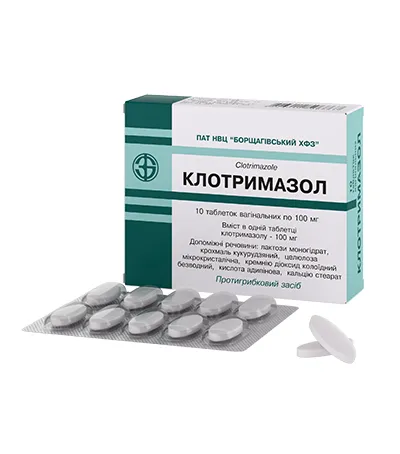
Table of Contents
INSTRUCTION FOR MEDICAL USE OF THE MEDICINAL PRODUCT CLOTRIMAZOLE (CLOTRIMAZOLUM)
Composition:
Active substance: clotrimazole;
1 tablet contains 100 mg of clotrimazole;
Excipients: lactose monohydrate; potato starch; adipic acid; sodium hydrogencarbonate; magnesium stearate; colloidal anhydrous silicon dioxide; sodium lauryl sulfate.
Pharmaceutical form. Vaginal tablets.
Main physicochemical properties: white, biconvex, bevel-edged, elongated tablets, rounded on one side and with a blunt edge on the other.
Pharmacotherapeutic group. Antimicrobial and antiseptics used in gynecology, excluding combinations with corticosteroids. Imidazole derivatives. Clotrimazole. ATC code G01AF02.
Pharmacological properties.
Pharmacodynamics.
The antifungal mechanism of action of clotrimazole is related to the inhibition of ergosterol synthesis, leading to structural and functional damage of the fungal cytoplasmic membrane.
Clotrimazole has a broad spectrum of antifungal activity in vitro and in vivo, acting against dermatophytes, yeasts, molds, and dimorphic fungi.
Under appropriate testing conditions, minimal inhibitory concentrations for these fungal types are approximately less than 0.062 – 8.0 μg/mL of substrate.
The mechanism of action of clotrimazole involves primarily fungistatic or fungicidal activity, depending on the concentration of clotrimazole at the site of infection.
In vitro, activity is limited to proliferating fungal elements; fungal spores exhibit only minimal sensitivity.
In addition to its antifungal activity, clotrimazole also acts against Gram-positive microorganisms (streptococci, staphylococci, Gardnerella vaginalis) and Gram-negative microorganisms (Bacteroides).
In vitro, clotrimazole inhibits the growth of Corynebacteria and Gram-positive cocci (except Enterococci) at concentrations of 0.5 – 10 μg/mL of substrate. Primary resistant strains of susceptible fungal species are rare. To date, the development of secondary resistance in initially susceptible fungi under therapeutic conditions has been observed only in very rare cases. Preclinical studies using single and repeated toxic doses have not revealed any damaging toxic, genotoxic, or adverse effects on reproductive function.
Pharmacokinetics.
Following vaginal administration, only a small amount of clotrimazole is absorbed (3 – 10%). Absorbed clotrimazole is rapidly metabolized in the liver to inactive metabolites. Therefore, the peak plasma concentration of clotrimazole after a 500 mg vaginal dose was less than 10 ng/mL. This indicates that measurable systemic effects or adverse reactions following intravaginal administration of clotrimazole are unlikely.
Clinical characteristics.
Indications.
Infections of the genital area (vaginitis) caused by fungi (usually of the genus Candida), and superinfections caused by bacteria sensitive to clotrimazole.
Contraindications.
Hypersensitivity to clotrimazole or to any of the other components of the medicinal product.
Interaction with other medicinal products and other forms of interaction.
Concomitant treatment with vaginally administered clotrimazole and orally administered tacrolimus (FK-506, immunosuppressant) or sirolimus may lead to increased plasma levels of tacrolimus or sirolimus. Therefore, patients should be carefully monitored for symptoms of tacrolimus or sirolimus overdose, and plasma levels of these drugs should be checked if necessary.
Special precautions for use.
Avoid contact with the eyes. Do not swallow.
Treatment should not be carried out during menstruation. Treatment should be completed before the onset of menstruation.
The patient should consult a physician: at the first signs of the disease; if symptoms persist for more than 7 days; if symptoms recur within 2 months or occur more than 4 times during the last 12 months.
Medical advice should be sought before starting treatment if the patient has any of the following conditions:
- recurrent fungal infection occurring more than twice within six months;
- history of sexually transmitted infections in the patient or her sexual partner;
- known hypersensitivity to imidazole derivatives or other vaginal antifungal agents.
The use of the drug without medical advice is not recommended in the following cases:
- vaginal bleeding accompanied by shoulder pain;
- foul-smelling vaginal discharge;
- vulvar or vaginal ulcers;
- lower abdominal pain or dysuria;
- any adverse reactions such as redness associated with treatment;
- elevated body temperature (38 °C or higher);
- nausea or vomiting;
- diarrhea;
- back pain.
During treatment with this medication, sexual intercourse should be avoided, as the infection may be transmitted to the partner. The effectiveness and safety of latex products (such as condoms and diaphragms) may be reduced.
Since both the vagina and external genital organs (labia and adjacent areas) are usually affected, combined treatment of both areas should be applied, including topical treatment with a cream for external use.
During treatment with this medication, treatment of both partners using the cream is recommended.
Do not use tampons, intravaginal douches, spermicides, or other vaginal products during treatment with this medication.
Use during pregnancy or breastfeeding.
Clinical studies on the effect of clotrimazole on female fertility have not been conducted; however, animal studies have not shown any effect of clotrimazole on fertility.
Animal studies have not revealed any direct or indirect harmful effects on reproductive function. The number of studies on the use of clotrimazole during pregnancy is limited; therefore, use of the drug during the first trimester of pregnancy is not recommended.
Breastfeeding should be discontinued during treatment with this medication.
Ability to affect reaction speed when driving or operating machinery.
Clotrimazole vaginal tablets do not affect the ability to drive or operate machinery, or have only a negligible effect.
Method of administration and dosage.
The usual dose is 1 vaginal tablet daily administered in the evening for 6 consecutive days.
Vaginal tablets should be inserted as deeply as possible into the vagina in the evening. Insertion is most convenient while lying on the back with knees slightly bent.
A moist environment is required for complete dissolution of the tablet within the vagina; otherwise, undissolved particles may be expelled. To prevent this, the tablet should be inserted as deeply as possible into the vagina, preferably before bedtime. If the vaginal tablets do not dissolve completely during one night, consider switching to a vaginal cream.
Treatment should be completed before the onset of menstruation. Treatment should not be continued during menstruation due to the risk of the medicinal product being washed out by menstrual flow.
Children.
Do not use in children under 12 years of age. For children aged 12 years and older, use only after consultation with a physician.
Overdose.
There is no risk of acute intoxication, as overdose is unlikely following a single vaginal dose or application of the topical formulation to the skin (application over large skin areas under conditions favoring enhanced absorption), or after accidental oral ingestion. There is no specific antidote. After accidental oral ingestion, gastric lavage may rarely be considered if a life-threatening dose has been ingested within the previous hour or if visible symptoms of overdose are present (e.g., dizziness, nausea, vomiting). Gastric lavage should be performed only if adequate airway protection is ensured.
Side effects.
Immune system disorders: allergic reactions, including urticaria, dyspnea, arterial hypotension, syncope.
Gastrointestinal disorders: abdominal pain.
Reproductive system and breast disorders: discomfort in the vulvar and vaginal area, swelling, burning sensation, erythema, skin desquamation in the genital area, irritation, pruritus, pelvic pain, rash, vaginal bleeding.
Shelf life. 3 years.
Storage conditions. Keep out of reach of children. Store at a temperature below 25 °C.
Packaging. 6 tablets in a blister made of colorless or white polyvinyl chloride film and aluminum foil (PVC-Al), 1 blister per cardboard pack.
Supply category. Over-the-counter.
Manufacturer. Delpharm Poznan S.A., Poland.
Manufacturer's address.
189, Grunwaldzka Str., 60-322 Poznan, Poland.