Clotrex
Ukraine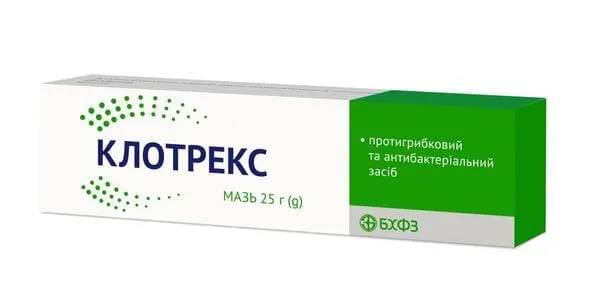
Instructions for Use
INSTRUCTIONS for medical use of the medicinal product CLOTREX (CLOTREX)
Composition:
Active substances: clotrimazole, gentamicin sulfate, calendula extract, yarrow extract;
1 g of the preparation contains: gentamicin sulfate – 1 mg, clotrimazole – 10 mg, calendula extract, thick (Calendulae flos extractum spissum) (2 - 3 : 1) (extraction solvent: ethanol 70% v/v) – 50 mg, yarrow
extract, thick (Millefolii herba extractum spissum) (3 - 8 : 1) (extraction solvent: ethanol 70% v/v) – 20 mg;
Excipients: propylene glycol, polyethylene glycol 400, polyethylene glycol 1500, emulsifier No 1, purified water.
Pharmaceutical form. Ointment.
Main physicochemical characteristics: ointment ranging from yellow or yellowish-brown to dark brown in color, of uniform consistency, with a weak specific odor.
Pharmacotherapeutic group. Antifungal agents for topical use.
ATC code D01A C.
Pharmacological properties.
Pharmacodynamics.
Klotrex is an effective antifungal and antibacterial agent with anti-inflammatory and reparative properties. The antifungal component of the drug, clotrimazole (an imidazole derivative), acts on the fungal cell membrane, disrupting its permeability to amino acids, glucose, phosphates, and K+ and Na+ ions, which leads to microbial lysis. Clotrimazole is effective against dermatophytes (Trichophyton rubrum, Trichophyton mentagrophytes, Epidermophyton floccosum), yeasts (Candida albicans, Candida pseudotropicalis, Cryptococcus neoformans), and molds (genus Aspergillus).
The aminoglycoside gentamicin, included in the formulation, enhances the drug's activity against gram-positive cocci, including penicillin- and cephalosporin-resistant Staphylococcus and Streptococcus species. Klotrex is also active against certain gram-negative bacteria (Bacteroides spp., Gardnerella vaginalis), as well as Malassezia furfur and Corynebacterium minutissimum. Calendula and arnica extracts accelerate tissue regeneration and wound epithelialization. The hydrophilic base, possessing high hyperosmolar activity, facilitates absorption of inflammatory exudate, thereby reducing the concentration of bacteria at the site of inflammation, their toxins, and degradation products of necrotic tissues.
Pharmacokinetics.
Not described.
Clinical characteristics.
Indications.
- Dermatophytoses (tinea pedis and tinea manuum, cutaneous fungal infections) caused by drug-susceptible strains, candidal infections, pityriasis versicolor, erythrasma;
- Skin infections caused by molds of the genus Aspergillus;
- Pyoderma, including gangrenous forms, superficial folliculitis, furunculosis, sycosis, paronychia, infected acne, and seborrheic dermatitis;
- Eczema of mycotic or bacterial etiology, secondary bacterial infections associated with fungal and viral skin infections;
- Infected wounds.
Contraindications.
Hypersensitivity to any component of the drug.
Interaction with other medicinal products and other forms of interaction.
Clotrimazole inhibits the action of other topical antifungal agents, particularly amphotericin, nystatin, and natamycin.
The antimicrobial effect of clotrimazole is enhanced by high concentrations of propyl paraben.
Dexamethasone, when used in high doses, inhibits the antifungal activity of clotrimazole.
In cases of intensive resorption of gentamicin, there may be an increased ototoxicity of other aminoglycoside antibiotics, polymyxin B, colistin, cephaloridine, ethacrynic acid, and furosemide.
Special precautions for use.
Apply the medication only to the affected area of the skin.
Do not use other topical medications during treatment with this product.
Do not use the medication in ophthalmology. Avoid contact with the eyes. If contact occurs, rinse the eyes thoroughly with plenty of water.
Do not swallow the medication!
During treatment, it is not recommended to wear clothing or footwear that does not allow air and moisture to pass through. After application, do not cover the treated area or apply an occlusive (airtight) dressing.
Use clotrimazole with caution if allergic reactions to any other antifungal agents have previously occurred. Contact dermatitis may develop after using many imidazole-derived antifungal agents. Cases of cross-sensitivity reactions have been reported; therefore, if an allergic reaction occurs to any antifungal agent of the imidazole class, consider the possibility of a similar reaction to another drug in this group. If irritation or other signs of hypersensitivity occur, discontinue use of the medication.
Adverse effects due to systemic absorption of gentamicin may occur with topical application, particularly when treating large body surface areas, especially during prolonged use or in the presence of skin lesions.
Prolonged topical use of antibiotics may occasionally lead to the growth of resistant microflora, including fungi. In such cases, as well as in the event of irritation, sensitization, or superinfection, treatment should be discontinued and appropriate therapy initiated.
If there is no improvement after 2 weeks of treatment for athlete's foot or after 4 weeks of treatment for dermatomycoses or foot mycoses, treatment should be discontinued and microbiological testing performed to confirm the diagnosis and rule out other causes of the condition.
The medication should be used for the full duration of treatment, even if symptoms resolve earlier. Adhering to these recommendations helps prevent reinfection (recurrence of the disease).
The product contains propylene glycol, which may cause skin irritation upon topical application.
Use during pregnancy or breastfeeding.
Clinical studies on the effect of clotrimazole on female fertility have not been conducted; however, animal studies have shown no effect of clotrimazole on fertility.
The number of studies on the use of clotrimazole during pregnancy is limited. Reproductive toxicity studies in animals have not revealed any direct or indirect harmful effects. As a precautionary measure, it is advisable to avoid using Clotrex during the first trimester of pregnancy.
Breastfeeding should be discontinued during treatment with Clotrex.
Ability to influence reaction rate while driving or operating machinery.
There are no data on the effect of the medication on reaction speed while driving or operating machinery.
Dosage and Administration.
Apply the ointment to adults, spreading a thin layer onto affected skin areas 2–3 times daily, under a non-occlusive dressing or without one. The duration of treatment depends on the nature, severity of the disease, and the extent of the affected area, and averages from 2 to 4 weeks. In severe skin conditions, treatment may be extended up to 5–6 weeks.
Children.
The drug must not be used for the treatment of children.
Overdose.
Overdose is unlikely when the drug is used according to the instructions.
If a large amount of the drug is accidentally ingested, symptoms such as nausea, vomiting, abdominal pain, and impaired liver function may occur.
Prolonged use of high doses of gentamicin may lead to overgrowth of antibiotic-resistant microorganisms.
In case of overgrowth of resistant microorganisms, treatment with the drug should be discontinued and appropriate therapy initiated.
Increased individual sensitivity to the drug components, local allergic reactions such as rashes, itching, and urticaria are possible.
With prolonged use (more than 14 days) over large skin areas, especially in patients with chronic renal insufficiency, the potential for systemic absorption effects of gentamicin should be considered: ototoxicity (dizziness, nausea, tinnitus), nephrotoxicity (increased blood urea and creatinine levels, reduced diuresis), and elevated serum bilirubin and transaminase levels.
Treatment. Discontinue the drug, gastric lavage. Symptomatic therapy.
Side effects.
Side effects that may be caused by clotrimazole.
Immune system: allergic reactions, including anaphylactic/anaphylactoid reactions (anaphylactic shock, angioneurotic edema, arterial hypotension, loss of consciousness, dyspnea, urticaria).
Skin and subcutaneous tissue: redness, blistering, skin peeling, burning/heat sensation, tingling, local swelling, itching, rash, erythema, general skin irritation, pain/discomfort, dry skin sensation; allergic contact dermatitis.
Side effects that may be caused by gentamicin: irritation, allergic reactions such as hyperemia and itching of the skin at the site of gel application.
Shelf life. 2 years.
Storage conditions. In the original packaging at a temperature not exceeding 25 °C.
Keep out of reach of children.
Packaging. 25 g in a tube and carton.
Prescription category. Prescription only.
Manufacturer.
Public Joint-Stock Company "Scientific-Production Center "Borshchagivskiy Chemical-Pharmaceutical Plant".
Location of manufacturer and address of its business activities.
17, Miru Street, Kyiv, 03134, Ukraine.
Frequently Asked Questions
What is Clotrex prescribed for?
The drug is used to treat fungal skin infections (mycosis of the feet, hands, and smooth skin), candidiasis, tinea versicolor, erythrasma, as well as bacterial infections such as pyoderma, furunculosis, infected wounds, seborrheic dermatitis, and eczema.
How should Clotrex be used correctly?
Adults should apply a thin layer of the ointment to the affected areas of the skin 2-3 times daily. The course of treatment usually lasts from 2 to 4 weeks, and in severe cases, it may extend to 5-6 weeks. It is important to complete the full course, even if symptoms disappear earlier.
What side effects may Clotrex cause?
Possible allergic reactions (swelling, rash, itching, urticaria), skin irritation, redness, peeling, or a sensation of burning or dryness. With prolonged use over large areas of skin, more serious effects may occur, such as impact on hearing (tinnitus, dizziness) or the kidneys.
Who should not use this drug?
The drug should not be used in case of hypersensitivity to any of its components. It is also not intended for treatment in children.
Can the ointment be combined with other medicines?
During treatment, other topical agents should not be used. Clotrimazole may inhibit the action of certain antifungal agents (e.g., nystatin), and high doses of dexamethasone may weaken its effect. Interaction with certain antibiotics is also possible.
What application precautions should be taken into account?
The ointment should be applied only to the affected skin; avoid contact with eyes and do not swallow. It is not recommended to use non-breathable or airtight footwear and clothing during treatment. Pregnant women should avoid using the drug during the first trimester, and breastfeeding should be discontinued during treatment.
This page has been machine-translated and may contain inaccuracies. The original data is available in the manufacturing country's language.
Last data check: July 21, 2026 · Data source: Державний реєстр лікарських засобів України