Clophelin-zn
Ukraine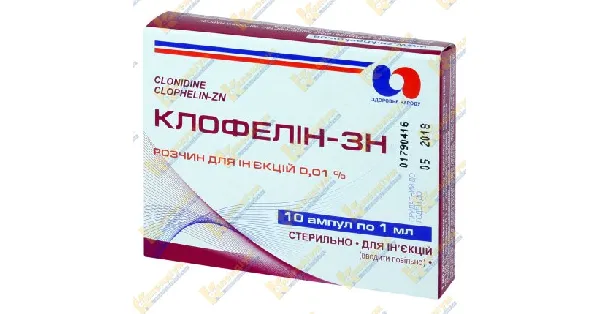
Table of Contents
INSTRUCTIONS FOR MEDICAL USE OF THE MEDICINAL PRODUCT KLOFELIN-ZN (CLOPHENYLIN-ZN)
Composition:
Active substance: clonidine;
1 ml of solution contains clonidine hydrochloride equivalent to 100 % substance 0.1 mg;
Excipients: diluted hydrochloric acid, water for injections.
Pharmaceutical form. Injection solution.
Main physicochemical properties: transparent, colorless liquid.
Pharmacotherapeutic group.
Antihypertensive agents. Antiadrenergic agents with central mechanism of action.
ATC code C02AC01.
Pharmacological properties.
Pharmacodynamics.
Antihypertensive agent. The mechanism of action is mediated by stimulation of central postsynaptic α2-adrenergic receptors, resulting in inhibition of sympathetic impulse transmission from the central nervous system and suppression of norepinephrine release from nerve endings. It slightly reduces plasma renin activity, aldosterone excretion, glomerular filtration, and sodium excretion.
Under the influence of Clonidine-ZN, peripheral vascular resistance decreases, heart rate is reduced, cardiac output is slightly diminished, and both systolic and diastolic blood pressure are significantly lowered. Increased resistance of cerebral vessels and reduced cerebral blood flow may occur. A sustained hypotensive effect may be preceded by a transient increase in blood pressure due to stimulation of peripheral postsynaptic α1-adrenergic receptors, which may occasionally be observed after rapid intravenous administration of the drug. The pronounced hypotensive effect of Clonidine-ZN occurs independently of the initial blood pressure level, both in patients with arterial hypertension and in normotensive and hypotensive individuals.
Clonidine-ZN attenuates somatic and autonomic symptoms of opioid and alcohol withdrawal. It also exerts sedative effects (due to increased excitation threshold of neurons in the reticular formation) and analgesic effects.
The antihypertensive effect after intravenous administration appears within 3–5 minutes, reaches maximum within 15–20 minutes, and lasts for 4–8 hours; after intramuscular administration, the onset is within 10 minutes, peak effect occurs at 30–60 minutes, and duration lasts 6–8 hours.
Pharmacokinetics.
Clonidine-ZN readily crosses the blood-brain barrier. Plasma protein binding is 20–40%. Due to high lipophilicity, it widely distributes into tissues, including the central nervous system. Approximately 50% of circulating Clonidine-ZN is metabolized in the liver into inactive metabolites. Therapeutic blood concentrations range from 0.0003 to 0.0015 μg/mL; toxic concentration is 0.025 μg/mL. It is primarily excreted in urine. The elimination half-life after intravenous administration is 9 hours. It readily penetrates histohematic barriers, including the blood-brain and placental barriers, and passes into breast milk. Women exhibit lower clonidine clearance and longer elimination half-life compared to men. In elderly patients and in patients with renal insufficiency, the elimination half-life is approximately doubled.
Clinical characteristics.
Indications.
Treatment of hypertensive crises.
Contraindications.
Increased individual sensitivity to the components of the drug, arterial hypotension, severe atherosclerosis of cerebral vessels, cerebral circulation disorders, obstructive peripheral arterial diseases (including Raynaud's syndrome), sinus bradycardia, sinoatrial node weakness syndrome, AV conduction disturbances (second- and third-degree atrioventricular block), cardiogenic shock, concomitant use of tricyclic antidepressants or ethanol, depressive states (including in medical history), renal function impairment, recent myocardial infarction, ischemic heart disease, severe peripheral circulatory disorders. Pediatric use (under 18 years of age).
Interaction with other medicinal products and other types of interactions.
Concomitant use with antiarrhythmic agents, calcium antagonists, vasodilators, antidepressants, phenothiazine derivatives, narcotic analgesics, norepinephrine, reserpine, cardiac glycosides, oral hypoglycemic agents, and antacids is not recommended. The effect of Clonidine-ZN is potentiated when used concomitantly with other antihypertensive agents (vasodilators, diuretics, β-adrenoreceptor blockers) and antihistamine drugs, as well as with fenfluramine. Reduced efficacy of Clonidine-ZN is observed when used concomitantly with tricyclic antidepressants, anorexigenic agents, sympathomimetics, nonsteroidal anti-inflammatory drugs, and nifedipine. β-adrenoblockers also contribute to a more pronounced increase in arterial pressure upon abrupt discontinuation of clonidine. Concomitant use with β-blockers and/or cardiac glycosides increases the risk of developing bradycardia and atrioventricular block. Clonidine-ZN enhances the effects of agents that depress the central nervous system and preparations containing ethanol. Nifedipine reduces the hypotensive effect of Clonidine-ZN. An additive hypotensive effect, sedative action, and dry mouth occur when used concomitantly with atenolol and propranolol. Clonidine may reduce the effectiveness of levodopa and piribedil in patients with Parkinson's disease. Clonidine may increase cyclosporine concentration, as well as blood glucose concentration due to reduced insulin secretion, which should be considered when used concomitantly with insulin. Do not administer together with α-adrenoblockers.
Special precautions.
If the recommended rate of intravenous administration of the drug is exceeded, a short-term but significant increase in systolic blood pressure may occur (on average 20 mm Hg higher than the initial level).
In elderly patients, especially those with signs of cerebral vascular sclerosis, increased sensitivity to the drug's effect may be observed; therefore, treatment of such patients should begin with reduced doses.
Clophelin-ZN must be used with caution in patients with severe cerebral vascular changes, depression, and renal insufficiency.
It should be noted that in some patients, after several administrations of the drug and its subsequent discontinuation, withdrawal syndrome in the form of a hypertensive crisis may develop. In such cases, immediate resumption of Clophelin-ZN at lower doses administered either by injection or orally is recommended, followed by gradual dose reduction, or replacement with other antihypertensive agents.
During therapy, alcohol consumption should be avoided.
When combined use of clonidine and β-adrenoreceptor blockers must be temporarily discontinued, the β-adrenoreceptor blocker should be withdrawn first to prevent sympathetic hyperreactivity, followed by gradual discontinuation of clonidine, especially if it has been administered in high doses.
Clonidine should be prescribed with caution to patients with diabetes mellitus, as clonidine may mask symptoms of hypoglycemia and reduce insulin secretion.
A transient increase in growth hormone concentration is possible.
The use of clonidine may lead to reduced or suppressed salivation, which may promote the development of dental caries, periodontosis, and oral candidiasis.
During treatment with this drug, regular monitoring of blood pressure is recommended. Caution is advised during prolonged physical exertion, especially in the upright position and in hot weather, due to the risk of orthostatic reactions.
Patients who wear contact lenses should be warned that treatment may lead to decreased secretion of the lacrimal glands.
Use during pregnancy or breastfeeding.
The drug is contraindicated during pregnancy. If use of the drug is necessary, breastfeeding should be discontinued.
Ability to affect reaction rate when driving or operating machinery.
When using Clophelin-ZN, potentially hazardous activities requiring increased attention and rapid mental and motor reactions, such as driving vehicles or operating machinery, should be avoided.
Administration and Dosage
The drug is intended for adult use only and must be administered in a hospital setting intravenously, intramuscularly, or subcutaneously. To prevent orthostatic effects, the patient must remain in a lying position during injection and for at least 2 hours thereafter.
For intravenous administration, 0.5–1.5 mL (0.05–0.15 mg) of 0.01% solution of Clonidine-ZN is diluted in 10–20 mL of 0.9% sodium chloride solution and administered by slow bolus injection over 3–5 minutes under strict monitoring of arterial pressure. In severe cases and only under hospital conditions, administration may be repeated 3–4 times daily.
For intramuscular and subcutaneous administration, 0.5–1.5 mL (0.05–0.15 mg) of undiluted Clonidine-ZN solution is administered.
Maximum single dose — 0.15 mg; maximum daily dose — 0.6 mg (divided into 4 doses).
Children
The drug is contraindicated for use in pediatric practice.
Overdose
Symptoms: drowsiness, symptomatic hypotension, orthostatic reactions, vomiting, xerostomia, generalized muscular hypotonia with reduced reflex response, miosis, paralytic ileus.
Significant overdose may lead to collapse, loss of consciousness, cardiac arrhythmias (especially in patients with cardiac conduction system pathology), and sharp fluctuations in arterial pressure.
Treatment: symptomatic; in case of severe arterial hypotension, dopamine or mesaton is administered; in case of symptomatic bradycardia, atropine sulfate is used. Hemodialysis is ineffective.
Adverse reactions.
Blood and lymphatic system disorders: increased blood glucose levels, thrombocytopenia.
Central nervous system disorders: transient confusion, hallucinations, headache, paresthesia, tremor, increased fatigue, weakness, somnolence, slowed mental and motor reaction speed, anxiety, restlessness, depression, vivid or nightmares, dizziness, anorexia.
Eye disorders: decreased tear secretion, accommodation disorders.
Cardiovascular system disorders: edema, bradycardia, orthostatic collapse (if the patient is in an upright position), Raynaud's syndrome, atrioventricular block, transient increase in blood pressure (in the first minutes after administration).
Respiratory, thoracic and mediastinal disorders: breathing difficulties, nasal congestion, dryness of nasal mucosa.
Gastrointestinal disorders: dry mouth, decreased appetite, nausea, vomiting, constipation, reduced gastric secretion, pseudo-obstruction of the colon, pain in salivary glands.
Skin and subcutaneous tissue disorders: skin rash, itching, alopecia; very rarely with sublingual administration (in hypertensive crisis) – mucosal edema; hyperemia, urticaria, angioneurotic edema.
Renal and urinary disorders: fluid retention, weight gain due to water and sodium retention, urinary retention.
Reproductive system and breast disorders: sexual dysfunction, decreased libido and potency, gynecomastia in males.
Hepatobiliary disorders: hepatitis, changes in liver function tests.
Shelf life.
2 years.
Storage conditions.
Store in the original packaging at a temperature not exceeding 25°C.
Keep out of reach of children.
Packaging.
1 ml in ampoules; 10 in a box; 10 (5x2) in blisters in a box.
Prescription status.
Prescription only.
Manufacturer.
Limited liability company "Kharkiv Pharmaceutical Enterprise "Zdorovye Naroda".
Manufacturer's address and place of business.
41 Kulikovskaya Street, Kharkiv, Kharkiv region, 61002, Ukraine.