Clonidine
Ukraine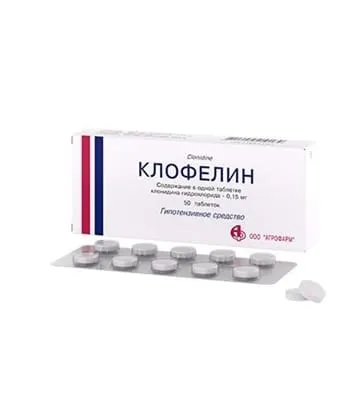
Table of Contents
INSTRUCTION FOR MEDICAL USE OF THE MEDICINAL PRODUCT CLOPHELIN (Clophelinum)
Composition:
Active substance: 1 tablet contains 0.15 mg of clonidine hydrochloride;
Excipients: potato starch, magnesium stearate, monohydrate lactose.
Pharmaceutical form. Tablets.
Main physicochemical properties: white, round, biconvex tablets.
Pharmacotherapeutic group. Antihypertensive agents. Central-acting antiadrenergic agents. Imidazoline receptor agonists. ATC Code C02AC01.
Pharmacological properties.
Pharmacodynamics.
An antihypertensive agent affecting central mechanisms of arterial pressure regulation. The antihypertensive effect of the drug is associated with a reduction in total peripheral vascular resistance, decreased heart rate, and cardiac output. The mechanism of action is mediated by stimulation of postsynaptic alpha-2 adrenergic receptors in inhibitory structures of the brain, resulting in reduced sympathetic outflow to blood vessels and the heart. Clonidine increases renal blood flow, raises cerebral vascular resistance, and slightly reduces cerebral blood flow. The drug exerts a pronounced sedative effect and reduces symptoms of opioid and alcohol withdrawal.
Pharmacokinetics.
After oral administration, the drug is rapidly and completely absorbed from the gastrointestinal tract. Bioavailability is approximately 100%. Maximum plasma concentration is reached within 1–2 hours. The antihypertensive effect develops within 30–60 minutes after administration and lasts for 8–12 hours. Clonidine is highly lipophilic and widely distributed in tissues, including the central nervous system. Approximately 50% of the drug circulating in the blood is metabolized in the liver into inactive compounds. Excretion occurs via urine (40–60%) and feces (10%). The elimination half-life varies widely, averaging 12 hours (range: 6–24 hours). Clonidine elimination is slowed in patients with severe renal impairment. Compared to men, women exhibit a longer elimination half-life.
Clinical characteristics.
Indications.
- Hypertensive crisis (except hypertensive crisis in pheochromocytoma);
- rarely for the treatment of arterial hypertension (as part of combination therapy);
- opioid withdrawal syndrome (as part of combination therapy).
Contraindications.
- Hypersensitivity to clonidine or to any of the excipients;
- arterial hypotension;
- cerebral circulation disorders, severe atherosclerosis of cerebral vessels;
- obstructive peripheral arterial diseases, severe peripheral circulatory disorders, Raynaud's syndrome;
- marked bradyarrhythmia, second- or third-degree atrioventricular block, sick sinus syndrome, cardiogenic shock;
- severe ischemic heart disease, recent myocardial infarction;
- severe renal function impairment;
- depressive states (including in medical history);
- concomitant use of tricyclic antidepressants, alcohol consumption.
Interaction with other medicinal products and other forms of interaction.
The antihypertensive effect induced by clonidine may be further enhanced by concomitant administration of other antihypertensive agents, such as diuretics, vasodilators, beta-adrenergic blockers, calcium antagonists, and ACE inhibitors; however, the effect of alpha1-adrenergic blockers when used concomitantly with clonidine may be unpredictable.
Cardiac glycosides, beta-adrenergic blockers, calcium channel blockers − increased risk of bradycardia or (in individual cases) AV block; increased risk of withdrawal syndrome when used concomitantly with beta-blockers, development or worsening of peripheral vascular disorders. Cases of severe bradycardia requiring hospitalization and cardiac pacing have been reported with concomitant use of clonidine and diltiazem or verapamil.
Atenolol, propranolol − additive antihypertensive effect, sedative effect, and dry mouth.
Antihistamines, fenfluramine, anesthetics − enhanced hypotensive effect.
Sympathomimetics (adrenaline, noradrenaline) − reduced antihypertensive effect of clonidine, risk of arterial hypertension with concomitant use.
Non-selective alpha-adrenergic blockers (including phentolamine, tolazoline), drugs with alpha2-adrenergic receptor blocking properties (e.g., mirtazapine) − dose-dependent antagonistic reduction of the alpha2-mediated antihypertensive effect of clonidine.
Tricyclic antidepressants, antipsychotic agents with alpha-adrenergic receptor blocking properties (chlorpromazine, haloperidol) − possible provocation or worsening of orthostatic reactions, reduced antihypertensive effect, increased risk of rebound arterial hypertension upon abrupt discontinuation of clonidine.
Tranquilizers, hypnotics, alcohol, other drugs that depress the central nervous system − possible enhancement of sedative effect, development of depressive disorders. A case of acute delirium has been reported with concomitant use of fluphenazine and clonidine. Symptoms resolved upon discontinuation of clonidine and recurred upon re-initiation.
Corticosteroids, nonsteroidal anti-inflammatory drugs, estrogens, anorexigenic agents (except fenfluramine), nifedipine − reduced antihypertensive effect of clonidine.
Hormonal contraceptives − when taken orally, possible enhancement of the sedative effect of the drug.
Methylphenidate − serious adverse events have been reported with concomitant use (causal relationship not established).
Levodopa, piribedil − clonidine may reduce their efficacy in patients with Parkinson's disease.
Cyclosporine − possible increase in cyclosporine blood concentration.
Antidiabetic agents (e.g., insulin) − clonidine may increase blood glucose concentration due to reduced insulin secretion, which should be taken into account.
Special precautions.
Patients should be instructed not to discontinue treatment without consulting their physician. Sudden discontinuation of the drug may lead to withdrawal syndrome due to increased plasma catecholamine levels: rapid rise in blood pressure, nervousness, agitation, headache, palpitations, tachycardia, nausea, sweating, tremor. Therefore, the drug should be discontinued gradually over 1–2 weeks, taking into account concomitant therapy.
Withdrawal syndrome may occur 18–72 hours after the last dose of clonidine. If withdrawal syndrome develops, the drug should be restarted immediately and then gradually discontinued, replacing it with other antihypertensive agents. Cases of hypertensive encephalopathy, cerebrovascular events, and fatal outcomes following abrupt discontinuation of clonidine have been reported.
The likelihood of such a reaction upon stopping clonidine increases with high-dose therapy or concomitant use of beta-blockers; therefore, special caution is recommended in such situations.
When combined therapy with beta-blockers requires interruption or discontinuation of antihypertensive treatment, beta-blockers (to prevent sympathetic hyperreactivity) should always be discontinued first, gradually, several days before beginning the gradual withdrawal of clonidine, especially if it has been used in high doses.
To prevent withdrawal syndrome, the drug should not be prescribed to patients who do not have conditions ensuring regular administration.
The drug should be used with caution:
- in patients with mild to moderate bradyarrhythmia;
- in patients with diabetes mellitus, as clonidine may mask symptoms of hypoglycemia and reduce insulin secretion;
- in patients with polyneuropathy or constipation;
- in elderly patients – due to the risk of increased sensitivity to the drug;
- in patients with renal impairment – due to the risk of delayed drug elimination;
- in individuals using contact lenses for vision correction – clonidine may cause dry eyes.
No therapeutic effect of clonidine is expected in arterial hypertension caused by pheochromocytoma.
Use of clonidine may reduce salivation. This may promote the development of dental caries, periodontitis, and oral candidiasis. Transient increase in growth hormone concentration is possible. A weakly positive Coombs' reaction may develop.
Alcoholic beverages are contraindicated during treatment with clonidine.
Patients should be warned that the sedative effect of the drug is enhanced when taken concomitantly with alcohol, barbiturates, or other sedative agents.
Regular monitoring of arterial blood pressure is recommended during clonidine therapy.
Caution is advised during prolonged physical exertion, especially in the upright position in hot weather, due to the risk of orthostatic reactions.
The drug contains lactose and therefore is contraindicated in patients with rare hereditary conditions such as galactose intolerance, lactase deficiency, or glucose-galactose malabsorption syndrome.
Use during pregnancy or breastfeeding.
The use of the drug during pregnancy is contraindicated.
If use of the drug is necessary, breastfeeding should be discontinued.
Ability to affect reaction speed when driving or operating machinery.
During treatment, patients should refrain from driving vehicles or engaging in potentially hazardous activities requiring heightened attention and rapid psychomotor responses.
Method of Administration and Dosage
Administer orally to adults. Dosages and treatment regimens are individually prescribed by a physician for each patient.
Tablets should be taken after meals with a sufficient amount of liquid.
Arterial Hypertension. The initial dose is 0.075 mg 2–4 times daily. If the response is inadequate, the single dose may be increased every 2–3 days up to 0.15–0.3 mg (1–2 tablets) per dose, taken 3 times daily.
During dose titration, it is recommended to use dosage forms of clonidine that allow for appropriate dose adjustments.
The usual daily dose is 0.3–0.45 mg (1 tablet 2–3 times daily).
If insufficient efficacy is observed at a dose of 0.45–0.6 mg (3–4 tablets) daily, combination therapy is advisable, including diuretics or other antihypertensive agents (except nifedipine), as prescribed by a physician.
The single dose must not exceed 0.3 mg. The maximum daily dose is 0.9 mg (6 tablets).
In exceptional cases, the daily dose may be increased up to 1.2 mg (8 tablets), but only under medical supervision in a hospital setting.
The duration of treatment is determined individually by the physician, depending on the course of the disease, achieved clinical effect, and drug tolerability.
Hypertensive Crisis. Administer 0.15–0.3 mg (1–2 tablets) sublingually (in the absence of pronounced dry mouth).
Alcohol or Opioid Withdrawal. Administer orally only in a hospital setting under monitoring of arterial pressure and pulse rate, 0.15–0.3 mg (1–2 tablets) 3 times daily at 6–8 hour intervals. If adverse effects develop, the single dose should be gradually reduced over 2–3 days, and the drug discontinued if necessary.
Elderly Patients, particularly those with cerebrovascular disorders, should be treated with caution.
Children.
The drug is contraindicated for use in pediatric practice.
Overdose.
Symptoms: dry mouth, miosis, sedative state including coma, symptomatic arterial hypotension, orthostatic reactions, bradycardia, on ECG – QRS complex widening, possible AV conduction delays and early repolarization syndrome, intermittent vomiting, hypothermia, respiratory depression (possibly apnea), impaired consciousness, collapse. Paradoxical increase in arterial blood pressure due to stimulation of peripheral alpha1-adrenoreceptors may occur (usually at doses exceeding 10 mg).
Treatment: discontinue the drug and provide symptomatic therapy. Gastric lavage and/or administration of activated charcoal – if indicated. In case of severe arterial hypotension – intravenous fluid administration and/or sympathomimetic inotropes (dopamine or mesaton); in case of severe persistent hypertension, alpha-adrenergic blockers may be required; in case of marked central nervous system depression or apnea – administer 2–4 mg of naloxone intravenously, repeated if necessary; in symptomatic bradycardia – administer atropine sulfate. Tolazoline may be used as a specific antidote: 1 mg of tolazoline intravenously or 50 mg orally neutralizes the effect of 0.6 mg of clonidine. Hemodialysis is ineffective.
Adverse reactions.
Gastrointestinal tract: dryness of oral mucosa, decreased appetite/anorexia, nausea, vomiting, constipation, reduced gastric secretion, abdominal pain, pseudo-obstruction of the large intestine, pain in salivary glands, including parotid gland, parotitis.
Hepatobiliary system: mild transient disturbances in liver function tests, hepatitis.
Cardiovascular system: bradycardia/tachycardia, congestive heart failure, edema, ECG changes (sinus node block, nodal bradycardia, high-degree AV block, arrhythmias), orthostatic hypotension/collapse, palpitations, Raynaud's syndrome, syncope. Cases of sinus bradycardia and AV block have been reported both with concomitant use of cardiac glycosides and without such use.
Nervous system and psychiatric disorders: asthenia, including increased fatigue, weakness, headache; sleep disturbances, including somnolence/insomnia, dizziness, sedation, confusion, impaired perception, decreased speed of mental and physical reactions, anxiety, agitation, nervousness, depression, vivid and/or nightmares, delirium, hallucinations (including visual, auditory), paresthesia, tremor.
Skin and subcutaneous tissue: pallor/hyperemia of the skin, hypersensitivity reactions, including pruritus, rash, including urticaria, angioedema, alopecia.
Endocrine system: gynecomastia.
Metabolic disorders: transient increase in blood glucose and creatine phosphokinase levels, sodium and water retention manifested by lower limb edema and weight gain.
Musculoskeletal system: occasional cramps of calf muscles, myalgia, arthralgia.
Respiratory, thoracic and mediastinal organs: nasal congestion, dryness of nasal mucosa, breathing difficulties.
Eye organs: accommodation disorders, blurred vision, decreased lacrimation, dry eyes, burning sensation in eyes.
Urinary and reproductive system: difficulty and delayed urination, nocturia, reduced potency and/or libido, erectile dysfunction.
Blood and lymphatic system: thrombocytopenia.
Other: fever, malaise; upon abrupt discontinuation – withdrawal syndrome (sudden increase in arterial pressure); weakly positive Coombs test, increased sensitivity to alcohol; very rarely with sublingual administration (during hypertensive crisis) – mucosal edema.
Shelf life. 4 years.
Storage conditions.
Store in original packaging at a temperature not exceeding 25 °C.
Keep out of reach of children.
Packaging.
10 tablets in a blister, 5 blisters in a carton.
Prescription category. Prescription only.
Manufacturer.
LLC "Agrofarm".
Manufacturer's location and address of business activity.
113-A, Tsentralna St., Irpin, Kyiv region, 08200, Ukraine.