Clofan
Ukraine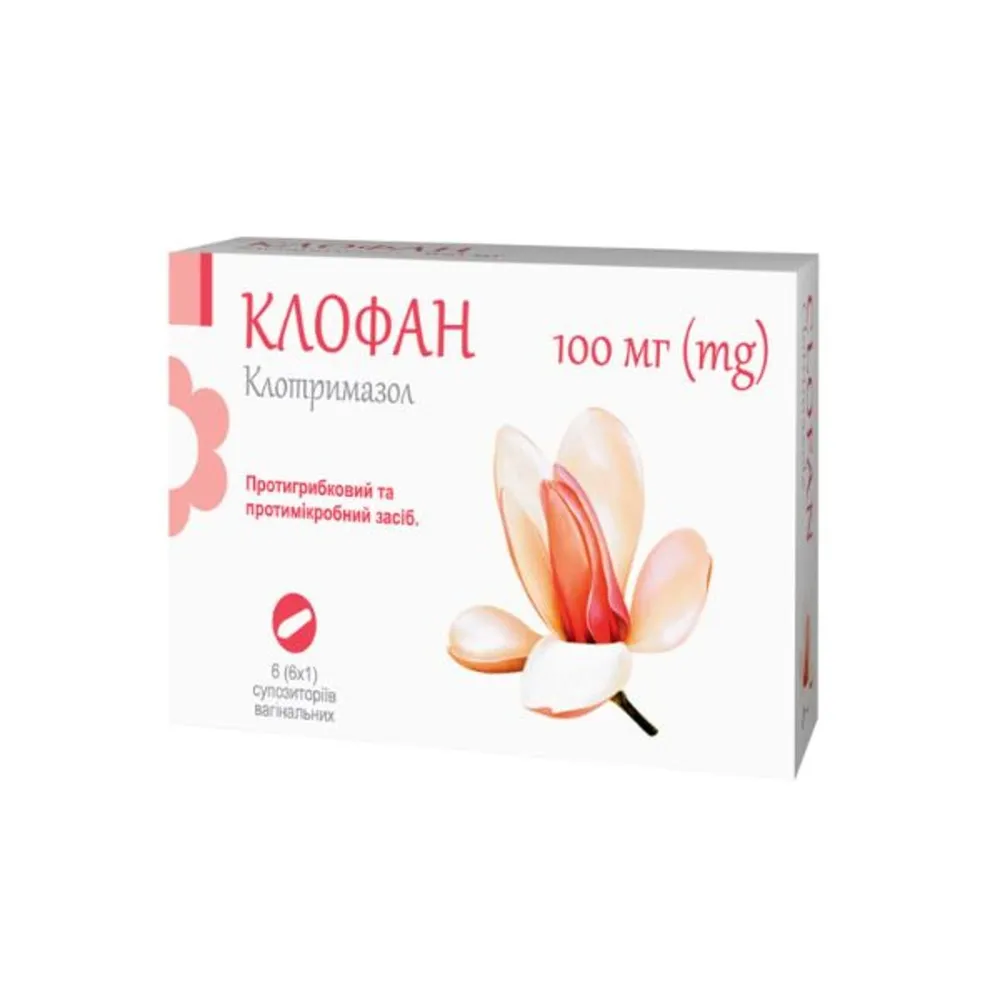
Table of Contents
INSTRUCTIONS FOR MEDICAL USE OF THE MEDICINAL PRODUCT CLOFAN (CLOFAN)
Composition:
Active substance: clotrimazole;
1 vaginal suppository contains 500 mg of clotrimazole;
Excipient: hard fat.
Dosage form. Vaginal suppositories.
Main physicochemical properties: suppositories are white to light yellow, torpedo-shaped.
Pharmacotherapeutic group. Antimicrobial and antiseptic agents used in gynecology, excluding combinations with corticosteroids. Clotrimazole.
ATC code G01AF02.
Pharmacological Properties.
Pharmacodynamics.
The antifungal mechanism of action of clotrimazole is associated with inhibition of ergosterol synthesis, leading to structural and functional damage of the cytoplasmic membrane.
Clotrimazole has a broad spectrum of antifungal activity both in vitro and in vivo, acting against dermatophytes, yeasts, molds, and dimorphic fungi.
Under appropriate testing conditions, the minimum inhibitory concentration for these fungal types is approximately less than 0.062–8.0 µg/mL of substrate.
The mechanism of action of clotrimazole involves primarily fungistatic or fungicidal activity, depending on the concentration of clotrimazole at the site of infection.
In vitro, activity is limited to proliferating fungal elements; fungal spores exhibit only minimal sensitivity.
In addition to its antifungal activity, clotrimazole also acts against gram-positive microorganisms (streptococci, staphylococci, Gardnerella vaginalis) and gram-negative microorganisms (Bacteroides).
In vitro, clotrimazole inhibits the growth of Corynebacteria and gram-positive cocci (except Enterococci) at concentrations of 0.5–10 µg/mL of substrate. Primary resistant strains of normally susceptible fungal species are rare. Development of secondary resistance during treatment in susceptible fungi is very rarely observed.
Preclinical studies conducted in volunteers using single and repeated toxic doses did not reveal any toxic, genotoxic, or reproductive effects.
Pharmacokinetics.
Pharmacokinetic studies following vaginal administration have shown that only a small amount of clotrimazole (3–10%) is absorbed. Absorbed clotrimazole is rapidly metabolized in the liver to inactive metabolites. Therefore, the peak plasma concentration of clotrimazole after a 500 mg vaginal dose was less than 10 ng/mL. This indicates that measurable systemic effects or adverse reactions following intravaginal administration of clotrimazole are unlikely.
Clinical characteristics.
Indications.
Infections of the genital area (vaginitis) caused by fungi (usually of the genus Candida) and superinfections caused by bacteria sensitive to clotrimazole.
Contraindications.
Hypersensitivity to clotrimazole or to any of the other components of the medicinal product.
Interaction with other medicinal products and other forms of interaction.
Concomitant treatment with vaginal clotrimazole and oral tacrolimus (FK-506; immunosuppressant) or sirolimus may lead to increased plasma levels of tacrolimus/sirolimus. Therefore, patients should be carefully monitored for symptoms of tacrolimus or sirolimus overdose, and, if necessary, by measuring their plasma concentrations.
Simultaneous use of vaginal suppositories with latex contraceptives (such as condoms and diaphragms) may cause damage to these devices, thus reducing their effectiveness. This effect is temporary and may occur only during treatment. Patients are advised to use alternative contraceptive methods for at least 5 days after administration of this medicinal product.
Special precautions for use.
Patients should consult a physician if they experience symptoms of candidal vaginitis for the first time.
Prior to using Clophan suppositories, patients are advised to consult a physician in any of the following cases:
- more than two episodes of candidal vaginitis within the past 6 months;
- history of sexually transmitted infections or sexual contact with a partner who has a sexually transmitted infection;
- pregnancy or suspected pregnancy;
- age under 16 or over 60 years;
- known hypersensitivity to imidazole derivatives or to any vaginal antifungal agents.
Clophan vaginal suppositories should not be used if the patient experiences any of the following symptoms, in which case medical advice should be sought:
- irregular vaginal bleeding;
- abnormal vaginal bleeding or bloody discharge;
- vulvar or vaginal ulcers, blisters, or sores;
- lower abdominal pain or dysuria;
- any adverse reactions such as redness, irritation, or swelling associated with treatment;
- high body temperature (≥38 °C) or chills;
- nausea or vomiting;
- diarrhea;
- vaginal discharge with an unpleasant odor.
Treatment should not be performed during menstruation due to the risk of the suppository being washed out by menstrual flow. Treatment should be completed before the onset of menstruation.
Do not use tampons, intravaginal douches, spermicides, or other vaginal products during the use of this medicinal product.
Sexual intercourse should be avoided during treatment with Clophan, as the infection may be transmitted to a partner.
Patients should be advised to consult a physician if symptoms persist for more than 7 days after starting treatment with Clophan suppositories. If candidal infection recurs after 7 days, the suppositories may be used again. However, if episodes of candidal infection recur more than twice within six months, patients should be advised to consult a physician.
Use during pregnancy or breastfeeding.
Pregnancy
Data on the use of clotrimazole during pregnancy are limited. Animal studies have shown reproductive toxicity of clotrimazole at high oral doses. However, due to low systemic exposure following intravaginal administration, harmful effects related to reproductive toxicity are not expected.
It is recommended to avoid using Clophan vaginal suppositories during the first trimester of pregnancy.
Breastfeeding period
There are no data on the excretion of clotrimazole into breast milk. However, systemic absorption after intravaginal administration is minimal and is unlikely to result in systemic effects. Clophan vaginal suppositories may be used during breastfeeding.
Fertility
Clinical studies on the effect of clotrimazole on fertility in women have not been conducted. However, animal studies have not shown any effect of clotrimazole on fertility.
Ability to affect reaction speed when driving or operating machinery.
The medicinal product has no effect or has a negligible effect on the ability to drive or operate machinery.
Method of Administration and Dosage.
One vaginal suppository to be used at night.
The vaginal suppository should be inserted into the vagina as deeply as possible before bedtime. For maximum comfort, insert the suppository while lying on your back with knees slightly bent.
A second course of therapy may be prescribed if necessary.
Treatment should not be carried out during menstruation. Treatment should be completed prior to the onset of menstruation.
Do not use tampons, intravaginal douches, spermicides, or other vaginal products during use of this medication.
During treatment with the medicinal product Clofan, sexual intercourse should be avoided, as the infection may be transmitted to the partner.
Children.
Do not use in children under 12 years of age. For children aged 12 years and older, use only after consultation with a physician.
Overdose.
There is no risk of acute intoxication, as overdose is unlikely following a single vaginal dose or topical application on the skin (application over large skin areas under conditions favoring enhanced absorption), or after accidental oral ingestion. There is no specific antidote.
However, in case of accidental oral ingestion and only if clinical symptoms of overdose occur (such as dizziness, nausea, or vomiting), preventive measures such as gastric lavage should be applied. Gastric lavage should be performed only if adequate airway protection is ensured.
Adverse reactions
The frequency of adverse reactions cannot be determined as they were reported during the post-marketing period. The frequency of the adverse reactions listed below is stated as "frequency unknown".
Immune system disorders
Frequency unknown: anaphylactic reaction, angioedema, hypersensitivity, allergic reactions.
Vascular disorders
Frequency unknown: syncope, arterial hypotension.
Respiratory, thoracic and mediastinal disorders
Frequency unknown: dyspnea.
Skin and subcutaneous tissue disorders
Frequency unknown: rash, urticaria, pruritus.
Reproductive system and breast disorders
Frequency unknown: vulvovaginal disorders (skin desquamation, discomfort, erythema, burning sensation, pruritus, pain), vaginal discharge, vaginal bleeding.
Gastrointestinal disorders
Frequency unknown: abdominal pain, nausea.
General disorders and administration site conditions
Frequency unknown: irritation at the application site, swelling, pain.
Reporting of suspected adverse reactions
Reporting suspected adverse reactions after authorization of the medicinal product is important. It allows ongoing monitoring of the benefit-risk balance of the medicinal product. Healthcare professionals and patients, as well as their legal representatives, should report all suspected adverse reactions and lack of efficacy via the Automated Pharmacovigilance Information System at the following link: https://aisf.dec.gov.ua.
Shelf life.
3 years.
Storage conditions.
Store in the original packaging at a temperature not exceeding 25 °C.
Keep out of the reach and sight of children.
Packaging.
1 suppository per strip. 1 strip per cardboard box.
Availability category.
Over-the-counter (without prescription).
Manufacturer.
Kusum Healthcare Pvt Ltd.
Manufacturer's address and location of operations.
SP-289 (A), RIICO Industrial area, Chopanki, Bhiwadi, Dist. Alwar (Rajasthan), India.