Clofan
Ukraine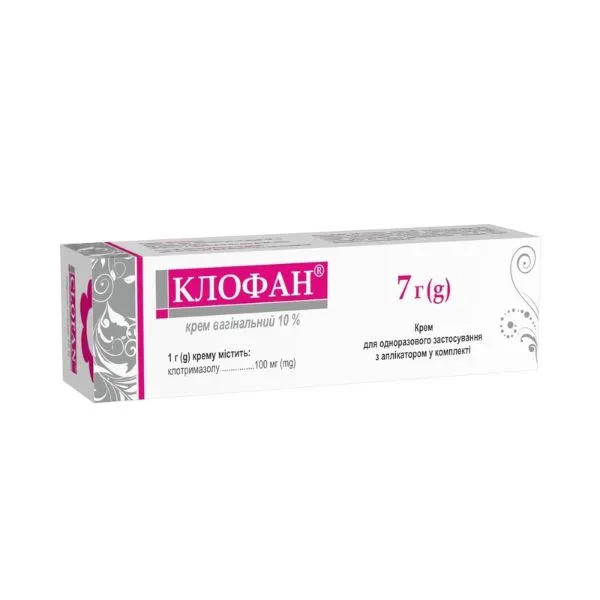
Table of Contents
INSTRUCTION FOR MEDICAL USE OF THE MEDICINAL PRODUCT CLOFAN (CLOFAN)
Composition:
Active substance: clotrimazole;
1 g of cream contains 20 mg of clotrimazole;
Excipients: cetyl palmitate, cetostearyl alcohol, sorbitan monostearate, polysorbate 60, octyldodecanol, benzyl alcohol, purified water.
Pharmaceutical form. Cream.
Main physicochemical properties: homogeneous, viscous white cream.
Pharmacotherapeutic group.
Dermatologicals. Antifungal agents for dermatological use. Topically applied antifungal agents. Imidazole and triazole derivatives. Clotrimazole. ATC code D01AC01.
Pharmacological properties.
Pharmacodynamics.
The antifungal mechanism of action of clotrimazole is associated with inhibition of ergosterol synthesis, leading to structural and functional damage of the fungal cytoplasmic membrane.
Clotrimazole has a broad spectrum of antifungal activity in vitro and in vivo, and acts against dermatophytes, yeasts, molds, and other fungal species.
Under appropriate testing conditions, minimal inhibitory concentrations for these fungal types range approximately from 0.062 to 8.0 µg/mL of substrate.
The mechanism of action of clotrimazole involves primarily fungistatic or fungicidal activity, depending on the concentration of clotrimazole at the site of infection.
In vitro, activity is limited to proliferating fungal elements; fungal spores exhibit only minimal sensitivity.
In addition to antifungal activity, clotrimazole also acts against gram-positive microorganisms (Streptococci/Staphylococci/Gardnerella vaginalis) and gram-negative microorganisms (Bacteroids).
In vitro, clotrimazole inhibits the growth of Corynebacteria and gram-positive cocci (except Enterococci) at concentrations of 0.5–10 µg/mL of substrate.
Primary resistant strains of normally sensitive fungal species are very rare; development of secondary resistance in initially sensitive fungi during treatment has been observed only in very isolated cases.
Pharmacokinetics.
When the cream is applied to intact skin or skin exhibiting signs of inflammation, clotrimazole enters the human systemic circulation in minimal amounts. Peak serum concentrations of clotrimazole were below the detection limit of 0.001 µg/mL, indicating a low likelihood of systemic effects or adverse reactions with topical use of clotrimazole.
Clinical characteristics.
Indications.
Candidal vulvitis.
Candidal vaginitis (as an adjunctive agent).
Treatment of the sexual partner to prevent reinfection.
Contraindications.
Hypersensitivity to the active substance or to any of the excipients of the medicinal product.
Interaction with other medicinal products and other forms of interaction.
When used concurrently with latex contraceptives, the cream may cause their damage and reduce effectiveness. Patients are advised to use alternative methods of contraception for at least five days after application of this medicine.
Special precautions for use.
Before using the medicinal product, it is necessary to consult a physician in the following cases:
- if this is the first episode of candidal vaginitis;
- if there have been more than two episodes of candidal vaginitis within the past 6 months;
- if there is a history of sexually transmitted infections or a partner with a significant history of sexually transmitted diseases;
- during pregnancy or suspected pregnancy;
- if the patient is under 16 or over 60 years of age;
- if there is known hypersensitivity to imidazole derivatives or to any antifungal agents.
The medicinal product must not be used, and medical advice should be sought if any of the following symptoms are present:
- irregular vaginal bleeding;
- pathological vaginal bleeding or vaginal discharge containing blood;
- ulcers or blisters on the vulva or in the vagina;
- lower abdominal pain or dysuria;
- any adverse reactions related to treatment, such as redness, irritation, or swelling;
- fever or chills;
- nausea, vomiting, or diarrhea;
- vaginal discharge with an unpleasant odor.
This medicinal product contains cetylstearyl alcohol, which may cause local skin reactions (e.g., contact dermatitis). The cream also contains benzyl alcohol, which may cause allergic reactions and mild irritation at the site of application.
Use during pregnancy or breastfeeding.
Fertility.
Clinical studies on the effect of clotrimazole on fertility in women have not been conducted; however, animal studies have not revealed any effect on fertility.
Pregnancy.
There is limited data on the use of clotrimazole in pregnant women. Animal studies have shown reproductive toxicity of clotrimazole following oral administration at high doses. Due to the low systemic exposure to clotrimazole after topical treatment, harmful effects on reproductive function are not expected. Clotrimazole may be used during pregnancy, but only under medical supervision.
Breastfeeding period.
There are no data on the excretion of clotrimazole into breast milk. However, systemic absorption is minimal following topical application and is unlikely to result in systemic effects. Klopfan cream may be used during breastfeeding. If applied locally to the nipple area, the breasts should be washed before feeding the infant.
Ability to affect reaction speed when driving or operating machinery.
Clotrimazole cream does not affect or has a negligible effect on the ability to drive or operate machinery.
Method of Administration and Dosage
The product is intended for topical use.
Apply a thin layer of cream to the affected skin of the external genital organs and adjacent areas 2–3 times daily and gently rub in.
Treatment should be continued until symptoms of infection have disappeared.
If symptoms of vaginitis do not improve within seven days of treatment, medical advice should be sought.
Treatment of the sexual partner.
To prevent re-infection, apply a thin layer of cream to the penis 2–3 times daily and gently rub in.
Treatment should be continued for 2 weeks.
Children.
There is no experience with the use of the product in children.
Overdose.
The risk of acute intoxication is negligible, as overdose is unlikely following a single excessive topical application (application over a large skin area under conditions favorable for absorption) or accidental oral ingestion.
There is no specific antidote.
However, in case of accidental oral ingestion, gastric lavage may rarely be required if a life-threatening dose of clotrimazole was ingested within the preceding hour or if clinical signs of overdose (e.g., dizziness, nausea, or vomiting) are present. Gastric lavage should only be performed if adequate airway protection is ensured.
Adverse Reactions
Since data on the adverse effects listed below are based on spontaneous reports, it is not possible to determine the exact frequency of their occurrence.
Immune system disorders: anaphylactic reaction, angioneurotic edema, hypersensitivity.
Vascular disorders: syncope, arterial hypotension.
Respiratory, thoracic and mediastinal disorders: dyspnea.
Skin and subcutaneous tissue disorders: blisters, contact dermatitis, erythema, paresthesia, skin peeling, pruritus, rash, urticaria, skin stinging / burning sensation.
General disorders and administration site conditions: irritation at the application site, reaction at the application site, swelling, pain.
Reporting of suspected adverse reactions.
Reporting suspected adverse reactions after the medicine has been authorized is important. It allows continued monitoring of the benefit-risk balance of the medicine. Healthcare professionals and patients, as well as their legal representatives, are encouraged to report any suspected adverse reactions and lack of efficacy through the Automated Pharmacovigilance Information System at the following link: https://aisf.dec.gov.ua
Shelf life. 2 years.
Storage conditions.
Store at temperatures not exceeding 25 °C in the original packaging. Do not freeze.
Keep out of reach and sight of children.
Packaging.
20 g in a tube, 1 tube in a cardboard box.
Supply category.
Over-the-counter (without prescription).
Manufacturer.
KUSUM HEALTHCARE PVT LTD.
Manufacturer's address and location of operations.
SP-289 (A), RIICO Industrial Area, Chopanki, Bhiwadi, Dist. Alwar (Rajasthan), India.