Humodar® p 100p
Ukraine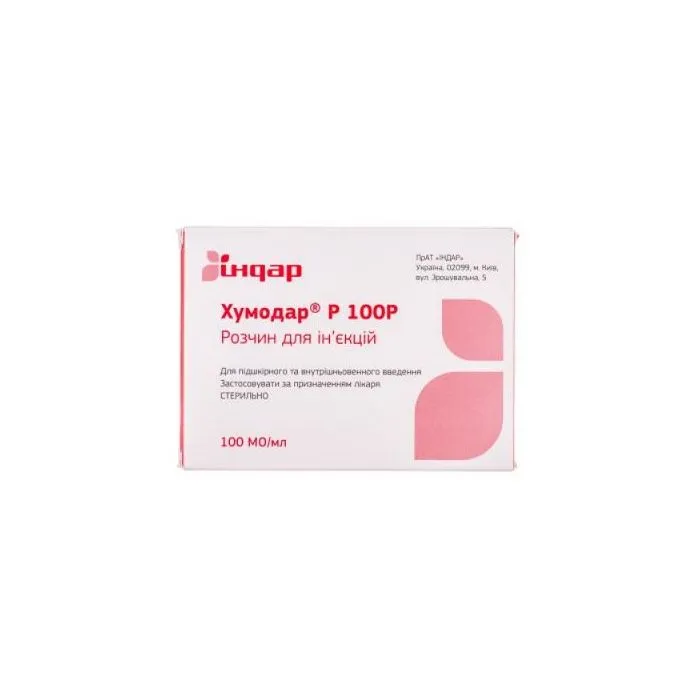
Table of Contents
INSTRUCTIONS FOR MEDICAL USE OF THE MEDICINAL PRODUCT HUMODAR® R 100R (HUMODAR R 100R)
Composition:
Active substance: recombinant human insulin;
1 ml of injection solution contains 100 IU of recombinant human insulin;
Excipients: m-cresol, hydrochloric acid concentrated, sodium hydroxide, sodium dihydrogen phosphate dihydrate, sodium chloride, glycerol, water for injections.
Pharmaceutical form. Solution for injection.
Main physicochemical characteristics: clear, colorless liquid.
Pharmacotherapeutic group.
Antidiabetic agents. Insulins and short-acting analogues.
ATC code A10AB01.
Pharmacological properties.
Pharmacodynamics.
The drug belongs to short-acting insulins. It provides rapid and significant reduction of blood glucose levels and enhances tissue glucose uptake. The active ingredient of the medicinal product is neutral insulin solution.
Pharmacokinetics.
HUMODAR® R 100R ensures rapid and significant reduction of blood sugar levels; the effect begins within 30 minutes and reaches its maximum level within 1–2 hours after subcutaneous administration of the drug. Depending on the dosage, the effect lasts for 5–7 hours.
Clinical characteristics.
Indications.
For the treatment of patients with diabetes mellitus who require insulin as a means to maintain normal blood glucose levels.
Contraindications.
Hypoglycemia, increased sensitivity to the drug HUMODAR® R 100R or to any of its excipients, except in cases where desensitization therapy is applied.
Interaction with other medicinal products and other forms of interaction.
The additional administration of any other medicinal products may enhance or reduce insulin's effect on blood glucose levels. Therefore, their use is possible only upon agreement with a physician.
Insulin requirements may increase when using medicinal products with hyperglycemic activity, such as oral contraceptives, corticosteroids, thyroid hormones and growth hormone, danazol, sympathomimetics (e.g., ritodrine, salbutamol, terbutaline), and diuretics (saluretics). Weakening of insulin action may occur during concomitant use with chlorprothixene, diazoxide, heparin, isoniazid, lithium carbonate, nicotinic acid, phenolphthalein, phenothiazine derivatives, phenytoin, as well as tricyclic antidepressants.
Insulin requirements may decrease when using medicinal products with hypoglycemic activity, such as oral hypoglycemic agents, salicylates (e.g., acetylsalicylic acid), sulfonamides, certain antidepressants (monoamine oxidase inhibitors), certain angiotensin-converting enzyme inhibitors (captopril, enalapril), angiotensin II receptor blockers, non-selective beta-blockers, or alcohol. Enhanced insulin action may occur during concomitant use with anabolic steroids, tetracyclines, clofibrate, cyclophosphamide, fenfluramine, and ethanol-containing preparations.
Somatostatin analogs (octreotide, lanreotide), clonidine, reserpine, or salicylates may either enhance or reduce insulin requirements.
Special precautions for use.
Any change in the type or brand of insulin must be made under close medical supervision. Changes in concentration, brand (manufacturer), type (rapid-acting, intermediate-acting, long-acting, etc.), species (animal-sourced insulin, human insulin, human insulin analog), and/or method of production (recombinant DNA insulin or animal-sourced insulin) may require adjustment of dosage.
The dosage required when using human insulin may differ from that required when using animal-sourced insulin. Dosage adjustments may be needed from the first dose or during the first few weeks or months of treatment.
In some patients who experienced hypoglycemic reactions after switching from animal-sourced insulin to human insulin, early warning symptoms of hypoglycemia were reported to be less pronounced or different compared to those previously observed during treatment with animal insulin. Patients who achieve significantly improved blood glucose levels (e.g., due to intensified insulin therapy) may subsequently experience fewer or no early warning symptoms of hypoglycemia, and they should be informed accordingly. Conditions in which early warning symptoms of hypoglycemia may be less specific or less pronounced include long-standing diabetes, diabetic neuropathy, or concomitant use of medications such as beta-adrenergic blockers.
Untreated hypoglycemic or hyperglycemic reactions may lead to loss of consciousness, coma, and may be fatal.
Use of incorrect doses or abrupt discontinuation of treatment, particularly in insulin-dependent diabetes, may lead to hyperglycemia and ketoacidosis—conditions that are potentially fatal.
Antibodies may be produced during treatment with human insulin, although generally in lower concentrations than with purified animal-sourced insulin.
Insulin requirements may change significantly in the presence of adrenal, pituitary, or thyroid gland disorders, or in the presence of renal or hepatic impairment.
Insulin requirements may also increase during illness or emotional stress. Dosage adjustments may be necessary when there are changes in the level of physical activity or usual dietary patterns.
Patients should be advised to rotate injection sites regularly to reduce the risk of lipodystrophy and cutaneous amyloidosis. There is a potential risk of delayed insulin absorption and impaired glycemic control following insulin injections into affected areas. It has been reported that changing the injection site to an unaffected area of skin may result in hypoglycemia. It is recommended to monitor blood glucose levels after changing the injection site, and dosage adjustment of antidiabetic agents may need to be considered.
Combination with pioglitazone
Cases of heart failure have been reported with concomitant use of pioglitazone and insulin, particularly in patients with risk factors for heart failure. This information should be considered when prescribing the combination of insulin with pioglitazone. When using this combination, patients should be monitored for symptoms of heart failure, weight gain, and edema. Treatment with pioglitazone should be discontinued if cardiac symptoms worsen.
Avoid direct contact of the cartridge or vial with the freezer compartment or cold packs.
A used cartridge or vial of insulin may be stored at room temperature (not above 30°C) for up to 4 weeks, provided it is protected from direct heat and light.
This medicinal product contains less than 1 mmol (23 mg)/dose of sodium, i.e., essentially sodium-free.
Use during pregnancy or breastfeeding.
Insulin does not cross the placental barrier, so there are no restrictions on insulin treatment during pregnancy.
Patients with insulin-dependent diabetes mellitus or gestational diabetes receiving insulin therapy require careful monitoring throughout pregnancy. Insulin requirements usually decrease during the first trimester and then increase during the second and third trimesters. Patients with diabetes should inform their physician if they become pregnant or plan to become pregnant.
During pregnancy, patients with diabetes require careful monitoring of blood glucose levels and overall health status.
Immediately after delivery, insulin requirements decrease sharply, increasing the risk of hypoglycemia. However, insulin requirements quickly return to pre-delivery levels.
Breastfeeding patients with diabetes may require adjustments in insulin dosage and/or dietary regimen.
Ability to influence the speed of reaction when driving or operating machinery.
The ability of patients using insulin to concentrate and react may be impaired as a result of hypoglycemia. This may constitute a risk factor, including when driving a vehicle or operating machinery.
Patients should be informed about the specific preventive measures necessary to avoid hypoglycemia while driving. This is particularly important for patients who have diminished or absent awareness of hypoglycemic warning symptoms or who frequently experience episodes of hypoglycemia. In such circumstances, the appropriateness of driving should be evaluated.
Method of Administration and Dosage
The dosage, administration schedule, and number of injections are determined by the physician based on individual patient needs and specific clinical circumstances. HUMODAR® R 100R is administered by subcutaneous injection, but may also be given by intramuscular injection, although this route is not recommended. HUMODAR® R 100R can be administered intravenously. Subcutaneous injections should be administered into the shoulder, thigh, buttocks, or abdomen. Injection sites should be rotated to avoid repeated injections at the same site more frequently than once per month, in order to reduce the risk of lipodystrophy and cutaneous amyloidosis (see sections "Special Warnings" and "Adverse Reactions"). When administering HUMODAR® R 100R, care should be taken to avoid injecting into a blood vessel. After injection, the injection site should not be massaged. Patients should be thoroughly instructed in proper injection technique. HUMODAR® R 100R may be used in combination with the medicinal product HUMODAR® B 100R. Insulin requirements may change significantly in renal or hepatic insufficiency.
Cartridges. Before using the pen device, hands should be washed and the rubber membrane of the cartridge disinfected. The cartridge is intended for use only in pen devices. When inserting the cartridge into the pen, follow the manufacturer's instructions for the pen device. If air bubbles are present in the cartridge, hold the pen with the needle pointing upward and tap the side of the cartridge gently to allow bubbles to rise to the surface. While keeping the pen in an upright position, expel 2 units of insulin through the needle. Repeat this procedure until all air is expelled and a drop of insulin appears at the needle tip. The presence of very small air bubbles is acceptable; however, a large number of bubbles may affect the accuracy of insulin dosing. Before injection, the skin at the injection site should be thoroughly cleaned. The needle should be inserted to the appropriate depth into the subcutaneous tissue, ensuring that a vein is not punctured. The injection site should not be massaged. Immediately after injection, the needle should be removed from the pen. This ensures sterility and prevents insulin leakage. Before each injection, ensure that a drop of insulin appears at the needle tip. If the insulin in the cartridge is nearly depleted and the leading edge of the plunger is at or beyond the colored line, do not use the cartridge.
Before each injection, always check the cartridge label to confirm that the insulin name and type correspond to the one prescribed by your physician.
Vials. Before the first withdrawal of insulin from the vial, remove the plastic cap indicating that the vial has not been used. For the selected dose, draw air into the syringe equal to the volume of insulin to be withdrawn and inject it into the insulin vial (not into the liquid). Invert the insulin vial together with the syringe and withdraw the required amount of insulin solution. Remove any air bubbles from the syringe. Disinfect the injection site, pinch the skin to form a fold, and insert the needle subcutaneously. Then slowly inject the insulin. After injection, carefully withdraw the needle from the skin, press the injection site with a cotton swab, and hold for several seconds. The solution should always remain clear and colorless. Switching from other insulin preparations should only be done under medical supervision. Patients must strictly follow the physician's instructions (daily insulin dosage, diet, and physical activity).
Children.
Dosage, administration schedule, and number of injections for children are determined by the physician based on individual needs in each specific case.
Overdose.
Insulin overdose may result from: absolute insulin overdose, switching insulin preparations, missed meals, vomiting, diarrhea, physical exertion, illnesses that reduce insulin requirements (kidney or liver disease, adrenal, pituitary or thyroid gland hypofunction), change in injection site (e.g., abdominal skin, forearm, thighs), or drug interactions that cause a sharp drop in blood glucose levels.
Symptoms of hypoglycemia include lethargy, confusion, tachycardia, headache, sweating, and vomiting.
Mild hypoglycemia is usually managed by oral administration of glucose or sugar-containing products. Patients should always carry at least 20 g of glucose (dextrose). If blood glucose cannot be promptly corrected, emergency medical assistance must be sought immediately. This is particularly dangerous for patients with cerebrovascular disorders or those with severe coronary heart disease in addition to diabetes. Moderate to severe hypoglycemia may be treated by intramuscular or subcutaneous administration of glucagon, followed by oral carbohydrate intake once the patient is stabilized. If there is no response to glucagon, intravenous glucose solution must be administered. In comatose patients, glucagon should be given intramuscularly or subcutaneously. In the absence of glucagon or if there is no response to glucagon, intravenous glucose solution must be administered. The patient should be fed as soon as consciousness is regained.
Continued carbohydrate intake and medical monitoring may be necessary, as hypoglycemia may recur after apparent clinical recovery.
Adverse Reactions.
Disorders of metabolism and nutrition.
In case of administration of too high a dose of insulin, missed meals, excessive physical exertion, or alcohol consumption, a hypoglycemic reaction may develop. Hypoglycemia is characterized by blood glucose levels below 50 mg/dL.
Severe hypoglycemia may lead to loss of consciousness and, in individual cases, to fatal outcomes. Hypoglycemia is the most common adverse effect of insulin therapy in patients with diabetes mellitus. The exact frequency of hypoglycemic episodes cannot be established, as it results from the combined influence of insulin dosage and other factors.
Very rarely, during the first weeks of insulin therapy, leg edema (so-called insulin edema) may occur, associated with fluid retention in the body. These edema usually resolve spontaneously.
Immune system disorders.
Local allergic reactions may occur frequently (frequency from 1/100 to < 1/10), including injection site reactions: skin redness, swelling, and itching. These reactions usually resolve within several days to several weeks. Sometimes, such conditions are not related to insulin itself but to other factors, such as irritant substances in skin-cleansing agents or inadequate injection technique.
Systemic allergic reactions are very rare (< 1/10,000) but potentially serious and represent a generalized allergic reaction to insulin.
Symptoms may include generalized skin rash, erosive mucosal lesions, nausea, chills, dyspnea, wheezing, hypotension, tachycardia, increased sweating, anaphylactic shock, and angioneurotic edema. Severe cases of generalized allergy can be life-threatening. In exceptional cases of severe allergy to HUMODAR® R 100R, immediate appropriate measures should be taken. Insulin substitution or desensitization therapy may be required. Insulin resistance may occur.
Skin and subcutaneous tissue disorders.
Cutaneous amyloidosis (frequency unknown) may develop at the injection site and delay local absorption of insulin. Regular rotation of injection sites within a specific injection area may help reduce or prevent these reactions (see section "Special instructions"). Atrophy or hypertrophy of subcutaneous fat tissue (lipodystrophy) may occur at the injection site. Lipodystrophy at the injection site occurs infrequently (frequency from 1/1000 to < 1/100). Transient edema. Continuous rotation of injection sites can help reduce or completely avoid these phenomena during further treatment. Cases of edema development during insulin therapy have been reported, particularly when previous poor metabolic control is improved by intensive insulin therapy.
Nervous system disorders.
Reversible peripheral neuropathy.
Shelf life.
2 years.
Storage conditions.
Keep out of reach of children.
Store at 2 °C to 8 °C. Do not freeze.
Do not use the medicinal product after the expiry date stated on the packaging.
Incompatibility.
HUMODAR® R 100R must not be mixed with other medicinal products.
Packaging.
Injection solution, 100 IU/mL, 3 mL in cartridges No. 3, No. 5 or 5 mL in vials No. 1, No. 5, 10 mL in vials No. 1.
Prescription category.
By prescription only.
Manufacturer.
JSC "Plant for Insulin Production "INDAR".
Manufacturer's address and location of business activity.
5 Zroshuvana St., Kyiv, 02099, Ukraine.