Humalog® mix 25
Ukraine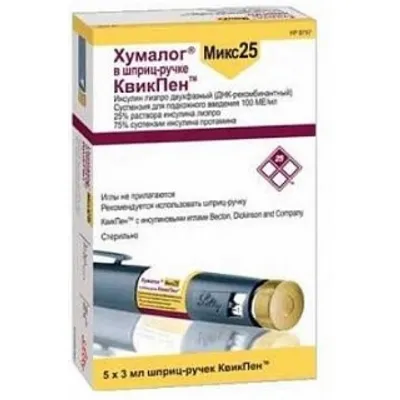
Table of Contents
INSTRUCTIONS FOR MEDICAL USE OF THE MEDICINAL PRODUCT HUMALOGâ MIX 25 (HUMALOGâ MIX 25)
Composition:
Active substance: insulin lispro;
1 ml of suspension contains 100 IU of insulin lispro (25% – insulin lispro and 75% – insulin lispro protamine suspension);
Excipients: glycerol; sodium hydrogen phosphate dihydrate; metacresol; zinc oxide; phenol; protamine sulfate; water for injections; hydrochloric acid 10%; sodium hydroxide 10%.
Pharmaceutical form. Suspension for subcutaneous injection.
Main physicochemical properties: white-colored suspension.
Pharmacotherapeutic group. Antidiabetic agents. Combinations of short- and intermediate-acting insulins. ATC code A10AD04.
Pharmacological properties.
Pharmacodynamics.
Humalog® Mix 25 – a DNA recombinant human insulin analogue – is a mixture consisting of 25% insulin lispro (a rapid-acting human insulin analogue) and 75% insulin lispro protamine suspension (an intermediate-acting human insulin analogue).
The primary action of insulin lispro is regulation of glucose metabolism.
In addition, all insulins exert anabolic and anticatabolic effects on various body tissues. In muscle and other tissues (except the brain), insulin increases glycogen, fatty acids, and glycerol levels, enhances protein synthesis and amino acid uptake. At the same time, in the liver, insulin suppresses glycogenolysis, gluconeogenesis, ketogenesis, lipolysis, protein catabolism, and amino acid production.
Insulin lispro has been shown to be equivalent to human insulin.
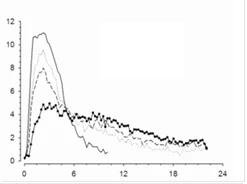
Insulin lispro acts rapidly, reaches its peak effect earlier than regular human insulin, and has a shorter duration of glucose-lowering action compared to regular human insulin following subcutaneous administration. The earlier onset of action of insulin lispro, approximately 15 minutes after injection, is directly related to its more rapid absorption. This allows insulin lispro to be administered closer to mealtime (0–15 minutes before meals) compared to soluble insulin (30–45 minutes before meals).
The activity profile of Humalog basal is similar to that of basal insulin (NPH) over a time period of approximately 15 hours.
| Glucose infusion rate (mg/min/kg) |
|
|
|
|
|
|
|
|
Injection button |
||
| Needle outer cap |
Needle inner cap |
Needle |
Pen cap |
Rubber disc |
Plunger |
Pen body |
Dosing window |
||||


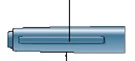
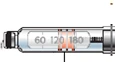
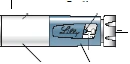
Description of the KwikPen pre-filled pen with Humalog® Mix 25 medication
Color of the pen body – blue
Color of the injection button – yellow
Color of the label – white label with a yellow stripe
The KwikPen pen device is recommended for use only with needles from Becton, Dickinson and Company (BD).
Preparing the KwikPen pen
- Wash your hands with soap.
- Read the label on the pen to make sure you are using the correct type of insulin. This is especially important if you use more than one type of insulin.
- Do not use the pen after the expiry date indicated on the label. Do not use the pen for more than 28 days, even if there is still insulin remaining in it.
- Always use a new needle for each injection to prevent infection and needle blockage.
| Step 1:
|
|
| Step 2:
Mixing is important to ensure you receive the correct dose. The insulin should appear uniformly mixed. |
|
| Step 3:
|
|
| Step 4:
|
|
| Step 5:
|
|
| Step 6:
|
|
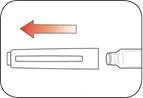
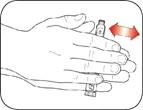
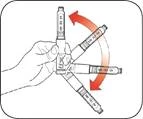
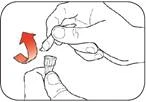
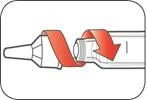
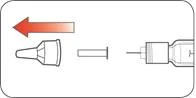
Checking the KwikPen insulin pen for insulin flow.
The insulin flow check for the KwikPen insulin pen must be performed before each injection.
- Checking the KwikPen insulin pen for insulin flow is necessary to remove any air that may accumulate in the needle or insulin cartridge during normal use, and to ensure that the pen is working properly.
- If you do not perform the insulin flow check before each injection, you may receive either too low or too high a dose of insulin.
| Step 7:
|
|
| Step 8:
|
|
| Step 9:
The presence of small air bubbles is normal and will not affect the insulin dose. |
|
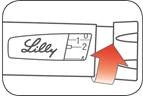
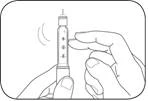
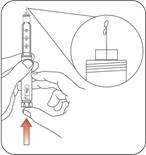
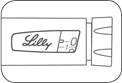
Dose Setting
- You can set doses from 1 to 60 units of insulin per single injection.
- If you need to inject a dose exceeding 60 units, you should perform 2 or more injections.
- If you need help deciding how exactly to divide your dose, consult your doctor.
- For each separate injection, use a new needle and repeat the pen check to ensure insulin flow.
| Step 10:
|
(Example: the dose window shows 12 units)
(Example: the dose window shows 25 units) |
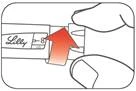
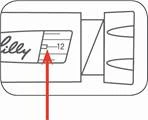
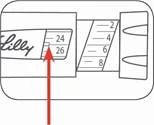
- The pen will not allow you to set a dose that exceeds the number of units remaining in the pen.
- If you need to inject a dose that exceeds the number of units remaining in the pen, you may inject the remaining units and then complete your dose using a new pen, or you may administer the full dose using a new pen.
- It is normal if a small amount of insulin remains in the pen that you are unable to inject.
Administering the dose
- Use the injection technique recommended by your doctor.
- Always rotate your injection sites.
- Never attempt to change the dose while injecting insulin.
| Step 11:
|
|
|
| Step 12:
|
|
|
|
|
|
| Do not attempt to administer insulin by turning back the injection button. You will not receive the required insulin dose this way. If the injection button is difficult to press:
|
||
| Step 13:
After each injection, the plunger moves slightly and you may not notice its movement. If you see blood after removing the needle from the skin, gently press a piece of gauze or swab against the injection site. Do not rub the injection site. |
|
|
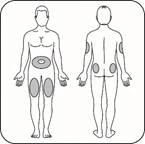
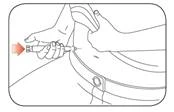

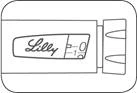
After injection.
| Step 14:
|
|
| Step 15:
|
|
| Step 16:
|
|
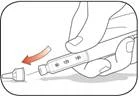
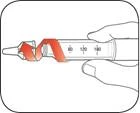
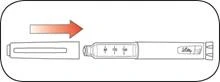
Storage of the pen injector
- Keep the pen injector and needles out of the reach of children.
- Do not store the pen injector with a needle attached.
- DO NOT USE the pen injector if any of its parts are damaged or broken.
- Always keep a spare pen injector available in case your pen injector is lost or damaged.
Children
The use of the medicinal product in children under 12 years of age is possible if advantages of its use compared to soluble human insulin are expected.
Overdose
Insulin medicinal products have no defined overdose limits, since blood glucose concentration results from a complex interaction between insulin levels, glucose input, and other metabolic processes. Hypoglycaemia may occur as a result of excessive insulin activity relative to food intake and energy expenditure. Hypoglycaemia is accompanied by symptoms including drowsiness, confusion, tachycardia, headache, sweating, and vomiting.
Mild hypoglycaemia can usually be managed by oral administration of glucose or sugar-containing products. Moderate to severe hypoglycaemia may be treated by intramuscular or subcutaneous administration of glucagon, followed by oral carbohydrates once the patient is stabilized. For patients who do not respond to glucagon, intravenous glucose administration is required. If the patient is comatose, glucagon should be administered intramuscularly or subcutaneously. In the absence of glucagon or if there is no response to glucagon administration, intravenous glucose must be given. The patient should be fed as soon as he or she regains consciousness.
Continued carbohydrate intake and medical monitoring may be necessary, since recurrence of hypoglycaemia may occur after apparent clinical improvement.
Adverse reactions.
Summary of safety profile
Hypoglycemia is the most common adverse effect of insulin therapy occurring in patients with diabetes mellitus. Severe hypoglycemia may lead to loss of consciousness and, in exceptional cases, to fatal outcome. The exact frequency of hypoglycemic episodes cannot be established, as it results from the influence of both insulin dose and other factors, such as patient's diet composition and physical activity.
Tabulated list of adverse reactions.
The adverse reactions listed below were observed during clinical trials. They are presented in the table below according to the Medical Dictionary for Regulatory Activities (MedDRA) system organ class and frequency (very common ≥ 1/10; common ≥ 1/100 to < 1/10; uncommon ≥ 1/1000 to < 1/100; rare ≥ 1/10000 to < 1/1000; frequency not known (cannot be estimated from available data).
Within each group, adverse reactions are listed in order of decreasing frequency.
| System organ classes according to MedDRA |
Very common |
Common |
Uncommon |
Rare |
Very rare |
Frequency not known |
| Immune system disorders |
||||||
| Local allergic reaction |
X |
|||||
| Systemic allergic reaction |
X |
|||||
| Skin and subcutaneous tissue disorders |
||||||
| Lipodystrophy |
X |
|||||
| Localized cutaneous amyloidosis |
X |
|||||
Description of individual adverse reactions
Local allergic reaction.
Local allergic reactions may commonly occur. At the injection site, erythema, swelling, or pruritus may be observed. This condition usually resolves within a few days or weeks. In some cases, this condition is not related to insulin, but rather to other factors, such as irritant substances in the skin-cleansing agent or inadequate injection technique.
Systemic allergic reaction.
Systemic allergic reaction occurs less frequently, but is potentially a more serious adverse effect and represents a generalized form of allergy to insulin. It may manifest as generalized rash, dyspnea, respiratory distress, hypotension, tachycardia, or increased sweating. Severe cases of systemic allergic reactions may be life-threatening.
Skin and subcutaneous tissue disorders.
Lipodystrophy and cutaneous amyloidosis may occur at the injection site, which may delay local absorption of insulin. Regular rotation of injection sites within a specific injection area may help reduce or prevent these reactions (see section "Special instructions").
Edema.
Cases of edema have been reported during insulin therapy, particularly when poor prior metabolic control is intensively corrected with insulin.
Shelf life.
3 years.
Duration of use after first opening: 28 days.
Storage conditions. Store at 2–8 °C; do not freeze. During use, the medicinal product should be stored at a temperature not exceeding 30 °C for no more than 28 days, protected from excessive heat and direct sunlight. During use, the cartridge or pre-filled pen must not be kept in the refrigerator. A pre-filled pen must not be stored with an attached needle. Keep out of reach of children.
Incompatibility.
Humalog® Mix 25 must not be mixed with any other medicinal products.
Packaging. 3 ml of injectable suspension in a glass cartridge sealed with a rubber stopper and aluminum seal. 5 cartridges per cardboard box.
3 ml glass cartridges in pre-filled pens (KwikPen), 5 pre-filled pens per cardboard box.
Prescription category. Prescription only.
Manufacturer:
Lilly France
Lilly France
Manufacturer's address and location of manufacturing site.
Zone Industrielle, 2 rue du Colonel Lilly, 67640 Fegersheim, France