Choriomon
Ukraine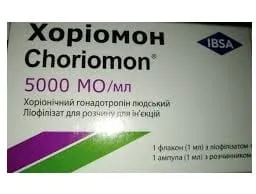
Table of Contents
INSTRUCTIONS FOR MEDICAL USE OF THE MEDICINAL PRODUCT CHORIOMON (CHORIOMON)
Composition:
Active substance: Human Chorionic Gonadotropin (hCG);
1 vial contains 5000 IU of human chorionic gonadotropin (hCG);
Excipient: lactose monohydrate;
Solvent: sodium chloride, water for injections.
Pharmaceutical form. Powder and solvent for solution for injection.
Main physicochemical properties: lyophilisate supplied with solvent. White lyophilisate or mass that may clump. Solvent (0.9% sodium chloride) – clear, colorless, odorless solution. Upon reconstitution, a clear, colorless solution free from visible foreign particles is formed.
Pharmacotherapeutic group. Gonadotropins and other ovulation stimulants. Gonadotropic hormones. ATC code G03G A01.
Pharmacological properties.
Pharmacodynamics.
Human chorionic gonadotropin (hCG), the active ingredient of the Choriomon preparation, is produced in the placenta. hCG is obtained from the urine of pregnant women. Its biological activity is largely similar to that of luteinizing hormone (LH) produced by the anterior pituitary gland, but it has a significantly longer half-life, i.e., possesses more prolonged activity.
In women, Choriomon stimulates the production of estradiol and progesterone. It is active in the final phase of follicular maturation, promotes follicular rupture and estrogen secretion, thereby improving corpus luteum function.
Pharmacokinetics.
The pharmacokinetics of Choriomon after subcutaneous administration show high variability. According to data collected during Choriomon studies, after a single subcutaneous injection of 10,000 IU, the maximum serum concentration of hCG is reached approximately 16 hours after administration. Peak concentrations of hCG (Cmax) were 338 ± 100 IU/L, with an AUC0-t of 22,989 ± 4,802 IU × h/L. After reaching Cmax, the serum level of hCG declines with a half-life of approximately 37 hours. hCG is primarily eliminated via the kidneys.
Pharmacokinetic studies in patients with hepatic or renal impairment have not been conducted.
Clinical characteristics.
Indications.
For stimulation of ovulation and induction of luteinization following follicular growth stimulation in women with anovulation and oligoovulation.
Within assisted reproductive technology (ART) programs, particularly in vitro fertilization: to trigger final maturation of follicles and luteinization after stimulation of follicular growth.
Contraindications.
Hypersensitivity to human chorionic gonadotropin or to any of the excipients.
Presence of uncontrolled non-gonadal endocrinopathies (e.g., disorders of the thyroid gland, adrenal glands, or pituitary gland).
Tumors of the breast, uterus, or ovaries.
Abnormal (non-menstrual) vaginal bleeding of unknown/diagnosed cause.
Congenital abnormalities of reproductive organs incompatible with pregnancy.
Uterine fibroids incompatible with pregnancy.
Hypothalamic or pituitary tumors.
Enlargement of ovaries or ovarian cysts not caused by polycystic ovary syndrome.
Ectopic pregnancy within the previous 3 months.
Active forms of thromboembolic disorders.
Primary ovarian insufficiency.
Onset of menopause.
Interaction with other medicinal products and other forms of interaction.
Due to the lack of compatibility studies, this medicinal product must not be mixed with other medicinal products. This particularly applies to drugs that stimulate ovulation (e.g., hCG) or contain cortisone, especially in high doses.
No specific interaction studies with Chorimon have been conducted, and no clinically significant interactions with medicinal products have been reported. hCG may interfere with radioimmunoassay of gonadotropins due to cross-reactivity, particularly with luteinizing hormone (LH). Physicians should inform the laboratory about patients receiving hCG when gonadotropin levels are being measured.
Special precautions for use.
Traceability
To improve the traceability of biological medicinal products, the name and batch number of the administered product should be clearly documented.
Chorimon must not be used for weight reduction. hCG does not influence fat metabolism, fat distribution or appetite.
For up to ten days following administration, Chorimon may affect immunological determination of hCG levels in serum or urine, potentially leading to a false-positive pregnancy test.
Hypersensitivity reactions
Hypersensitivity reactions, both generalized and local, are possible; anaphylaxis; cases of Quincke's edema have been reported. If a hypersensitivity reaction is suspected, Chorimon should be discontinued and other potential causes of the reaction should be evaluated.
Ectopic pregnancy
Infertility in women undergoing assisted reproductive technologies (ART) increases the frequency of ectopic pregnancy. Therefore, early confirmation by ultrasound that the pregnancy is intrauterine is essential. Prior to treatment for inadequate endogenous gonadal stimulation, patients should be evaluated to exclude anatomical abnormalities of the genital organs or nongonadal endocrinopathies (e.g., thyroid or adrenal disorders, diabetes). Primary ovarian insufficiency should be excluded by measuring gonadotropin levels.
Multiple pregnancy, delivery and abortion
Pregnancy following ovulation induction with gonadotropins is associated with an increased risk of pregnancy loss and multiple pregnancy. In cases of multiple pregnancy, particularly of high order, the risk of adverse outcomes during the perinatal period for the woman is increased. Parents should be informed about the potential risks of multiple pregnancy before starting treatment.
Congenital malformations
The incidence of congenital malformations following assisted reproductive technologies (ART) may be higher than after spontaneous conception. This is considered to be related to factors contributing to infertility (e.g., maternal age, sperm characteristics).
Vascular complications
Thromboembolic events, both in association with ovarian hyperstimulation syndrome (OHSS) and independently, have been reported following treatment with gonadotropins, including Chorimon. Intravascular thrombosis, which may occur in venous or arterial vessels, can lead to reduced blood flow to vital organs or limbs. Women with recognized risk factors for thrombosis, such as personal or family history, severe obesity, or thrombophilia, may have an increased risk of developing venous or arterial thromboembolic events during or after treatment with gonadotropins. In such women, the benefits of ART should be weighed against the risks. However, it should be noted that spontaneous pregnancy itself is also associated with an increased risk of thrombosis.
Benign and malignant neoplasms
Both benign and malignant tumors of the ovaries and other reproductive organs have been reported in women who have received various infertility treatment regimens. It has not yet been established whether gonadotropin therapy increases the baseline risk of these tumors in infertile women.
Ovarian hyperstimulation syndrome (OHSS)
OHSS is a medical condition distinct from uncomplicated ovarian enlargement. Clinical signs and symptoms of mild to moderate OHSS include abdominal pain, nausea, diarrhea, mild to moderate ovarian enlargement and ovarian cysts. Severe OHSS may be life-threatening. Clinical signs and symptoms of severe OHSS include large ovarian cysts, acute abdominal pain, ascites, pleural effusion, hydrothorax, dyspnea, oliguria, hematological abnormalities and weight gain. In rare cases, venous or arterial thromboembolism may occur in association with OHSS. Transient abnormalities in liver function tests indicating impaired liver function, with or without morphological changes on liver biopsy, have also been reported in association with OHSS.
OHSS may be triggered by administration of human chorionic gonadotropin (hCG) and pregnancy (endogenous hCG). Early OHSS usually occurs within 10 days after hCG administration and may be related to an excessive ovarian response to gonadotropin stimulation. Late OHSS occurs more than 10 days after hCG administration as a consequence of hormonal changes during pregnancy. Due to the risk of OHSS, patients should be monitored for at least two weeks following hCG administration.
Women with known risk factors for high ovarian response may be particularly susceptible to developing OHSS during or after treatment with Chorimon. During the first cycle of ovarian stimulation, when risk factors are only partially known, careful monitoring for early signs and symptoms of OHSS is recommended.
To reduce the risk of OHSS, ultrasound assessment of follicular development should be performed before and at regular intervals during treatment. Concomitant measurement of serum estradiol levels may also be useful. In ART, the risk of OHSS is increased when 18 or more follicles of diameter ≥11 mm are present. When 30 or more follicles are present, administration of hCG is not recommended.
Ovarian torsion
Ovarian torsion has been reported after treatment with gonadotropins, including Chorimon. Ovarian torsion may be associated with other conditions such as OHSS, pregnancy, previous abdominal surgery, history of ovarian torsion, and prior or current ovarian cysts. Early diagnosis and immediate detorsion can prevent ovarian damage due to compromised blood supply.
This medicinal product contains less than 1 mmol (23 mg) of sodium per dose, i.e., essentially "sodium-free".
Use during pregnancy or breastfeeding.
Chorimon is not indicated during pregnancy.
There are no clinical data on pregnancies exposed to the drug. The potential risk to the pregnant woman is unknown.
Chorimon is not indicated during breastfeeding. There are no data on the excretion of human chorionic gonadotropin in breast milk.
Fertility
Chorimon is indicated for the treatment of infertility (see section "Indications").
Ability to affect reaction speed when driving or operating machinery.
Chorimon does not affect the ability to drive or operate machinery.
Method of Administration and Dosage
Treatment should only be initiated by a physician experienced in infertility management.
For women with anovulation or oligoovulation, 5000 IU (one vial) or 10000 IU (two vials) of Chorimon shall be administered 24–48 hours after optimal follicular growth stimulation has been achieved. On the day of chorionic gonadotropin injection and the following day, patients are advised to have sexual intercourse.
Within assisted reproductive technology programs, such as in vitro fertilization (IVF), 5000 IU (one vial) or 10000 IU (two vials) of Chorimon shall be administered 24–48 hours after the last dose of follicle-stimulating hormone (FSH) or human menopausal gonadotropin (hMG), i.e., when optimal follicular growth stimulation has been achieved.
Chorimon can be administered both intramuscularly and subcutaneously. After dissolving the powder with the solvent, the reconstituted solution should be used immediately. Any unused solution must be discarded.
Children
Not applicable.
Overdose
Acute toxicity of Chorimon is unlikely. No signs of acute overdose have been reported. However, it is possible that very high doses of hCG may induce ovarian hyperstimulation syndrome (OHSS) in women (see "Special Warnings and Precautions for Use").
In case of overdose, women should be examined by a physician for symptoms indicative of OHSS (see "Special Warnings and Precautions for Use"). Women with mild or moderate OHSS may require monitoring of fluid intake and output. Paracentesis for analysis of ascitic fluid may be necessary. Women with severe OHSS should also have fluid intake and output monitored, and thromboprophylaxis with low molecular weight heparin should be considered. Hematocrit is an important indicator of the degree of intravascular volume depletion. Vital signs must be monitored, and hospitalization should be considered for women who are unable to achieve adequate pain control or maintain sufficient fluid intake due to nausea, or who have critical OHSS.
Side effects.
Chorimon may cause reactions at the injection site, which are usually mild and temporary. The most serious adverse reaction is ovarian hyperstimulation syndrome (OHSS), which in most cases can be successfully treated if diagnosed promptly and treatment is initiated in a timely manner.
| Immune system disorders |
|
| Common |
local hypersensitivity reactions |
| Uncommon |
generalized rash or fever, systemic hypersensitivity reaction, anaphylactic reaction |
| Gastrointestinal disorders |
|
| Common |
abdominal pain, nausea, vomiting and diarrhea |
| Uncommon |
ascites |
| General disorders and administration site conditions |
|
| Common |
bruising, pain, redness, swelling and itching at injection site |
| Uncommon |
fatigue |
| Nervous system disorders |
|
| Common |
headache |
| Psychiatric disorders |
|
| Common |
mood changes |
| Uncommon |
restlessness |
| Reproductive system and breast disorders |
|
| Common |
ovarian hyperstimulation syndrome of mild or moderate severity, breast tenderness, ovarian cysts |
| Uncommon |
severe ovarian hyperstimulation syndrome |
| Rare |
ovarian cyst rupture |
| Skin and subcutaneous tissue disorders |
|
| Rare |
angioneurotic edema |
| Respiratory, thoracic and mediastinal disorders |
|
| Uncommon |
pleural effusion associated with severe ovarian hyperstimulation syndrome |
| Investigations |
|
| Uncommon |
weight gain associated with severe ovarian hyperstimulation syndrome |
| Vascular disorders |
|
| Rare |
thromboembolism associated with ovarian hyperstimulation syndrome |
Shelf life. 3 years. After reconstitution, the preparation should be used immediately.
Storage conditions.
Store at a temperature not exceeding 25 °C in the original packaging to protect from light. Keep out of reach of children.
Incompatibility.
Due to lack of compatibility studies, Chorimon should not be mixed with other medicinal products. This is particularly important for drugs that stimulate ovulation (e.g., hCG) or contain cortisone, especially at high doses.
Packaging.
1 glass vial with powder, together with 1 ampoule containing 1 ml of solvent (sodium chloride 0.9%) in a cardboard box.
Prescription status.
Prescription only.
Manufacturer.
IBSA Institut Biochimique SA, Switzerland.
Address of the manufacturer and site of activity.
Via Piano Scoppiolo 49, 6912 Pazzallo, Switzerland