Hepiderm plus
Ukraine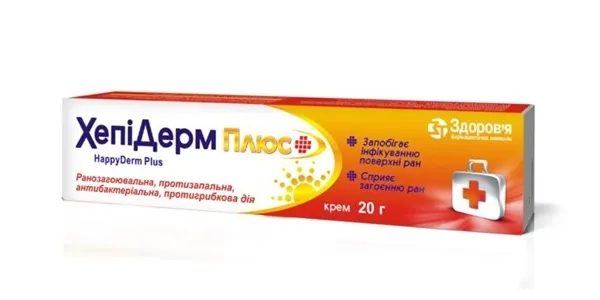
Table of Contents
INSTRUCTIONS FOR MEDICAL USE OF THE MEDICINAL PRODUCT HEPIDERM PLUS (HAPPYDERMPLUS)
Composition:
Active substances: dexpanthenol, benzalkonium, chlorhexidine;
1 g of the preparation contains dexpanthenol 50 mg, benzalkonium chloride 0.5 mg; chlorhexidine digluconate solution 38.8 mg;
Excipients: cetostearyl alcohol; polyethylene glycol (macrogol) stearate; polyoxyl hydrogenated castor oil; DL-pantolactone; propylene glycol; mineral oil; white soft paraffin; purified water.
Pharmaceutical form. Cream.
Main physicochemical properties: cream of white to almost white color, of homogeneous consistency.
Pharmacotherapeutic group. Agents promoting wound healing (scar formation). ATC code D03AX.
Pharmacological Properties
Pharmacodynamics. The cream exerts wound-healing, anti-inflammatory, antibacterial, and antifungal effects.
Dexpanthenol is rapidly converted into pantothenic acid (vitamin B5) in skin cells and acts as a vitamin. Pantothenic acid is a component of coenzyme A, an essential cofactor playing a key role in cellular metabolism. Thus, dexpanthenol promotes the formation and healing of damaged areas of the skin and mucous membranes, enhances hydration of the stratum corneum, improves skin barrier function, accelerates mitosis, and increases the strength of collagen fibers.
Chlorhexidine is a well-tolerated antiseptic with bactericidal activity against gram-positive bacteria, particularly sensitive strains of Staphylococcus aureus—microorganisms most commonly associated with skin infections. Chlorhexidine is less active against gram-negative pathogens. Some strains of Pseudomonas and Proteus are resistant to chlorhexidine. The drug is active against Candida albicans and some other fungi. When applied topically, it prevents wound surface infection.
Benzalkonium chloride is a quaternary ammonium compound with antiseptic and antimicrobial properties. Benzalkonium chloride exerts bactericidal effects against a broad spectrum of gram-positive and gram-negative bacteria. It is active against enterococci, gonococci, staphylococci, corynebacteria, Candida species, herpes simplex virus type II, cytomegalovirus, HIV, chlamydia, and trichomonads.
The original formulation of the medicinal product enhances the intensity of antimicrobial action.
Pharmacokinetics. Dexpanthenol is rapidly absorbed through the skin following topical application. In skin cells, dexpanthenol is quickly converted into pantothenic acid, thereby replenishing the body's stores of this vitamin. When entering systemic circulation, pantothenic acid binds to plasma proteins (β-globulin and albumin). Pantothenic acid does not undergo biotransformation and is excreted unchanged (60–70% is excreted in urine, the remainder in feces).
Absorption of chlorhexidine through intact skin has not been detected. In infants bathed in a 4% solution of chlorhexidine gluconate, low blood concentrations of chlorhexidine (1 μg/mL) were observed.
Benzalkonium is not absorbed through intact skin or mucous membranes and, when used at recommended doses, does not penetrate into blood plasma or breast milk.
Clinical characteristics.
Indications. The medicinal product is applied topically for the following indications:
- treatment of minor abrasions, scratches, cuts, lacerations, skin fissures, minor burns, and prevention of their infection;
- treatment of nipple fissures in breastfeeding women;
- treatment of skin infections, particularly secondarily infected eczema and neurodermatitis;
- in burn medicine, for the treatment of granulating burn wounds, preparation of wounds for autodermoplasty, and after plastic surgery to improve graft take;
- in surgery, for the treatment of wounds of various localization and origin, including postoperative wounds, trophic ulcers, and pressure sores in the regeneration phase (phase 2 of the wound healing process);
- in radiation medicine, for the treatment of radiation ulcers in the regeneration phase.
Contraindications. The product should not be used in cases of increased individual sensitivity to any of its components.
The product is contraindicated for application on a perforated tympanic membrane.
The product must not be used for the treatment of infected wounds with abundant purulent exudation during the first phase of wound healing. Cream application is possible only after elimination of purulent infection and transition of the inflammatory process into the regeneration phase.
The product should not be used in cases of allergic diseases and hemophilia.
Interaction with other medicinal products and other forms of interaction. Dexpanthenol may enhance the effect of depolarizing muscle relaxants (suxamethonium chloride, decamethonium bromide) and reduce the effect of non-depolarizing muscle relaxants (tubocurarine chloride) due to its ability to stimulate acetylcholine synthesis.
Chlorhexidine is incompatible with emulsifying agents and other anionic compounds.
Benzalkonium chloride is incompatible with soaps and other anionic surfactants, as well as with citrates, iodides, nitrates, permanganates, salicylates, silver salts, and tartrates.
The product is not recommended for simultaneous use with other antiseptics to avoid mutual interference (antagonism or inactivation).
Special precautions for use.
For external use only.
Avoid contact with eyes, ears, and mucous membranes. In case of accidental contact with eyes, rinse thoroughly with copious amounts of running water.
This product is not recommended for treating skin irritations with low risk of infection (e.g., sunburn). In such cases, HepiDerm-Health, topical cream, is recommended. Do not use in allergic skin disorders without infectious complications.
Extensive, heavily contaminated, deep wounds, as well as wounds resulting from bites or punctures, require medical intervention (risk of tetanus). If wound size remains large or the wound does not heal within 10–14 days, the continued use of this product should be re-evaluated. Treatment should also be reassessed if pronounced perifocal hyperemia, swelling, severe pain, increased purulent exudation, or fever occur (risk of sepsis). If symptoms persist or the condition worsens, consult a physician.
The product contains cetostearyl alcohol, which may cause local skin reactions (e.g., contact dermatitis); polyoxyl hydrogenated castor oil, which may cause skin reactions; and propylene glycol, which may cause skin irritation.
Use during pregnancy or breastfeeding. During pregnancy, avoid applying the cream to large areas of skin, as there are no controlled data from studies in pregnant women.
Breastfeeding women should remove any residual cream with clean, soft wipes and wash the nipples and surrounding skin with warm boiled water before nursing.
Ability to affect reaction speed when driving or operating machinery. No effect.
Method of administration and dosage.
The cream is for topical use.
The frequency of cream application and duration of treatment are determined individually by a physician, depending on the course of the disease, efficacy, and tolerability of the therapy.
For adults and children aged 1 year and older, the cream should be applied in a thin layer once or several times daily, as needed, to previously cleansed affected areas of skin. The dosage is determined individually depending on the size of the affected area. Occlusive dressings may be used if necessary.
The drug should be used until complete wound healing and resolution of inflammation.
Children. The drug may be used in children aged 1 year and older.
Overdose. There have been no reports of overdose with topical use of the drug. Hypervitaminosis has not been observed. Elevated aminotransferase levels have been reported after chlorhexidine self-poisoning. Skin irritation may frequently occur after repeated topical application to the same skin areas. The drug is intended for the treatment of superficial skin injuries. Application to large skin areas should be avoided.
Side effects.
Immune system, skin and subcutaneous tissue disorders: allergic reactions, including skin allergic reactions such as contact dermatitis, allergic dermatitis, pruritus, erythema, burning sensation, eczema, rash, urticaria, swelling, skin irritation, blisters. Hypersensitivity, anaphylactic reactions and anaphylactic shock (life-threatening) with corresponding laboratory and clinical manifestations, including asthma syndrome, mild to moderate reactions which may affect the skin, respiratory system, gastrointestinal tract, cardiovascular system, including cardiorespiratory failure.
Shelf life. 2 years.
Storage conditions. Store in the original packaging at a temperature not exceeding 25 °C. Keep out of reach of children.
Packaging. Cream, 20 g, 40 g or 100 g in a tube in a box.
Supply category. Over-the-counter.
Manufacturer. Limited liability company "Pharmaceutical Company "Zdorovia".
Manufacturer's location and address of its place of business. Ukraine, 61013, Kharkiv region, city of Kharkiv, Shevchenka Street, 22.