Helpex® lar
Ukraine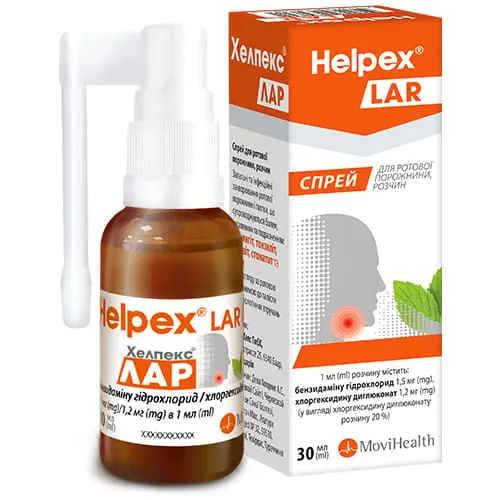
Table of Contents
INSTRUCTIONS FOR MEDICAL USE OF THE MEDICINAL PRODUCT HELPEX® LAR (HELPEX® LAR)
Composition:
Active substances: chlorhexidine digluconate, benzidamine hydrochloride;
1 ml of solution contains: benzidamine hydrochloride 1.5 mg, chlorhexidine digluconate 1.2 mg
(in the form of 20% chlorhexidine digluconate solution);
Excipients: glycerin, polysorbate 20, peppermint flavor, Vaporboost Flexarome flavor, sorbitol solution 70% non-crystallizing (E 420), sodium bicarbonate, concentrated hydrochloric acid, purified water, ethanol 96%.
Pharmaceutical form. Mouthwash solution.
Main physicochemical properties: clear, colorless or slightly yellow solution.
Pharmacotherapeutic group.
Agents for use in dentistry. Other agents for local oral use. ATC code A01AD02.
Pharmacological Properties
Pharmacodynamics
Xyloproct® LA is an antiseptic, analgesic, and anti-inflammatory agent indicated for the treatment of inflammatory and infectious diseases of the oral cavity and throat associated with pain, inflammation, and irritation: pharyngitis, tonsillitis, gingivitis, stomatitis, and aphthae. It exerts antiseptic action in the oral cavity and facilitates swallowing. It is used prophylactically before and after dental procedures. It reduces dental plaque formation and symptoms of gingivitis and can be used as an alternative to routine oral hygiene procedures.
Benzidamine is a locally-acting nonsteroidal anti-inflammatory drug (NSAID) with anti-inflammatory, analgesic, and anti-exudative properties. When applied locally, it produces an anesthetic effect on the mucous membranes of the oral cavity.
The clinical efficacy of benzidamine has been demonstrated in clinical trials involving patients with localized inflammatory conditions in the oral cavity and pharynx accompanied by pain. Analgesic effects of benzidamine were more frequently reported in models of experimental inflammation than in pain without inflammation. Its efficacy upon local application is due to its ability to penetrate the epithelial layer and achieve effective concentrations in inflamed tissues.
Benzidamine inhibits the synthesis of prostaglandins and pro-inflammatory cytokines (TNF-α and IL-1β).
Additional mechanisms of action include suppression of the oxidative burst of neutrophils, membrane stabilization via inhibition of granule release from neutrophils and lysosomal stabilization. Local anesthetic activity is attributed to interaction with cationic channels.
Chlorhexidine is a cationic biguanide antiseptic. When applied locally, it exerts antibacterial, bactericidal, and prolonged bacteriostatic effects against a broad spectrum of Gram-positive bacteria (Micrococcus sp., Staphylococcus sp., Streptococcus sp., Bacillus sp., Clostridium sp., Corynebacterium sp., etc.) and Gram-negative bacteria, yeasts (e.g., Candida albicans and others), fungi, and lipophilic viruses (influenza, herpes, HIV, etc.), thus being active against the most clinically relevant pathogens of the oral flora. It binds to the mucous membrane and inhibits bacterial growth through prolonged surface action. Chlorhexidine is a strong base with affinity for oral structures, including hydroxyapatite of tooth enamel, tooth surface pellicle, bacterial proteins, and salivary proteins.
It is absorbed by phosphate-containing sites on the microbial cell wall, disrupting the integrity of the cell membrane. It provides prolonged persistent antimicrobial activity, preventing microbial proliferation for at least 6 hours after application. The antimicrobial activity of chlorhexidine gluconate is not reduced in the presence of blood, pus, or saliva.
It is effective in a wide range of pathological conditions affecting the oropharynx. It reduces dental plaque formation and associated gingivitis, manifested by redness, swelling, or bleeding of the gums. It decreases the frequency of aphthous ulcer occurrence and accelerates healing after surgical procedures. It helps prevent dental plaque and gingivitis when routine oral hygiene measures are not feasible.
Pharmacokinetics
Absorption
Due to its cationic nature, chlorhexidine digluconate binds to the mucous membrane and other tissues upon local application and is very poorly absorbed. After topical use, blood levels of chlorhexidine are not detectable.
When applied locally, benzidamine is absorbed through the oral mucosa and exerts anti-inflammatory and anesthetic effects at the site of application. When administered as a solution, the amount of benzidamine entering the systemic circulation is so minimal that no systemic pharmacological effects are expected.
Distribution
The drug acts locally, and according to the recommended route of administration, it should not be swallowed. Systemic absorption and distribution are not expected following application.
Biotransformation
Since chlorhexidine digluconate is poorly absorbed, it cannot be measured in plasma. Benzidamine is metabolized primarily via oxidation and conjugation.
Elimination
Chlorhexidine does not accumulate in the body and is metabolized only to a minor extent. Approximately 10% of the chlorhexidine that reaches the stomach is absorbed and excreted by the kidneys; 90% of the unabsorbed amount is eliminated via feces.
Benzidamine and its metabolites, if entering the systemic circulation, are primarily excreted in urine.
Clinical characteristics.
Indications.
- Inflammatory and infectious diseases of the oral cavity and pharynx accompanied by pain, inflammation, and irritation: pharyngitis, tonsillitis, gingivitis, stomatitis, and aphthae.
- For oral hygiene before and after dental procedures.
- For reduction of dental plaque.
Contraindications.
Hypersensitivity to benzydamine, chlorhexidine, or to any other component of the medicinal product.
Interaction with other medicinal products and other forms of interaction.
Chlorhexidine digluconate is a cationic substance and is incompatible with anionic and iodine-containing substances; therefore, they should not be used simultaneously.
There are no reports of interactions between benzydamine and other medicinal products.
Special precautions for use
For topical use only (in the oral cavity); avoid contact with eyes and ears. In case of contact with eyes, rinse immediately and thoroughly with plenty of water.
The medicinal product should not be diluted and must not be swallowed. After each application, the patient should clear their throat by coughing. If hypersensitivity reactions occur during use, discontinue treatment and consult a physician.
If a burning or stinging sensation occurs during application, the solution may be diluted with water.
If there is no improvement in the patient's condition within 3–4 days of starting treatment, consult a physician for further management.
Benzydamine should not be used in patients with hypersensitivity to acetylsalicylic acid or other NSAIDs.
The use of this medicinal product may cause bronchospasm in patients with bronchial asthma or a history of bronchial asthma. Such patients must be warned accordingly.
In some patients, ulcers of the buccal or pharyngeal mucosa may be due to serious underlying pathological conditions. Therefore, patients whose symptoms worsen or do not improve within 3 days, or who develop fever or other symptoms, should consult a physician or dentist as appropriate.
Chlorhexidine is incompatible with anionic substances commonly present in toothpastes. Therefore, teeth should be brushed before mouth rinsing or at another time.
The medicinal product may cause temporary, reversible discoloration of teeth and tongue. This can be minimized by reducing intake of staining foods and beverages. In patients with dental prostheses, clean prostheses with a regular denture cleaner. In patients with orthodontic appliances, when normal tooth brushing is not possible and if discoloration persists, professional cleaning and polishing may be required.
The product is sugar-free and therefore suitable for use in diabetic patients. It does not contain dyes.
For athletes: Medicinal products containing ethanol may lead to a positive doping test result, depending on the thresholds established by certain sports federations.
Glycerin exerts a soothing effect on the oral mucosa.
Use during pregnancy or breastfeeding
Do not use during pregnancy or breastfeeding due to lack of adequate safety data.
Fertility. No adverse effects of chlorhexidine digluconate on fertility have been observed. Studies on the effect of benzydamine hydrochloride on fertility have not been conducted.
Ability to affect reaction speed when driving or operating machinery
The medicinal product does not affect the ability to drive or operate machinery.
Method of Administration and Dosage
For rinsing the oral cavity in adults and children aged 12 years and older.
Measure 15 ml of the solution in the measuring cup. Use undiluted or diluted (with an equal amount of water). Rinse 2–3 times daily, with intervals of 3–5 hours. If necessary, the number of rinses may be increased to 4 times daily. Hold in the mouth for at least 30 seconds. Do not swallow.
Do not use for more than 7 consecutive days without consulting a physician.
The medication helps reduce plaque and gingivitis during treatment.
When used as an alternative to routine oral hygiene procedures, the solution should be held in the oral cavity for at least 1 minute.
Children
This medicinal product is intended for use in children aged 12 years and older.
Overdose
In case of accidental ingestion, systemic adverse effects are not expected.
Chlorhexidine is poorly absorbed when ingested; therefore, systemic effects are unlikely. The main consequence of ingesting excessive doses may be irritation of mucous membranes.
Benzidamine may cause intoxication only if more than 300 mg is taken orally (which is hundreds of times higher than the possible doses of this medicinal form). Symptoms of overdose after ingestion of a large dose most commonly include nausea, vomiting, abdominal pain, esophageal irritation, dizziness, hallucinations, excitement, anxiety, and irritability. In children, excitement, seizures, tremor, nausea, excessive sweating, ataxia, and vomiting have been very rarely observed.
In acute overdose, symptomatic and supportive treatment is recommended, including gastric lavage, correction of fluid and electrolyte imbalances, observation, and adequate hydration.
In case a child accidentally ingests a significant amount of the product, alcohol intoxication may occur.
Adverse Reactions
Adverse reactions are classified according to frequency of occurrence: very common (≥ 1/10); common (from ≥ 1/100 to < 1/10); uncommon (from ≥ 1/1000 to < 1/100); rare (from ≥ 1/10,000 to < 1/1,000); very rare (< 1/10,000); frequency not known (cannot be estimated based on available data).
Immune system disorders:
Uncommon – photosensitivity reactions;
Rare – hypersensitivity reactions;
Very rare – angioneurotic edema;
Frequency not known – itching, rash, urticaria, anaphylactic reaction.
Respiratory, thoracic and mediastinal disorders:
Very rare – laryngospasm;
Frequency not known – bronchospasm.
Nervous system disorders:
Frequency not known – dizziness, headache.
Gastrointestinal disorders:
Very common – tongue coating;
Common – dry mouth, oral numbness, taste alteration;
Rare – burning sensation in the mouth;
Very rare – discoloration of teeth and tongue, tingling, cold sensation in the oral cavity, irritation of the oral mucosa, swelling of the oral mucosa, desquamation, nausea, vomiting, thirst, parotid gland swelling.
Reporting of suspected adverse reactions
Reporting of suspected adverse reactions after authorization of the medicinal product is important. It allows continued monitoring of the benefit-risk balance of the medicinal product. Healthcare professionals and patients, or their legal representatives, should report any suspected adverse reactions and lack of efficacy via the Automated Pharmacovigilance Information System at: https://aisf.dec.gov.ua.
Shelf life
3 years.
Storage conditions
Store in the original packaging, out of reach and sight of children, at a temperature not exceeding 25 °C.
Packaging
200 ml of solution in a bottle; 1 bottle with a measuring cup in a cardboard box.
Availability classification
Over-the-counter (without prescription).
Manufacturer
Deva Holding A.Ş.
Manufacturer's address and location of operations
Çerkezköy Site I, Çerkezköy Organize Sanayi Bölgesi, Karacağaç Mah., Atatürk Caddesi No 32, 59510, Kapaklı, Tekirdağ, Turkey.
Marketing Authorization Holder
Movi Health GmbH.
Address of the Marketing Authorization Holder
Bleghistrasse 25, 6340 Baar, Switzerland.